Economic Environment in Practice: Economic Growth & Taxation (AQA A Level Business): Revision Note
Syllabus Edition
First teaching 2026
First exams 2028
Exam code: 7132

Economic growth
Economic growth means an increase in the value of goods and services produced by an economy over a period of time
It is usually measured as the percentage change in gross domestic product (GDP)
Real GDP growth adjusts for inflation, showing the true increase in output rather than just rising prices, and is the measure governments usually focus on
The economic cycle
The business cycle describes the upturns and downturns in the level of a country’s economic activity over time
A recession occurs when an economy experiences two consecutive quarters (6 months) or more of negative economic growth
A boom is defined as a period of time where an economy experiences increasing/high rates of economic growth
The business cycle over time

Stage of the business cycle | Characteristics | Impact on businesses |
|---|---|---|
Recession |
|
|
Boom |
|
|
Economic growth matters to business because it's closely linked to consumer confidence, spending power, business investment, government tax revenue and unemployment
These rise and fall together with the wider economy
Recent trends
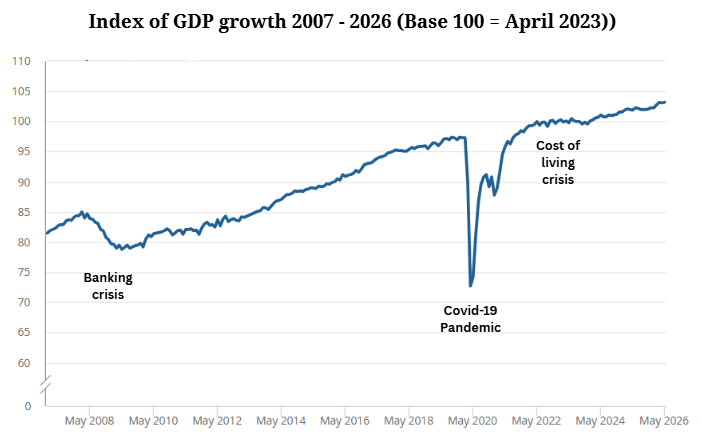
UK GDP grew by 0.6% in Q1 2026 and 0.7% in Q2 2026, following annual growth of 1.3% in 2025 and 1.0% in 2024
This represents a modest, gradual recovery rather than a strong boom
Growth has been led by the services sector
It follows on from the sharp squeeze on household spending during the 2022 cost of living crisis
Consumer confidence has, however, remained fragile even as the overall economy has kept expanding
Benefits of economic growth for business
Rising national income increases consumer spending power
Demand for most goods and services tends to increase
Businesses often see rising sales and revenue without needing to cut prices or compete as aggressively
Growing confidence can make it easier to raise finance for expansion
Investors and lenders see less risk
A growing economy usually increases tax revenue for the government
This sometimes allows it to invest more in infrastructure or services that benefit business
Challenges of economic growth for business
Growth isn't always felt evenly
Some sectors or regions can continue to struggle even while the overall economy grows
Strong or fast growth can push inflation up
Demand for resources, labour and materials rises faster than supply
Businesses that expand based on a period of growth can be left overextended if growth slows again
Increased costs, such as those related to extra staff or inventory, don't disappear as quickly as revenue can fall
Modest growth, like the UK is currently experiencing, can still leave real consumer spending power squeezed
This means growth in GDP doesn't automatically lead to stronger sales for every business
Example
A retailer might see its overall market grow slightly, but if consumer confidence stays weak, customers may still trade down to cheaper products rather than genuinely increase how much they spend
Impact of economic growth on functional areas
Functional area | Impact | Example |
|---|---|---|
Marketing |
|
|
Finance |
|
|
Human resources |
|
|
Operations |
|
|
Case Study
Greggs and economic growth

Greggs, the UK bakery and food-to-go chain, reported total sales up 7.2% to £1.10 billion in the first half of 2026, with operating profit rising almost 23% to £86.5 million. This improvement was achieved even as the UK economy grew only modestly and consumer confidence remained subdued.
The business grew its share of customer visits to 8.7%, despite an overall decline in the food-to-go market as a whole, largely by emphasising its reputation for good-value food during a period when many customers were still cautious with spending.
However, Greggs also warned that rising costs from its expansion, including new shops and staff, meant profits in the second half of the year would fall year-on-year unless consumer confidence genuinely improved.
Taxation and government spending
Governments impose direct and indirect taxes on businesses and households
Direct taxes are levied on income
Examples include income tax and corporation tax
Indirect taxes are levied on spending
Examples include sales tax (VAT), stamp duty and excise duty
Taxation is the main way the government funds spending on public services and its other key priorities, including
Education
Including schools, colleges and universities
Healthcare
Including hospitals, social care, public health programmes, doctors and dentists
Emergency services
Including police, paramedics, the fire service and coastguard
Judicial systems
Including courts and prisons
Defence
Including the armed forces and border controls
Social security
Including state pensions and unemployment benefits
Business support
Including providing grants that encourage certain behaviours or subsidies that reduce the costs of businesses that provide certain goods or services
Governments use taxation and spending together as fiscal policy
Expansionary policy
Increasing spending or cutting taxes to boost a slowing economy
Contractionary policy
Raising taxes or cutting spending to reduce inflation or high government debt
Taxation is also collected by local and regional councils
Business rates and council tax revenues are used to fund local services such as roads, street lighting, refuse collection and social services
The impact of an increase in taxation
Impact | Explanation |
|---|---|
Revenue |
|
Costs |
|
Business decisions |
|
Case Study
Employer National Insurance contributions
In April 2025, the UK government implemented significant changes to employer National Insurance contributions (NICs) which are a direct tax
Rate Increase: The employer NIC rate rose from 13.8% to 15%
Threshold reduction: The earnings threshold at which employers start paying NICs decreased from £9,100 to £5,000 per year
These adjustments aimed to improve public finances but have raised concerns among businesses regarding increased operational costs

Increased operational costs
Higher payroll expenses
Employers now pay more NICs per employee, increasing overall payroll costs.
For an employee earning £30,000 annually, the NIC payable by the employer increased by approximately £270 per year due to the rate rise
Pressure on employment decisions
Hiring freezes
To manage rising costs, some businesses have paused recruitment
Job reductions
Particularly in sectors like retail and hospitality, companies are considering reducing part-time roles to cut expenses
Investment and growth constraints
Delayed expansion plans
With tighter budgets, businesses may postpone investments in growth or infrastructure
Reduced training budgets
Companies might limit spending on employee development programmes
Sector-specific challenges
Small and medium enterprises (SMEs)
SMEs, with limited financial buffers, are particularly affected, potentially leading to closures or downsizing
Labour-intensive industries
Sectors that rely heavily on human labour face steeper cost increases, impacting their competitiveness
Business response
To mitigate the impact, businesses are exploring various strategies
Salary sacrifice schemes
Encouraging employees to exchange part of their salary for non-cash benefits, reducing NIC liabilities
Operational efficiency
Streamlining processes to lower costs without reducing staff
Pricing
Passing some of the increased costs to consumers through price rises, where market conditions allow
Impact of taxation on functional areas
Functional area | Impact | Example |
|---|---|---|
Marketing |
|
|
Finance |
|
|
Human resources |
|
|
Operations |
|
|

Unlock more, it's free!
Join the 100,000+ Students that ❤️ Save My Exams
the (exam) results speak for themselves:

Was this revision note helpful?
