Managing, Developing & Retaining Talent (AQA A Level Business): Revision Note
Syllabus Edition
First teaching 2026
First exams 2028
Exam code: 7132

What is talent management?
Talent management refers to the strategies and processes a business uses to attract, manage, develop and retain skilled employees in order to meet its objectives
Effective talent management reduces costs, improves productivity and helps the business build a competitive advantage through its people
The talent management cycle
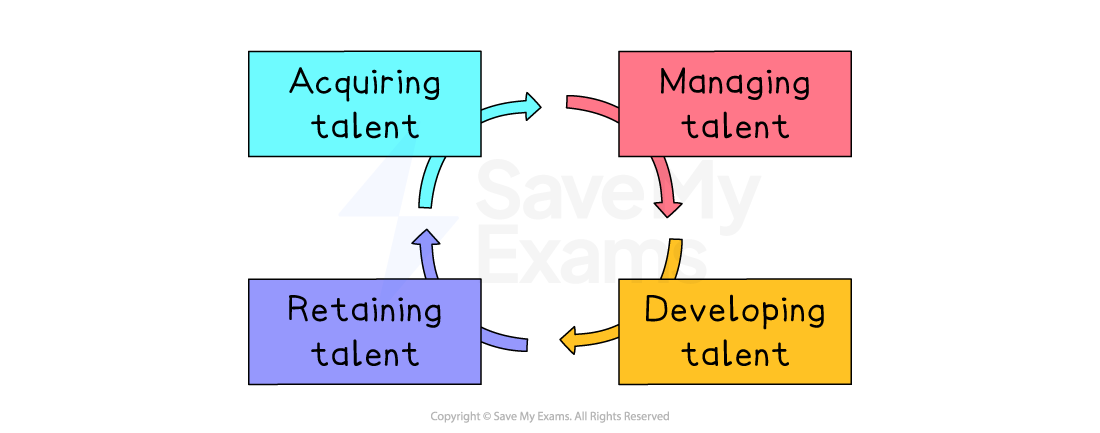
Finding and hiring the right people
Managing talent
Supporting employees to perform effectively in their current roles
Developing talent
Building employees' skills and capabilities over time
Retaining talent
Keeping high-performing employees within the business
Managing talent
Purpose and value
Ensures employees understand what is expected of them and have the support to meet those expectations
Well-managed employees tend to be more motivated, productive and less likely to leave
Clear direction and regular feedback reduce costly mistakes and underperformance
Methods of managing talent
Method | Explanation |
|---|---|
Induction training |
|
Setting SMART objectives |
|
Regular one-to-one meetings |
|
360-degree feedback |
|
Performance improvement plans (PIPs) |
|
Challenges of managing talent
Inconsistent management quality
The effectiveness of talent management depends on the communication and management skills of individual line managers
Bias in assessments
Subjective judgements can lead to unfair assessments, particularly in large organisations
Time and resources
Conducting meaningful reviews and holding one-to-one meetings across a large workforce is time-consuming
Developing talent
Purpose and value
Investing in employee development increases the skill level of the workforce
This improves quality, productivity and innovation
Employees who feel the business is investing in their future are more likely to be motivated and loyal
Development supports succession planning
Preparing employees for more senior roles so the business is not dependent on external recruitment for leadership positions
Methods of developing talent
Method | Explanation |
|---|---|
On-the-job training |
|
Off-the-job training |
|
Mentoring |
|
Job rotation |
|
Continuing professional development (CPD) |
|
Challenges of developing talent
Financial cost
Training and development programmes require investment, which can be difficult to justify in the short term
Time away from work
Off-the-job training reduces productive output during the training period
Risk of losing trained employees
Businesses that invest heavily in development risk losing those employees to competitors once their skills have improved
Relevance
Training must be kept up-to-date and aligned with business needs
Outdated training programmes waste resources
Retaining talent
Staff retention refers to a business's ability to keep its employees over time
Purpose and value
High retention reduces recruitment costs, preserves the skills and knowledge employees have built up
Businesses with strong retention records often develop a positive employer reputation
This makes it easier to attract future talent
Methods of retaining talent
Method | Explanation |
|---|---|
Competitive pay and benefits |
|
Career progression opportunities |
|
Flexible working |
|
Positive workplace culture |
|
Recognition and reward schemes |
|
Employee voice |
|
Challenges of retaining talent
Salary competition
Larger businesses or those in fast-growing sectors can often offer higher pay than smaller rivals
Career ceiling
In smaller businesses, limited promotion opportunities can cause employees to look elsewhere to develop their careers
Wellbeing
Employees who are overworked or under-supported are more likely to leave, regardless of pay
Case Study
Brightpath Learning

Brightpath Learning is a UK-based online education business with 280 employees. The company offers digital revision tools and tutoring services to secondary school students. Since launching six years ago, the business has grown quickly but struggled to hold on to its best people.
Exit interviews revealed a consistent pattern: employees left because they felt underdeveloped and could not see a clear future at the company. In response, Brightpath introduced a structured talent management programme. Every employee now receives a quarterly one-to-one with their line manager, a personal development plan and access to a £500 annual learning budget. Senior roles are advertised internally before going external, and a mentoring scheme pairs junior staff with experienced colleagues.
Within 18 months, staff turnover fell from 34% to 19%. Employee engagement scores rose significantly, and the business promoted six internal candidates into management roles, saving an estimated £60,000 in external recruitment costs.
Examiner Tips and Tricks
When answering questions on retaining talent, do not simply list methods – explain why a specific method would suit the business in the question. A small business with a limited budget might focus on flexible working and career progression rather than high pay, while a large firm might use structured development programmes and performance bonuses. Marks are awarded for applying your answer to context
Employee appraisal
Employee appraisal is a process where a manager or supervisor assesses an employee's job performance
Discussion points in employee appraisals

Performance is measured against the tasks and responsibilities stated in the employee's job description
Constructive feedback is given and there is a discussion of goals and development opportunities
Advantages and disadvantages of employee appraisals
Advantages | Disadvantages |
|---|---|
|
|
|
|
|
|
|
|

Unlock more, it's free!
Join the 100,000+ Students that ❤️ Save My Exams
the (exam) results speak for themselves:

Was this revision note helpful?
