Diseconomies of Scale (AQA A Level Business): Revision Note
Syllabus Edition
First teaching 2026
First exams 2028
Exam code: 7132

Written by: Lisa Eades
Updated on
What are diseconomies of scale?
Diseconomies of scale are the cost disadvantages a business can experience as it grows too large, causing the average cost per unit to rise rather than fall
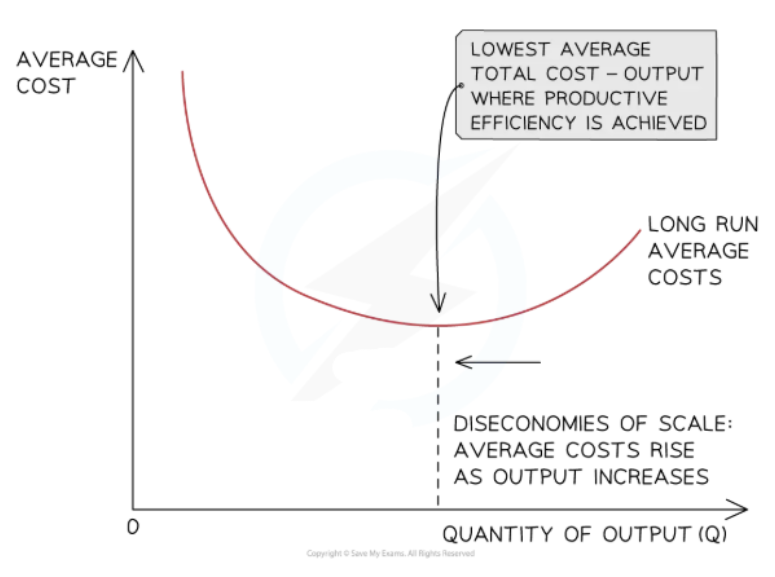
Growth doesn't always reduce costs indefinitely
Beyond a certain size, a business may become less efficient
Very large businesses need to manage their scale carefully to avoid rising average costs
Example
A large multinational retailer struggles to maintain the same standard of customer service across thousands of stores that it achieved when it had only a handful of branches
Control
Control diseconomies occur when it becomes harder for management to monitor and direct the activities of a much larger workforce or number of sites
As a business grows, senior managers can lose direct oversight of day-to-day operations
This makes it harder to ensure consistent standards, spot problems early and hold its staff accountable
Example
A fast-food chain expanding rapidly across the country finds it increasingly difficult for head office to monitor food hygiene standards consistently across every branch
Weaker control can lead to inconsistent quality, missed problems and less accountability
This can increase costs, for example through waste, errors or reputational damage, undermining any efficiency gains a business hoped to achieve through growth
Communication
Communication diseconomies occur when it becomes more difficult to pass information accurately and quickly through a larger, more complex organisation
Messages may need to pass through more layers of management
This increases the risk of delay, misunderstanding or information being lost or distorted along the way
Example
Instructions from senior management at a large manufacturing company take longer to reach shop-floor workers, and get slightly altered, as they pass through several layers of supervisors
Poor communication can lead to mistakes, duplicated work or slow decision-making
This increases costs and reduces efficiency, which can offset some of the cost advantages a business gained from growth
Coordination
Coordination diseconomies occur when it becomes harder to organise and align the activities of different departments, teams or sites so they work effectively together
As a business grows, different parts of the organisation may develop their own working practices or priorities
This makes it more difficult to ensure everyone is working towards the same goals
Example
A large retail chain finds that different regional teams have started using different suppliers and pricing strategies, making it difficult for head office to maintain a consistent brand experience across the country
Poor coordination can result in duplicated effort, conflicting decisions or inconsistent standards across a business
This can increase costs and limit the benefits that growth was intended to bring
Examiner Tips and Tricks
When explaining diseconomies of scale, be specific about whether the problem relates to control, communication or coordination, and link it to a concrete consequence, such as inconsistent quality or slower decision-making, rather than simply stating that "the business becomes harder to manage
Case Study
Ashgrove Retail

Ashgrove Retail grew rapidly over five years, expanding from twelve stores in the south-west of England to more than 150 stores nationwide.
As the business grew, head office found it increasingly difficult to monitor standards across every branch, and several stores began falling behind on cleanliness and inventory management without being noticed for weeks.
Instructions from senior management also took longer to reach store staff, passing through several new layers of regional managers, and were sometimes misunderstood or applied inconsistently by the time they reached the shop floor.
Regional teams began making their own decisions about local suppliers and promotions, resulting in different pricing and product ranges from one region to another, which confused customers who visited stores in different parts of the country.
Head office eventually introduced a smaller number of clearly defined regional divisions, each led by a manager reporting directly to senior management
It also introduced software to track performance across all stores.
This reduced some of the inconsistency, although managers admitted that maintaining the same close oversight they'd had as a smaller business had become permanently more difficult

Unlock more, it's free!
Join the 100,000+ Students that ❤️ Save My Exams
the (exam) results speak for themselves:

Was this revision note helpful?