Introduction to the Marketing Mix (AQA A Level Business): Revision Note
Syllabus Edition
First teaching 2026
First exams 2028
Exam code: 7132

The 4 P's
The marketing mix refers to the four key elements a business must get right to successfully market a product to its target market
Together, these are known as the 4 P's
Product
Price
Place
Promotion
Each element must be carefully considered
Crucially, all four must work together coherently
The decisions made about one P directly affect and must be consistent with the others
What are the 4 P's?
Element | Explanation | Example |
|---|---|---|
Product |
|
|
Price |
|
|
Place |
|
|
Promotion |
|
|
Influences on the marketing mix
Before deciding on the right product features, pricing tactics, distribution channels and promotional tools, businesses consider a range of factors that shape every element of the mix
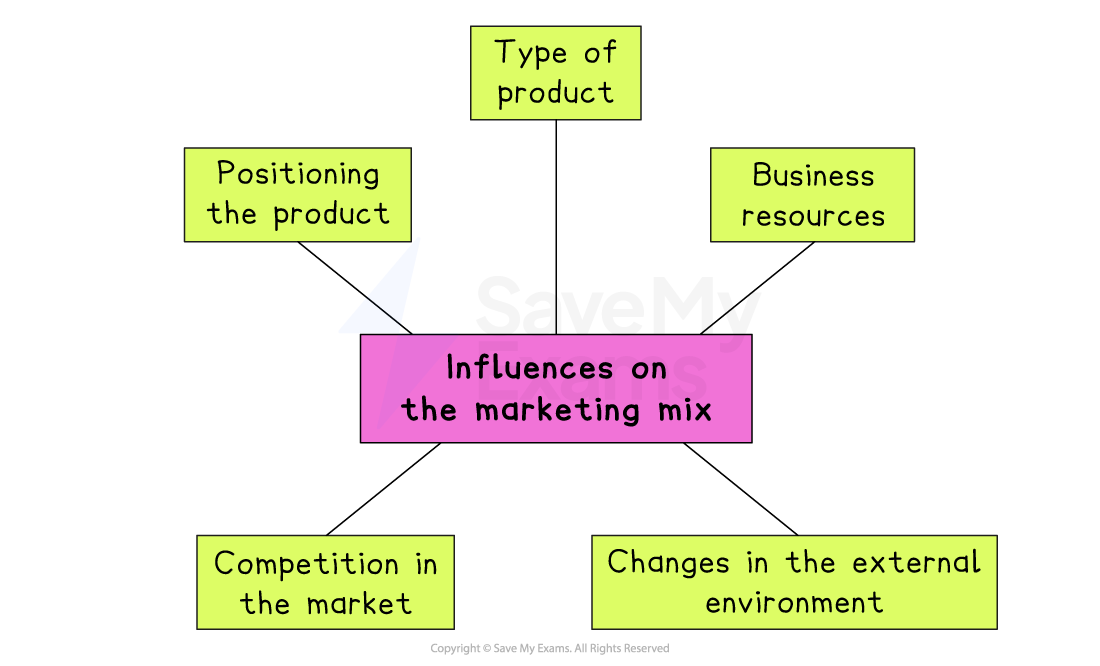
Positioning of the product
The image the business wants customers to hold determines every element of the mix, from design and pricing to advertising style and choice of distribution channel
Waitrose positions itself as a premium grocer
High-quality products, higher prices, aspirational advertising, and selective store locations in affluent areas
Aldi positions itself on value
Simple own-brand products, low prices, no-frills stores, and promotional campaigns that focus on price comparisons with rivals
Type of product
Whether the product is a consumer good (bought by individuals) or a B2B product (sold to other businesses) significantly affects the mix
Consumer goods often rely on emotional appeal and convenience
Kellogg's uses colourful packaging, television advertising, and wide supermarket distribution to appeal to household shoppers
B2B products prioritise performance, reliability and personal relationships
Rolls-Royce jet engines rely on direct personal selling to airline buying teams, complex contract negotiations, and extensive long-term after-sales support
Business resources
The financial resources, expertise and capacity available to a business limit what is achievable across the mix
Larger businesses can invest in product development, wide distribution, and expensive advertising
Unilever launches products globally with multi-million-pound advertising campaigns and established retail distribution networks
Smaller businesses must focus their limited budgets more carefully
A small independent food producer may rely entirely on a farmers' market stall, a basic website and social media to reach customers
Competition in the market
The number and strength of competitors influence pricing, promotion and product decisions
Intense competition may require more aggressive pricing and promotional activity
The UK supermarket sector is highly competitive - Tesco, Sainsbury's and Asda use price promotions, loyalty schemes and extensive advertising to win customers
Limited competition allows greater flexibility
Brompton folding bicycles face fewer direct rivals and can sustain premium prices while relying on specialist retailers and word-of-mouth promotion
Changes in the external environment
Political, economic, social and technological shifts can force rapid changes to the marketing mix
Businesses that respond quickly can gain a competitive advantage
The rapid growth of social media has transformed promotional strategies across virtually every industry
Many businesses shifted advertising budgets away from television and print towards Instagram, TikTok and YouTube
Rising consumer expectations around delivery speed have also forced many retailers to invest heavily in faster, more flexible logistics
Examiner Tips and Tricks
Influences on the marketing mix rarely act in isolation - a change in the external environment may affect resources, which in turn limit promotional options. In evaluation questions, consider how multiple influences interact to shape a business's marketing decisions

Unlock more, it's free!
Join the 100,000+ Students that ❤️ Save My Exams
the (exam) results speak for themselves:

Was this revision note helpful?
