Opportunities & Threats of Global Strategy (AQA A Level Business): Revision Note
Syllabus Edition
First teaching 2026
First exams 2028
Exam code: 7132

What is global strategy?
Globalisation is the increasing interconnectedness and interdependence of economies, markets, businesses and cultures across the world
It has been driven by improvements in transport and communication technology, and the reduction of trade barriers between countries
Reasons for increased globalisation
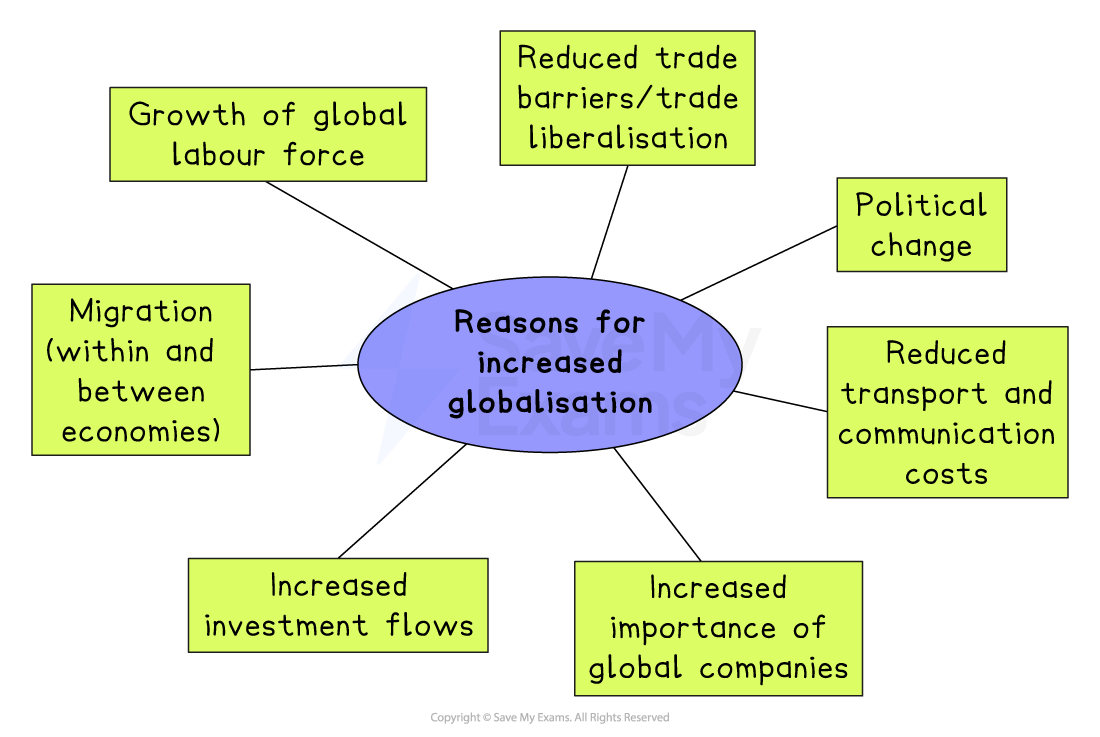
Factor | Explanation |
|---|---|
Political change |
|
Reduced cost of transport and communication |
|
Increased significance of transnational companies |
|
Increased investment flows (FDI) |
|
Migration (within and between economies) |
|
Growth of the global labour force |
|
Structural change |
|
A global strategy is a business's plan for operating, selling or producing across multiple countries, rather than remaining focused solely on its domestic market
Examples of global strategies
Pursuing sales growth in larger or faster-growing markets
When demand in the home market begins to level off, entering overseas markets allows a firm to attract new groups of customers to keep revenue rising
Example
Apple expanded aggressively into China and, more recently, India
International sales now account for well over half of its total revenue
Spreading risk through market diversification
Operating in several economies means that an economic downturn or a government policy change is less likely to threaten the whole business
Example
Starbucks relies on rising sales in China and the Asia–Pacific region to offset periods of weaker sales in North America
Gaining economies of scale and lower unit costs
Supplying a global customer base supports longer production runs, bulk purchasing and shared research and development
Example
Toyota builds cars like the Corolla on shared global designs, making them in large numbers for sale worldwide, which lowers the cost of each car
Extending the product life cycle
A product that is mature at home may still be in its introduction or growth phase abroad, allowing the firm to generate additional revenue without having to change the product's design
Example
Netflix launched its streaming service in South America and Africa after US subscriber growth slowed
Global opportunities
Globalisation offers businesses huge chances to grow and cut costs
Companies that plan well, perhaps by adapting products, securing reliable global supply chains and understanding local cultures, can turn global reach into long-term success
Why globalisation matters to business
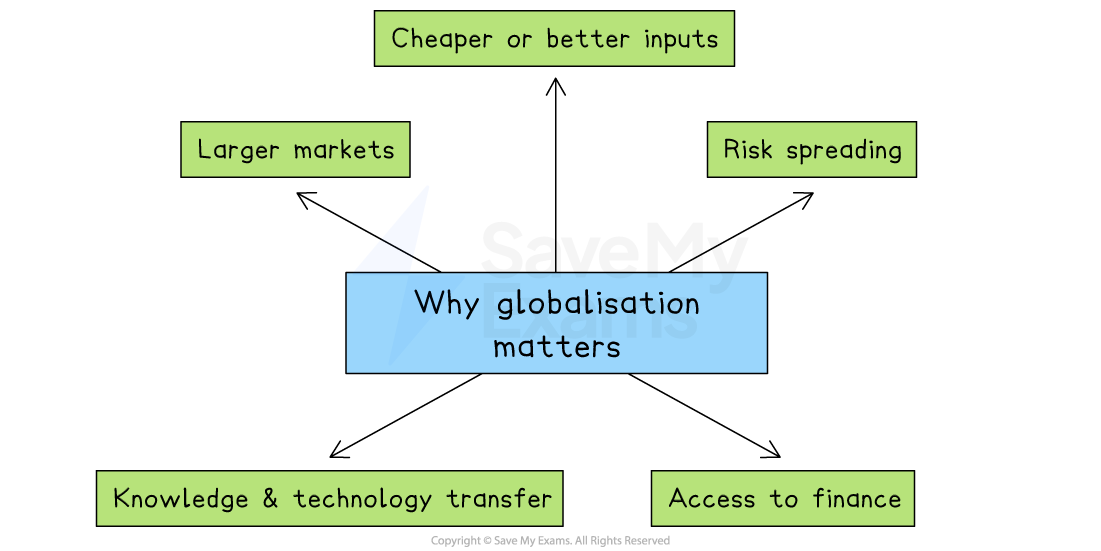
Larger markets
More customers
Selling in several countries multiplies the potential customer base well beyond the limits of the home market
Economies of scale
A bigger output allows fixed costs, such as R&D, marketing and equipment, to be spread over more units, lowering average costs and helping prices stay competitive
Cheaper or better inputs
Global sourcing
Firms can shop around the world for raw materials, components or services at the best balance of price and quality
Specialist skills
Access to clusters such as India’s IT sector or Germany’s precision engineering brings in expertise that may be scarce at home
Risk spreading
Diversified revenue
Weak demand in one region can be balanced by strength in another, making overall sales less volatile
Knowledge and technology transfer
Learning from partners
Joint ventures, licensing and worldwide supply chains expose firms to new ideas, production techniques and management practices
Innovation stimulus
Competing on a global stage pushes businesses to improve products and processes faster
Access to finance
Broader funding sources
Listing on foreign stock exchanges or issuing global bonds widens the pool of investors and can lower the cost of capital
Global threats
Global strategy also brings significant challenges, including greater competition, more complex operations and risk
Threat | Explanation | Example |
|---|---|---|
Increased competition |
|
|
Cultural and legal differences |
|
|
Exchange rate risk |
|
|
Political and economic instability |
|
|
Greater reputational risk |
|
|
Global strategy and functional areas
Pursuing a global strategy can have significant impacts on a business's functional areas
Marketing
Products, branding and pricing often need to be adapted for different cultures and markets
Inadequate market research increases the risk of costly mistakes
Example
McDonald's adapts its menu significantly across different countries, for example offering the McAloo Tikki burger in India and avoiding beef products, to suit local tastes and religious requirements
Finance
Must manage foreign exchange risk and navigate more complex international tax rules
The finance function often faces a higher cost of raising finance to fund overseas expansion
Example
Starbucks faced heavy criticism from UK tax authorities and Parliament over how little UK tax it paid, because profits were moved through countries such as the Netherlands and Switzerland
This shows how complicated tax rules can get for a business operating in many countries
Human resources
Must manage a more culturally diverse workforce and comply with different employment laws across countries
This creates additional complexity in recruitment, training and staff management
Example
Unilever manages a hugely diverse international workforce across more than 190 countries, requiring HR policies flexible enough to comply with a wide range of different national employment laws
Operations
Needs to manage more complex, geographically dispersed supply chains
It may face difficult decisions about where to locate production
Example
IKEA sources materials and makes its products through suppliers in around 50 different countries
It has to carefully manage logistics, quality and delivery times across a much bigger and more complicated network than a business that only operates in one country

Unlock more, it's free!
Join the 100,000+ Students that ❤️ Save My Exams
the (exam) results speak for themselves:

Was this revision note helpful?
