The Importance of Business Values & Culture (AQA A Level Business): Revision Note
Syllabus Edition
First teaching 2026
First exams 2028
Exam code: 7132

The significance of business values
Business values are the core principles and beliefs that guide how a business and its employees behave, make decisions and treat others
Business values are often expressed in a business's mission statement
Examples of business values
Business | Values |
|---|---|
Amazon |
|
IKEA |
|
John Lewis Partnership |
|
Business values provide a shared sense of purpose and direction
They help employees understand what the business stands for beyond simply making a profit
They guide decision-making at all levels, helping staff and managers act consistently
They help attract and retain employees and customers who share or respect those values
They support consistent behaviour across a business
This becomes more important as it grows and senior managers can no longer oversee every decision directly
They can differentiate a business from competitors, particularly where customers increasingly favour businesses seen as ethical, sustainable or socially responsible
They build trust with stakeholders, including investors, regulators and the wider public, when values are genuinely reflected in day-to-day practice
Factors influencing business culture
Business culture is the shared values, attitudes and beliefs that characterise a business
Culture is often described as 'the way things are done' within an organisation
Culture is not accidental
It develops through deliberate choices and influences that build up over time
What determines a business's culture?
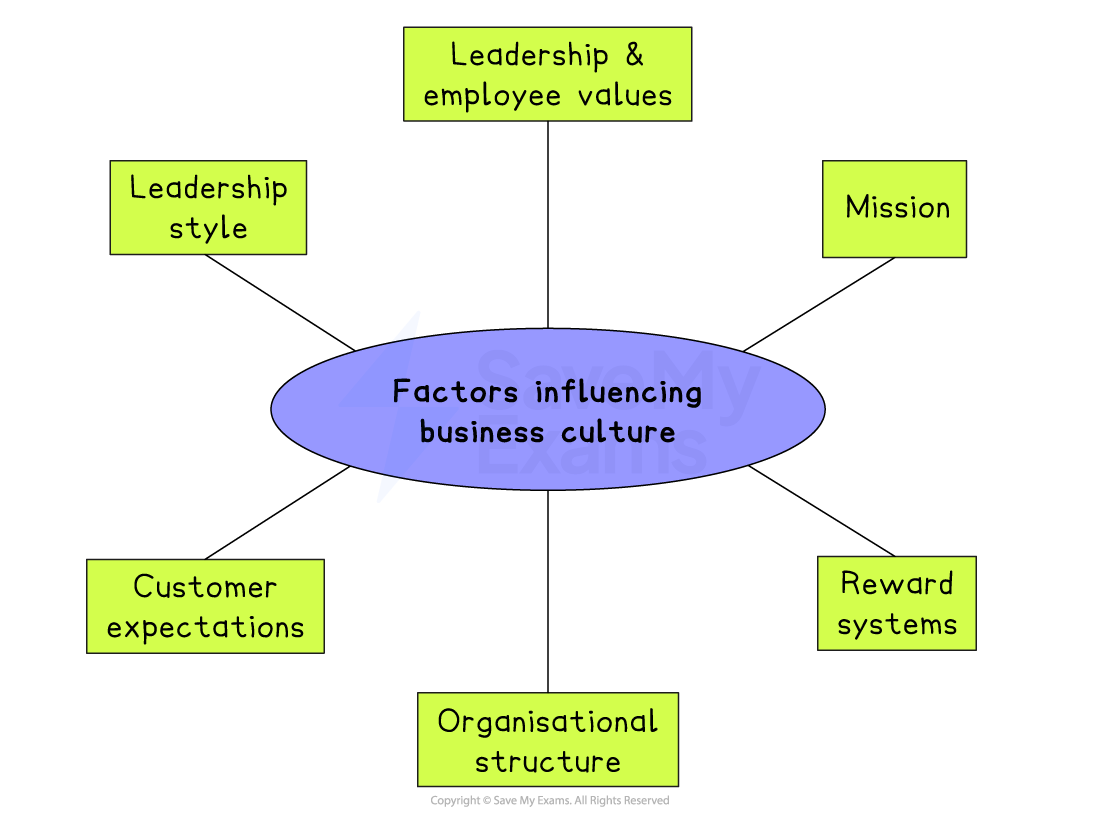
Leadership and employee values
The personal values and behaviours of both senior leaders and employees shape the everyday culture of a business
Staff often take cues on acceptable behaviour from those around them, especially senior figures
Long-standing traditions and ways of working can embed particular cultures
Historical successes and failures shape attitudes and beliefs in the workplace
Example
Companies like John Lewis have long-standing employee ownership cultures due to their historical belief in staff involvement
Leadership style
Whether managers lead in an autocratic, democratic or more relaxed way strongly affects how much trust, openness and initiative exists within a business's culture
An autocratic leader might create a power culture, whereas a democratic leader might encourage a person culture
Example
Richard Branson’s relaxed, creative leadership style created a person-centred culture at Virgin.
Mission
A business's stated purpose or mission can shape culture by giving employees a clear sense of what the organisation is trying to achieve
It encourages behaviour that supports that goal
Reward systems
How a business rewards employees, for example through pay, bonuses, recognition or promotion, influences what behaviour is encouraged or discouraged within the culture
Organisational structure
A tall, hierarchical structure can create a formal, cautious culture
A flatter structure often supports a more open, collaborative culture
Customer expectations
Where customers expect high levels of service or ethical standards, a culture may develop that reflects and reinforces those expectations
Businesses often mirror or react to wider societal values and expectations, such as sustainability, equality or work-life balance
Shifts in society's values, such as environmental awareness, can push businesses towards more ethical or environmentally conscious cultures
Example
Rising societal concerns over climate change have encouraged many businesses, such as Patagonia, to embed sustainability into their core culture
Positive and negative business culture
Positive business culture
Where employees feel trusted, valued and motivated, and where everyday behaviour is in line with the business's stated values
Impact of a positive business culture
Improves employee motivation, engagement and morale
This can increase productivity and reduce employee turnover
Encourages employees to act in line with the business's values
This reduces the risk of poor practice or scandal
Builds a stronger reputation with customers, investors and potential recruits
Supports better teamwork and communication
It helps the business respond effectively to challenges or changes
Negative business culture
Where trust, communication or morale have broken down, often leading to behaviours that conflict with what the business claims to stand for
Impact of a negative business culture
Can lead to low morale, high employee turnover and difficulty recruiting or retaining talented employees
Increases the risk of poor decision-making, unethical behaviour or scandal
Particularly if employees feel pressured or unsupported
Damages a business's reputation with customers, investors and the wider public if problems become known
Can reduce productivity and increase costs
For example through absenteeism, conflict or poor customer service
Example
A business known for a high-pressure, target-driven culture may see short-term sales increase, but risks high employee turnover, burnout and, in some cases, staff cutting corners or mis-selling to meet targets
Case Study
Northgate Fitness
Northgate Fitness operates a chain of gyms across the Midlands.
For several years, sales staff were set aggressive monthly membership targets, with bonuses dependent on hitting these numbers. This created a high-pressure culture in which some staff pushed customers into signing lengthy membership contracts without fully explaining cancellation terms, leading to a wave of complaints and negative online reviews. Employee turnover in the sales team was unusually high, with several employees reporting stress and burnout linked to the pressure to meet targets.
Following an investigation prompted by customer complaints, the management team redesigned the reward system, reducing the emphasis on sales numbers and introducing bonuses linked to customer satisfaction and retention instead. Staff also received training on being transparent with customers about contract terms.
Within a year, employee turnover in the sales team had fallen significantly, and customer complaints about mis-selling dropped sharply, with online reviews improving alongside them.
Some senior managers were initially concerned that softer targets would reduce membership sales, but overall revenue remained stable, as fewer customers cancelled early.
Examiner Tips and Tricks
Avoid treating "values" and "culture" as the same thing.
Values are what a business says it believes in; culture is what actually happens day to day.
A business can state positive values but still have a negative culture if leadership and behaviour don't match them, so keep this distinction clear in your answer

Unlock more, it's free!
Join the 100,000+ Students that ❤️ Save My Exams
the (exam) results speak for themselves:

Was this revision note helpful?
