Shares & Shareholding (AQA A Level Business): Revision Note
Syllabus Edition
First teaching 2026
First exams 2028
Exam code: 7132

Reasons to buy shares
Investors buy shares in a plc for several reasons
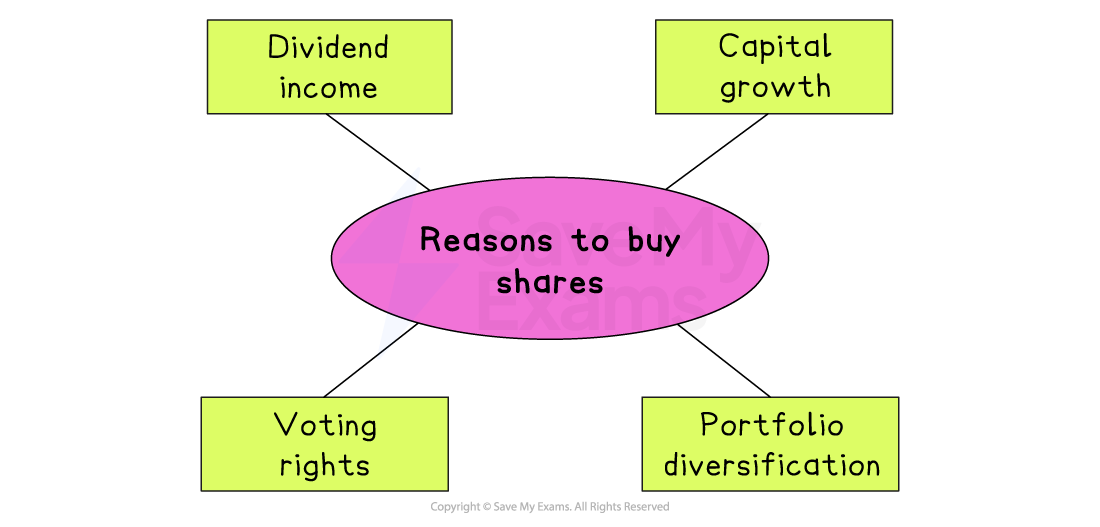
Dividend income
Regular payments from company profits provide an ongoing return on investment
Capital growth
If the share price rises over time, shares can be sold for more than their purchase price, generating a profit
Voting rights
Shareholders can vote on major decisions at the AGM, giving them influence over the company's direction
Portfolio diversification
Spreading investment across shares in different companies and sectors reduces overall investment risk
Influences on share prices
The share price is the price at which a single share in a plc can be bought or sold on the stock exchange at any given moment
Share prices fluctuate constantly, reflecting how investors collectively judge the company's current performance and future prospects

Why does the share price change?
Company performance
Strong profits and revenue growth increase investor confidence and push the share price up
Poor results have the opposite effect
Dividend payments
Higher dividend payments can attract more buyers, increasing demand for shares and raising the price
Economic conditions
Rising interest rates, high inflation or falling consumer confidence can reduce share prices across the market
Market sentiment
Investor confidence, news stories, analyst recommendations and broader market trends all influence how buyers and sellers value shares
Competition and industry trends
Developments in the sector, such as the entry of a major rival or regulatory changes, affect how investors assess a company's prospects
Leadership changes
The appointment of a new chief executive or significant changes to the board of directors can cause share prices to rise or fall, depending on investor reaction
Consequences of changes in the share price
A rising share price
A rising share price is a vote of confidence in a company
A high price means the firm needs to sell fewer new shares to raise the same cash, so existing owners avoid their control being highly diluted
Lenders see rising shares as a sign of strength, so they may be willing to offer loans on better terms
Directors’ bonuses and share-option rewards often rise with the share price, keeping key staff motivated
A falling share price
A falling share price signals doubt in a company
A weaker share price signals risk, so banks may charge more interest or tighten lending criteria
A low valuation can tempt rival firms or investors to launch a hostile takeover bid
Employees with share options see their potential payout shrink, which can hurt motivation and staff retention
In the long term, a falling share price could make recruitment of high-calibre staff difficult
Shareholder calculations
Investors and analysts use financial calculations to assess the value of a plc and the returns it offers to shareholders
Market capitalisation
Market capitalisation is the total market value of a company
Why is it important?
It gives shareholders a clear sense of the total value of their investment in the company
A rising market capitalisation means their shares are worth more
It allows comparison of company size across different businesses, helping investors decide where to invest
A high market capitalisation makes the company harder to take over, since a potential acquirer would need to buy a very large number of shares
This protects existing shareholders' interests
Formula
Market capitalisation = Number of issued shares × Current share price
Worked Example
Hartfield plc has 500 million shares in issue. The current share price is 320p. The company pays total dividends of £50 million.
Hartfield plc has a current market value of £1.6 billion
Dividends per share
Dividends per share are the income a shareholder earns per share held
Why is it important?
This calculation shows exactly how much income a shareholder receives for every share they hold, making it easy to calculate total dividend income
A rising DPS signals that the company is growing its profits and rewarding shareholders more generously over time
A falling or cancelled DPS may indicate financial difficulty, giving shareholders an early warning that the business is under pressure
Formula
Dividends per share = Total dividends paid ÷ Number of ordinary shares
Worked Example
Hartfield plc has 500 million shares in issue. The current share price is 320p. The company pays total dividends of £50 million.
Shareholders currently receive an income of 10 pence per share they own
Dividend yield
Dividend yield is the dividend per share expressed as a percentage of the share price
Why is it important?
This calculation allows shareholders to compare the income from shares directly against other investments, such as savings accounts or bonds
It helps investors assess whether a company's shares offer good value for money relative to alternatives available in the market
A very high dividend yield can sometimes be a warning signal
It may reflect a falling share price rather than a genuinely generous dividend, so shareholders should interpret it alongside other financial data
Formula
Dividend yield = (Dividend per share ÷ Share price) × 100
Worked Example
Hartfield plc has 500 million shares in issue. The current share price is 320p. The company pays total dividends of £50 million.
Shareholders currently receive a return of 3.1% on the shares they own
Examiner Tips and Tricks
Calculating the correct figure is only part of the answer. In higher-mark questions, you must also interpret what it means in context. For example, a rising dividend yield can sound like good news for shareholders, but if it is being driven by a falling share price rather than a rising dividend, it may actually signal that the business is in difficulty.
Always consider why a figure has changed before drawing a conclusion, and compare it against previous years, competitor businesses or industry averages to make your analysis as strong as possible

Unlock more, it's free!
Join the 100,000+ Students that ❤️ Save My Exams
the (exam) results speak for themselves:

Was this revision note helpful?
