Environmental, Social & Governance Reporting (AQA A Level Business): Revision Note
Syllabus Edition
First teaching 2026
First exams 2028
Exam code: 7132

What is environmental, social and governance reporting?
Environmental, Social and Governance (ESG) reporting is the process by which a business discloses information about its environmental impact, social practices and governance structures, alongside its usual financial reporting
Elements of ESG reporting
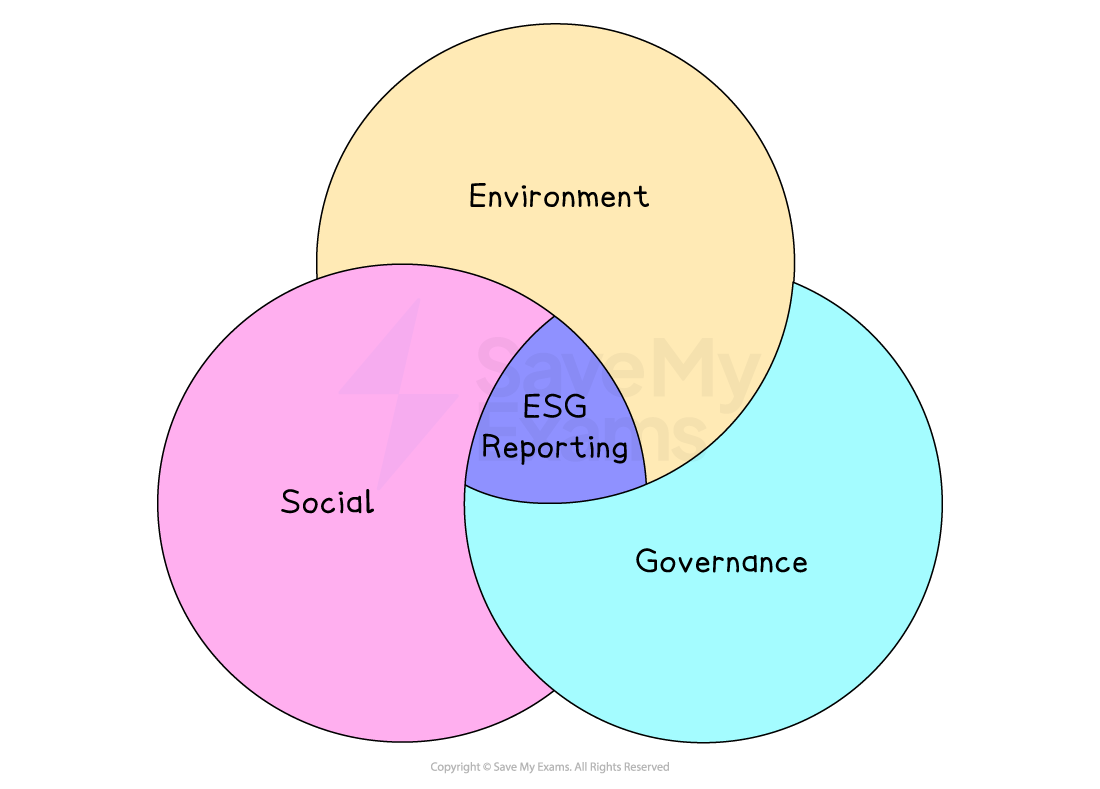
Environmental
Covers a business's impact on the natural environment
Such as emissions, resource use and waste
Example
In 2025, Marks & Spencer disclosed around 385 million kg of CO₂e emissions and outlined progress on zero operational waste to landfill, alongside a target to cut emissions 55% by 2030
Social
Covers how a business treats people
Including employees, customers, suppliers and the communities it operates in
Example
UK companies with 250+ employees must publish an annual gender pay gap report
In 2024/25, advertising group WPP reported its gender pay gap had narrowed from 18.1% to 17.8% year on year.
Governance
Covers how a business is run
Including the make-up of its board of directors, executive pay and how decisions are made and monitored
Example
AstraZeneca reported that its CEO was paid around 176 times more than the average employee in 2025.
This is a governance disclosure UK companies must make each year, giving shareholders a clear way to compare executive pay with pay across the rest of the business
The purpose and value of ESG reporting
It gives investors, customers and other stakeholders a more complete picture of a business's overall performance, beyond financial results alone
It helps identify risks that might not appear in traditional financial statements, such as environmental liabilities or poor governance practices
It improves transparency and accountability, making it harder for a business to hide poor practice
It aids comparison between businesses, helping investors and customers choose between competitors based on more than just price or profit
It can improve access to finance, as many investors now favour or require strong ESG performance before investing
ESG reporting is increasingly required or expected by regulators and stock exchanges, so it is becoming a standard part of how larger businesses operate
Why improve environmental, social and governance performance?
It reduces the risk of legal action or fines
ESG standards are often ahead of future laws, so acting early avoids being caught out later
Example
Since 2021, UK government departments have required suppliers bidding for contracts worth over £5 million a year to submit a Carbon Reduction Plan
Businesses already managing their ESG performance well find this much easier to meet
It improves reputation and brand image
Customers, investors and employees are more likely to trust and support a business seen as responsible
It can improve access to finance and lower borrowing costs
Many banks and investors now prefer, or require, good ESG performance before lending or investing
It reduces long-term risks
For example, using fewer scarce resources or keeping workers safer means fewer problems down the line
Example
Mondelez invests in its cocoa farming communities partly to protect its own long-term cocoa supply, which is increasingly threatened by climate change
It can improve staff recruitment, motivation and retention
Employees increasingly want to work somewhere they feel good about
It strengthens relationships with a wide range of stakeholders
This includes regulators, communities and suppliers, not just customers and shareholders
It can create a competitive advantage
Standing out from rivals with weaker ESG performance can win over customers and investors
Difficulties of improving ESG performance
The cost of measuring and reporting data
It takes time and money to collect accurate information from every part of a business, especially a large one with many sites
E.g. A large manufacturer may need to check emissions figures separately at each of its factories around the world
A lack of standardised measures
There is no single agreed way to measure ESG performance
It can therefore be hard to know if a business's figures are accurate or fair to compare with others
E.g. A 2023 investigation found that over 90% of carbon credits sold by Verra did little real good for the climate, even though companies were using them to back up their environmental claims
Balancing short-term cost against long-term benefit
Improving ESG performance often costs money now, which is at odds with many shareholders who want profits straight away
Supply chain complexity
It is difficult to check that every supplier, especially those overseas, is meeting the same standards
Risk of greenwashing or bluewashing accusations
If a business's claims turn out to be exaggerated, this can badly damage trust
Slow progress on some governance measures
Targets like getting more diversity into senior leadership can take a long time to achieve, even with real effort
E.g. Even as UK boards of directors overall hit their gender diversity targets, the number of women in senior executive roles in many of the largest companies actually fell by 11% between 2022 and 2024
Measures of environmental, social and governance performance
Businesses use specific, measurable indicators to track and report ESG performance, allowing comparison over time and between businesses
Measure | Explanation |
|---|---|
Health and safety |
|
Emissions |
|
Resource usage |
|
Community investment and philanthropy |
|
Composition of directors |
|
A company's annual ESG report might show a reduction in workplace injuries over the previous year, a fall in carbon emissions per unit produced, and an increase in the proportion of women on its board
Stakeholders can use these measures to track its progress across all three ESG areas
Examiner Tips and Tricks
Don't treat ESG and CSR as identical terms.
CSR is broader and voluntary, covering a business's overall approach to social responsibility
ESG reporting specifically refers to structured, measurable disclosure across defined categories, often used by investors to assess risk

Unlock more, it's free!
Join the 100,000+ Students that ❤️ Save My Exams
the (exam) results speak for themselves:

Was this revision note helpful?
