Ways to Match Supply & Demand (AQA A Level Business): Revision Note
Syllabus Edition
First teaching 2026
First exams 2028
Exam code: 7132

Production scheduling
Production scheduling means planning when and how much to produce, adjusting the timing or volume of production runs as demand changes
Ways businesses can use production scheduling
Bringing forward or delaying production to match an expected rise or fall in demand
Using overtime or extra shifts to increase output temporarily during a known busy period
Rescheduling maintenance to quieter periods, so production time isn't lost when demand is high
Prioritising production of the highest-demand products during a specific period, ahead of slower-selling lines
Example
A toy manufacturer schedules extra production runs in the autumn to build up inventory ahead of the Christmas period
Advantages and disadvantages of production scheduling
Advantages |
|
|---|---|
Disadvantages |
|
Inventory levels
Inventory levels are the amount of stock (raw materials, work in progress or finished goods) a business holds
These can be increased or decreased to manage supply against changing demand
Building up inventory ahead of a high-demand period lets a business meet orders without increasing production immediately
Running inventory down as demand falls avoids holding unnecessary stock
Ways businesses can manage inventory levels:
Building up stock ahead of a known seasonal peak, such as before Christmas or summer
Running inventory levels down deliberately as a product nears the end of its life or demand is expected to fall
Using just-in-time methods to keep inventory low when demand is stable, while holding buffer inventory when demand is likely to fluctuate
Agreeing flexible delivery arrangements with suppliers, so inventory can be topped up quickly when needed
Example
A garden centre increases its stock of plants and equipment ahead of spring, when demand is highest
Advantages and disadvantages of managing inventory levels
Advantages |
|
|---|---|
Disadvantages |
|
Employment forms
Adjusting the type of contracts used, such as part-time, temporary, zero-hours or freelance staff, can allow a business to flexibly increase or decrease the workforce in line with demand
Hiring temporary or zero-hours staff during peak periods allows a business to expand its workforce quickly without a long-term commitment, then reduce it again once demand falls
Ways businesses can adjust the form of employment
Hiring temporary or seasonal staff for a fixed period to cover a predictable demand peak
Using zero-hours contracts so staff can be called in only when they are actually needed
Offering part-time contracts to cover busy hours or days without paying full-time wages
Using freelance or agency staff for short-term projects or unpredictable spikes in workload
Example
A theme park hires temporary and zero-hours staff over the summer holidays to cope with higher visitor numbers
Advantages and disadvantages of adjusting the form of employment
Advantages |
|
|---|---|
Disadvantages |
|
Outsourcing
Outsourcing means paying another business to carry out an activity, such as production or a specific process, rather than doing it in-house
Outsourcing extra production during high demand allows a business to increase output without investing in its own additional capacity
It can then scale outsourcing back down as demand falls
Ways businesses can use outsourcing
Contracting another manufacturer to produce extra units during a period of high demand
Using a third-party logistics company to handle deliveries during busy periods, rather than expanding an in-house fleet of delivery vehicles
Outsourcing a specific stage of production, such as packaging, to free up in-house capacity for core output
Agreeing outsourcing on a temporary or short-term contract, so it can be scaled back once demand falls
Example
A clothing retailer outsources extra manufacturing to an overseas factory during a period of unexpectedly high demand for a new product line
Advantages of outsourcing
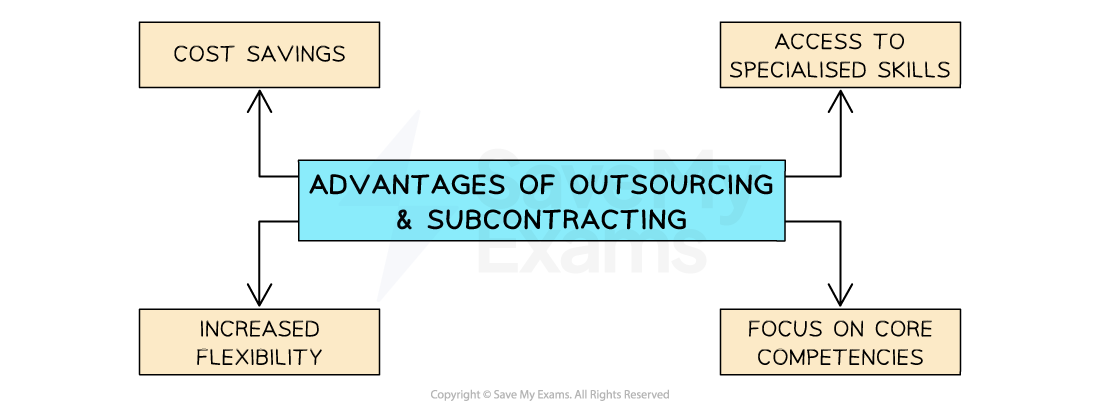
Cost savings
Businesses can often reduce expenses associated with operations such as hiring and training employees, maintaining infrastructure and managing IT systems
Access to specialised skills
External specialists have resources that the business lacks internally, which allows it to benefit from the knowledge and experience of industry specialists as and when required
Increased flexibility
Businesses can provide greater flexibility to scale their operations up or down based on demand fluctuations, which is particularly valuable in industries with seasonal or unpredictable demand
Focus on core competencies
Businesses can concentrate their resources and efforts on their core competencies, where they can add value
Limitations of outsourcing
Quality control
Using external providers makes it harder to ensure consistent quality and adherence to company standards
Loss of control
Handing direct control over those activities to others outside of the business may be risky
Companies must carefully select reliable partners and establish clear contractual terms to protect their interests
Data security and confidentiality
Sharing sensitive information outside of the business introduces potential risks to data security and confidentiality
Communication and cultural differences
Using global providers may result in language barriers or problems with time zone differences
Cultural differences may present communication challenges
Capital investment
Capital investment means spending money on machinery, equipment or technology to permanently increase a business's production capacity
Investing in new machinery or technology allows a business to meet a sustained rise in demand, rather than just a short-term spike
Ways businesses can use capital investment
Purchasing new machinery or equipment to raise the maximum level of output
Investing in automation or technology that speeds up existing production processes
Expanding or upgrading premises to allow additional production lines to operate
Investing in technology that enables remote or flexible working, increasing the workforce's effective output
Example
A bakery invests in a new automated oven to increase its daily bread output and meet growing demand from supermarkets
Advantages and disadvantages of capital investment
Advantages |
|
|---|---|
Disadvantages |
|
Increasing or decreasing capacity
Capacity is the maximum output a business can produce in a given period; increasing or decreasing capacity means changing this maximum to match demand
Ways businesses can change capacity
Opening a new production site, or closing or mothballing one when demand falls
Adding or removing a shift pattern, such as running a night shift during a period of peak demand
Increasing or decreasing the hours a factory or facility operates each day or week
Renting additional space, machinery or equipment temporarily, rather than committing to a permanent expansion
Example
A car manufacturer opens a second shift at its factory to increase capacity during a period of high demand
Advantages and disadvantages of changing capacity
Advantages |
|
|---|---|
Disadvantages |
|
Challenges of not matching supply and demand
Failing to match supply and demand means a business produces either too little or too much relative to what customers actually want
An undersupply is where demand exceeds supply
An oversupply is where supply exceeds demand
Consequences of undersupply
Lost sales and revenue, as customers who can't be served may buy from a competitor instead
Damage to customer satisfaction and brand reputation, particularly if shortages happen repeatedly
Pressure to rush production or expand capacity quickly, which can increase costs or reduce quality
Consequences of oversupply
Higher storage costs and cash tied up in unsold stock
Risk of stock becoming obsolete, out of date or having to be sold at a discount, reducing profit margins
Wasted resources, including materials, labour and capacity, that could have been used more productively elsewhere
Case Study
The Daily Crumb

The Daily Crumb is a chain of high-street bakeries known for its pies and seasonal treats. Each December, demand for its products rises sharply, and in one particularly busy year, the business initially struggled to keep up.
To cope, The Daily Crumb rescheduled production, moving planned maintenance to January and running extra overnight shifts to increase output ahead of the rush. It also hired temporary and zero-hours staff for the six weeks running up to Christmas, and built up stock of non-perishable ingredients several weeks in advance.
Despite this, one branch ran out of its most popular pie range on two occasions, losing sales to a nearby competitor and receiving complaints on social media.
Recognising the same issue was likely to recur, the directors approved capital investment in a second oven for its busiest branch, permanently increasing its capacity ahead of the following year.
Examiner Tips and Tricks
When answering questions on matching supply and demand, identify whether the case study business faces a demand increase or decrease, and select the method(s) that best fit that specific situation rather than describing every method generically

Unlock more, it's free!
Join the 100,000+ Students that ❤️ Save My Exams
the (exam) results speak for themselves:

Was this revision note helpful?
