Business Decisions (AQA A Level Business): Revision Note
Syllabus Edition
First teaching 2026
First exams 2028
Exam code: 7132

Influences on business decisions
Businesses face decisions at every level - from day-to-day operational choices to major long-term strategic commitments
No decision is made in isolation - a range of internal and external factors shape the options available and the choices ultimately made
Types of business decision
Type of decision | Explanation |
|---|---|
Strategic |
|
Tactical |
|
Operational |
|
Key influences on business decisions
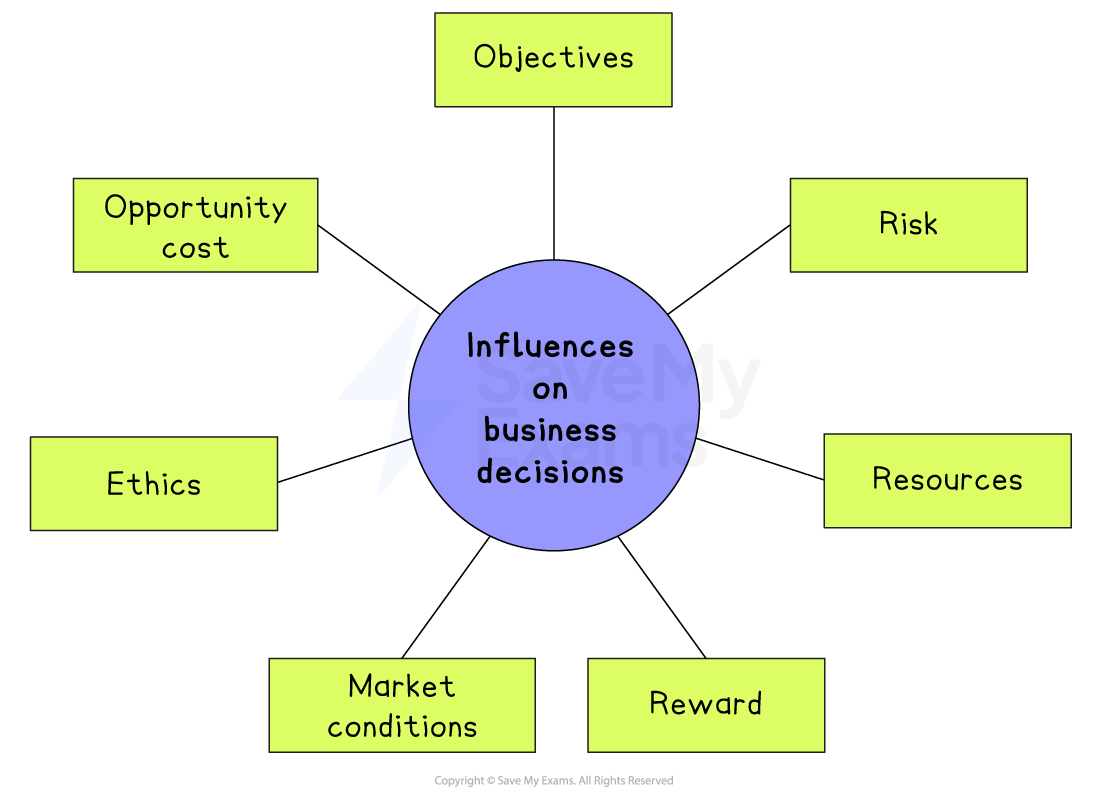
Objectives
Decisions are shaped by what the business is trying to achieve
A business focused on rapid growth may make very different choices from one prioritising stability or survival
E.g. a business with a market share objective may accept lower profit margins to fund aggressive pricing
Risk
All decisions carry some degree of uncertainty
A business's willingness to accept risk influences which options it considers viable
E.g. a start-up with limited funds may avoid high-risk decisions such as launching several products simultaneously
Reward
The potential return from a decision is weighed against its cost and risk
Higher potential rewards may justify accepting greater uncertainty
E.g. a business may invest heavily in research and development if the projected revenue from a new product is substantial
Resources
The availability of financial, human and physical resources limits what a business can realistically do
Resource constraints often force difficult prioritisation
E.g. a small business with limited capital may be unable to invest in new technology even if it would improve efficiency
Market conditions
The state of the market, including competition levels, consumer confidence and the broader economic environment, determines which decisions are viable
E.g. a business may postpone a price increase if consumer spending is falling due to rising inflation
Ethics
A business may reject a course of action that conflicts with its values or causes harm to stakeholders, even if it is legal and financially attractive
E.g. choosing not to source materials from a supplier with poor labour practices despite the lower cost
Opportunity cost
Every decision involves a trade-off
The opportunity cost is the value of the next best alternative given up when a choice is made
E.g. a business that uses surplus cash to open a new store gives up the opportunity to invest that money in staff training or product development
Examiner Tips and Tricks
In longer answers, the most effective responses do not just list influences - they show how influences interact. For example, a high potential reward might lead a business to accept greater risk, but limited resources may ultimately prevent it from pursuing the opportunity at all. Showing these connections demonstrates strong analytical thinking
Risks & rewards in decision making
Every business decision involves:
An element of risk - the possibility that outcomes will be worse than expected
A potential reward - the benefit gained if the decision succeeds
Understanding the relationship between risk and reward is central to effective business decision-making at every level of an organisation
The risk-reward relationship
There is generally a positive relationship between risk and reward
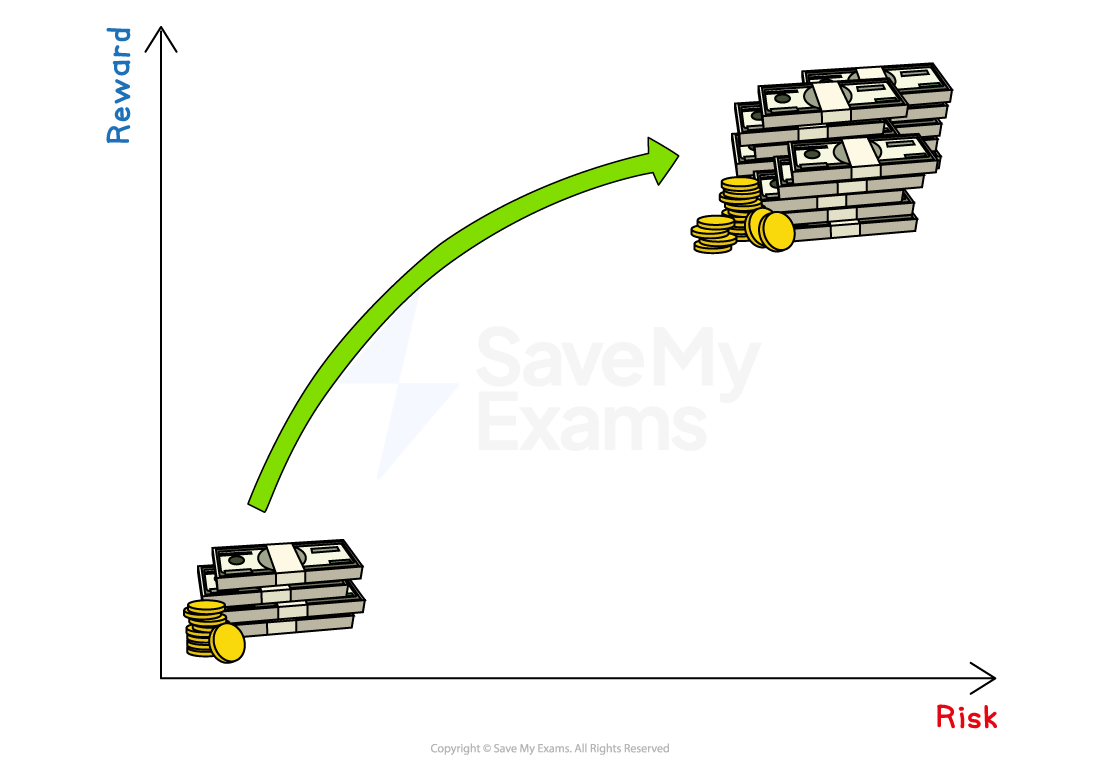
Higher potential rewards tend to come with higher levels of risk
Lower-risk decisions typically offer more modest returns
Businesses must decide whether the potential reward of a decision justifies the level of risk involved
Launching a completely new, untested product carries a high risk of failure but also the potential for high revenue if it succeeds
Making a small improvement to an existing product is less risky but unlikely to generate a significant increase in revenue
Risk appetite
Risk appetite is the level of risk a business is willing to accept when making decisions
Influence on risk appetite | Explanation |
|---|---|
Financial strength |
|
Ownership structure |
|
Business objectives |
|
Stage of development |
|
Industry |
|
Why the balance matters
Informed decision-making
Weighing risk against reward helps businesses make evidence-based choices rather than relying on guesswork or instinct
Resource allocation
Understanding risk and reward helps businesses direct limited resources towards decisions most likely to achieve their objectives
Financial planning
Anticipating potential losses allows businesses to set aside contingency funds and prepare for adverse outcomes
Avoiding overexposure
Taking on excessive risk without sufficient potential reward can threaten the financial stability of a business
Avoiding missed opportunities
Being too risk-averse can prevent a business from innovating or growing, allowing competitors to gain an advantage
Examiner Tips and Tricks
Risk and reward appear throughout the course, not just in this topic. In evaluation questions, consider whether the potential reward justifies the risk given the specific context - a large, financially strong business can absorb risks that might threaten the survival of a smaller one. This kind of contextual judgement is what higher mark bands reward
Ethical dilemmas in decision making
Ethics refers to a set of moral principles that guide behaviour
In a business context, this means considering the impact of decisions on all stakeholders, not just shareholders
An ethical dilemma arises when a business must choose between options that conflict with one another on moral grounds
Most commonly, they arise when acting ethically increases costs, or when maximising profit requires compromising ethical values
Profit vs ethics
The central ethical dilemma most businesses face is the tension between maximising profit and doing what is morally right
Examples of profit vs ethics decisions
Sourcing and supply chain
Using cheaper suppliers with poor labour or environmental standards reduces costs and increases profit, but causes harm to workers and the environment
Pricing
Charging the highest price the market will bear maximises revenue, but may make essential products unaffordable to those who need them most
E.g. pharmaceutical companies pricing life-saving medication beyond the reach of lower-income patients
Employment practices
Using zero-hours contracts or paying minimum wages reduces costs, but can harm employee wellbeing and financial security
Environmental impact
Choosing cheaper, less sustainable production methods reduces costs but increases environmental damage
Marketing
Misleading or manipulative advertising may boost short-term sales, but it deceives consumers and damages trust
Tax avoidance
Using legal strategies to minimise tax liability increases profit for shareholders, but reduces funds available for public services
Why ethical behaviour matters in the long run
Acting ethically can increase short-term costs, but there are strong long-term reasons to do so
Reason | Explanation |
|---|---|
Reputation and brand loyalty |
|
Employee motivation and retention |
|
Attracting investment |
|
Avoiding legal and regulatory risk |
|
Long-term profitability |
|
Examiner Tips and Tricks
In evaluation questions about ethical dilemmas, always weigh short-term against long-term consequences. Choosing profit over ethics may boost profits, but the reputational damage from an ethical failure can be far more costly over time. The strongest answers acknowledge that the right balance depends on the specific business, its objectives and the nature of the ethical issue - avoid treating ethics as simply "good" and profit as simply "bad"

Unlock more, it's free!
Join the 100,000+ Students that ❤️ Save My Exams
the (exam) results speak for themselves:

Was this revision note helpful?
