Technology in Supply Chain Management (AQA A Level Business): Revision Note
Syllabus Edition
First teaching 2026
First exams 2028
Exam code: 7132

The value of technology in supply chain management
Adopting technology across the supply chain brings a range of wider benefits that help a business run more effectively as a whole
Benefits of technology in supply chain management
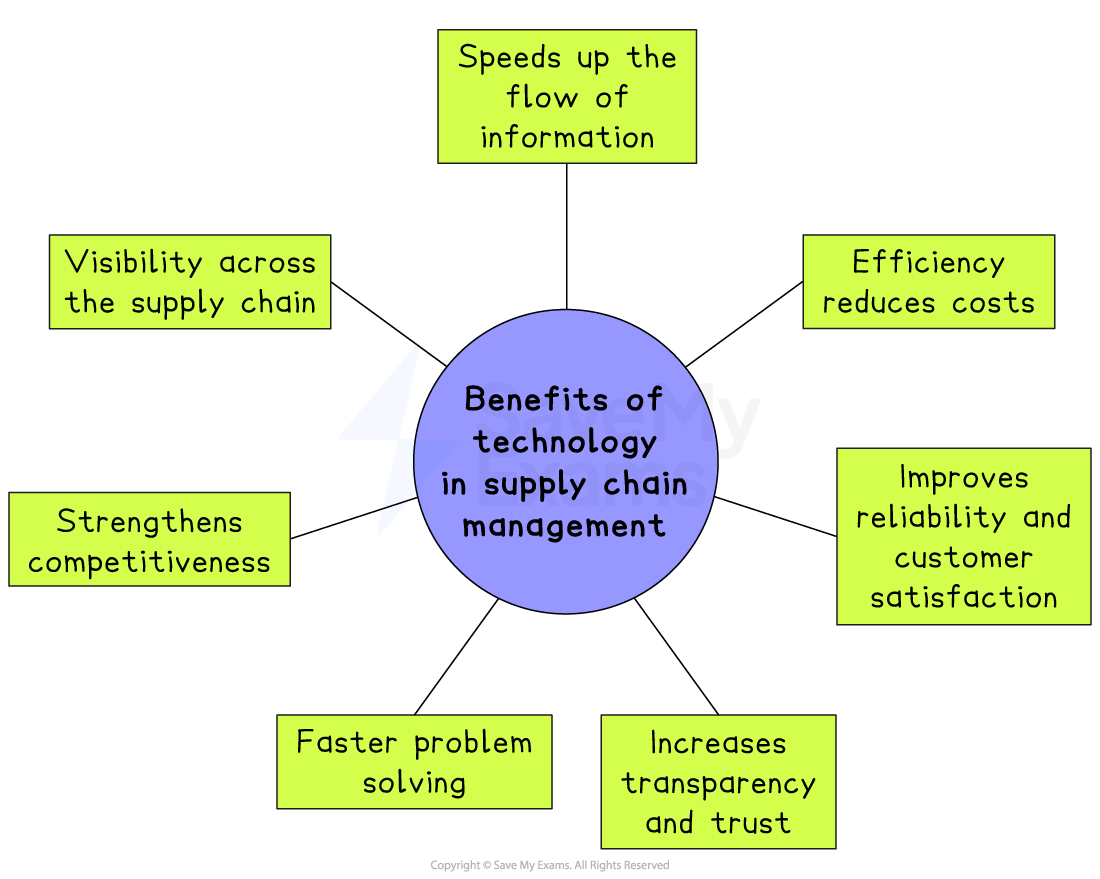
Improves visibility across the whole supply chain
Businesses can see where materials, inventory and deliveries are at every stage, rather than only when problems are reported
This allows issues to be spotted and dealt with before they escalate into serious disruption
Speeds up the flow of information
Suppliers, businesses and customers can share data instantly rather than relying on phone calls, emails or paperwork
This reduces the delays associated with human communication
Reduces costs through greater efficiency
Better route planning, more accurate ordering and reduced administration all help cut unnecessary spending across the supply chain
This frees up money for other areas of the business
Improves reliability and customer satisfaction
More accurate tracking reduces missed deliveries and unexpected delays
This helps a business build a reputation for dependability
Increases transparency and trust
Technologies such as blockchain make it easier to prove where materials came from and how they were handled
This can meet growing customer expectations around ethical and traceable sourcing
Supports faster problem solving
When a supplier fails or transport is disrupted, real-time data helps a business identify the issue and respond quickly
Strengthens competitiveness
Businesses that invest in effective supply chain technology can often operate more efficiently and reliably than rivals that still rely on manual systems
This can make it easier to win and keep contracts with major customers
Ways technology is used in supply chain management
Technology helps businesses track, coordinate and speed up every stage of their supply chain, from raw materials leaving a supplier to finished goods reaching a customer.
GPS tracking and telematics
GPS (Global Positioning System) tracking and telematics use satellite and sensor data to monitor the real-time location, speed and condition of vehicles, containers or shipments as they move through the supply chain
Businesses and logistics providers fit tracking devices to vehicles or containers
Live location data is transmitted so the exact position of goods can be checked at any point in their journey
Example
Maersk provides real-time tracking of over 12 million shipping containers a year, combining GPS, ship tracking signals and scans to give customers live updates on location, estimated arrival time, and even the temperature of perishable cargo
Advantages |
|
|---|---|
Disadvantages |
|
Supply chain management software
Supply chain management software integrates data from suppliers, production, inventory and distribution into a single system
This allows different parts of the supply chain to share information instantly, rather than relying on separate systems or manual communication between departments and suppliers
Example
Unilever uses complex software to integrate data from its suppliers, factories and distributors across the world, giving it a real-time view of its entire global supply chain
Advantages |
|
|---|---|
Disadvantages |
|
Blockchain
Blockchain is a shared digital record system that securely stores information about a product's journey through the supply chain
Data cannot be altered or deleted
Businesses record verified information at each stage, such as origin, processing and shipping
This creates a transparent, unamendable history that interested parties can access instantly
Example
Walmart worked with IBM to use blockchain technology to trace the origin of mangoes sold in its US stores, reducing the time needed to trace a batch back to the farm from around seven days to just 2.2 seconds
Advantages |
|
|---|---|
Disadvantages |
|
AI-powered logistics and route optimisation
AI-powered logistics tools use artificial intelligence to plan and adjust delivery routes, schedules or supply chain decisions automatically, based on large amounts of real-time data
These systems analyse factors such as traffic, weather, delivery windows and vehicle capacity to calculate efficient routes and schedules that can update in real time as conditions change
Example
Logistics company UPS uses an AI-powered route optimisation system called ORION to plan its delivery routes, saving the company around 100 million miles driven each year and hundreds of millions of dollars in costs
Advantages |
|
|---|---|
Disadvantages |
|
Examiner Tips and Tricks
For questions on technology in supply chain management, be specific about which stage of the supply chain a technology affects, such as tracking shipments, sharing information with suppliers, or planning delivery routes, rather than describing the benefits of "technology" in supply chains generically.

Unlock more, it's free!
Join the 100,000+ Students that ❤️ Save My Exams
the (exam) results speak for themselves:

Was this revision note helpful?
