Porter's Five Forces: Theory (AQA A Level Business): Revision Note
Syllabus Edition
First teaching 2026
First exams 2028
Exam code: 7132

Porter's five forces
Porter’s five forces model identifies the key pressures on an industry that impact the ability of a business to compete with rivals
It helps managers think strategically about the environment in which the business operates
The five forces
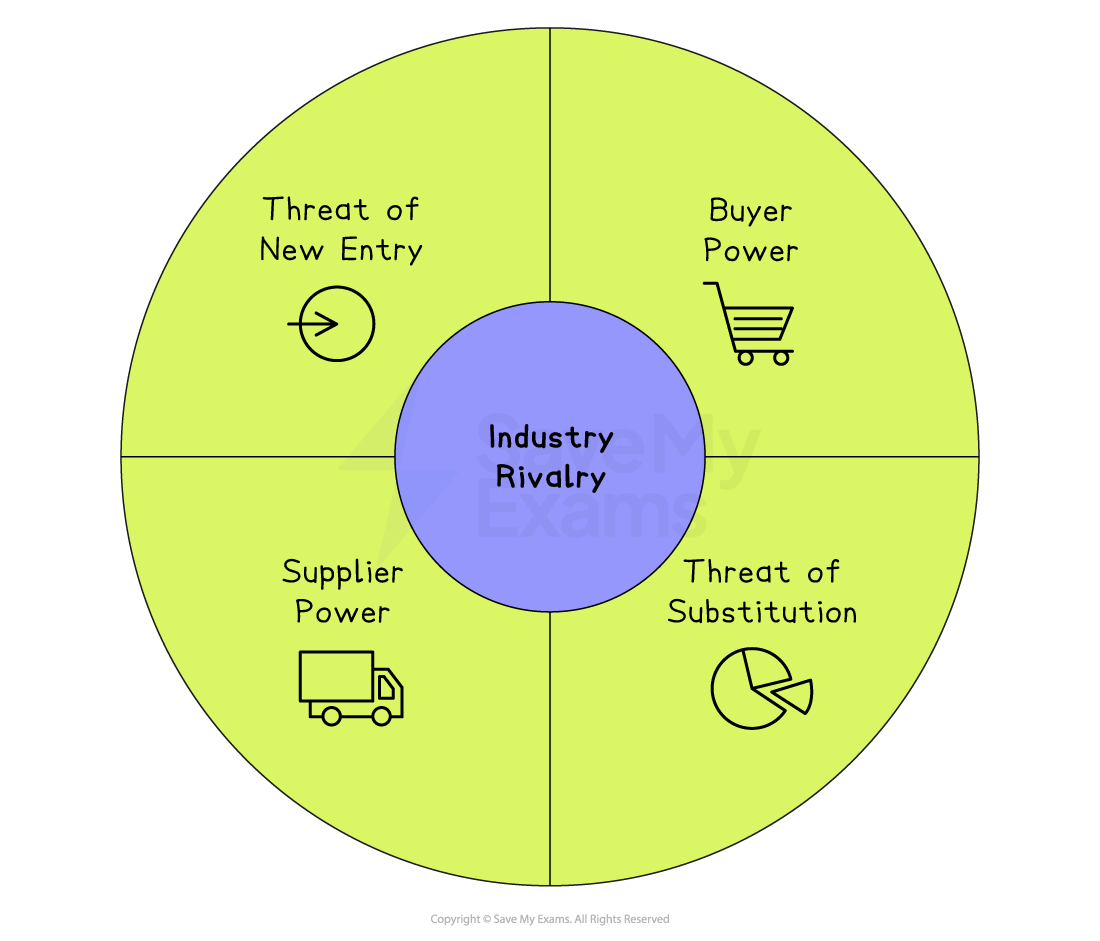
Entry threat
How easily new competitors could enter the market
Buyer power
How much influence customers have over price and terms
Supplier power
How much influence suppliers have over price and terms
Rivalry
How intense the competition is between existing businesses in the same market
Substitute threat
How easily customers could switch to a different type of product that meets the same need
Examiner Tips and Tricks
When supplier power rises or rivalry intensifies, show how this squeezes profit margins, then suggest a defence (e.g., differentiation) for evaluation
Balancing threat with strategy helps you achieve better analysis marks
Influences on the five forces
Rivalry
The level of rivalry is high when:
There are more competitors, as businesses fight harder for the same customers
Competitors are a similar size, since no single business dominates the market
The market is growing slowly, as businesses can only grow by taking customers from rivals
Products are very similar, since customers can switch easily based on price alone
Exit barriers are high, so struggling firms keep competing rather than leaving the industry
Example
Tesco, Sainsbury's, Asda and Aldi compete intensely on price, since their products are similar and customers can switch easily between them
Buyer power
The threat of buyer power is high when:
There are few large buyers, since each one matters more to the seller
Customers can easily switch to a competitor
It is cheap and easy for customers to switch to a new supplier
Customers care a lot about price
Customers can easily compare prices and quality, for example online
Example
Large supermarkets have strong buyer power over small food producers, since they buy in huge volumes and can switch suppliers if prices aren't competitive
Supplier power
The threat of supplier power is high when:
There are few suppliers, since businesses have fewer choices
The material or component supplied is hard to replace
It is expensive or difficult for a business to change to a new supplier
The buyer only makes up a small share of the supplier's sales, so the supplier has less to lose by losing that customer
Example
Chip makers such as Nvidia hold strong supplier power over some technology companies, since only a small number of businesses can produce the most advanced computer chips
Entry threat
The entry threat is high when:
It is cheap and easy to start up, for example because minimal capital investment is required
Existing businesses have weak brand loyalty
It is easy for a new business to get its products to customers
There are few laws or licences making it difficult to enter the industry
Example
It is easy for a new company to start an online food delivery app, since it requires relatively little upfront investment and few specialist licences compared with entering an industry like car manufacturing
Substitute threat
The substitute threat is high when:
There are many different products that meet the same customer need
Substitutes are cheaper or work just as well
It is easy and cheap for customers to switch to the substitute
Example
Streaming services such as Netflix act as a substitute threat to cinemas, since customers can choose to watch films at home instead

Unlock more, it's free!
Join the 100,000+ Students that ❤️ Save My Exams
the (exam) results speak for themselves:

Was this revision note helpful?
