The Importance of Digital Strategy (AQA A Level Business): Revision Note
Syllabus Edition
First teaching 2026
First exams 2028
Exam code: 7132

The purpose of a digital strategy
A digital strategy is a business's plan for using digital technology to achieve its overall objectives across the whole organisation
Typical elements of a digital strategy
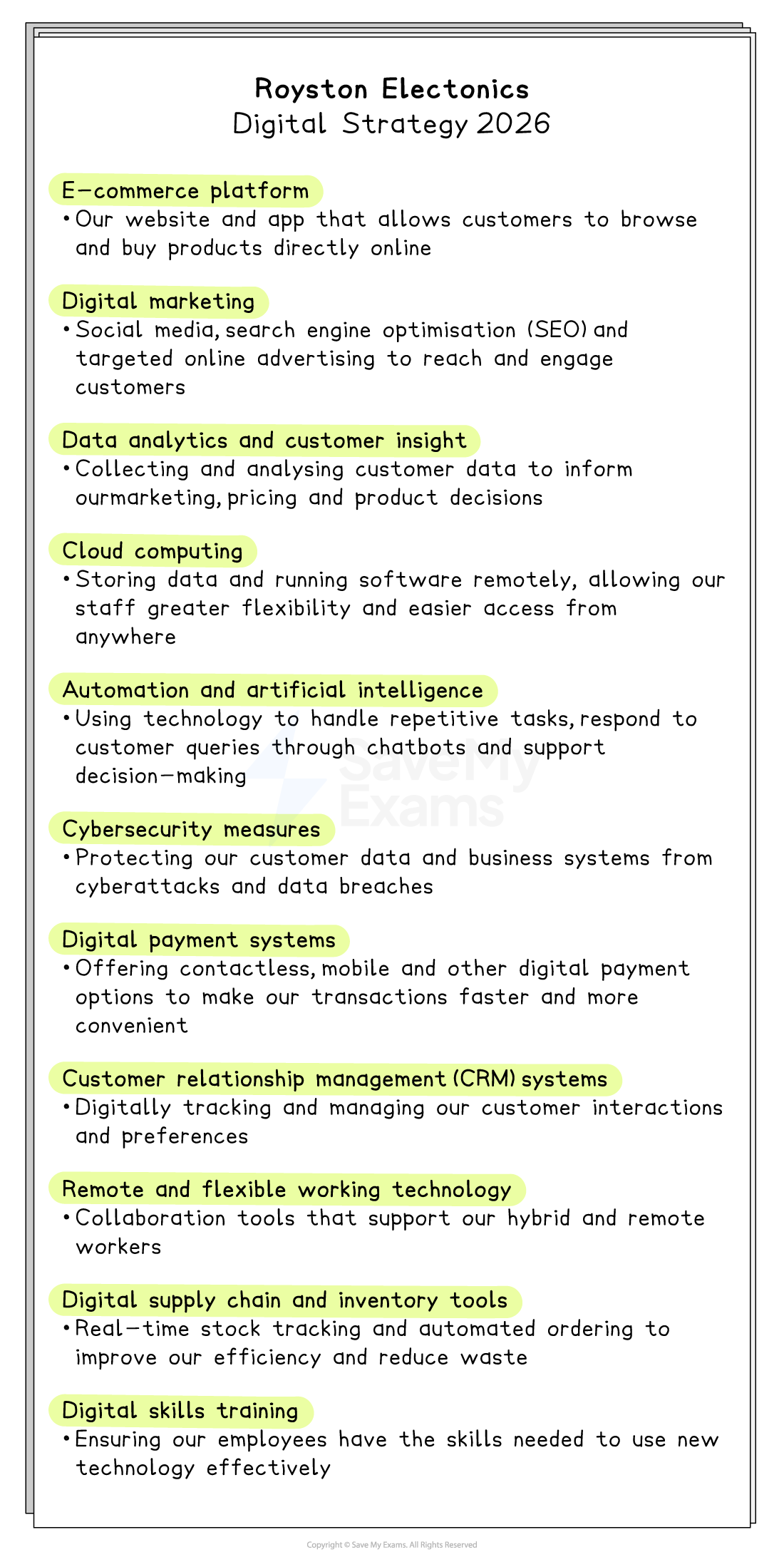
Why is digital strategy important?
Digital behaviour has permanently shifted
Internet sales made up around 28% of total retail sales in Great Britain in 2026, up from just 19.2% before the pandemic in 2019
A strong online presence is no longer optional for most consumer-facing businesses
There is a widening digital divide between large and small firms
75% of the largest UK law firms and 68% of large accountancy firms now use AI, compared with just 15% of small firms
Businesses without a clear digital strategy risk falling further behind more digitally capable competitors
Adoption without strategy risks wasted investment
77% of UK SME leaders say they lack the skills needed to successfully implement new technology
Simply buying digital tools is not enough - a strategy is needed to use them effectively
The value of digital strategy
Improves efficiency and reduces costs
Automating processes and digitising record-keeping reduces manual work and human error
This frees up staff time for higher-value tasks
Improves customer experience
Digital tools such as apps and personalised recommendations improve convenience and engagement
This helps build customer loyalty
Example
Domino's Pizza's app allows customers to order and track their pizza in real time, creating a smoother, more engaging experience than a traditional phone order
Enables data-driven decision-making
Digital systems generate large amounts of data that can inform more accurate marketing, HR, finance and operations decisions than judgement alone
Supports the introduction of new revenue streams
Digital technology can allow a business to sell in entirely new ways, rather than simply digitising its existing approach
Example
Adobe shifted from selling one-off physical software licences to its subscription-based Creative Cloud service
This created a more predictable and ultimately more profitable revenue stream
Improves communication and collaboration
Shared digital tools help coordinate decisions across functional areas and international sites
This reduces communication diseconomies of scale
Helps build and protect competitive advantage
A strong digital strategy helps a business avoid falling behind more digitally capable rivals
This reduces the risk of strategic drift
Digital strategy and functional areas
A digital strategy doesn't just affect the IT department
The same piece of technology often changes how a business runs across marketing, finance, HR and operations
Digital strategy needs to be planned for the whole business, not treated as just an IT or marketing job
Functional area | Possible impact |
|---|---|
Marketing |
|
Finance |
|
Human resources |
|
Operations |
|
Digital strategy and competitiveness
A strong digital strategy can become a genuine source of competitive advantage
Through faster response to customer needs, lower costs from automation, and the ability to reach customers globally without physical expansion
Businesses that fail to invest in digital capability risk falling behind more agile, digitally focused competitors
Example
Comet, once one of the UK's largest electrical retailers, collapsed into administration in 2012, having failed to develop a competitive online retail strategy
At the time rivals such as Amazon and Currys were rapidly growing their digital sales
Digital platforms can also lower barriers to entry for smaller rivals
New competitors can challenge established businesses without needing large-scale physical facilities of their own
E.g. Small independent brands can now compete directly with major retailers by selling through platforms such as Shopify or TikTok Shop, without needing to build their own stores or warehouses
A well-developed digital strategy can even become a product in its own right
This can create an additional competitive advantage beyond a business's core operations
Example
Tesco developed its own customer data and loyalty analytics system, originally built to support its Clubcard scheme, into a separate business called Dunnhumby
This business now sells data analytics services to other retailers around the world
Case Study
Elmwood Hardware

Elmwood Hardware is a UK chain of DIY and hardware stores that had seen sales slowly decline as larger rivals invested heavily in online shopping.
In response, Elmwood launched a new digital strategy, building an e-commerce website, introducing click-and-collect at all its branches, and installing stock management software that gave real-time visibility of inventory across every store.
The finance team used the new system's data to identify which product lines were most profitable, while marketing used customer browsing data to send personalised promotions rather than generic emails.
Store staff were retrained to handle online order preparation alongside their usual duties, requiring new scheduling systems from HR to manage the additional workload.
Within a year, online sales accounted for a fifth of Elmwood's total revenue, and better stock visibility reduced wasted spending on overstocked items.
Elmwood was also able to match the delivery speed of larger competitors for the first time, helping it retain customers who had previously switched to bigger, more digitally advanced rivals.

Unlock more, it's free!
Join the 100,000+ Students that ❤️ Save My Exams
the (exam) results speak for themselves:

Was this revision note helpful?
