Economic Environment in Practice: Inflation & Interest Rates (AQA A Level Business): Revision Note
Syllabus Edition
First teaching 2026
First exams 2028
Exam code: 7132

Written by: Lisa Eades
Updated on
Inflation
Inflation is a sustained rise in the general price level of goods and services in an economy over time
It is measured in the UK using the Consumer Prices Index (CPI), published monthly by the Office for National Statistics
This index is based on average price rises of a typical 'basket of goods' purchased by UK households
Causes of inflation
Demand-pull inflation
Demand-pull inflation occurs when total demand in the economy grows faster than the economy's ability to supply goods and services
It is often linked to low unemployment, low interest rates or strong consumer confidence
Businesses can often raise prices without losing many customers, but this creates pressure to expand their productive capacity quickly
Cost-push inflation
Cost-push inflation occurs when the costs of production rise, such as raw materials, energy or wages
Businesses pass these higher costs on as higher prices
Profit margins are reduced if costs rise faster than businesses can increase prices
Recent trends
Inflation fell during the 2020-2021 Covid-19 pandemic as household spending was significantly reduced
It rose sharply during 2021 and 2022 as a result of supply chain pressures caused by the Russia-Ukraine conflict
The introduction of a range of tariffs by the Trump administration in 2025 increased the rate of inflation, though their impact is easing
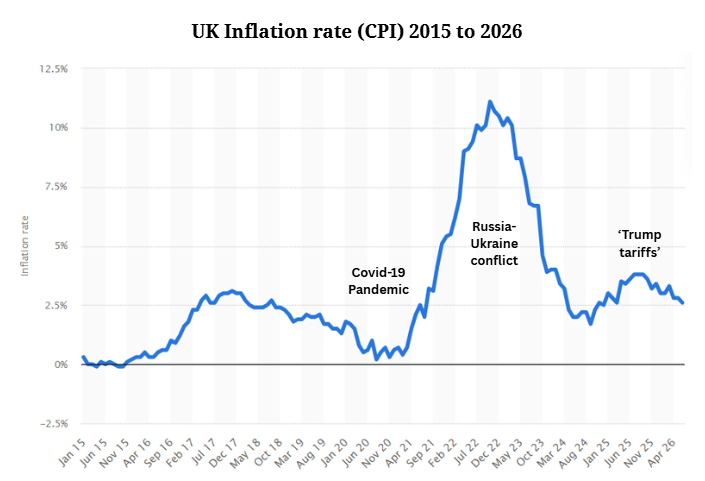
The Bank of England has an inflation target of two per cent, set by the government
UK inflation was 2.6 per cent in the twelve months to June 2026, down from 2.8 per cent the previous month
Monthly inflation rose by just 0.1 per cent in June 2026, compared with a rise of 0.3 per cent in June 2025
The fall was mainly due to cheaper transport costs - especially motor fuel and diesel
Inflation is gradually falling back towards the Bank of England's target, although services inflation remains relatively high
Benefits of low, stable inflation for business
Costs and prices become easier to predict, helping businesses to more accurately budget and plan for the long-term
Wage demands from employees are lower, reducing the pressure on labour costs
Businesses find it easier to commit to long-term investment, as the future value of returns is more certain
Challenges of high inflation for business
Costs of raw materials, energy and wages rise, reducing profit margins
Consumers have less real disposable income, which can reduce demand, particularly for non-essential goods
Forecasting costs and revenues becomes more difficult, making financial planning less reliable
Employees push for higher wages to protect their real income, risking higher labour costs or industrial disputes
Rising inflation is not always felt evenly across a business, as some suppliers or cost categories rise faster than others
Example
A restaurant chain may choose to hold its prices steady to protect customer numbers, even as the cost of food ingredients and staff wages continues to rise, leaving it with significantly lower profit margins on each sale
Impact on functional areas
Functional area | Impact | Example |
|---|---|---|
Marketing |
|
|
Finance |
|
|
Human resources |
|
|
Operations |
|
|
Interest rates
Interest rates are the cost of borrowing money, or the reward for saving it, usually expressed as a percentage of the amount borrowed or saved
In the UK, the base rate is set by the Bank of England's Monetary Policy Committee (MPC) which meets roughly eight times a year
The rates charged by commercial banks on loans, mortgages and savings are heavily influenced by the base rate
Interest rates and inflation
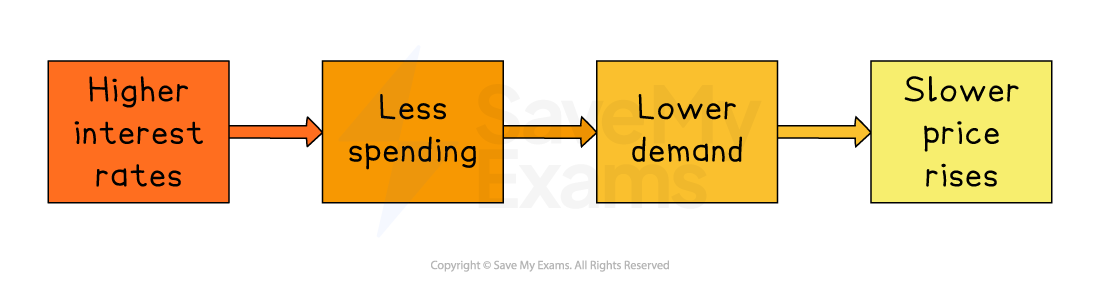
Higher interest rates make borrowing more expensive and saving more attractive
This has a knock-on effect on spending
Mortgages and loans become more expensive
People with variable-rate mortgages or loans see their repayments rise, leaving less spare cash to spend on goods and services
Saving becomes more rewarding
With better returns on savings, people are tempted to save rather than spend
Borrowing to spend becomes less appealing
Credit cards, car finance and other borrowing cost more, so people take out less of it
With less money circulating and being spent, demand for goods and services falls
When demand falls, businesses have less room to keep raising prices so inflation slows down
This is why the Bank of England raises interest rates when inflation is too high, and cuts interest rates when the economy needs a boost
Recent trends
The Bank of England base rate was held at 3.75 per cent in July 2026, having been cut from four per cent in December 2025
Services inflation was persistently high at 3.7 per cent, so a future base rate rise is likely
However, some economists forecast the base rate could fall further, towards 3.25 per cent by the end of 2026, if inflation continues to ease
Mortgage interest rates fell from around 4.65 per cent in early 2025 to 4.22 per cent by mid-2026
This remains high by recent historical standards and continues to reduce household spending power
The impact of a change in interest rates
Revenue
Rising rates reduce consumers' disposable income, as mortgage and loan repayments increase, lowering demand for many goods and services
Falling interest rates tend to boost consumer spending and revenue
Costs
Rising rates increase the cost of paying back loans, overdrafts and other variable-rate borrowing, reducing profit
Businesses holding significant debt are affected most
Business decisions
Higher rates discourage investment in new equipment, premises or expansion, as borrowing is more expensive and the risk of committing to repayments increases
Businesses may delay capital investment projects until rates fall
Sector-specific challenges
Sector | Challenges |
|---|---|
Housebuilders and property developers |
|
Small and medium enterprises (SMEs) |
|
Capital-intensive manufacturers |
|
Business responses to changes in interest rates
Businesses may switch to fixed-rate borrowing
They aim to protect themselves from further rate rises and improve certainty over future costs
Capital investment, such as new premises or equipment, may be postponed until borrowing costs fall
Some businesses prioritise paying down existing debt over expansion
This reduces their exposure to interest rate changes
Where possible, businesses may pass on higher borrowing costs to customers through price increases
However, this risks reducing demand further
Case Study
Barratt Redrow and interest rates
Barratt Redrow, one of the UK's largest housebuilders, recently reported that its order book was down 11.2 per cent on the year before, with fewer homes sold in advance for 2026 than in 2025.
The company's operating profit margin had fallen sharply, from around 17 per cent in 2021 to 5.1 per cent in 2025. This was largely because mortgage affordability had worsened as interest rates remained high.
Barratt Redrow's share price fell by around 27 per cent over the course of 2026, with similar falls for its rivals Taylor Wimpey and Persimmon. Investors judged that mortgage rates above five per cent would continue to reduce buyer demand until the Bank of England cut the base rate.
Examiner Tips and Tricks
When answering questions on inflation or interest rates, always link the economic change to a specific, named business function or decision, and use current data where you can.

Unlock more, it's free!
Join the 100,000+ Students that ❤️ Save My Exams
the (exam) results speak for themselves:

Was this revision note helpful?