Trade Unions & Employee Forums (AQA A Level Business): Revision Note
Syllabus Edition
First teaching 2026
First exams 2028
Exam code: 7132

The nature of representation
Employees can be represented in workplace matters in two ways
Individual representation
Individual representation is when a single employee is supported or represented in a specific dispute, meeting or procedure, such as a disciplinary hearing or grievance meeting
In the UK, employees have a legal right to be accompanied by a trade union representative or a workplace colleague in any formal meeting
This is known as the right to accompaniment
Advantages and disadvantages of individual representation
Advantages |
|
|---|---|
Disadvantages |
|
Collective representation
Collective representation is when a group of employees is represented together, usually through a trade union, in negotiations or discussions that affect all members
It is most powerful in the context of collective bargaining for pay, hours and conditions on behalf of all trade union members
Strength in numbers gives employees significantly more power than when acting alone
Advantages and disadvantages of collective representation
Advantages |
|
|---|---|
Disadvantages |
|
The role of trade unions
A trade union is an independent organisation that represents the collective interests of workers, negotiating with employers on pay, working conditions and employment rights
The functions of trade unions
Collective bargaining
Negotiating pay, hours, holiday entitlement and other employment terms on behalf of members
Outcomes are set out in a collective agreement that applies across all workers represented by the trade union
Individual representation
Supporting members in disciplinary hearings, grievance procedures and any subsequent appeals
Providing legal advice and assistance in cases of unfair dismissal, discrimination or breach of contract
Health and safety
Monitoring working conditions and raising concerns with management
Trade union safety representatives have a legal right to inspect the workplace and be consulted on safety matters
Communication and campaigning
Acting as a formal channel between employees and management
Campaigning for improvements to employment law and workers' rights at a national level
Training and education
Providing members with training in employment rights, health and safety and workplace skills
Example
Unite the Union offers a wide range of training courses to members, covering areas from equality and diversity to financial wellbeing
Key trade unions in the UK
Trade union | Focus |
|---|---|
Unite |
|
UNISON |
|
NEU (National Education Union) |
|
CWU (Communication Workers Union) |
|
RMT |
|
Advantages of trade unions
Provide professional, experienced representation for employees in disputes and negotiations
Can secure improvements to pay and conditions that individual employees could not achieve alone
Protect employees from unfair treatment
Particularly those in lower-paid or less secure roles
Provide a structured channel for resolving workplace conflict before it escalates
Disadvantages of trade unions
Industrial action can be damaging for the business, its employees and the wider public
Union membership has declined significantly in the UK private sector, reducing collective bargaining power in many industries
Collective agreements may not reflect the preferences of every individual member
Some employers view union involvement as adversarial rather than collaborative, which can itself increase tension
Case Study
The RMT rail dispute
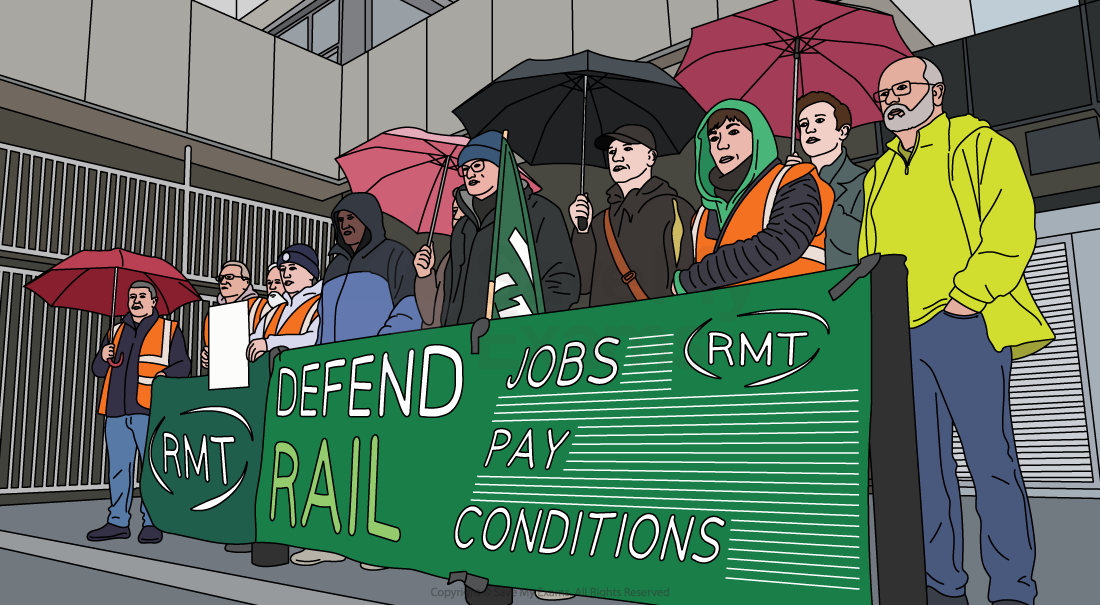
The RMT (National Union of Rail, Maritime and Transport Workers) represents approximately 40,000 rail workers across the UK. In 2022, the union entered into a dispute with Network Rail and train operating companies after employers offered a pay rise that fell significantly below the rate of inflation - at a time when the cost of living was rising sharply.
The RMT called a series of strike days throughout 2022 and into 2023, bringing large parts of the rail network to a standstill on multiple occasions. Millions of passengers faced severe disruption, and the rail industry is estimated to have lost hundreds of millions of pounds in revenue. Despite public pressure and political intervention, the RMT continued with its collective action for more than a year, demonstrating the significant power of a well-organised union.
Negotiations continued throughout the dispute, with ACAS providing conciliation support. Settlements were gradually reached with individual operators from late 2023 onwards, securing improved pay offers and a commitment to job security.
The role of employee forums
An employee forum is a formal body of elected employee representatives who meet regularly with management to discuss workplace matters, share information and raise employee concerns
Employee forums exist within the business and are open to all employees regardless of union membership
They focus on consultation and communication rather than negotiation
What employee forums typically discuss
Business performance updates and planned changes to strategy or operations
Proposed changes to working conditions, policies or procedures
Wellbeing, health and safety matters
Ideas and suggestions from the workforce
Advantages of employee forums
They provide a structured channel for two-way communication between employees and management
They are open to all employees
They are collaborative, in contrast to the adversarial nature of many trade union negotiations
They can identify concerns early and help resolve them before they escalate into formal disputes
Disadvantages of employee forums
They have no formal bargaining power
Management can choose to ignore the forum's recommendations
They may be considered by employees as a management-controlled body rather than a genuinely independent voice
There is a risk that they become a box-ticking exercise if concerns are raised by workers but never acted upon
They are less effective than trade unions in situations where employees need strong representation
Example
The NHS has joint consultative committees in its hospital trusts, bringing together management and employee representatives to discuss structural changes, working conditions and staff wellbeing
When new shift patterns were introduced in recent years at several trusts, JCCs gave frontline staff the opportunity to raise concerns before decisions were finalised. In some cases this led to changes that reduced the impact on the workforce
Examiner Tips and Tricks
Be precise about the difference between trade unions and employee forums when applied to a specific scenario. A business facing a pay dispute is most likely dealing with trade union collective bargaining; a business consulting its workforce about a new flexible working policy is more likely to use an employee forum or JCC. Identifying the right mechanism for the context, and explaining why it is appropriate, earns application marks

Unlock more, it's free!
Join the 100,000+ Students that ❤️ Save My Exams
the (exam) results speak for themselves:

Was this revision note helpful?
