What is Human Resource Planning? (AQA A Level Business): Revision Note
Syllabus Edition
First teaching 2026
First exams 2028
Exam code: 7132

The purpose of human resource planning
Human resource (HR) planning is the process of analysing a business's current workforce and forecasting what it will need in the future, then putting strategies in place to close the gap between the two
It involves asking:
What people does the business have now?
What people will it need?
What actions are required to get there?
HR planning is an ongoing process that must be reviewed regularly as business strategy and external conditions change
The HR flow

Recruitment
HR planning identifies when new employees are needed, how many to hire and what skills they should have
Proactive recruitment avoids filling vacancies at short notice, which often leads to rushed decisions and higher costs
Example
A technology company planning to launch a new product in 18 months uses HR planning to begin recruiting developers straight away, giving enough time to find the right candidates before the critical development phase begins
Training
HR planning identifies skills gaps – areas where current employees do not yet have the abilities the business will need in the future
This allows the business to plan training programmes well in advance rather than discovering gaps too late to address them
Training identified through HR planning may include:
Technical skills for new equipment or systems
Management development for employees being prepared for more senior roles
Compliance training required by new legislation
Example
A logistics company planning to switch its fleet to electric vehicles identifies that mechanics lack the skills to service electric engines, and begins funding training a year before the fleet change takes place
Redeployment
Redeployment means moving employees from declining areas of the business into different roles elsewhere, rather than making them redundant
This benefits the business by retaining experienced staff
It also benefits employees by allowing them to keep their jobs and develop new skills
Example
A bank reducing its branch network as customers move to online banking uses HR planning to retrain branch staff for digital customer service roles, avoiding large-scale redundancies
Redundancy
Redundancy is the dismissal of employees because their role is no longer needed, typically due to changes in the business such as restructuring, falling demand or the introduction of new technology
HR planning ensures redundancies are managed fairly, legally and with adequate notice
Early identification allows the business to:
Explore alternatives to compulsory redundancy, such as voluntary redundancy or reduced hours
Consult with affected employees in line with legal requirements
Provide support and retraining for those leaving
Minimise disruption to ongoing operations
Retention
Employee retention refers to a business's ability to keep its staff over time
Retaining staff matters because replacing an employee is expensive
Costs include advertising, recruitment, onboarding and the lost productivity while a new employee gets up to speed
High employee turnover also disrupts teams, reduces institutional knowledge and can damage morale among those who remain
HR's goal is to ensure that employees who are performing well have no reason to look elsewhere
To improve retention, HR teams focus on a range of strategies including
Competitive pay and benefits
Clear career progression pathways
Flexible working arrangements
Investment in training and development
Creating a positive workplace culture where employees feel valued and heard
The value of human resource planning
Effective HR planning is beneficial for several reasons
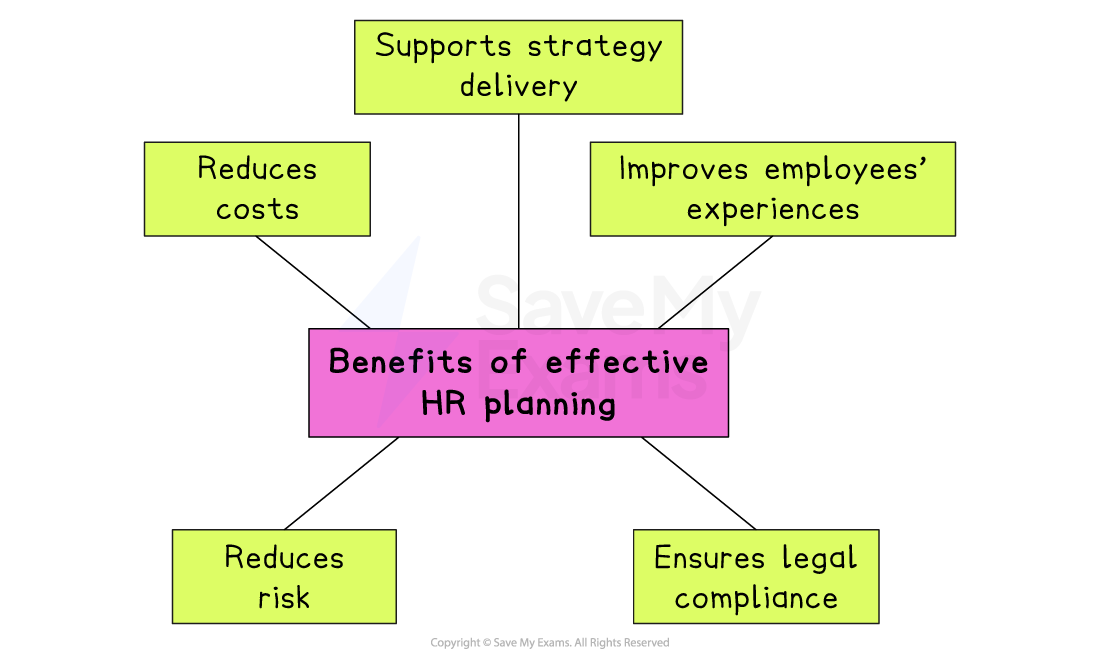
It reduces costs
Proactive planning helps avoid costly last-minute hiring, reduces employee turnover and prevents the business from having too many or too few employees
It supports strategy delivery
It ensures the business has the people it needs to carry out its plans, rather than being held back by workforce shortages or skills gaps at critical moments
It improves employees' experiences
Employees in well-planned organisations are more likely to receive appropriate development, feel secure in their roles and see clear progression opportunities
It reduces risk
Planning ahead means the business is less likely to be caught off guard by changes it could have anticipated, such as retirements of key staff
It ensures a business is legally compliant
Structured planning helps the business meet its obligations under employment law, particularly around redundancy, equality and working hours
Influences on human resource planning
The current workforce
Before planning for the future, a business must understand what it currently has
Skills and qualifications
What can existing employees do, and where are the gaps?
Age profile
A workforce with many older employees is a sign of upcoming retirements
A younger workforce may lack experience
Employee turnover rates
High employee turnover in particular roles highlights retention problems that must be considered in future recruitment plans
Performance levels
Identifying high performers and those who require development informs both training plans and succession decisions
Example
A manufacturing firm finds that 40% of its skilled machinists are over 55, which prompts it to draw up a recruitment and training plan to develop the next generation of skilled workers before a critical shortage develops
Future human resource needs
HR planning must reflect a clear picture of what the business will need from its workforce going forward:
Business strategy
Expansion requires more staff
Cost reduction may require fewer
New products or services often require new skills
Planned operational changes
Introducing new technology, relocating, entering new markets or restructuring the business can all increase or decrease the number and type of staff needed
Legislative changes
New laws may mean the business needs staff with specialist knowledge, or that existing employees need to work differently
Anticipated departures
By anticipating retirements and other expected departures, the business can plan ahead for who will fill those roles
Skills and numbers gaps
A numbers gap occurs when the business expects to have too few or too many employees relative to future requirements
Too few employees means recruitment or redeployment activity is needed
Too many employees may require redundancy or retraining programmes
A skills gap occurs when the business has enough people but they lack the capabilities required
This informs training and development planning or targeted external recruitment
Example
A digital marketing agency finds that only eight of its 40 staff have expertise in social media and data analytics, areas central to its three-year strategy
This skills gap leads it to launch a major training programme and a focused recruitment plan targeting digital specialists
The labour market
The labour market is the pool of available workers and the conditions in which businesses compete for them
Labour market condition | Explanation |
|---|---|
Availability of candidates |
|
Wage levels |
|
Geographic factors |
|
Competition from other employers |
|
Example
A cybersecurity company planning to recruit 20 specialist analysts discovers that salaries for these roles are rising 15% per year
Rather than competing in an expensive open market, it establishes a graduate training scheme and university partnerships to develop its own talent at a lower long-term cost
Case Study
Bright Start Learning

Bright Start Learning operates 18 children's tutoring and activity centres across the South East. Following strong demand, the board of directors approved plans to open six new centres over the next two years, creating an immediate need for around 90 additional members of staff, including qualified teachers and specialist activity coaches.
HR planning quickly revealed two significant challenges
A review of the current workforce showed that three of the most experienced centre managers were approaching retirement, creating a succession gap that needed addressing before the expansion got underway
A labour market analysis found that qualified primary school teachers – the business's preferred candidates for senior tutoring roles – were in short supply, with several competitor providers actively recruiting in the same areas
In response, Bright Start launched an internal management development programme to prepare junior staff for centre manager roles, reducing its dependence on external recruitment for leadership positions.
It also partnered with two local universities to offer placement schemes, building a pipeline of newly-qualified graduates who already had experience of working in Bright Start's centres before they were formally hired.
Without structured HR planning, the expansion would have proceeded without a strategy for closing either gap – putting both the opening and the quality of the new centres at serious risk
Examiner Tips and Tricks
HR planning questions often ask you to link the internal needs of the business to external labour market conditions. A plan that makes sense based on business strategy may be unrealistic if the right workers are not available in sufficient numbers. Always consider both dimensions when evaluating whether an HR plan is achievable

Unlock more, it's free!
Join the 100,000+ Students that ❤️ Save My Exams
the (exam) results speak for themselves:

Was this revision note helpful?
