Cooperatives & Social Enterprises (AQA A Level Business): Revision Note

Syllabus Edition

First teaching 2026

First exams 2028

Exam code: 7132

Lisa Eades

Written by: Lisa Eades

Reviewed by: Bridgette Barrett

Updated on

Co-operatives

  • Co-operatives are a form of for-profit social enterprise that are owned and run by and for their members, with the principle that working together means more power

    • Each member owns one share and has one vote on key decisions

    • Profits are either shared equally between members or reinvested for their benefit

  • Co-operatives are often celebrated as businesses that take a broader approach to business than the generation of profits and provide some key social benefits

  • However, they do have some disadvantages

    • Decision-making in cooperatives can be time-consuming, as members have the right to have a say

    • When a member leaves a co-operative, their share is relinquished and they receive no further benefits

    • Disagreements can occur when members possess differing social and commercial objectives

Types of co-operatives
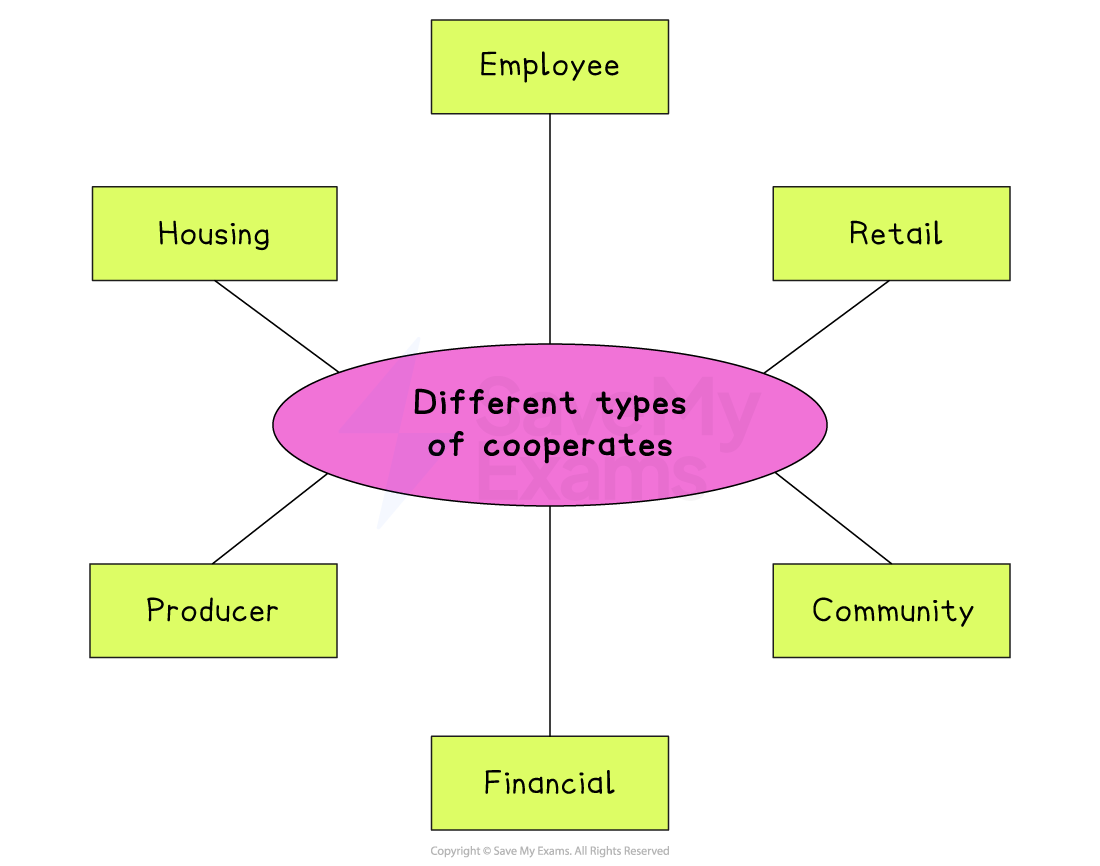
Diagram showing types of co-operatives: employee, retail, community, financial, producer and housing linked around a central pink oval title.
Retail, employee and producer are the most common types of co-operative

1. Worker co-ops

  • Owned equally by workers within the business

  • Each employee has a vote in business decisions

  • Profit is shared equally between employees

    • E.g. Suma Wholefoods, based in West Yorkshire, is one of the UK's largest worker co-operatives - all employees are equal partners and share in the profits

2. Community co-ops

  • Owned by members of a local community

  • Members usually contribute time as well as finances to the co-operative

  • Profit is commonly reinvested to continue providing socially valuable products

    • E.g.The Old Crown pub in Hesket Newmarket, Cumbria, was bought by local villagers in 1999 to prevent closure - profits are reinvested to keep the pub running for the community

3. Retail co-ops

  • A group of independent retailers come together and operate under one brand name

  • Buying power is increased, and marketing costs are shared

    • E.g.The Co-operative Group (The Co-op) is the UK's largest consumer co-operative, owned by over 4 million members who receive a share of profits and vote on key business decisions

4. Producer co-ops

  • Groups of manufacturers work together during the production process

  • Sharing and maximising the use of expensive capital equipment is often a key aim

  • Producer cooperatives are common in agriculture

    • E.g. First Milk is a farmer-owned dairy co-operative that collects, processes and markets milk on behalf of its member farmers across the UK

5. Financial co-ops

  • Organisations that provide financial services to individuals who may not otherwise qualify for standard banking products

  • Often focused on a particular community

  • Social aims take precedence over profits

    • E.g. Medway Credit Union provides loans and savings facilities to those living with challenging circumstances

6. Housing co-ops

  • Organisations that provide housing for members 

  • Members collectively own and benefit from socially cohesive and lower-cost dwellings

    • E.g. LILAC (Low Impact Living Affordable Community) in Leeds is a housing co-operative where residents collectively own and manage an eco-friendly housing development

Advantages and disadvantages of co-operatives

Advantages

Disadvantages

  • Because members have a stake in the business and a vote in key decisions, they tend to be more committed and engaged than employees in conventional businesses

  • Profits are distributed equally among members or reinvested for their collective benefit, rather than flowing to external shareholders with no direct connection to the business

  • The one-member, one-vote principle ensures all members have an equal say, regardless of the size of their financial contribution

  • Co-operatives often pursue broader social goals alongside commercial ones, building strong community relationships and customer loyalty

  • Member commitment and a focus on long-term sustainability can make co-operatives more stable during economic downturns than purely profit-driven businesses

  • The democratic process requires member consultation and agreement, which can be time-consuming and slow the business's ability to respond quickly to change

  • Members may hold different social and commercial priorities, leading to disagreements that are difficult to resolve

  • Co-operatives cannot issue shares on a stock exchange, restricting their ability to raise large amounts of finance for significant investment or rapid growth

  • When a member leaves, they relinquish their share and receive no ongoing financial benefit from the business's future success

  • Without professionally appointed specialist managers, co-operatives may lack the expertise needed to run the business efficiently as it grows in scale and complexity

Examiner Tips and Tricks

The one-member, one-vote principle is co-operatives' most distinctive feature and can be evaluated from either side. It promotes fairness and democratic ownership, which can motivate members and build loyalty. However, it can also slow strategic decision-making, particularly where members hold conflicting social and commercial objectives. In exam questions, do not treat the co-operative structure as simply positive or negative - consider whether the democratic model is an asset or a constraint, given the specific context of the business described

Social enterprises

  • A social enterprise is a business that has the primary purpose of creating social or environmental impacts, in addition to generating profits

Objectives of social enterprises

Social

Environmental

  • Provide jobs and support for disadvantaged groups in society, such as people with disabilities or unhoused people

  • Protect the natural world, animals and their habitats

  • Reduce the impact of pollution or overdevelopment

Ethical

Financial

  • Operate the business in a responsible way

  • Treat stakeholders, including employees and suppliers, fairly

  • Make a profit to invest back into the social enterprise to expand the social work that it performs

Examples of social enterprises

  • Croydon Community Nursery

    • Provides affordable childcare

    • Any surplus goes to fund bursary places for low-income families

  • Big Issue Group

    • Gives homeless people an income by selling the Big Issue magazine

    • Also invests in social-enterprise start-ups

Case Study

  • Butterfly Books is a social enterprise that publishes children’s educational books in the UK

  • Their aim is to "educate, inspire and entertain children, striving to change future generations by reducing gender bias in job roles"

  • A recent book entitled "My Mummy is an Engineer" challenges gender stereotypes

Colourful butterfly logo with wings in red, purple, yellow, teal, and blue, accompanied by the text "Butterfly Books" in purple and blue.
Butterfly Books aims to raise children's awareness of career options to improve diversity and reduce national skill gaps

Advantages and disadvantages of social enterprises

Advantages

Disadvantages

  • Social enterprises are often well-regarded by consumers and the wider public, making it easier to attract highly motivated employees who share the organisation's values and to build strong, loyal customer relationships

  • For-profit rivals may be encouraged to improve their ethical and environmental practices to better compete, raising standards across the sector as a whole

  • Profits (surpluses) are directed towards the social mission, ensuring that commercial success translates directly into meaningful benefit for communities or causes

  • Social enterprises may qualify for grants, government subsidies and investment from investors that are simply not available to conventional for-profit businesses

  • A clear social mission gives employees a strong sense of purpose that can improve engagement and reduce staff turnover beyond what financial rewards alone can achieve

  • Because social enterprises present themselves as ethical and responsible, any gap between their stated mission and their actual behaviour can attract severe reputational damage

  • Profits are shared with members or directed towards social causes, so less capital is available for growth and investment, making it harder to compete with better-resourced, profit-driven rivals

  • The need to consult a wide range of stakeholders can make it difficult to respond quickly to market changes or competitive threats

  • Social enterprises that prioritise their mission over profit may struggle to secure funding, as investors may not see a sufficient return

  • Pressure to maximise social impact can conflict with the need to generate sufficient revenue to sustain and grow the business, creating difficult strategic trade-offs for leaders

Unlock more, it's free!

Join the 100,000+ Students that ❤️ Save My Exams

the (exam) results speak for themselves:

Lisa Eades

Author: Lisa Eades

Expertise: Curriculum Expert

Lisa has taught A Level, GCSE, BTEC and IBDP Business for over 20 years and is a senior Examiner for Edexcel. Lisa has been a successful Head of Department in Kent and has offered private Business tuition to students across the UK. Lisa loves to create imaginative and accessible resources which engage learners and build their passion for the subject.

Bridgette Barrett

Reviewer: Bridgette Barrett

Expertise: Development Editor

After graduating with a degree in Geography, Bridgette completed a PGCE over 30 years ago. She later gained an MA Learning, Technology and Education from the University of Nottingham focussing on online learning. At a time when the study of geography has never been more important, Bridgette is passionate about creating content which supports students in achieving their potential in geography and builds their confidence.
