Employee Wellbeing (AQA A Level Business): Revision Note
Syllabus Edition
First teaching 2026
First exams 2028
Exam code: 7132

What is employee wellbeing?
Employee wellbeing refers to the overall physical, mental and emotional health of employees
It includes factors such as workload, workplace relationships, job security, working conditions and access to support
A business that takes wellbeing seriously creates an environment where employees can perform effectively without their health or quality of life being compromised
Benefits of improving employee wellbeing
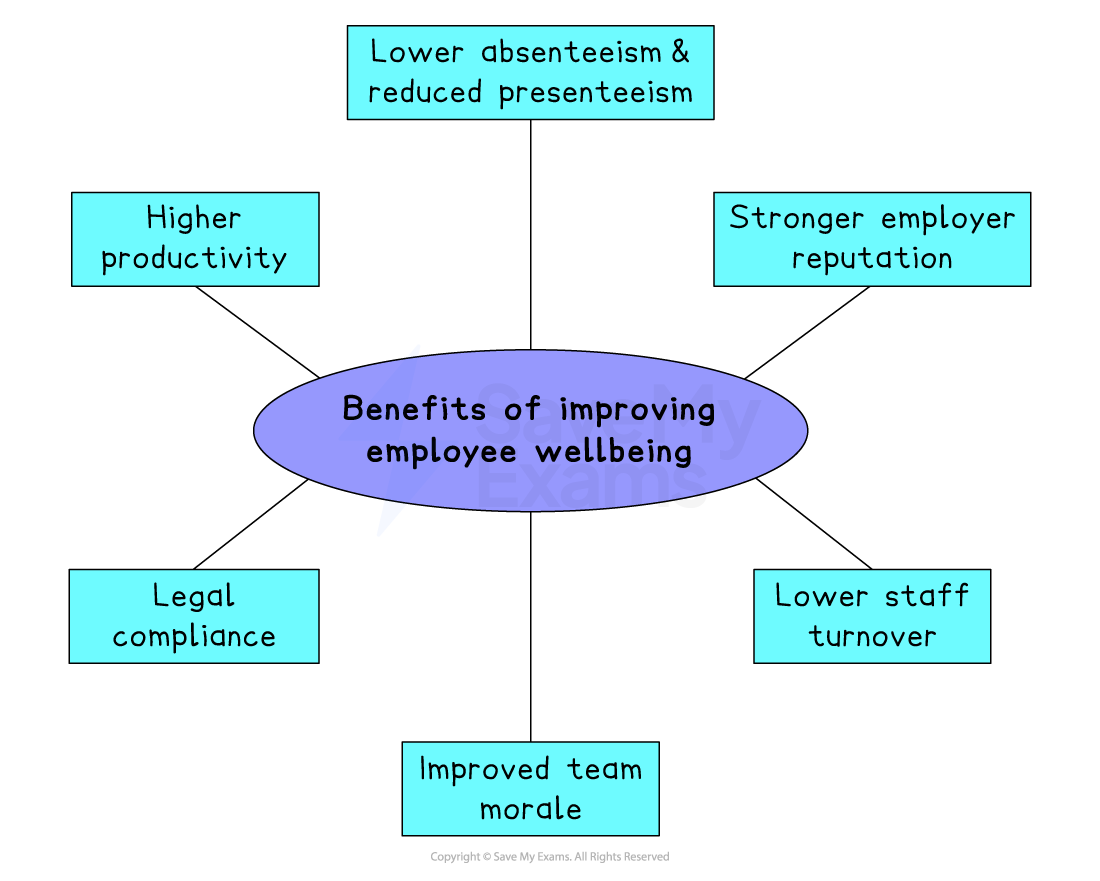
Higher productivity
Employees who are physically and mentally well are more focused, make fewer errors and perform better over time
Lower absenteeism and reduced presenteeism
Good wellbeing reduces the number of sick days taken, maintaining high output and reducing pressure on colleagues
'Presenteeism' is where employees are physically at work but not performing effectively due to stress, illness or burnout
Wellbeing initiatives reduce its impact
Lower staff turnover
Employees who feel genuinely supported are more likely to remain with the business, reducing the costs of recruitment and training
Stronger employer reputation
Businesses known for looking after their people attract higher-quality job applicants and build a long-term competitive advantage in the labour market
Improved team morale
A positive wellbeing culture creates a supportive, collaborative working environment that benefits all employees
Legal compliance
Employers have a duty of care under UK health and safety legislation
Proactive wellbeing management reduces the risk of legal claims and fines
Challenges of improving employee wellbeing
Challenge | Explanation |
|---|---|
Cost |
|
Measuring impact |
|
Stigma |
|
Individual differences |
|
Manager capability |
|
Wellbeing washing |
|
Remote and hybrid working |
|
Ways to improve employee wellbeing
Physical and mental health support services
Businesses can provide dedicated services to support employees' physical and mental health, either directly or through third-party providers
Examples
Employee Assistance Programmes (EAPs) offer confidential counselling
Private health insurance
Subsidised gym membership
Mental health first aiders
Occupational health referrals
Advantages of physical and mental health support services
Directly addresses the causes of employee absence by providing early support before issues become serious
Visible mental health provision reduces stigma and encourages employees to seek help
Demonstrates genuine commitment to employee welfare, improving trust and loyalty
Can reduce long-term costs by preventing minor health issues from escalating
Disadvantages of physical and mental health support services
Can be expensive to provide, particularly for smaller businesses
Services are often underused
Employees may not know they exist or may feel reluctant to access them
Difficult to measure the direct impact on business performance
Can become a tick-box exercise if not supported by a genuinely healthy workplace culture
Example
Barclays Bank launched its "This is Me" campaign to encourage mental health at work
The initiative included training managers to hold wellbeing conversations, introducing mental health first aiders across the business and creating a culture where discussing mental health was openly encouraged
Barclays reported a significant reduction in mental health-related absence and an improvement in engagement scores following the programme
Inclusive work environment
An inclusive work environment is one where all employees feel valued, respected and able to contribute fully, regardless of their background, identity or personal characteristics
Examples
Diversity and inclusion policies
Zero-tolerance approaches to discrimination and harassment
Accessible facilities for employees with disabilities
Inclusive leadership training
Flexible policies accommodating different religious or cultural practices
Advantages of an inclusive work environment
Improves the wellbeing of employees who might otherwise feel excluded, undervalued or unsafe
Reduces the risk of discrimination claims and legal and reputational damage
Broadens the range of perspectives within the workforce, improving creativity and better decision-making
Strengthens an employer's reputation, making the business more attractive to a wider pool of candidates
Disadvantages of an inclusive work environment
Requires genuine cultural change
Policies alone do not create inclusion — attitudes and behaviours must also change
Difficult to implement consistently across large or geographically dispersed organisations
Requires ongoing investment in training and leadership commitment
Progress can be slow and hard to measure
Example
Microsoft runs one of the most widely recognised disability inclusion programmes in the global technology sector
The business has adapted its recruitment process to support neurodivergent candidates, trained hiring managers in inclusive interview techniques and introduced assistive technology tools across its offices
It has also set measurable targets for disability inclusion at all levels of the organisation
Employee voice
Employee voice is where employees can express their views, ideas and concerns to management, giving them a meaningful say in decisions that affect their working lives
Examples
Staff surveys
Suggestion schemes
Works councils
Trade union representation
Employee forums
Open-door policies
Advantages of employee voice
Makes employees feel valued and respected, improving their sense of belonging and commitment
Shows up problems and ideas that management may not otherwise hear, improving the quality of decisions
Identifies wellbeing issues early, before they escalate into more serious problems
Reduces the risk of industrial disputes by giving employees a legitimate outlet for concerns
Disadvantages of employee voice
Only effective if management genuinely listens and acts
Unaddressed feedback can increase frustration rather than reduce it
Collecting, analysing and responding to employee input takes time
Risk of becoming a box-ticking exercise if employees feel their views are sought but ignored
Some employees may not feel confident expressing critical views, particularly in organisations without strong psychological safety
Example
Partners (employees) at the John Lewis Partnership elect representatives to its Partnership Council, which has influence over business decisions and is an opportunity to question senior management directly
Partners also elect representatives to the board of directors, giving employees a real stake in how the business is run
Flexible working
Flexible working includes arrangements that give employees greater control over when, where and how they work, including remote working, hybrid working, flexitime, compressed hours and part-time contracts
The right to request flexible working from the first day of employment took effect in April 2024 (previously employees needed 26 weeks' service)
From a wellbeing perspective, flexible working is particularly valuable
It allows employees to manage work around personal and family commitments, reducing stress and improving work-life balance
Advantages of flexible working
Reduces stress and the risk of burnout by giving employees greater control over their working schedule
Supports employees with caring responsibilities, health conditions or disabilities who may not be able to work standard hours
Reduces commuting time and cost, which can significantly improve day-to-day quality of life
Reduces presenteeism
Employees who feel in control of their time are more likely to be genuinely productive when they are working
Disadvantages of flexible working
Not all roles can be performed flexibly
Manufacturing, healthcare and retail roles typically require physical presence at set times
Can create resentment among employees in roles that do not allow flexibility
Harder for managers to monitor performance and maintain team cohesion
Can blur the boundary between work and personal life, increasing the risk of employees overworking
Example
Aviva, the UK insurance company, introduced a flexible working policy allowing all employees to request any working pattern from their first day
The chief executive described it as a way to attract the widest possible talent pool and support employee wellbeing
Early results showed a measurable improvement in employee satisfaction scores and a reduction in employee turnover among staff who adopted flexible arrangements
Examiner Tips and Tricks
Be careful to distinguish between genuine wellbeing strategies and superficial ones. In exam answers, a business that offers free fruit or gym discounts without addressing workload, management style or workplace culture is unlikely to see improvements in wellbeing outcomes. The strongest answers will recognise that wellbeing is deeply connected to how a business is managed day-to-day – not simply the perks it provides
Case Study
Broadlands Arable Ltd

Broadlands Arable Ltd is a family-owned farming business in Lincolnshire, employing 45 full-time staff and up to 80 seasonal workers during harvest periods.
Like many agricultural businesses, Broadlands faced significant wellbeing challenges: physically demanding work, long hours during peak seasons and geographic isolation contributed to high stress levels and above-average absence rates among permanent staff.
In 2022, the business joined with a rural mental health charity to introduce an employee assistance programme tailored to agricultural workers. Six permanent employees were trained as mental health first aiders, and monthly team meetings gave all staff – including seasonal workers – an opportunity to raise concerns with management.
Broadlands also introduced flexible working outside harvest periods, allowing permanent workers to compress their hours and take extended breaks during quieter months.
Within 18 months, reported stress levels fell and staff retention among permanent staff improved from 71% to 84%.
Wellbeing strategies in the primary sector must account for the specific pressures of physical, seasonal and geographically isolated working environments, challenges that standard wellbeing programmes are rarely designed to address

Unlock more, it's free!
Join the 100,000+ Students that ❤️ Save My Exams
the (exam) results speak for themselves:

Was this revision note helpful?
