Resistance to and Management of Change (AQA A Level Business): Revision Note
Syllabus Edition
First teaching 2026
First exams 2028
Exam code: 7132

What is resistance to change?
Resistance to change is the reluctance or refusal of employees, managers or other stakeholders to accept, support or engage with a change a business is trying to introduce
Resistance to change is a natural human response to uncertainty
It can occur even when a proposed change would genuinely benefit the business and the people affected by it
If left unmanaged, resistance can significantly slow down, weaken or derail the implementation of a well-planned strategy
Resistance most commonly comes from employees
Employees are usually most directly affected by day-to-day changes to their role, workload or working practices
Active and passive resistance
Examples of active resistance include
Openly opposing a decision
Deliberately obstructing its implementation
Taking industrial action
Examples of passive resistance include
Reduced effort
Disengagement
Quietly continuing to work in the old way
Kotter and Schlesinger's four reasons for resistance to change
Kotter and Schlesinger identified four reasons why workers resist change
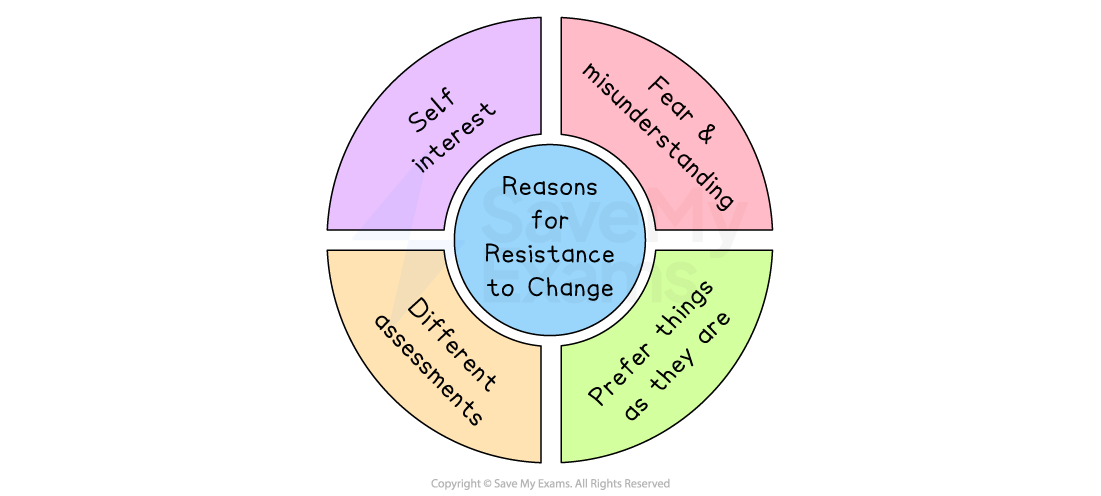
The four reasons
Self-interest
People worry that change could threaten their job, status or pay.
It’s natural for employees to protect what they value most.
If staff feel little loyalty, they’ll put their own needs first
Fear and misunderstanding
Employees may not know why change is needed or have the wrong facts.
Without a clear reason, it’s easy to believe that everything’s fine as it is
Sometimes people convince themselves the old way works better than it actually does
Different assessments
Not everyone agrees on what the problem is or how to fix it
Some may back a completely different solution
This isn’t just self-interest - it is genuine debate over what’s best for the business
Prefer things as they are
Many prefer routine and feel uneasy about new ways of working
Past bad experiences can make people extra wary
If it feels risky, staff tend to resist even small changes
Overcoming resistance to change
Kotter and Schlesinger also suggested a range of methods that can be used to overcome resistance to change
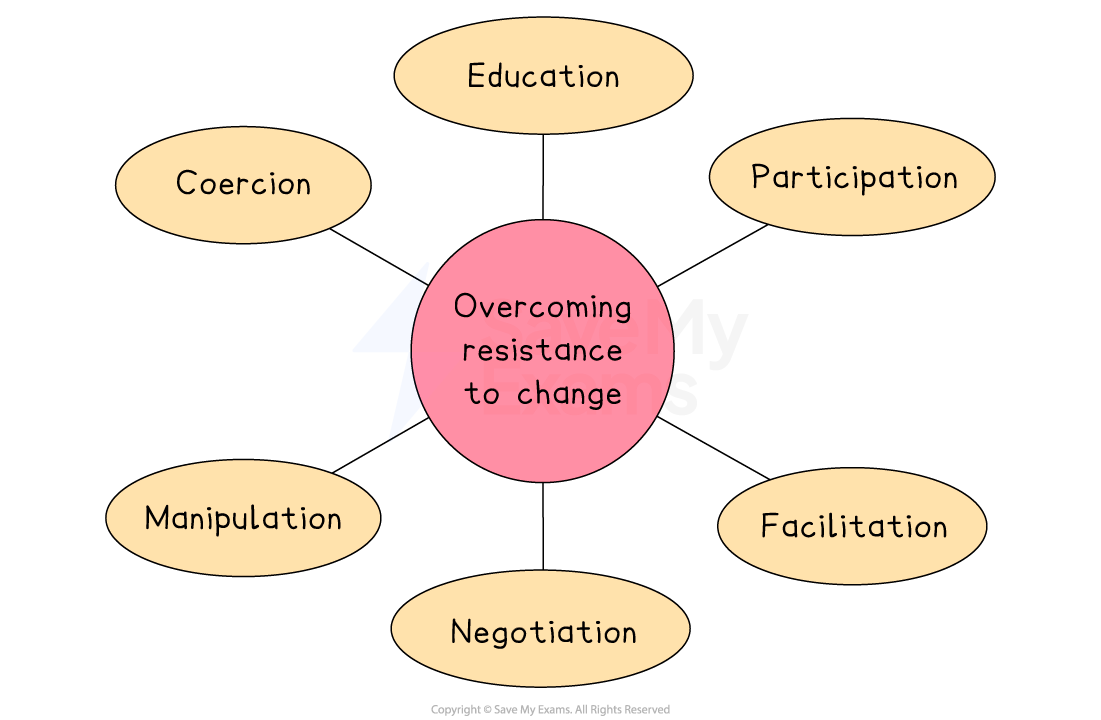
Education and communication
Useful when people lack facts or hold incorrect views about the change
Sharing clear information explains why the change is needed
Convincing everyone may take significant time and discussion
Participation and involvement
Inviting staff to help design and implement the change builds commitment
When people feel ownership of the process, they’re more likely to support and drive it forward
Facilitation and support
Anxiety about new ways of working can increase resistance
Providing training, resources and coaching helps employees cope and accept the change
Negotiation and agreement
Bargain with resistors, offering compromises to gain their backing
This often results in a slightly adjusted plan that still meets core objectives.
Manipulation and co-option
Offering perks or roles to influential individuals encourages them to champion the change
Explicit and implicit coercion
As a last resort, change may be enforced through formal orders or implied threats.
Staff comply because they have no real choice.
If the new approach proves successful, people may come to accept it over time
The importance of managing change effectively
Managing change effectively helps a business achieve its intended benefits more quickly
Benefits of effectively managed change
Achieves the intended benefits of the change faster and more fully
Maintains staff morale and engagement throughout the transition, rather than only after it is complete
Protects the business's reputation with customers, investors and the wider public
Builds a more resilient, adaptable organisational culture
This often makes future change easier to manage as well
Example
IBM is widely regarded as having successfully managed several major strategic changes over its long history, shifting from a hardware-focused business towards software and consulting services
It achieved this by investing heavily in staff retraining and engaging in clear internal communication throughout each transition
Risks of poorly managed change
Increased resistance
Employees who feel a change is being forced on them without explanation or consultation are far more likely to resist it
Lost productivity during the transition
Uncertainty and disruption can reduce output and quality while a change is being implemented
Damaged trust and morale
Handling change badly can harm the relationship between management and staff long after the change itself is complete
Reputational damage
Change that is handled insensitively and becomes public can damage a business's reputation with customers and the wider public
Wasted resources
Money, time and management effort invested in a change can be lost if implementation fails, stalls or has to be reversed
Loss of competitive advantage
A business that manages change badly risks falling behind rivals who adapt more smoothly and quickly
Example
Royal Mail's attempts to change working practices in recent years have instead faced repeated strikes and other forms of industrial action
This was blamed in part on poor consultation and communication with staff during the process
Lewin's Force Field analysis
Force field analysis involves managers identifying the driving and restraining forces that surround a strategic change decision
Once identified these forces can be analysed to determine whether a decision should go ahead
Driving forces
Driving forces are factors that could justify that strategic change is needed
Internal driving forces may include:
Outdated machinery or product lines
Declining team morale
The need to increase profitability
External driving forces may include:
A volatile market
Disruptive technology, e.g. AI
Changing demographic trends
Restraining forces
Restraining forces are factors that could prevent or limit change
Internal restraining forces may include:
Fear of the unknown
The existing organisational structure
"That's not how things are done here" attitudes
External restraining forces may include:
Existing commitments to partner organisations
Government legislation
Obligations towards customers
Weighting the forces
Driving forces and restraining forces are weighted from 1 to 5 in terms of their relative importance
A value of 5 is most important and 1 least important
A simple force field analysis

Analysis of the force field
Four driving forces justify a decision for change
Their weightings are 5, 4, 3 and 2
The total value of these driving forces is 5 + 4 + 3 + 2 = 14
Four restraining forces prevent or limit change
Their weightings are 4, 3, 2 and 1
The total value of these restraining forces is 4 + 3 + 2 + 1 = 10
The relative weight of driving forces is greater than the relative weight of restraining forces
There is a good chance that this decision would be successful
To maximise the chance of success, driving forces could be further strengthened or restraining forces weakened/eliminated
Worked Example
After several years of poor financial performance, the owners of Lujosa Ltd. are considering the relocation of their factory from Scotland to Indonesia.
Department managers have provided feedback on the idea. They have identified the following driving and restraining forces.
Force | Description | Weighting |
|---|---|---|
Driving |
| 5 |
| 3 | |
| 1 | |
Restraining |
| 4 |
| 2 | |
| 4 |
Use force field analysis to analyse whether Lujosa Ltd's owners should go ahead with the decision
Construction of Lujosa's force field analysis
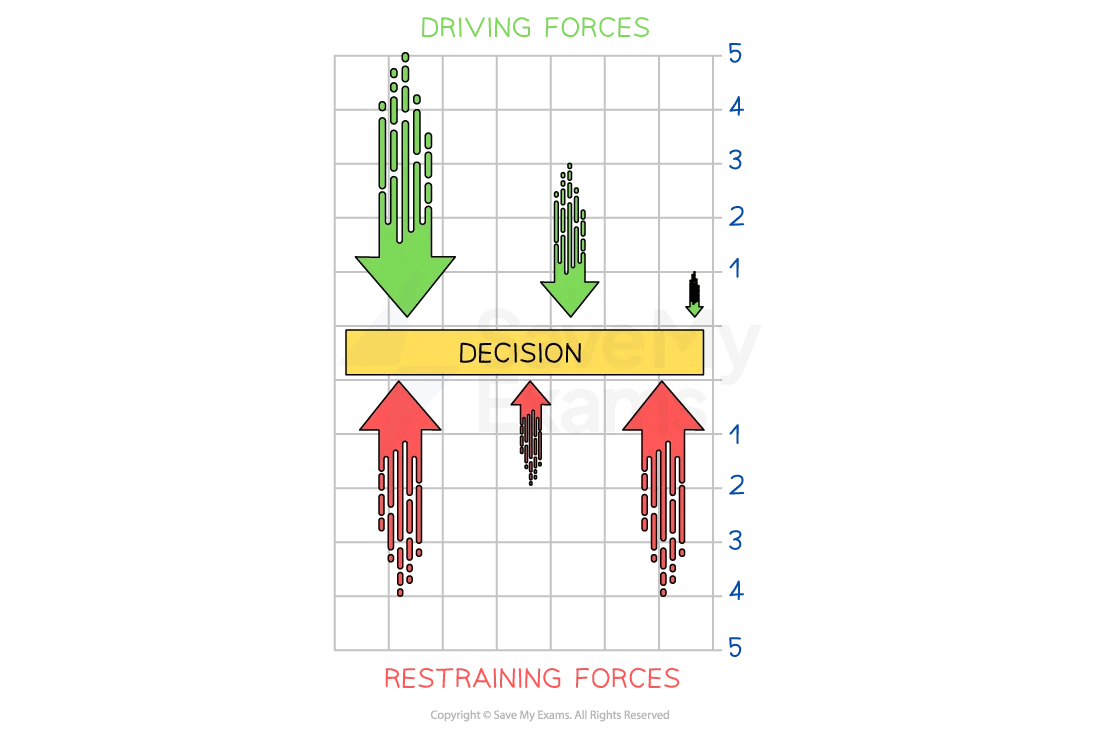
Relative weight of driving forces
5 + 3 + 1 = 9
Relative weight of restraining forces
4 + 2 + 4 = 10
Comparison of the relative weights of driving and restraining forces
The relative weight of restraining forces (10) is greater than the relative weight of driving forces (9)
There is little chance that this decision would be successful and should be abandoned
Evaluating the use of force field analysis
Force field analysis is a valuable technique for assessing the factors influencing a situation
It is most effective when used alongside other decision-making tools
This helps ensure a comprehensive understanding of the situation
Strengths of force field analysis
Strength | Explanation |
|---|---|
Simple and visual |
|
Comprehensive |
|
Identifies most critical factors |
|
Assists decision-making |
|
Helps communication |
|
Weaknesses of force field analysis
Force field analysis has some significant limitations
Particularly in situations where precision is required
Weakness | Explanation |
|---|---|
Subjective |
|
Lacks quantitative data |
|
Snapshot |
|
Doesn't provide solutions |
|
Limited in complex situations |
|

Unlock more, it's free!
Join the 100,000+ Students that ❤️ Save My Exams
the (exam) results speak for themselves:

Was this revision note helpful?
