Answering 9-Mark Questions (AQA A Level Business): Revision Note
Syllabus Edition
First teaching 2026
First exams 2028
Exam code: 7132

How do I answer an AQA A Level Business 9-mark question?
Nine-mark questions appear in all three exam papers
Each paper has four 9-mark questions: the third and fourth questions after each case study
That makes them worth 36 of the 90 marks on each paper, more than any other question type
The command word is always Assess, e.g.:
Assess whether increasing spending on X would lead to higher profits
Assess how important Y is likely to be…
Two marks are available for knowledge (AO1), two for application (AO2), two for analysis (AO3) and three for evaluation (AO4)
Evaluation is worth the most marks, so your judgement matters
The question asks you to weigh up the case for and against one issue and then reach a judgement
E.g. whether to raise a price, launch a product or spend more on something
You only need to make a decision on this issue
You do not need to suggest alternatives
Some nine-mark questions also ask you to carry out a calculation and use it in your answer
These are covered in the second part of this page
Aim to spend about 10 minutes on a 9-mark question, writing roughly 230–360 words
How 9-mark questions are marked
Nine-mark questions are marked using three levels
Level | Marks | What the examiner is looking for |
|---|---|---|
3 | 7–9 | Good application to the context, logical chains of reasoning, and evaluation that weighs up the arguments and reaches a convincing judgement that fully answers the question |
2 | 4–6 | Good application and basic chains of reasoning, with some supported evaluation, but the arguments may not be weighed up against each other |
1 | 1–3 | Some knowledge and an attempt to use the context, but little analysis and a judgement that is just asserted |
0 | 0 | Nothing creditworthy |
There are three mark caps to be aware of:
An answer that shows only knowledge can score a maximum of 2 marks
An answer with knowledge and analysis but no use of the case study and no judgement can score a maximum of 4 marks
An answer with no evaluation can score a maximum of 6 marks
To reach Level 3, the mark scheme says there must be a clear answer to the question that weighs up an argument and a counterargument
Suggested structure
AQA does not require a set structure
You could argue for and against and then conclude, evaluate as you go, or even open with your judgement and then support it
The structure below is a reliable way to make sure you cover every assessment objective
Example question
Case Study
Kettle & Crumb Ltd
The business runs a busy bakery café in the centre of York. Around 40% of its customers are tourists. Most of the rest are local office workers who visit on weekdays, many of whom use a loyalty card. Over the past year, the cost of butter and flour has risen by 18%. A branch of a national coffee chain, 200 metres away, charges around 15% less for similar drinks and pastries. The owners are considering raising all prices by 10%.
Assess whether raising prices by 10% would increase profit for Kettle & Crumb Ltd.
[9 marks]
Key business skills are highlighted

Step 1
Start off by defining the key term in the question, or the business concept that will drive your answer
This secures knowledge (AO1) marks and gives your answer a clear focus
Keep it brief - there are only 2 AO1 marks

Step 2
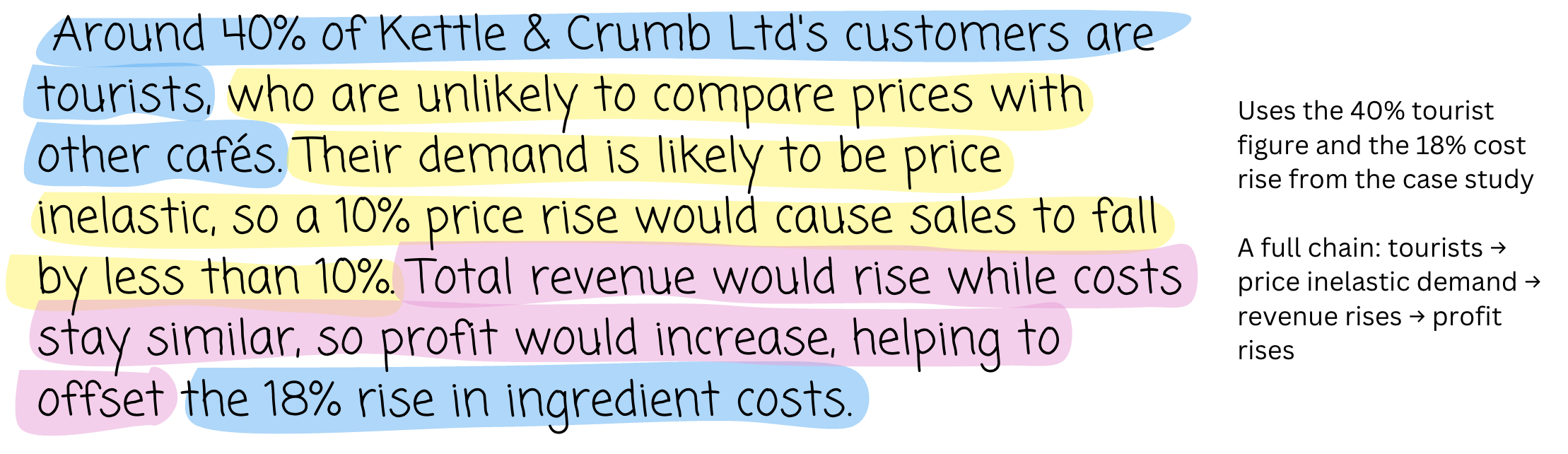
Make your first argument, supporting one side of the question
Support it with relevant context from the case study
Develop a chain of reasoning using the X→Y→Z approach
E.g. X leads to Y, which results in Z
Make sure your chain ends at the exact thing the question asks about (here, profit, not just sales or revenue)
Step 3
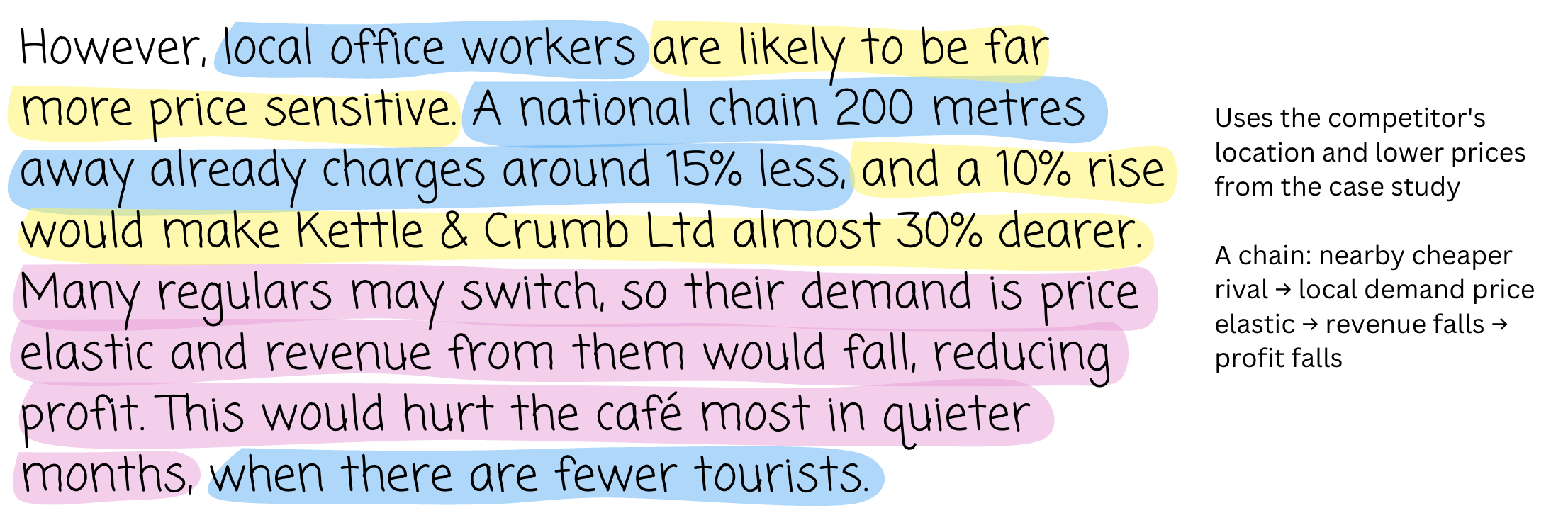
Now show balance by making a counterargument
Make a logical, relevant counterpoint that also links to the question
Use a different piece of context from the case study
A further chain of X→Y→Z reasoning is required
Step 4
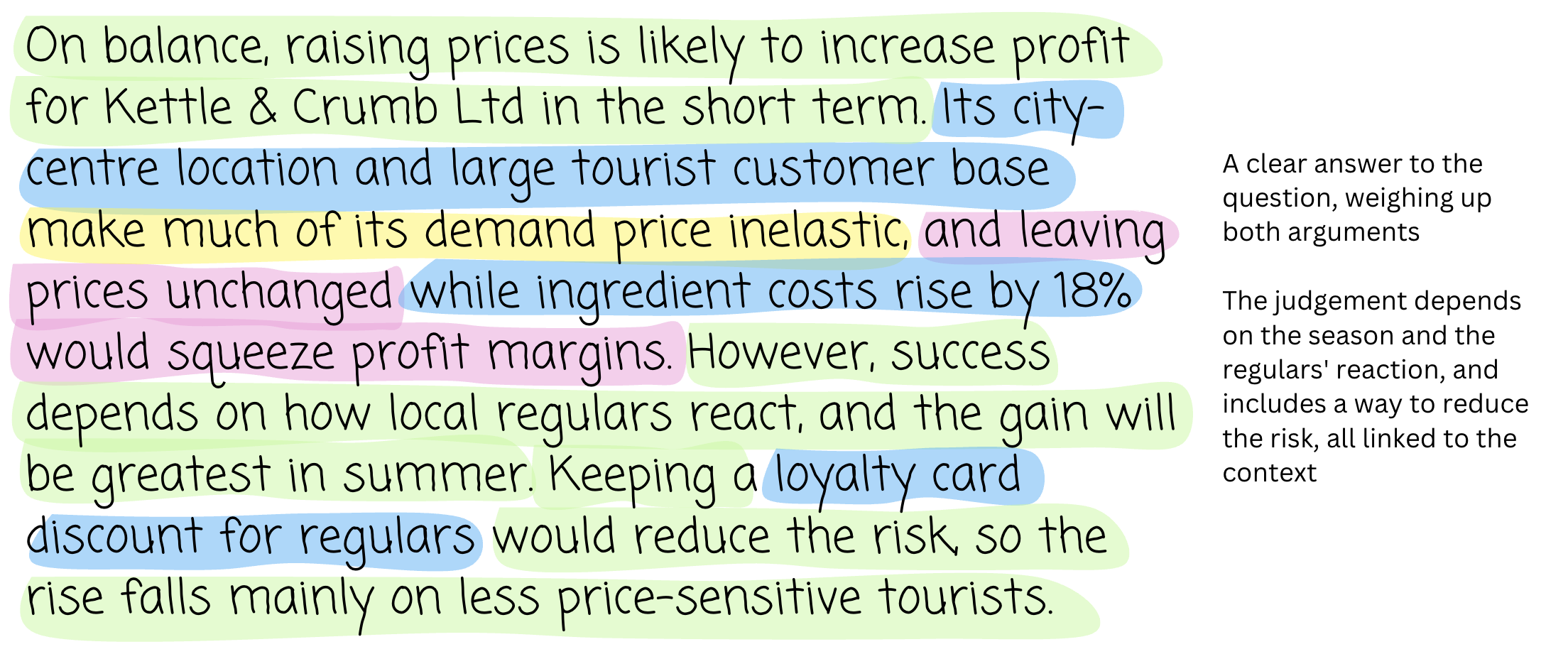
In your final paragraph, make a supported judgement
Give a clear answer to the question: yes, no, or yes in some circumstances
Weigh up your two arguments. Which is stronger for this business, and why?
Explain what your judgement depends on, using the case study
With 3 marks for evaluation, this should be the most developed part of your answer
A judgement that simply repeats your earlier points, or is not supported, is not creditworthy evaluation
Common mistakes
Leaving the judgement out
Without evaluation, the maximum is 6 marks
Always finish with a clear answer to the question
Sitting on the fence
"It depends" is only creditworthy if you explain what it depends on and still give an answer
Drifting into a different issue
A 9-mark question asks you to judge one issue
You do not need to suggest alternative strategies
Examiner Tips and Tricks
Decide your answer before you start writing. Jot "yes", "no" or "only if…" in your plan, next to the one fact from the case study that tips the balance. Each paragraph can then build towards that judgement instead of drifting.
How do I answer a 9-mark question with a calculation?
Every paper includes questions with a quantitative focus, where you must carry out a calculation and use the result in your answer
Papers 1 and 2 have two of these, and Paper 3 has one
Each is worth either 9 or 15 marks
The question still uses the command word Assess, and it tells you which calculation to carry out
The calculation is not a separate task
It is the evidence for your argument and your judgement
How the marks are split
Six of the 9 marks are for quantitative skills:
Skill | What you need to do | Marks |
|---|---|---|
AO1 Knowledge | Show the correct formula and select the right figures | 2 |
AO2 Application | Carry out the calculation correctly | 2 |
AO3 Analysis | Interpret the result and use it in an argument | 1 |
AO4 Evaluation | Use the result to support your judgement | 1 |
The other 3 marks (AO3 1, AO4 2) are for wider analysis and evaluation linked to the calculation
E.g. comparing your result with other information in the case study, or considering the limitations of the data
Three rules from the mark scheme are worth knowing:
A correct calculation on its own, with no analysis or evaluation, scores 4 marks
An answer based only on the calculation, without using other information from the case study, can score a maximum of 6 marks
The Own Figure Rule always applies
If you make a mistake in the calculation but interpret your wrong answer correctly, you can still earn analysis and evaluation marks
Suggested structure
Example question
Case Study
Rowan Vets Ltd
The business operates nine veterinary practices in Shropshire. In 2026 it opened its ninth practice and increased its workforce from 170 staff on 1 January to 190 staff on 31 December. During 2026, 43 staff left the business. Of these, 18 left within six months of joining. The employee turnover for veterinary practices across the sector is 15%. Rowan Vets Ltd's employee turnover in 2025 was 31.0%. Two of its practices are currently short of vets, and it costs around £8,000 to recruit each new vet.
Assess whether Rowan Vets Ltd has a serious problem with staff retention.
Calculate the employee turnover for Rowan Vets Ltd in 2026 to support your answer. Give your answer to one decimal place.
[9 marks]
Key business skills are highlighted
Step 1
Write out the formula and show which figures you are using
This earns AO1 marks even if you later make an arithmetic error
Check carefully that you have picked the right figures. Wrong figures mean no credit for the calculation

Step 2
Carry out the calculation, showing your working
Give your answer to the number of decimal places the question asks for
Include the correct units (e.g. %, £, times). An answer with the wrong units is treated as inaccurate

Step 3
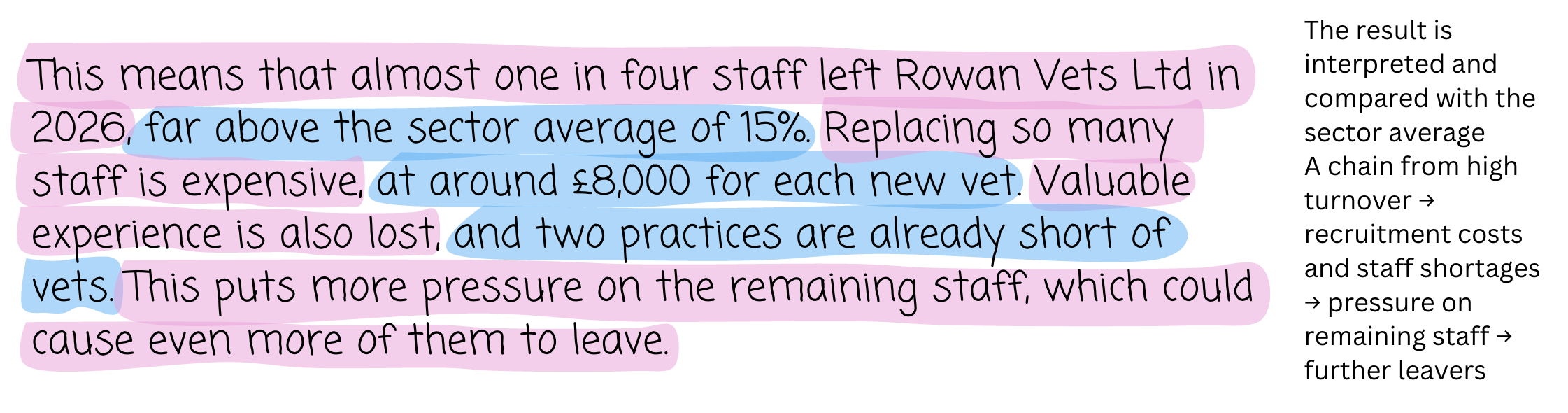
Interpret your result and use it in an argument
Say what the figure means, then compare it with a benchmark in the case study, such as an industry average, a previous year or a target
Develop an X→Y→Z chain that links the figure to the question
Step 4
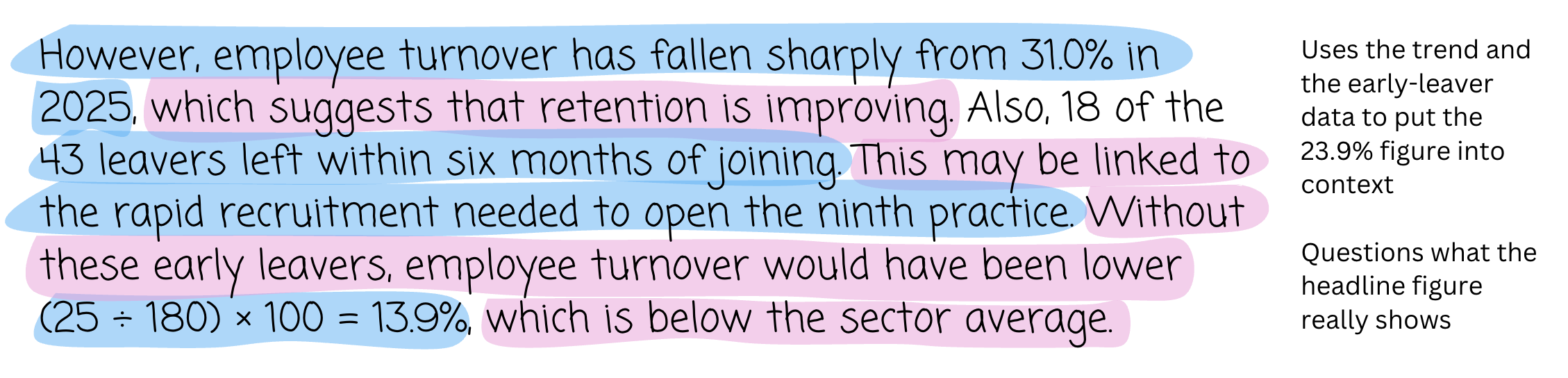
Now show balance by using other information in the case study to challenge or add to what the figure suggests
Is the trend improving or getting worse?
Is there a one-off reason for the result?
Does the figure hide anything? Considering the limitations of the data is a strong form of evaluation
Step 5
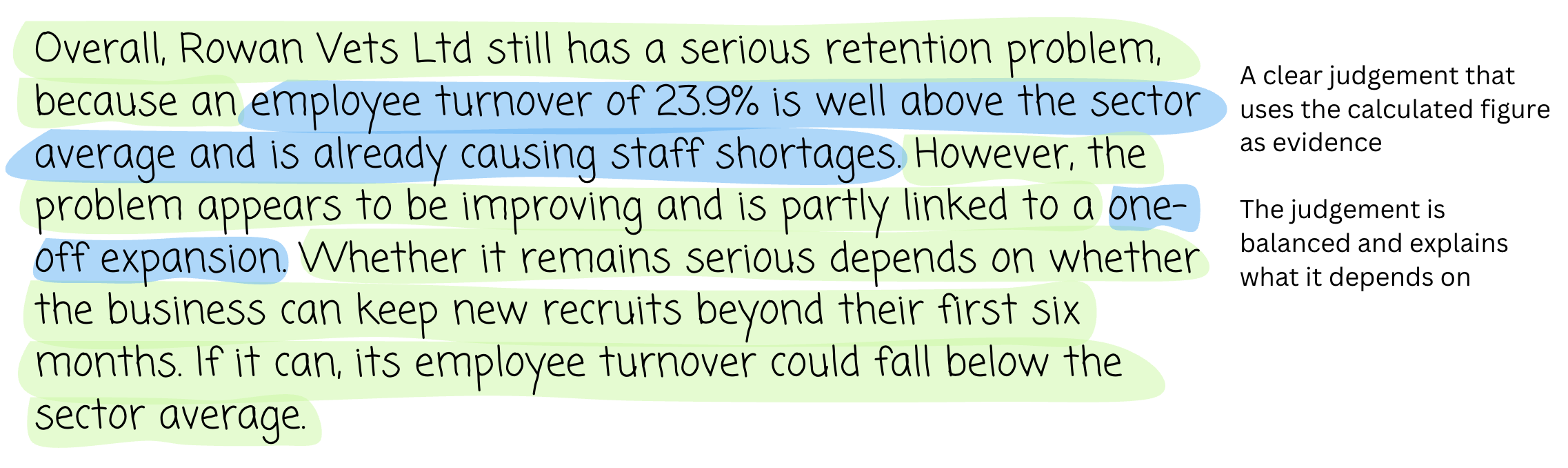
Make a supported judgement that uses your calculated figure
Give a clear answer to the question
Weigh up what the calculation shows against the wider information
Explain what your judgement depends on
Common mistakes
Calculating and then moving on
In a calculation question, a correct answer alone is worth 4 marks
The rest of the marks come from using the figure
Not showing working
If your final answer is wrong, the examiner can only credit your formula and figure selection if they can see them
Rounding too early
Keep full figures in your calculator and only round your final answer to the number of decimal places asked for
Examiner Tips and Tricks
In calculation questions, compare your figure with something else in the case study. A figure on its own, such as 23.9%, tells the examiner very little until you show whether it is high or low for this business.

Unlock more, it's free!
Join the 100,000+ Students that ❤️ Save My Exams
the (exam) results speak for themselves:

Was this revision note helpful?
