Answering 15-Mark Questions (AQA A Level Business): Revision Note
Syllabus Edition
First teaching 2026
First exams 2028
Exam code: 7132

How do I answer an AQA A Level Business 15-mark question?
Fifteen-mark questions appear in all three exam papers
Each paper has two 15-mark questions: the final question after each case study
That makes them worth 30 of the 90 marks on each paper
The command word is always Evaluate
Three marks are available for knowledge (AO1), three for application (AO2), four for analysis (AO3) and five for evaluation (AO4)
Evaluation is worth a third of the marks, so a strong answer must reach a well-supported judgement
Every 15-mark question asks you to evaluate two courses of action and recommend one
There are two types:
Type | What the question gives you | Example question wording |
|---|---|---|
Decision making |
| Evaluate both suppliers and recommend which one would be the better choice… |
Problem solving |
| Evaluate two ways the business could reduce the risks it faces and recommend which one it should implement first. |
Some 15-mark questions also ask you to carry out a calculation and use it in your answer
Aim to spend about 18 minutes on a 15-mark question, writing roughly 330–460 words
How 15-mark questions are marked
Fifteen-mark questions are marked using five levels
Level | Marks | What the examiner is looking for |
|---|---|---|
5 | 13–15 |
|
4 | 10–12 |
|
3 | 7–9 |
|
2 | 4–6 |
|
1 | 1–3 |
|
0 | 0 |
|
There are three mark caps to be aware of:
An answer that shows only knowledge can score a maximum of 3 marks
An answer with knowledge and analysis but no use of the case study and no evaluation can score a maximum of 7 marks
An answer with no evaluation can score a maximum of 10 marks
The mark scheme states that there must be an overarching judgement to the question, supported by evaluation
If your judgement ignores one of the options, or ignores a counterargument you raised earlier, it is unlikely to reach the top level
Suggested structure
AQA does not require a set structure
You could evaluate each option in turn and then conclude, or make your recommendation clear from the start and then justify it
The structure below is a reliable approach for both question types
Example question
Case Study
Brightling Brewery Ltd is an independent brewer of alcohol-free craft beers in Kent. Most of its £2.4m annual revenue comes from selling to local cafés, restaurants and farm shops. It is currently operating at 92% capacity utilisation. The directors want to increase sales and are considering two options.
Option 1 is to supply a national supermarket chain, which would stock its alcohol-free beers in 300 stores. The supermarket would pay a wholesale price 25% lower than its local customers pay.
Option 2 is to open a taproom at the brewery and expand its online shop, at a cost of £180,000. Online sales grew by 40% last year.
Evaluate both options and recommend which one Brightling Brewery Ltd should choose.
[15 marks]
Key business skills are highlighted

Step 1
Start off with a brief introduction that shows knowledge of the key concept behind the two options
This secures some knowledge (AO1) marks and helps you focus on what the options have in common and how they differ
One or two sentences is enough

Step 2
Make a strong argument for the first option
Support it with context from the case study
Develop a chain of reasoning using the X→Y→Z approach, ending at what the business wants to achieve

Step 3
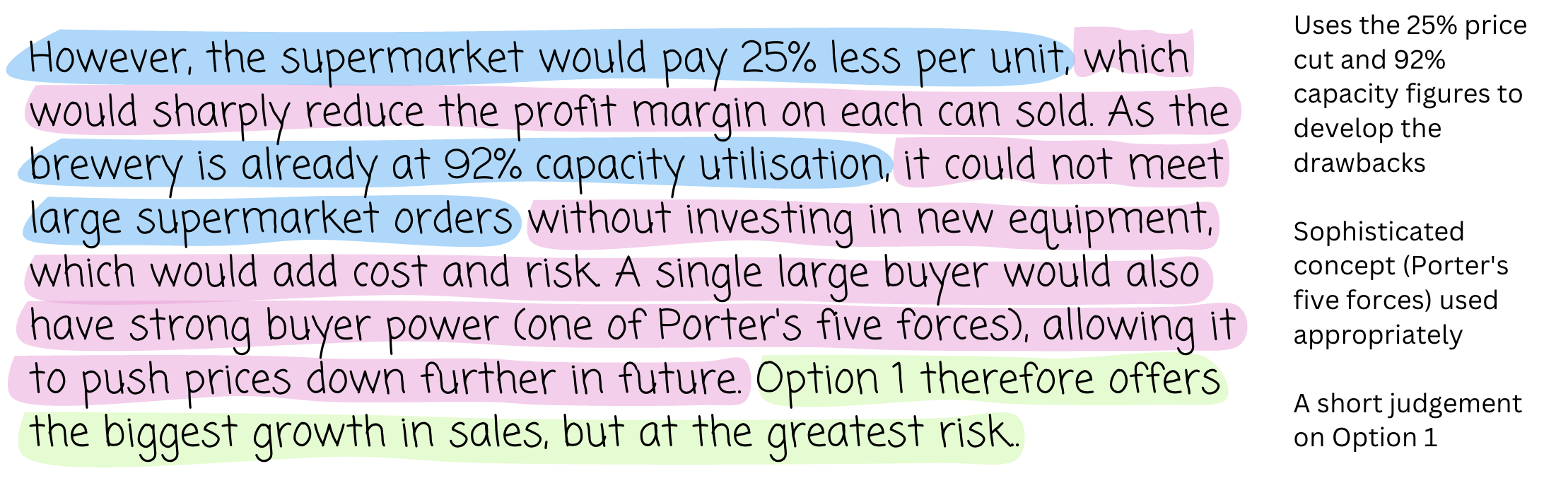
Show balance by making a counterargument for the first option
A further chain of X→Y→Z reasoning with context is required
Finish the paragraph with a short judgement on this option
Top-level answers show evaluation throughout, not just at the end
Where relevant, use a sophisticated concept: a theory, model or framework that is not the main focus of the question but strengthens your analysis
Step 4
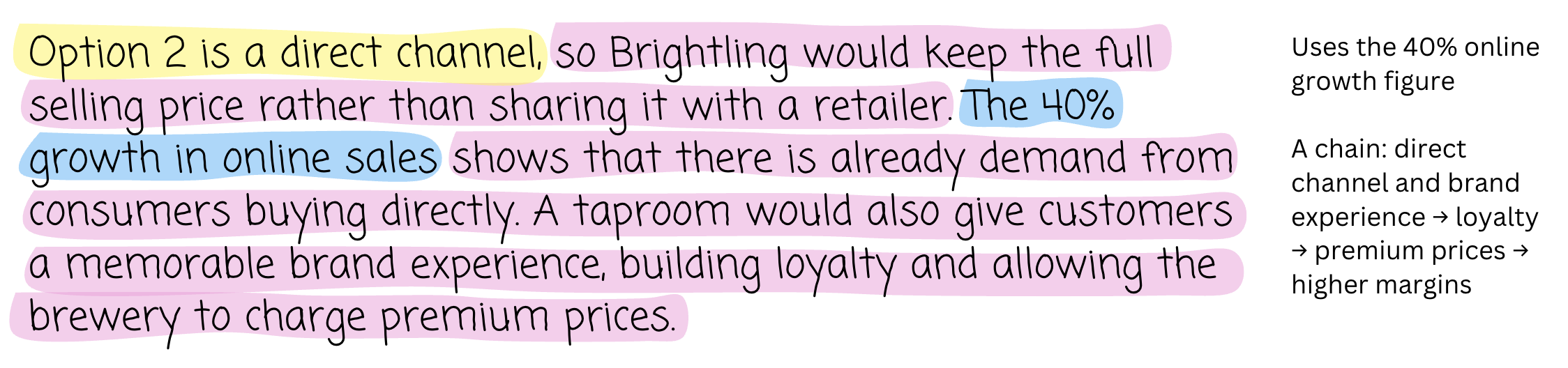
Now move on to the second option, making a strong argument in its favour with context and an X→Y→Z chain
Step 5
Show balance with a counterargument for the second option, again ending with a short judgement

Step 6
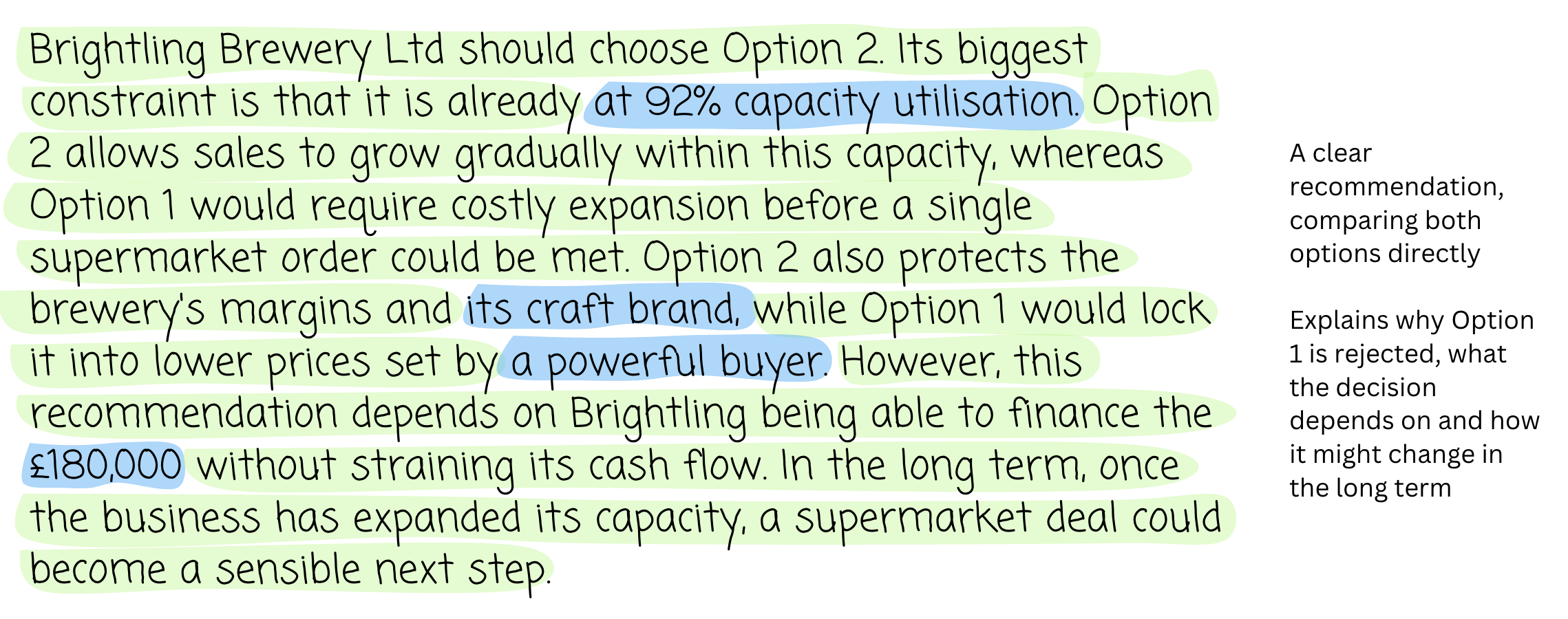
Finish with an overarching judgement. This should be the most developed section of your answer
Make a clear recommendation
Compare the options directly. Explain why your chosen option is better for this business and why the other one has been rejected
Explain what your recommendation depends on
Make sure your judgement deals with the counterarguments you raised earlier
Making your judgement stronger
Use the following checklist when planning your final paragraph:
Priorities: which option best meets the business's main objective or solves its most urgent problem?
Time: would your answer be different in the short term and the long term?
Depends on: what key factor would change your recommendation?
Challenge the data: is any of the information in the case study unreliable, out of date or based on a forecast?
Risk: which option is riskier, and can the business afford that risk?
Common mistakes
Analysing only one option in depth
Level 4 and Level 5 both require developed analysis of both options
Not making a recommendation
The question tells you to recommend one
With no evaluation at all, the maximum is 10 marks
A one-sided judgement
Explain why you rejected the other option, not just why you chose yours
Repeating earlier points in the conclusion
Your judgement should add something: a direct comparison, what it depends on, or the short-term and long-term view
Choosing options that do not fit the case study
In problem-solving questions, the relevance of your options to the business is part of what is assessed
How do I choose my own two options?
In a problem-solving 15-mark question, you choose the two options yourself
E.g. Evaluate two sources of external finance that the business could use and recommend which one it should choose
The examiner will consider how relevant your options are to the context, so choose carefully
Spend a minute planning before you write:
Pick options that clearly solve the problem in the question
Pick two options that are clearly different
Two very similar options make the comparison weak
Pick options that the case study gives you evidence for, both for and against
Pick options you can analyse confidently
A familiar option you can develop fully is better than an ambitious one you cannot explain
Example plan
Case Study
Brightling Brewery Ltd
Brightling Brewery Ltd, an alcohol-free craft brewer, is operating at 92% capacity utilisation
Evaluate two ways Brightling Brewery Ltd could increase its capacity and recommend which one it should implement first. [15 marks]
Option | Why it fits the context | Arguments for | Arguments against |
|---|---|---|---|
Add an evening shift | Demand peaks in summer, so extra capacity may only be needed for part of the year | Quick to introduce Uses existing equipment No large investment | Higher labour costs (overtime or new staff) Harder to supervise quality Staff may resist unsocial hours |
Buy new fermentation tanks | A permanent increase in capacity supports long-term growth | Lowers unit costs over time Allows future growth, e.g. supplying new customers | Large upfront cost Takes time to install Capacity may sit idle in winter |
These options work well because they are clearly different: one is short-term and flexible, the other long-term and costly
This makes it easier to write a strong judgement about which to implement first
How do I answer a 15-mark question with a calculation?
The question still uses Evaluate and tells you which calculation to carry out
E.g. Evaluate whether the business should launch in Region A or Region B. Calculate the return on investment in Region B to support your answer.
6 of the 15 marks are for quantitative skills, split in the same way as a 9-mark calculation question:
Skill | What you need to do | Marks |
|---|---|---|
AO1 Knowledge | Show the correct formula and select the right figures | 2 |
AO2 Application | Carry out the calculation correctly | 2 |
AO3 Analysis | Interpret the result and use it in an argument | 1 |
AO4 Evaluation | Use the result to support your judgement | 1 |
The other 9 marks (AO1 1, AO2 1, AO3 3, AO4 4) are for wider analysis and evaluation of both options
Three rules from the mark scheme are worth knowing:
A correct calculation with no analysis or evaluation scores 4 marks
An answer that does not use the calculation can score a maximum of 9 marks
The Own Figure Rule always applies
If you make a mistake in the calculation but interpret your answer correctly, you can still earn analysis and evaluation marks
However, if you select the wrong figures, the calculation itself earns no credit
Follow the same six steps as above, but build the calculation into the option it relates to, then use it again in your final judgement
Example question
Case Study
Brightling Brewery Ltd
The business is an independent brewer of alcohol-free craft beers in Kent. Most of its £2.4m annual revenue comes from selling to local cafés, restaurants and farm shops. It is currently operating at 92% capacity utilisation. The directors want to increase sales and are considering two options.
Option 1 is to supply a national supermarket chain, which would stock its alcohol-free beers in 300 stores. The supermarket would pay a wholesale price 25% lower than its local customers pay.
Option 2 is to open a taproom at the brewery and expand its online shop, at a cost of £180,000. Online sales grew by 40% last year.
The taproom would have annual fixed costs of £96,000. The average visitor would spend £14, and the variable cost per visitor would be £6. The directors forecast 15,000 visitors in the first year.
Evaluate both options and recommend which one Brightling Brewery Ltd should choose.
Calculate the break-even number of visitors per year for the taproom to support your answer.
[15 marks]
Key business skills are highlighted
Step 1
Start off with a brief introduction that shows knowledge of the key concept behind the two options
This secures some knowledge (AO1) marks and helps you focus on what the options have in common and how they differ
One or two sentences is enough
Step 2
Make a strong argument for the first option
Support it with context from the case study
Develop a chain of reasoning using the X→Y→Z approach, ending at what the business wants to achieve
Step 3
Show balance by making a counterargument for the first option
A further chain of X→Y→Z reasoning with context is required
Finish the paragraph with a short judgement on this option
Top-level answers show evaluation throughout, not just at the end
Where relevant, use a sophisticated concept: a theory, model or framework that is not the main focus of the question but strengthens your analysis
Step 4
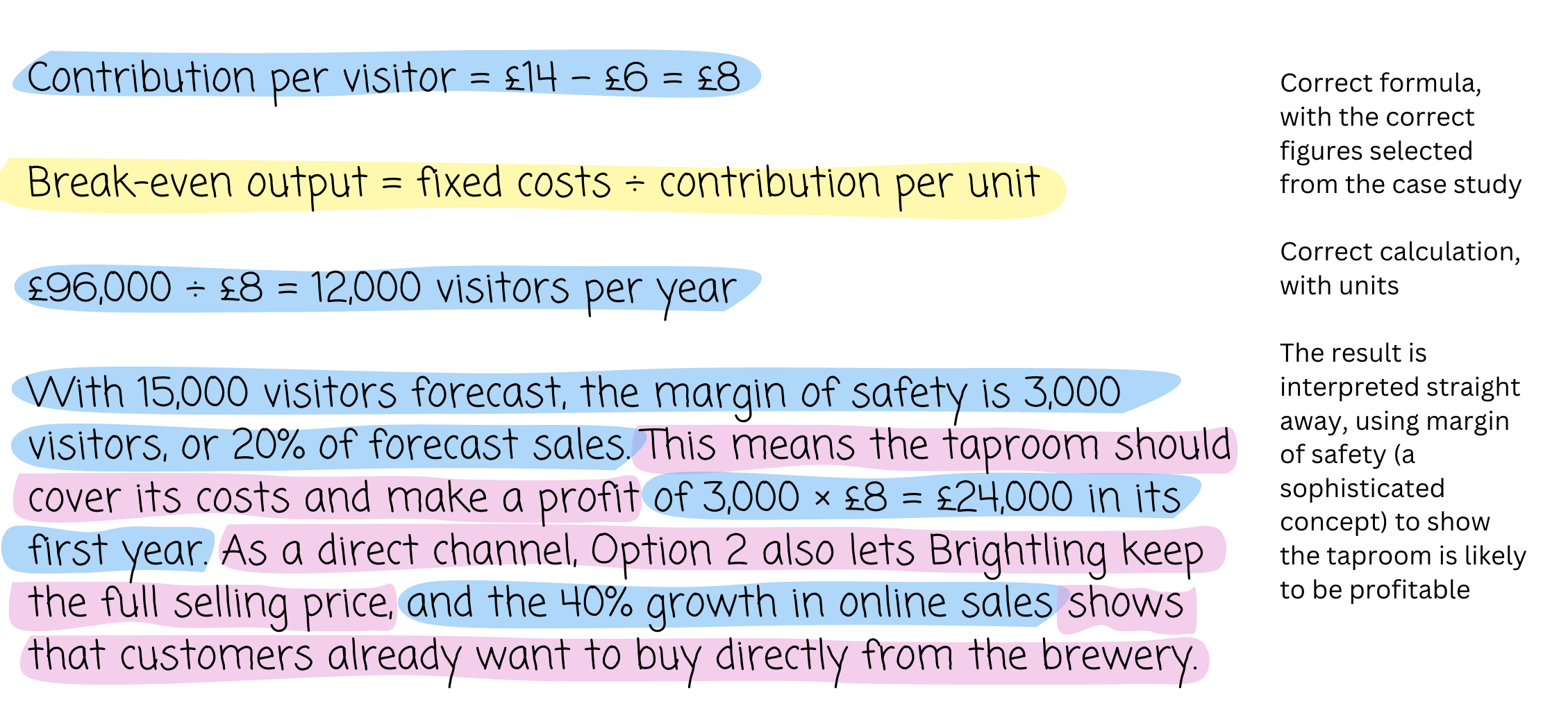
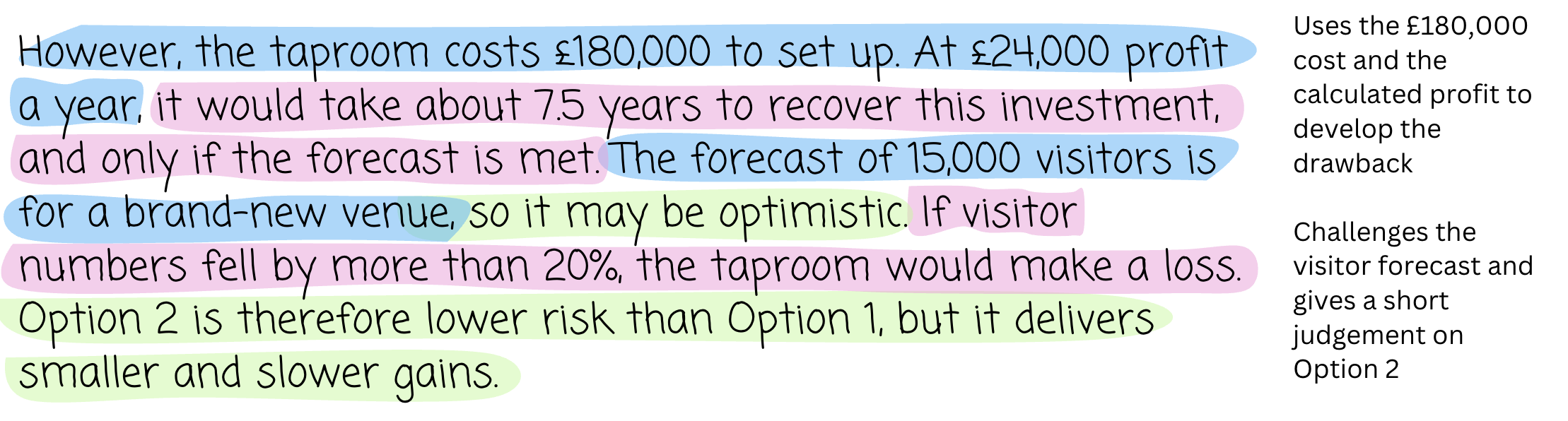
Move on to the second option and build the calculation into it
Write out the formula and show which figures you are using
Carry out the calculation, giving your answer with the correct units
Interpret the result straight away: what does it tell you about this option?
Step 5
Show balance with a counterargument for the second option
Where you can, challenge the figure you calculated. Is it based on a forecast or an assumption?
End the paragraph with a short judgement on this option
Step 6
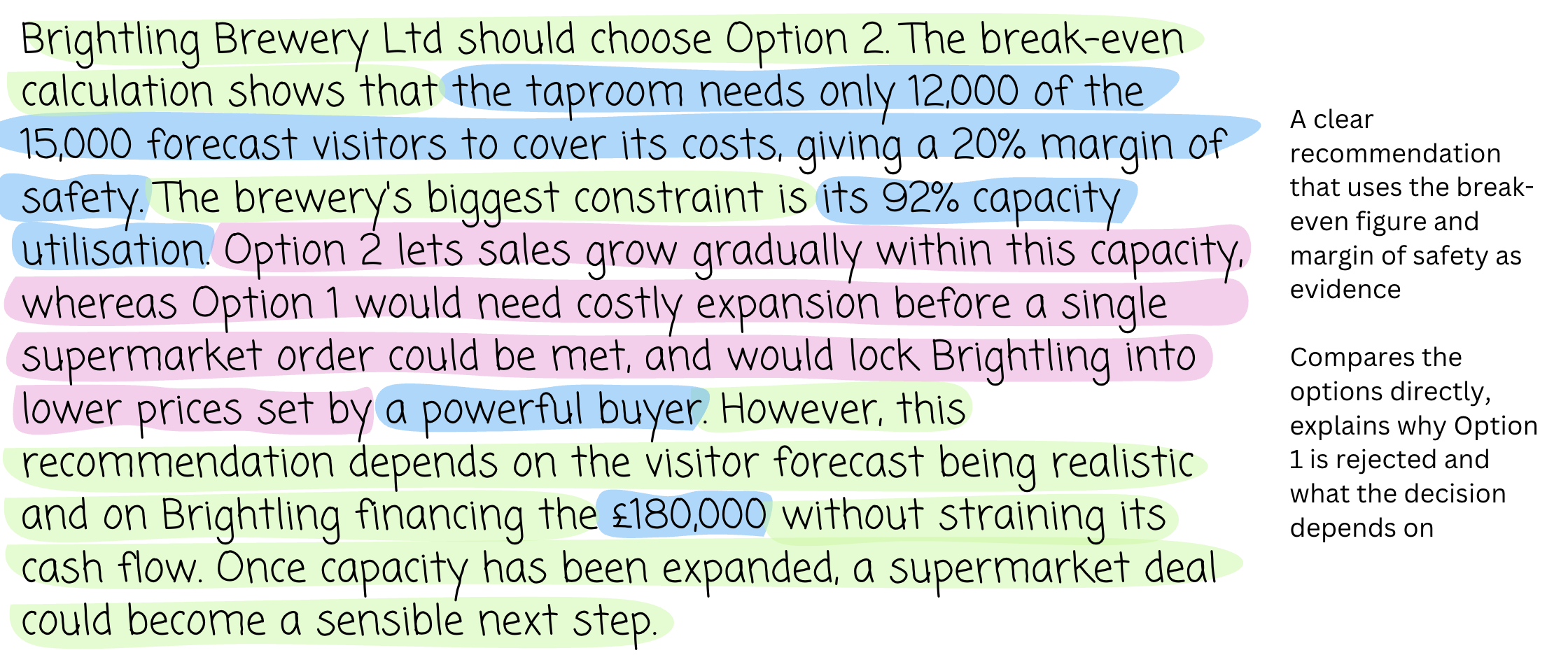
Finish with an overarching judgement that uses your calculated figure as evidence
Make a clear recommendation and compare the options directly
Explain why the other option has been rejected
Explain what your recommendation depends on
Common mistakes
Ignoring the calculation in the judgement
In calculation questions, an answer that does not use the result cannot score more than 9
Examiner Tips and Tricks
With 5 evaluation marks, the 15-mark question rewards judgement more than any other question type. Show evaluation throughout your answer by ending each option with a short judgement, then bring them together in your final paragraph.
A strong recommendation usually sounds like this: "[Business] should choose Option X, because [main reason linked to the context], whereas Option Y [main weakness]. However, this depends on [key factor]."

Unlock more, it's free!
Join the 100,000+ Students that ❤️ Save My Exams
the (exam) results speak for themselves:

Was this revision note helpful?