Business & Objectives (AQA A Level Business): Exam Questions

Exam code: 7132

Syllabus Edition

First teaching 2026

First exams 2028

2 hours15 questions
1
6 marks

Source A: Gymshark Ltd

Ben Francis was 19 when he asked his parents if he could use their garage to start making gym clothes he had designed. Whilst studying business at university, Ben teamed up with a school friend, and the gymwear business Gymshark Ltd was born.

Ben used his £5-an-hour wage at Pizza Hut and £1000 savings to invest in equipment like a sewing machine. Ben taught himself to sew and went to bodybuilding events to raise brand awareness. In 2012, Ben dropped out of university to focus on the business full-time.

The Gymshark Ltd brand has become a hit with younger gym goers and is doing well in a highly competitive market. Its competitors include Nike, Adidas and Puma. Instead of using traditional advertising or selling in high street shops, Gymshark Ltd has grown by having athletes and social media 'influencers' wear its clothes on platforms like Instagram, TikTok, and Facebook. Ben is also well known and still shares his own fitness videos online to promote the brand. The company now has 18 million followers on social media.

Gymshark Ltd is a private limited company. In 2021, it raised £200 million by selling shares to a company called General Atlantic. This made Gymshark Ltd one of relatively few British businesses valued at over $1 billion. Ben still owns a 70% stake in the company and has a clear vision of how he wants the business to develop. General Atlantic owns just over 20%. Managers at Gymshark Ltd own 10%. The funds were raised with the aim of expanding the business in North America, where Gymshark Ltd already makes a large part of its sales, and to grow the business rapidly in Asia. Ben has ambitious plans and wants to make the Gymshark Ltd brand the UK equivalent of Nike. The Nike brand was worth $31 billion in 2023 globally; market research suggests that 43% of people who buy Nike sportswear would do so again.

In October 2022, Gymshark Ltd made a significant investment and opened its first physical store on Regent Street in London.

Source: information sourced from Gymshark, 2024

Ben Francis has demonstrated several entrepreneurial characteristics in his career.

Analyse how one of these entrepreneurial characteristics has contributed to the success of Gymshark Ltd.

2
6 marks

Source B: Battersea Dogs' and Cats' Home

Battersea Dogs' and Cats' Home is a registered charity, number 206394. It works with animals, provides services to the general public, and operates in London, in Windsor and Maidenhead, and in Kent. It has no shareholders and no owners. Any money left over at the end of the year stays in the charity.

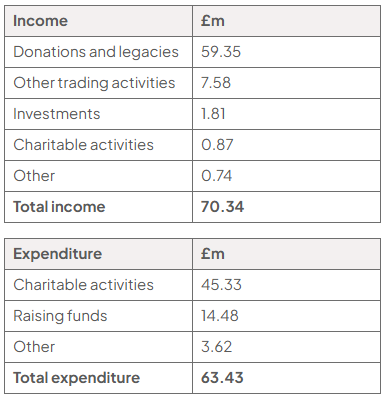
Almost all of its money is given rather than earned. In the year to 31 December 2024 its total income was £70.34 million, of which £59.35 million came from donations and legacies. A legacy is money left to a charity in somebody's will, and legacies alone came to £32.57 million, almost half of everything Battersea received. The rest came from other trading activities, £7.58 million, from charitable activities, £869 000, from investments, £1.81 million, and from other sources, £741 000.

Raising that money costs money. Battersea spent £14.48 million on raising funds during the year. It spent £45.33 million on its charitable activities and £3.62 million on other costs, giving total expenditure of £63.43 million.

Income has grown in three of the past four years, from £52.71 million in 2020 to £70.34 million in 2024. Expenditure has risen every year over the same period.

The charity faces a planning problem that a company selling to customers does not. Nobody can be told in advance how much will be left to Battersea in wills, or when. Legacies are the largest single source of its income and the least predictable.

Source: Charity Commission register of charities, entry 206394

Battersea Dogs' and Cats' Home has no shareholders, and any money left over at the end of the year stays in the charity.

Analyse one way in which having no shareholders might affect the objectives Battersea Dogs' and Cats' Home sets itself.

3
6 marks

Source B: Battersea Dogs' and Cats' Home

Battersea Dogs' and Cats' Home is a registered charity, number 206394. It works with animals, provides services to the general public, and operates in London, in Windsor and Maidenhead, and in Kent. It has no shareholders and no owners. Any money left over at the end of the year stays in the charity.

Almost all of its money is given rather than earned. In the year to 31 December 2024 its total income was £70.34 million, of which £59.35 million came from donations and legacies. A legacy is money left to a charity in somebody's will, and legacies alone came to £32.57 million, almost half of everything Battersea received. The rest came from other trading activities, £7.58 million, from charitable activities, £869 000, from investments, £1.81 million, and from other sources, £741 000.

Raising that money costs money. Battersea spent £14.48 million on raising funds during the year. It spent £45.33 million on its charitable activities and £3.62 million on other costs, giving total expenditure of £63.43 million.

Income has grown in three of the past four years, from £52.71 million in 2020 to £70.34 million in 2024. Expenditure has risen every year over the same period.

The charity faces a planning problem that a company selling to customers does not. Nobody can be told in advance how much will be left to Battersea in wills, or when. Legacies are the largest single source of its income and the least predictable.

Source: Charity Commission register of charities, entry 206394

Appendix D: Battersea Dogs' and Cats' Home income and expenditure, year to 31 December 2024

Income (£m): donations and legacies 59.35, other trading activities 7.58, investments 1.81, charitable activities 0.87, other 0.74; total 70.34. Expenditure: charitable activities 45.33, raising funds 14.48, other 3.62; total 63.43.

Source: Charity Commission

Legacies are gifts left to a charity in somebody's will, and they brought Battersea Dogs' and Cats' Home £32.57 million of its £70.34 million income.

Analyse one reason why depending on legacies might make it difficult for Battersea Dogs' and Cats' Home to plan ahead.

4
6 marks

Source A: MPB Group Ltd

MPB Group Limited buys and sells used cameras and video equipment. Matt Barker founded the business in Brighton in 2011. Customers can sell their old equipment to MPB, trade it in against something else, or buy used gear at a lower price than new. The company recirculates around 570 000 items a year, and says it wants to extend the life of photo and video equipment rather than see it sit unused in a drawer.

Everything is bought and sold through MPB's own website. There are no shops. The company has offices in Brighton, Brooklyn and Berlin, so it trades in the United Kingdom, the United States and Germany. Every item is inspected by a product specialist and graded for its condition, then sold with a twelve-month warranty. Prices are set by the make, model, condition and the market the item is being sold in.

Because MPB has no shops and does not advertise on television, almost all of its customers arrive through a search engine. Some of those visits are earned, when MPB's own articles, reviews and buying guides appear in the search results without being paid for. Others are bought, when MPB pays to appear above the free results and is charged every time somebody clicks.

MPB has grown quickly. Turnover rose by 15.5% in the year to 31 March 2025 and the company took on 49 more staff. Some of that growth has been funded by borrowing. Over the same year total liabilities rose by 22.7% while net assets fell by 19.7%. Matt Barker is still a director, but he no longer runs the company alone. In 2021 an outside investment company placed directors on the board, and MPB now has 16 shareholders and an independent chairman.

MPB wants to sell more in the United States and Germany. It could spend more on paid search advertising, or it could invest in its own content so that more customers find it without a payment being made for every click.

Source: information sourced from Companies House and MPB Group Ltd, 2026

In 2021 an outside investment company placed directors on MPB Group Ltd's board.

Analyse one way in which this might affect how MPB Group Ltd is run.

5
6 marks

Source A: Games Workshop Group PLC

Games Workshop Group PLC designs, makes and sells fantasy miniatures, and the games and stories that go with them. Its main brand is Warhammer. The company is based at Willow Road in Nottingham, where it makes its models, and it is a public limited company whose shares are traded on the London Stock Exchange. Kevin Rountree is the chief executive. It employs about 3 000 people.

The company earns money in two quite different ways. Most of it comes from the core business: selling miniatures and books through its own shops, through independent retailers it calls trade accounts, and through its own website. The rest comes from licensing, which means letting other companies pay to use Warhammer characters and worlds in their own products, such as video games and television.

In the 52 weeks to 31 May 2026 the core business had its best year yet. Core revenue rose 10.9% to £626.8 million and core operating profit rose to £245.1 million. Licensing went the other way. Licensing revenue fell from £52.5 million to £32.9 million, and licensing operating profit fell from £49.5 million to £29.9 million.

Licensing matters more than its size suggests. It costs very little to run, because the company is selling permission rather than a product, so almost all of the revenue it brings in becomes profit.

Total revenue still reached a record £659.7 million and profit before tax a record £275.7 million. Earnings per share rose from 594.9p to 624.0p. Even so, the dividend paid during the year fell from 520p a share to 485p.

Games Workshop says its decisions are focused on long-term success rather than short-term gains, and that it intends to carry on making the best fantasy miniatures in the world forever.

Source: Games Workshop Group PLC results, 28 July 2026

Appendix C: Extract from Games Workshop Group PLC's stated strategy

"Our ambitions remain clear: to make the best fantasy miniatures in the world, to engage and inspire our customers, and to sell our products globally at a profit. We intend to do this forever. Our decisions are focused on long-term success, not short-term gains."

"We nurture a craft based hobby. We understand that what we make may not appeal to everyone, so to recruit and retain customers we are absolutely focused on making our models the best in the world."

Source: Games Workshop Group PLC annual report, 2026

Games Workshop Group PLC says its decisions are focused on long-term success rather than short-term gains (Appendix C).

Analyse one way in which this objective might affect how much Games Workshop Group PLC spends on developing new models.

6
6 marks

Source A: Bunzl plc

Bunzl plc is a distribution and services group. It does not make much: it buys products from manufacturers, holds them, and delivers them to businesses that need them regularly but do not want to manage the supply themselves. Its customers are in cleaning and hygiene, safety, healthcare, foodservice and grocery, and they are spread across more than 30 countries.

A hospital does not want to negotiate with forty suppliers for gloves, wipes and aprons. Bunzl sells it one relationship. That is the business.

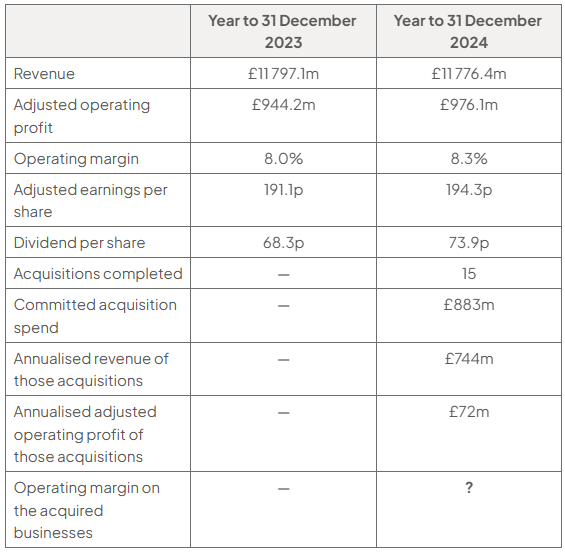
The year to 31 December 2024 produced an odd set of numbers. Revenue was £11 776.4 million against £11 797.1 million, which is a fall of 0.2%. But at constant exchange rates, which strips out the effect of the pound moving against other currencies, revenue rose 3.1%. Adjusted operating profit rose 3.4% as reported and 7.2% at constant rates. Appendix B shows the two measures side by side.

The margin improved, from 8.0% to 8.3%. Bunzl puts that down partly to selling more of its own brand products, which it sources itself rather than buying from a manufacturer whose name is on the box, and partly to the businesses it has bought.

Buying businesses is how Bunzl grows. During 2024 it completed 15 acquisitions, 13 of them announced, and committed a record £883 million to them. Those businesses are expected to add £744 million of revenue and £72 million of adjusted operating profit in a full year.

Adjusted earnings per share reached 194.3p and the dividend rose 8.2% to 73.9p. Cash conversion was 93%.

Source: information sourced from Bunzl plc annual results for the year ended 31 December 2024

Appendix A: Bunzl plc selected results

Table comparing Bunzl’s 2023 and 2024 results, including revenue, operating profit and margin. In 2024, 15 acquisitions cost £883m and added £744m revenue and £72m profit; acquired-business margin is shown as “?”.

Source: Bunzl plc

Bunzl plc committed a record £883 million to 15 acquisitions during 2024.

Analyse one risk to Bunzl plc of committing so much money to acquisitions in a single year.

7
6 marks

Source A: Wrenfield Schoolwear Ltd

Wrenfield Schoolwear Ltd makes and sells school uniform from a unit in Nottingham: blazers, jumpers, skirts, trousers and PE kit, most of it carrying an embroidered school badge. Priya Wrenfield started it in 2009 after both her children came home in December with blazers that had already worn through at the elbow. The objective written into the company's own documents has never changed: to make uniform that lasts three years, and to keep a full set below £60. It is a private limited company and it employs 41 people.

It sells in two ways. Sixty-two schools have an exclusive supply contract with Wrenfield Schoolwear Ltd, which means a parent at one of those schools cannot buy the uniform anywhere else; the school receives a share of everything sold. That brought in £3 320 000 last year. The rest, £1 165 000, came from Wrenfield Schoolwear Ltd's own website, mostly from parents at schools with no exclusive supplier.

The marketing objective set two years ago was to grow sales by 5% by 2025. Sales rose from £4 200 000 to £4 485 000, which is 6.8%, and Priya Wrenfield has told the board the objective was met. Appendix A contains the figure she has not put in front of them.

A full set of uniform now costs a parent £61.

Wrenfield Schoolwear Ltd commissioned a survey last spring of 400 parents, 400 pupils and 96 school business managers, asking each of them to score four things out of ten. The results are in Appendix B. Priya Wrenfield has read them several times and has not yet decided what to do about them.

Wrenfield Schoolwear Ltd's stated objective is to make uniform that lasts three years and to keep the price of a full set below £60.

Analyse one way in which this objective might affect the decisions Priya Wrenfield takes about the materials she buys.

1
9 marks

Source B: Mishcon de Reya LLP

Mishcon de Reya LLP is a law firm. It advises businesses and wealthy individuals on disputes, property, corporate deals and private matters, and it is led by managing partner James Libson. It has offices in London, Cambridge and Oxford, and overseas in Hong Kong, Singapore and the United Arab Emirates. About 1 250 people work there, including more than 650 lawyers.

It is not a company. It is a limited liability partnership, which means it is owned by its members, the partners, rather than by shareholders. Members put capital into the firm when they join and take a share of the profit rather than a salary. Nobody outside the partnership owns any part of it.

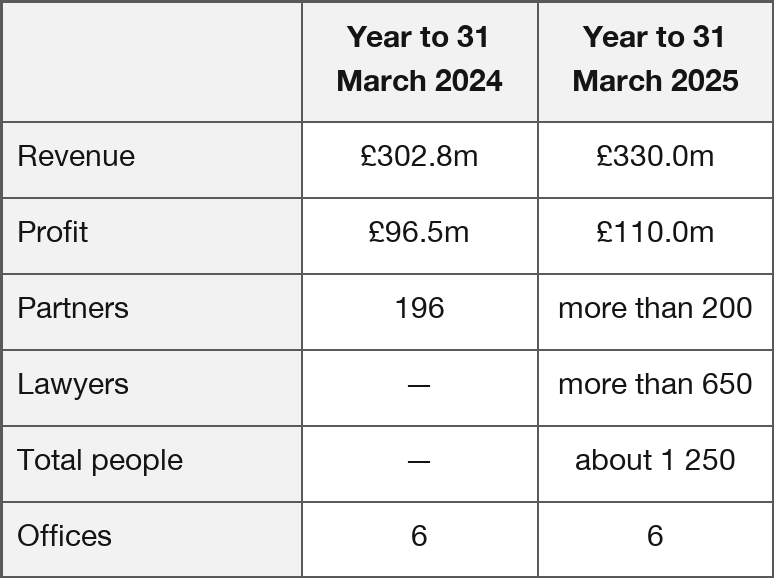
The year to 31 March 2025 was the firm's best. Revenue rose 9% to £330 million and profit rose 14% to £110 million, the first time it has passed £100 million. The firm says it has tripled in size over the past decade. Its work during the year included advising Wayve on what it describes as Europe's largest artificial intelligence investment and defending O2 in a collusion claim.

Growing has meant admitting people. Sixteen new partners joined during the year and a further 27 people were promoted to partner from inside the firm, alongside 13 promotions to legal director. There are now more than 200 partners. As in any partnership, some members retire or leave each year, so membership grows by less than the number admitted.

That is the tension the firm is sitting with. In a partnership the profit is divided between the members, so every partner admitted is another share of the same pool. The firm now has to decide where its next stage of growth should come from: more partners in the United Kingdom, where it already has three offices and knows the market, or a bigger presence in Hong Kong, Singapore and the United Arab Emirates, where the offices exist but are small. Appendix F sets out the two options.

Source: information sourced from Mishcon de Reya LLP, results for 2024/25

Appendix D: Mishcon de Reya LLP selected results

Selected results for years to 31 March 2024/2025: revenue £302.8m/£330.0m; profit £96.5m/£110.0m; partners 196/over 200; lawyers —/over 650; total people —/about 1,250; offices 6/6.

The 2024 revenue and profit figures are those implied by the reported increases of 9% in revenue and 14% in profit.

Source: Mishcon de Reya LLP; 2024 partner number from analyst estimates

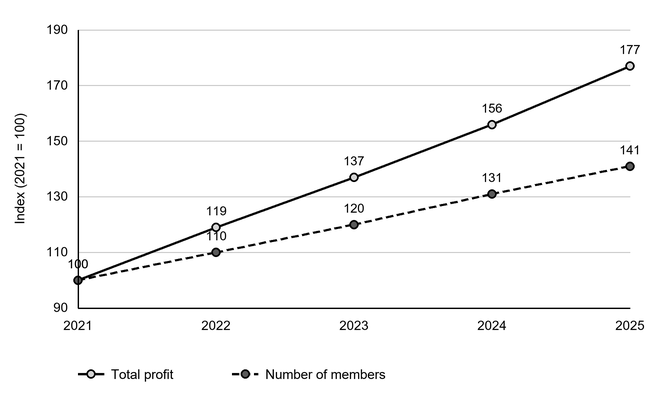
Appendix E: Mishcon de Reya LLP profit and members, analyst estimates

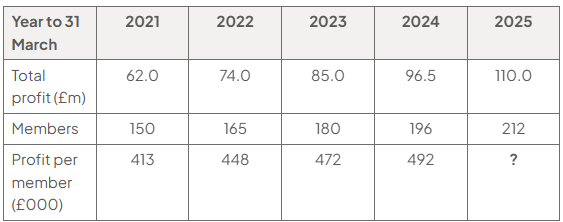
Line chart of indexed total profit and number of members, 2021 equals 100: profit rises to 119, 137, 156 and 177 by 2025; members rise to 110, 120, 131 and 141.
Table for years to 31 March 2021 to 2025: total profit (£m) 62.0, 74.0, 85.0, 96.5, 110.0; members 150, 165, 180, 196, 212; profit per member (£000) 413, 448, 472, 492, ?.

Source: Analyst

Assess whether Mishcon de Reya LLP's growth has made its individual members better off.

Calculate the percentage change in Mishcon de Reya LLP's number of members between 2024 and 2025 to support your answer.

Give your answer to one decimal place.

2
9 marks

Source A: Games Workshop Group PLC

Games Workshop Group PLC designs, makes and sells fantasy miniatures, and the games and stories that go with them. Its main brand is Warhammer. The company is based at Willow Road in Nottingham, where it makes its models, and it is a public limited company whose shares are traded on the London Stock Exchange. Kevin Rountree is the chief executive. It employs about 3 000 people.

The company earns money in two quite different ways. Most of it comes from the core business: selling miniatures and books through its own shops, through independent retailers it calls trade accounts, and through its own website. The rest comes from licensing, which means letting other companies pay to use Warhammer characters and worlds in their own products, such as video games and television.

In the 52 weeks to 31 May 2026 the core business had its best year yet. Core revenue rose 10.9% to £626.8 million and core operating profit rose to £245.1 million. Licensing went the other way. Licensing revenue fell from £52.5 million to £32.9 million, and licensing operating profit fell from £49.5 million to £29.9 million.

Licensing matters more than its size suggests. It costs very little to run, because the company is selling permission rather than a product, so almost all of the revenue it brings in becomes profit.

Total revenue still reached a record £659.7 million and profit before tax a record £275.7 million. Earnings per share rose from 594.9p to 624.0p. Even so, the dividend paid during the year fell from 520p a share to 485p.

Games Workshop says its decisions are focused on long-term success rather than short-term gains, and that it intends to carry on making the best fantasy miniatures in the world forever.

Source: Games Workshop Group PLC results, 28 July 2026

Appendix B: Games Workshop Group PLC earnings, dividends and cash

  • Earnings per share = 624.0p in 2026 (594.9p in 2025)

  • Dividends per share declared and paid during the year = 485p in 2026 (520p in 2025)

  • Net increase in cash before dividends paid = £210.3m in 2026 (£197.5m in 2025)

  • Cash held at the end of the year = £182.9m

Source: Games Workshop Group PLC and Companies House

Appendix C: Extract from Games Workshop Group PLC's stated strategy

"Our ambitions remain clear: to make the best fantasy miniatures in the world, to engage and inspire our customers, and to sell our products globally at a profit. We intend to do this forever. Our decisions are focused on long-term success, not short-term gains."

"We nurture a craft based hobby. We understand that what we make may not appeal to everyone, so to recruit and retain customers we are absolutely focused on making our models the best in the world."

Source: Games Workshop Group PLC annual report, 2026

Assess whether Games Workshop Group PLC's focus on long-term success rather than short-term gains is in the interests of its shareholders.

3
9 marks

Source A: Ridgeway Signs

Tomasz Nowak trades as Ridgeway Signs. He is a sole trader, which means the business is not separate from him in law: he owns everything it owns and he is personally responsible for everything it owes. He has no employees and works from a rented unit on a small industrial estate, with a van.

He designs, prints and fits signs for local businesses: shop fascias, vehicle graphics, banners, menu boards and exhibition displays. Almost all of his customers are other businesses within about twenty miles. Every job is quoted separately, and he wins roughly one quote in three.

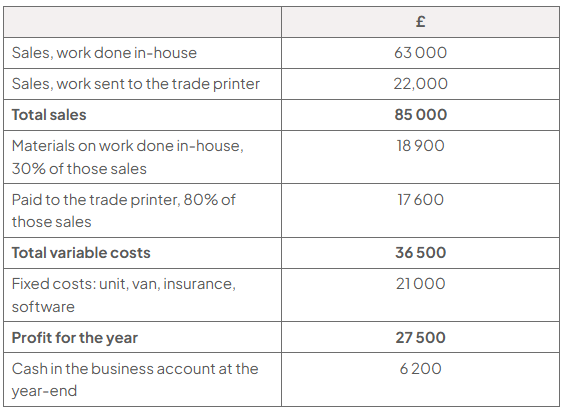
Last year Ridgeway Signs took £85 000. Materials cost about 30p in every pound of work Tomasz does himself, so he keeps about 70p. Rent on the unit, the van, insurance and design software cost £21 000 a year whatever he sells.

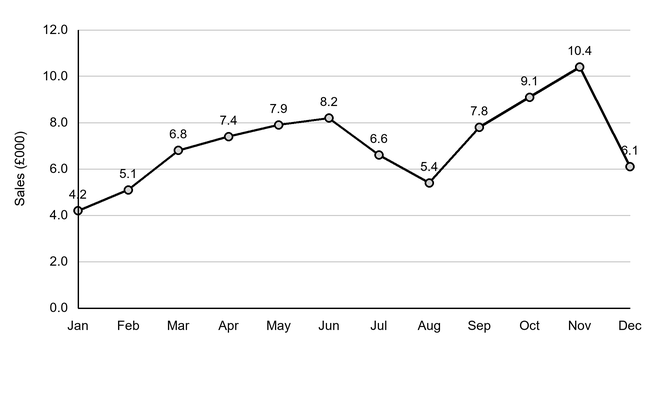
The business has a shape to it. Appendix B shows sales month by month. October and November are his best months, because retailers refit before Christmas, and January and February are his worst.

There is one piece of work he cannot do. Large-format printing — vehicle wraps and big banners — needs a machine he does not own, so he sends those jobs to a trade printer in another town. Last year that work was worth £22 000 of his sales, but the trade printer takes most of it: Tomasz keeps only about 20p in the pound. He also turns away large jobs when the trade printer is busy.

A wide-format printer costs £24 000. Tomasz has £6 200 in the business account. Appendix C sets out what his accountant thinks would happen if he bought one.

Appendix A: Ridgeway Signs, summary of last year

Appendix A table of Ridgeway Signs’ annual finances: in-house sales £63,000, trade-printer sales £22,000, total sales £85,000; variable costs £36,500, fixed costs £21,000, profit £27,500 and year-end cash £6,200.

Source: Analyst

Appendix B: Ridgeway Signs monthly sales

Line chart of Ridgeway Signs’ monthly sales: sales in £000 on a 0–12 vertical axis, by month. Values: Jan 4.2, Feb 5.1, Mar 6.8, Apr 7.4, May 7.9, Jun 8.2, Jul 6.6, Aug 5.4, Sep 7.8, Oct 9.1, Nov 10.4, Dec 6.1.

Source: Analyst

Assess whether working alone, with no employees, limits what Tomasz Nowak can achieve with Ridgeway Signs.

4
9 marks

Source B: Brightpath Learning Ltd

Brightpath Learning Ltd is an online tutoring company set up six years ago by two former teachers, Aisha Rahman and Tom Petridis, who are its only shareholders and directors. It employs 31 people at its office in Leeds and works with about 400 self-employed tutors.

It sells two quite different things.

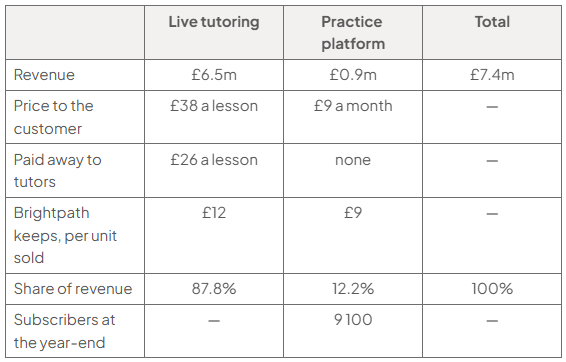
Live tutoring. A student books one-to-one lessons online with a subject specialist. A lesson costs the parent £38. Brightpath pays the tutor £26 and keeps £12. This is the larger part of the business and the part parents ask for by name, but it can only grow as fast as Brightpath can recruit and check tutors, and a tutor can only teach one student at a time.

The practice platform. A subscription costs £9 a month and gives a student unlimited access to Brightpath's own question banks, marked practice papers and progress tracking. It costs almost nothing to serve one more subscriber, because the material is already written. Fewer parents ask for it, because it is harder to explain than a lesson with a teacher.

Last year Brightpath took £7.4 million: £6.5 million from tutoring and £0.9 million from subscriptions. Fixed costs, covering the office, the 31 staff, the software and the marketing, came to £1.9 million.

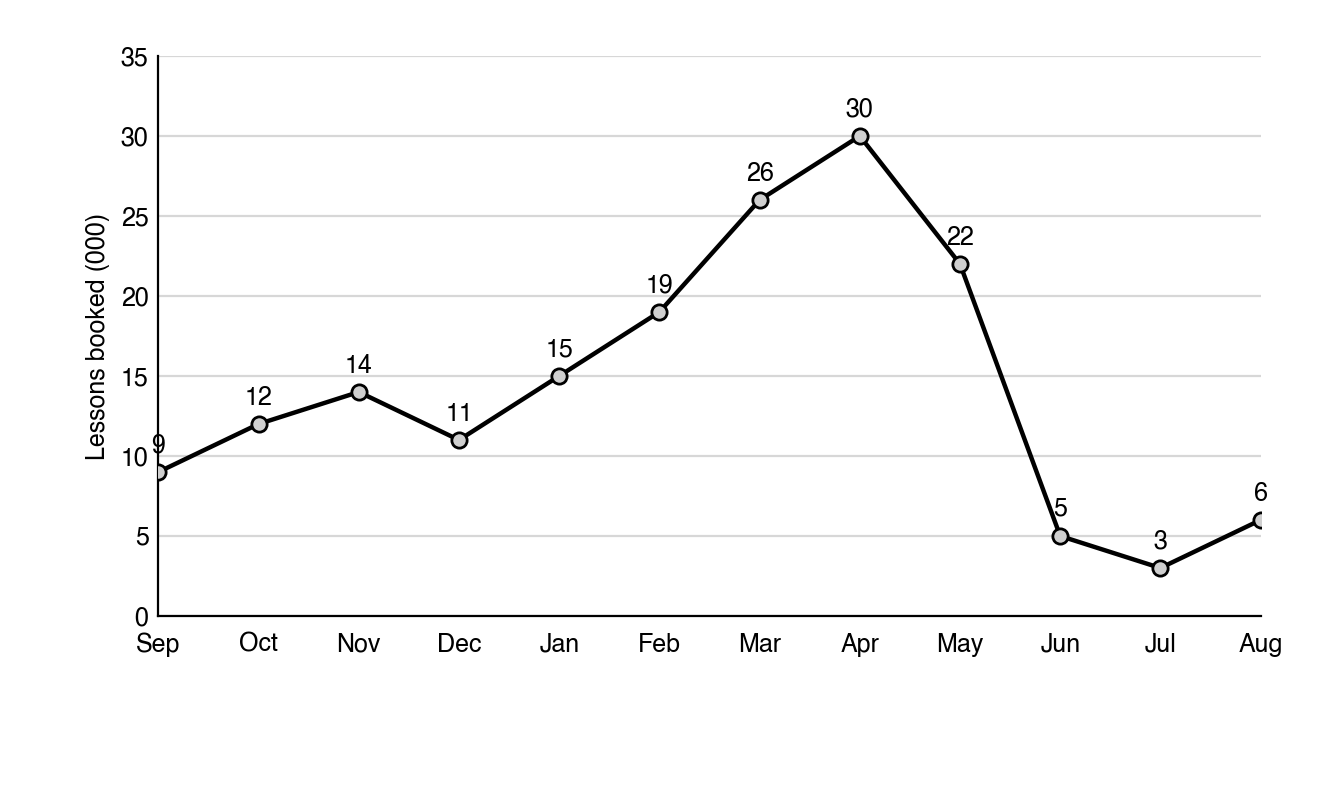
The business is highly seasonal. Appendix E shows lessons booked month by month: demand builds through the autumn, rises sharply after Christmas and peaks in April, then collapses once exams finish. Aisha and Tom have to pay the office and the staff through June, July and August whatever happens.

They now have to decide where to put next year's money. Appendix F sets out the two options.

Appendix D: Brightpath Learning Ltd, summary of last year

Table comparing Brightpath’s services: tutoring revenue £6.5m, customer price £38 per lesson, tutor payment £26 and retained £12; platform revenue £0.9m, price £9 monthly and retained £9. Revenue shares are 87.8% and 12.2%; platform has 9,100 subscribers.

Source: Analyst

Appendix E: Brightpath Learning Ltd lessons booked by month

Line chart of lessons booked monthly, in thousands, from September to August: 9, 12, 14, 11, 15, 19, 26, 30, 22, 5, 3 and 6 respectively; the y-axis ranges from 0 to 35 thousand.

Source: Analyst

Assess whether Brightpath Learning Ltd's seasonal pattern of demand makes planning more difficult for Aisha Rahman and Tom Petridis.

5
9 marks

Source B: Dunelm Group plc

Dunelm Group plc sells homewares and furniture: curtains, bedding, cookware, lighting, storage, sofas. It is a public limited company and it sells through large out-of-town stores and through its website and app.

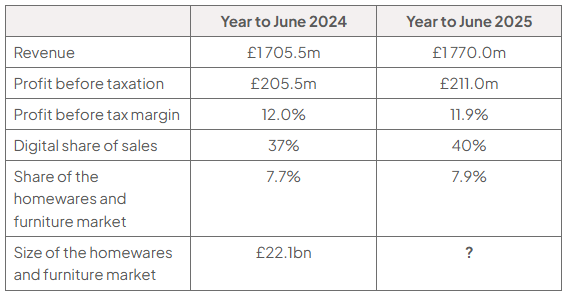
In the year to 28 June 2025 revenue rose 3.8% to £1.77 billion and profit before tax rose 2.7% to £211 million, with the margin slipping slightly to 11.9%. Its share of the combined homewares and furniture market rose from 7.7% to 7.9%, and the number of active customers, meaning people who have bought something within the last year, rose slightly.

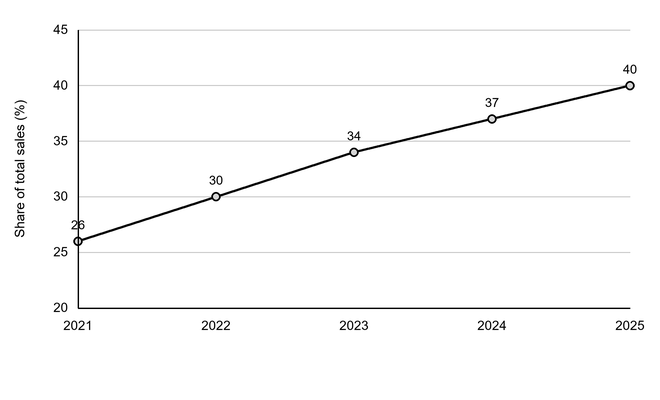
The change underneath those figures is where the customer shops. Digital sales are now 40% of everything Dunelm sells, up from 37% the year before. Appendix E shows how that share has moved over five years.

The complication is that digital and stores are not two separate businesses with two separate customers. The same person browses online and buys in store, or measures an item in store and orders at home, or buys online and returns to a store. A sofa is rarely bought without being sat on. A set of tea towels rarely needs a visit. Dunelm has to work out what a customer actually wants from each part of the business, when that customer does not think of them as separate at all.

It now has to decide where the next investment goes. Appendix F sets out the options.

Source: information sourced from Dunelm Group plc preliminary results for the year ended 28 June 2025

Appendix D: Dunelm Group plc selected results

Table of Dunelm selected results for years to June 2024 and 2025: revenue £1,705.5m to £1,770.0m; profit before tax £205.5m to £211.0m; margin 12.0% to 11.9%; digital sales 37% to 40%; market share 7.7% to 7.9%; market size £22.1bn to unknown.

Source: Dunelm Group plc

Appendix E: Dunelm digital share of sales, analyst estimates

Line chart of Dunelm digital sales as a share of total sales, rising steadily from 26% in 2021 to 30% in 2022, 34% in 2023, 37% in 2024 and 40% in 2025. Percentage axis spans 20 to 45.

Source: Analyst

Assess whether Dunelm Group plc should treat its digital sales and its stores as one business or as two.

1
15 marks

Source B: Home Instead Ltd

Home Instead Limited arranges care for older people in their own homes: help with washing and dressing, meals, medication, shopping and company. It has been trading in the United Kingdom since 2005 from an office near Warrington, and it is owned by an American company.

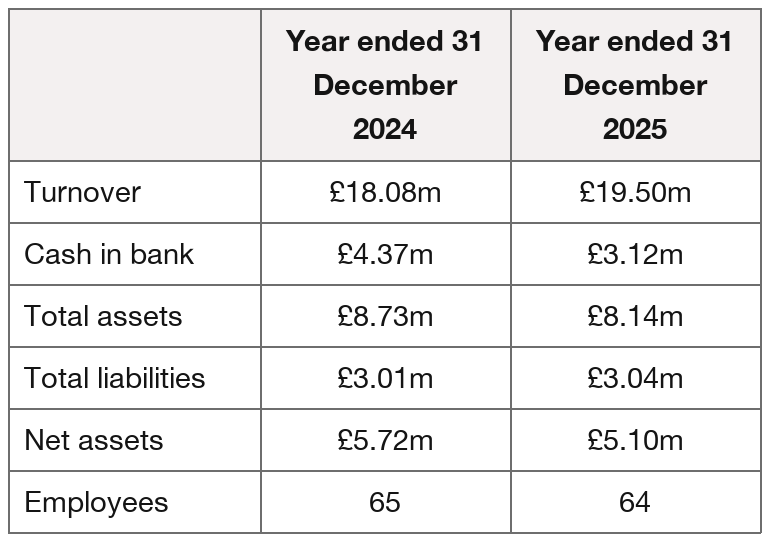
Home Instead does not provide the care itself. It is a franchisor. Local business owners buy the right to run a Home Instead office in a particular area, and in return they use the name, the training and the systems, and pay a fee on everything they sell. Those franchisees recruit and employ the carers. This is why the company's accounts look so unusual for a care business: turnover of £19.5 million but only 64 employees, because almost everybody who does the work is employed by somebody else.

The market is growing. The Office for National Statistics projects that the number of people in the UK at state pension age will rise from 12.0 million in mid-2022 to 13.7 million by mid-2032, an increase of 13.8%, while the population as a whole grows by 7.3%. Older people are becoming a larger share of the country, and most of them would prefer to stay in their own homes.

The company's own finances moved in two directions during 2025. Turnover rose 7.9% to £19.5 million. But cash at the bank fell by 28.8% to £3.12 million and net assets fell by 10.8% to £5.10 million.

Home Instead now has a choice about how to grow. It could recruit more franchisees to cover the areas it does not reach. Or it could buy back some territories and run them itself, employing the carers directly. Appendix E shows what a typical franchise costs to run and Appendix F shows the break-even chart for one.

Source: information sourced from Companies House and the Office for National Statistics, 2026

Appendix D: Home Instead Ltd selected financial data

Table comparing Home Instead’s financial data for years ended 31 December 2024 and 2025: turnover, cash, assets, liabilities, net assets and employees, with values shown in millions except employees.

Source: Companies House

Appendix E: Information on one Home Instead franchise

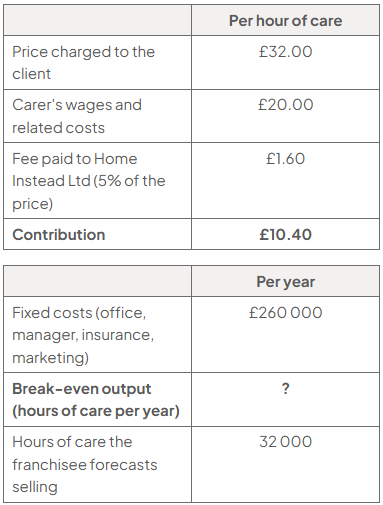
Two tables for one franchise: per hour, price £32, wages and related costs £20, Home Instead fee £1.60 and contribution £10.40; per year, fixed costs £260,000, break-even output unknown and forecast sales 32,000 hours.

Source: Analyst

Appendix F: Break-even chart for one Home Instead franchise

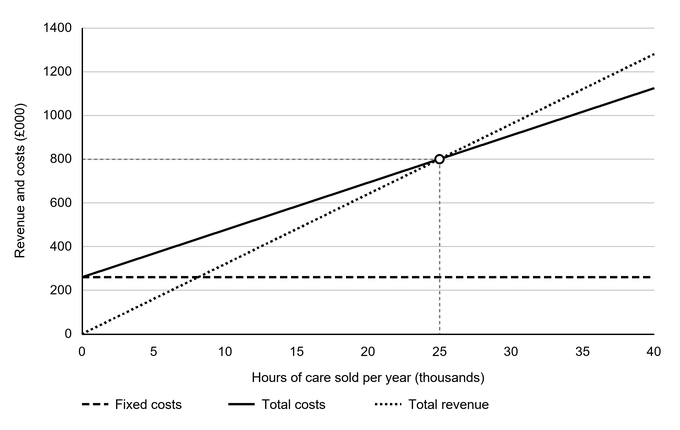
Break-even chart for a franchise: hours of care sold per year, 0 to 40,000, against revenue and costs, £000. Fixed costs are £260,000; total revenue and costs intersect at 25,000 hours and £800,000.

Source: Analyst

Home Instead Ltd has decided to buy back some territories and run them itself, employing the carers directly.

Evaluate whether Home Instead Ltd should finance buying back territories from its own cash or with a bank loan.

2
15 marks

Source B: Ashgrove Print Ltd

Ashgrove Print Ltd is a commercial printer in Dewsbury. Ken Ashgrove started it in 1994 after fifteen years at a firm that lost its only large customer and closed in a fortnight, and he told his daughter Nadia more than once that he built Ashgrove Print Ltd so that nobody would ever again be able to tell him what to charge. Nadia Ashgrove has run it since 2021. It is a private limited company and employs 34 people.

The work comes in two kinds. Long-run work is leaflets and shelf-edge cards for Fenwold Stores, a supermarket group: high volume, printed to a price Fenwold Stores fixes, and paid for in 74 days. It brought in £2 472 000 last year and cost £2 100 000 in paper, ink, plates and press time. Short-run work is menus, packaging, programmes and art prints for about 300 small local customers: low volume, priced job by job, and paid for in 21 days, often on collection. It brought in £1 648 000 and cost £784 000.

Across all its customers, Ashgrove Print Ltd waits an average of 53 days to be paid. It buys paper from two mills on 30-day terms. Its agreed terms with its own smaller suppliers, the plate makers, the bindery, the finishers and the courier, are also 30 days. Last year it paid them on average in 61 days. Its overdraft facility is £150 000 and it was £96 000 into it at the year end.

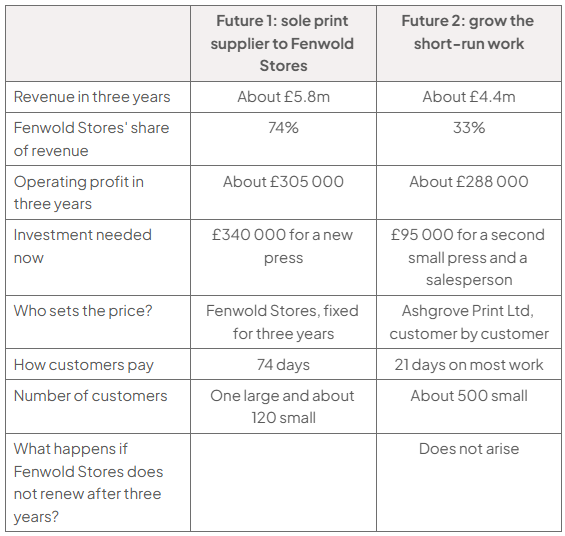
Fenwold Stores has now offered Ashgrove Print Ltd all of its print work on a three-year contract. It would need a new press costing £340 000, which the bank will lend against. Appendix F sets out that future and the one Nadia Ashgrove has been building towards instead.

Appendix D: Ashgrove Print Ltd, income statement for last year

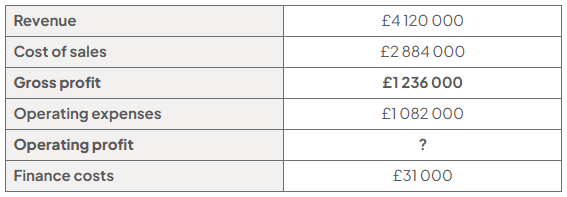
Income statement for Ashgrove Print Ltd: revenue £4,120,000; cost of sales £2,884,000; gross profit £1,236,000; operating expenses £1,082,000; operating profit shown as a question mark; finance costs £31,000.

Source: Analyst

Appendix E: Ashgrove Print Ltd, where the revenue is and where the profit is

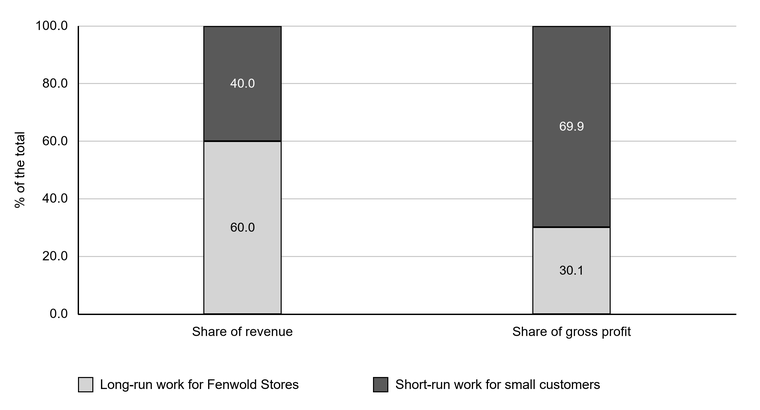
100% stacked bar chart of Ashgrove Print Ltd’s revenue and gross profit shares: Fenwold long-run work is 60.0% and 30.1%; small-customer short-run work is 40.0% and 69.9%. Axis: percentage of total, 0 to 100.

Source: Analyst

Appendix F: Data for two futures for Ashgrove Print Ltd

Table comparing two futures for Ashgrove Print Ltd. Future 1, Fenwold only: revenue about £5.8m; Fenwold Stores 74% of revenue; operating profit about £305 000; £340 000 for a new press; price fixed by Fenwold for three years; paid in 74 days; one large and about 120 small customers; what happens if Fenwold does not renew after three years is not provided. Future 2, short-run growth: revenue about £4.4m; Fenwold Stores 33% of revenue; operating profit about £288 000; £95 000 for a second small press and a salesperson; prices set customer by customer; 21 days on most work; about 500 small customers.

Source: Analyst

Appendix F sets out two futures for Ashgrove Print Ltd.

Evaluate both futures and recommend which one would be the better for Ashgrove Print Ltd.

3
15 marks

Source B: Foxhall Creamery Ltd

Foxhall Creamery Ltd makes hard cheese on the Shropshire border. It is a private limited company owned in equal shares by Kate Foxhall, who is 61, and Owen Ridd, who is 58, and it employs 48 people. Revenue last year was £6 800 000, sold to farm shops, delicatessens and independent grocers, none of whom takes more than 4% of output.

The cheese has to sit. The youngest thing Foxhall Creamery Ltd sells has been in the store for nine months, and its best-known cheese comes out at fourteen. Every wheel in the store is money already spent and not yet earned, and there are two rooms of them.

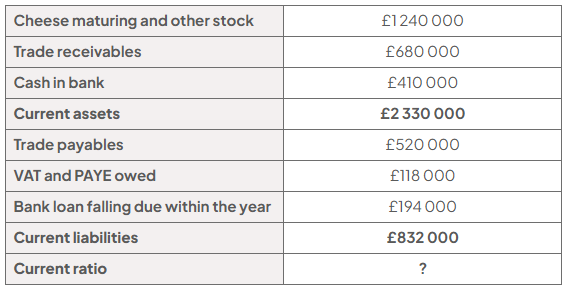
The accounts look reassuring. At the year end the company held £1 240 000 of inventory, was owed £680 000 by customers and had £410 000 in the bank, against £520 000 owed to suppliers, £118 000 in VAT and PAYE, and £194 000 of the bank loan falling due within the year. The loan stands at £1 460 000 in total, and the financial objective for this year is to reduce it by £200 000.

Foxhall Creamery Ltd values the cheese in its store at what the milk, the labour and the power have cost. A wheel that has been maturing for thirteen months appears in the accounts at the same figure as it did on the day it was made, although the price it will fetch has roughly doubled in the meantime.

The company needs a third maturing store, which will cost £900 000. It can pay for it out of the bank balance and this year's retained profit, or it can borrow again.

There is a larger question behind that one. Kate Foxhall wants to retire within five years. A cheese wholesaler has offered £4 900 000 for the company. The alternative the two of them have been reading about is an employee ownership trust, which would buy the business on behalf of the 48 staff and pay Kate Foxhall and Owen Ridd out of future profits over about seven years.

Appendix D: Foxhall Creamery Ltd, current assets and current liabilities

Appendix D table: current assets are cheese inventory £1.24m, trade receivables £680,000 and cash in bank £410,000, totalling £2.33m. Current liabilities total £832,000; current ratio: ?.

Source: Analyst

Appendix E: Foxhall Creamery Ltd's current assets

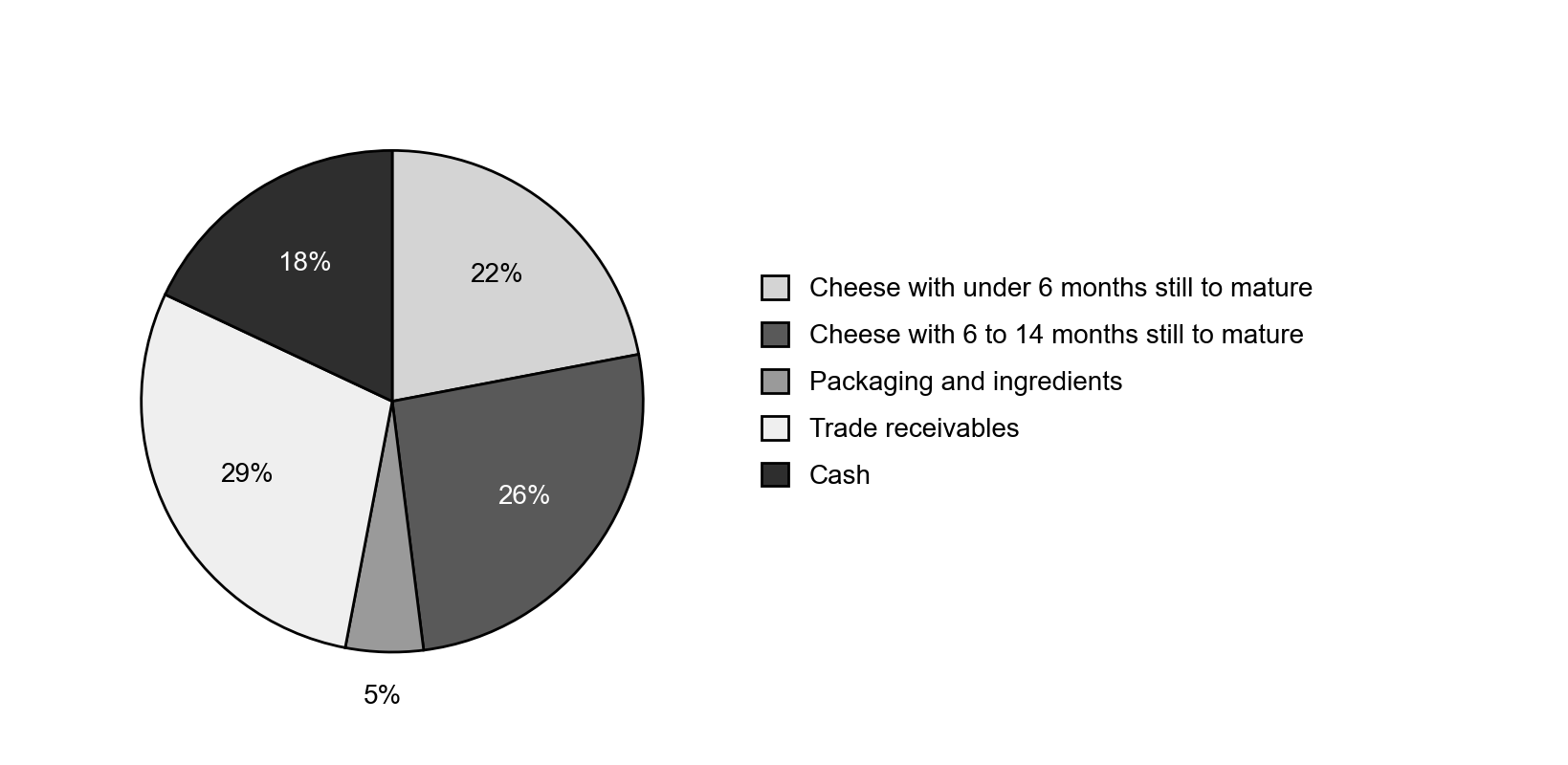
Pie chart of Foxhall Creamery’s current assets: trade receivables 29%, cheese with six to fourteen months still to mature 26%, cheese under six months 22%, cash 18%, and packaging and ingredients 5%.

Source: Analyst

Appendix F: Data for two objectives for the next five years

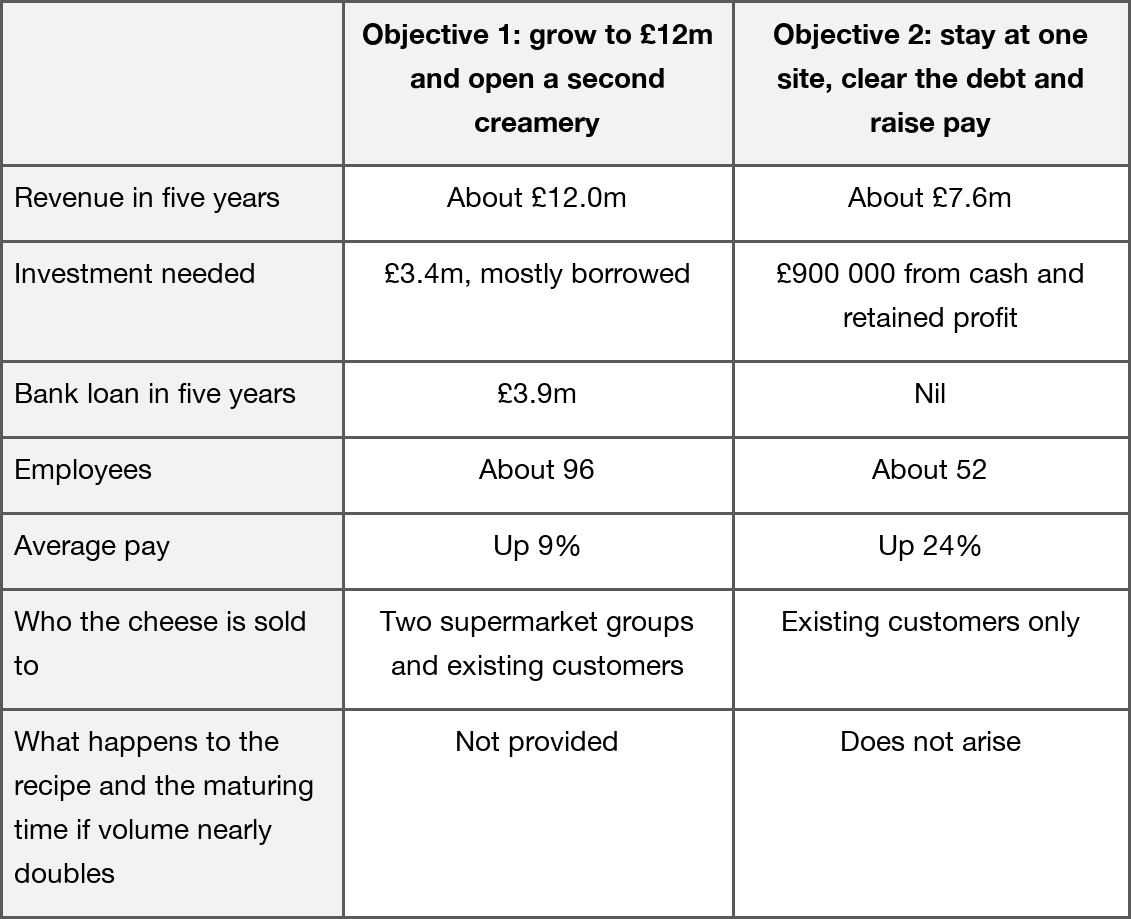
Table comparing two five-year objectives: Objective 1 grows revenue to about £12.0m by opening a second creamery; Objective 2 stays at one site, reaches about £7.6m and clears the bank loan.

Source: Analyst

Appendix F sets out two objectives for Foxhall Creamery Ltd for the next five years.

Evaluate both objectives and recommend which one would be the better for Foxhall Creamery Ltd.