Competitive Environment (AQA A Level Business): Exam Questions

Exam code: 7132

Syllabus Edition

First teaching 2026

First exams 2028

2 hours15 questions
1
6 marks

Source B: Farmoor Cycles

Farmoor Cycles is an independent bicycle retailer in the UK. It was established in Oxford in 2002 as a worker cooperative by a group of cycling enthusiasts. It now has two other shops in Birmingham and Manchester. The UK bicycle retail sector has a few large national chains that sell bikes, such as Halfords, Decathlon and Argos, as well as many small independent businesses. The entry threat to the industry is high.

The mission of Farmoor Cycles is to:

  • provide affordable bicycles for cyclists of all kinds

  • promote the benefits of cycling for cyclists of all kinds

  • build a fairer society through cooperative ownership.

The business states that 'we have the passion, specialist expertise and links with the local community that customers want'.

It values:

  • democracy

  • honesty

  • openness

  • social responsibility

  • caring for others.

The business is considering investing in a new inventory management system (Appendix C) which has a forecast life span of 4 years. It usually aims for an average rate of return on its investments of at least 10%. The current rate of interest for taking out a bank loan is 8%.

Appendix G: UK bicycle retail industry data
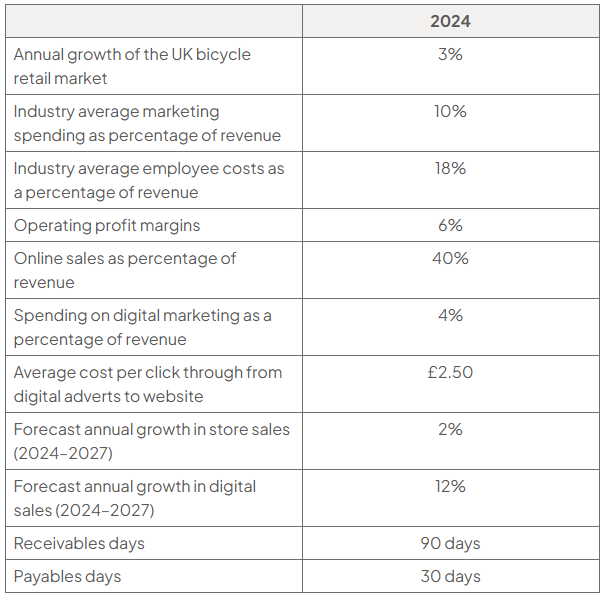
2024 UK bicycle retail industry data table: market growth 3%; marketing, employee and digital marketing spending 10%, 18% and 4% of revenue; operating margin 6%; online sales 40%; click cost £2.50; forecast store and digital growth 2% and 12%; receivables and payables 90 and 30 days.

According to Porter's five forces model, bicycles create a substitute threat for cars.

Analyse one action that might be taken by the UK Government that might affect the strength of this substitute threat.

2
6 marks

Source A: JCB

J.C. Bamford Excavators Limited, known as JCB, makes construction and agricultural machinery, including backhoe loaders, excavators and telescopic handlers. It was founded in 1945 by Joseph Cyril Bamford and is still owned by the Bamford family. Its headquarters are at Rocester, Staffordshire, and it employs more than 20 000 people in 23 factories around the world. It sells its machines through independent dealers. Its competitors include Caterpillar and Komatsu, both of which are larger.

In 2025 JCB's turnover was £5.7 billion, compared with £5.8 billion in 2024, and its profit before tax fell from £687 million to £642 million. It sold 113 498 machines, about 5% fewer than in 2024, although it increased its share of the global market. Demand for machinery was flat in North America and fell by 12% in India. The company has no net borrowing, and it expects moderate growth in 2026.

Demand for construction machinery depends on the amount of building taking place, which tends to fall when interest rates are high. Many machines in the UK are bought by plant hire companies, which buy in large numbers and rent the machines to builders.

JCB is investing £100 million at its Staffordshire headquarters, including £60 million in a fully automated paint plant, which it says will help to secure more than 8 000 UK jobs.

In April 2025 the United States introduced tariffs on imports, including a tariff of 10% on most goods from the UK. JCB responded by doubling the size of the factory it was building in San Antonio, Texas, which will be its largest in the world. It said that in the short term the tariffs would have a significant impact on its business, but that in the medium term the Texas factory would help to reduce that impact.

Over three years JCB spent £100 million, and employed more than 150 engineers, developing an engine which burns hydrogen instead of diesel. In January 2025 the engine was approved for use in Great Britain, Northern Ireland and nine other European countries. JCB also makes machines powered by batteries.

Source: JCB and press reports

Many of JCB's machines in the UK are bought by plant hire companies, which buy in large numbers and rent the machines to builders.

Analyse one way in which the buying power of plant hire companies might affect the prices JCB can charge.

3
6 marks

Source B: Draycote Soap Co

Draycote Soap Co Limited makes solid shampoo bars, conditioner bars and soaps by hand in a workshop near Rugby, Warwickshire. It was founded in 2016 by Hannah Okafor, who began making soap at her kitchen table; she remains its Managing Director and sole owner. The company employs 14 people. Its products contain no palm oil, are sold without any plastic packaging, and have an average customer rating of 4.8 out of 5 from more than 6 000 reviews.

The company sells through five channels:

  • Its own website, where a shampoo bar costs £8.50.

  • Amazon.

  • About 240 independent shops, many of which specialise in reducing waste.

  • Markets and fairs.

  • TikTok Shop, since 2024/25, where people who post videos of its products earn a commission on each sale they generate.

All of its staff are paid at least the Real Living Wage, a voluntary rate set by the Living Wage Foundation which is higher than the legal minimum wage. Several large distribution warehouses close to the workshop also recruit local staff. Every product is packed in a card box which costs 11p, compared with about 4p for a plastic wrapper.

Supermarkets have begun to sell their own-label shampoo bars, priced from about £3. Lush, a much larger business with its own shops, has sold solid shampoo bars for many years. In 2026 a national supermarket chain offered Draycote Soap Co a three-year contract to make shampoo bars to be sold under the supermarket's own label.

Source: Draycote Soap Co

Supermarkets have begun to sell own-label shampoo bars priced from about £3. Draycote Soap Co's shampoo bars cost £8.50 on its website.

Analyse one way in which supermarket own-label bars might affect the price Draycote Soap Co can charge.

4
6 marks

Source B: Thornbury Mills

Thornbury Mills Limited is a private limited company which mills wheat into flour at a single site on the edge of Thornbury, South Gloucestershire. The business was founded in 1887 and is owned by the fourth generation of the Hale family. Its Managing Director is Clare Hale, and it employs 86 people. In the year to 31 July 2026 the mill processed 118 000 tonnes of wheat into 92 000 tonnes of flour and 25 000 tonnes of wheatfeed, the bran and other parts of the grain which are sold for animal feed. Most of the wheat is bought from farms in Gloucestershire, Wiltshire and Herefordshire.

The company sells flour to three types of customer:

  • Two large plant bakeries, which make sliced bread for supermarkets. Together they bought 58% of its flour in the year.

  • Biscuit and cake manufacturers.

  • Craft bakeries, which buy flour in 16 kilogram bags.

Flour for each plant bakery is milled to that bakery's own specification, and a bakery wishing to change supplier must first run baking trials with flour from the new mill. The price the plant bakeries pay is agreed every three months with reference to the market price of wheat.

Thornbury Mills buys about 70% of the wheat it needs on forward contracts, which fix the price up to twelve months before the wheat is delivered. It buys the remainder at the market price at the time of delivery.

From 13 December 2026 the law requires every miller producing more than 500 tonnes of flour a year to add folic acid to non-wholemeal wheat flour, at 250 micrograms for every 100 grams. Flour must already contain added calcium, iron, niacin and thiamin. Thornbury Mills has installed dosing equipment costing £85 000, and estimates that the folic acid and the additional testing will cost £0.55 for each tonne of flour.

In 2023 a fire in the mill's dust extraction system stopped production for nine days. During that time the company's customers were supplied by another flour miller, under an agreement by which each mill supplies the other's customers if either stops production. The agreement remains in place.

The mill operates 24 hours a day and uses large amounts of electricity. In 2024 the company installed solar panels on the roofs of the mill and its warehouse. It delivers flour in its own fleet of 14 diesel lorries. Since 2023 it has bought 8% of its wheat from farms using regenerative methods, such as reduced ploughing and the planting of cover crops, and pays those farmers a premium of £15 a tonne. In 2026 the larger of its two plant bakery customers asked each of its suppliers to cut the emissions linked to the products they supply by 30% by 2030.

Source: Thornbury Mills

Two large plant bakeries buy 58% of Thornbury Mills' flour, and agree its price every three months with reference to the market price of wheat.

Analyse one way in which the power of these two buyers might affect Thornbury Mills' profit margin.

5
6 marks

Source A: Wickes

Wickes Group plc is a UK home improvement retailer listed on the London Stock Exchange. It became an independent company in 2021, when it separated from Travis Perkins. It has 230 stores and about 7 800 employees, and serves three groups of customers:

  • Tradespeople, through its TradePro membership scheme. Sales to TradePro members rose in 2025.

  • Do-it-yourself customers.

  • Design & Installation customers, whose kitchens and bathrooms it designs and fits.

It reports a "market-leading price position" against its wider peer group.

Wickes describes itself as "a digitally-led, service-enabled home improvement retailer". Two-thirds of its sales are digitally enabled, but 96% are fulfilled from its stores. Wickes has cut the time to prepare a Click & Collect order from 30 minutes to 15 minutes, and Wickes Rapid delivers orders of up to 800kg to a home or building site within three hours. Its strategy rests on seven "growth levers", including winning trade customers, digital capability and store investment.

Several rivals, including Homebase, have left the market since 2023. Homebase went into administration at the end of 2024, and Carpetright, CTD Tiles and Wilko have also left. Four of Wickes's five new stores in 2025 were former Homebase stores, and it employed 54 former Homebase staff.

In March 2026 the chief executive, David Wood, announced an ambition to reach 300 stores, creating more than 2 000 new jobs. Wickes plans 4 to 5 new stores in 2026, 7 to 9 in 2027 and at least 10 a year from 2028. It reports "ever-increasing demand for prime retail locations".

Source: Wickes Group plc, results for the year ended December 2025, annual report 2025 and half-year results 2026

Several of Wickes's rivals, including Homebase, have left the UK home improvement market since 2023.

Analyse one way in which the exit of these rivals might affect Wickes.

6
6 marks

Source B: Thistleden Kitchens

Thistleden Kitchens Limited is a private limited company, founded in Penrith, Cumbria, in 2003. It designs, makes and fits hand-built painted timber kitchens, each designed for the individual customer, and employs 64 people. In 2025 its kitchens sold for an average of £26 300.

It sells through four showrooms:

  • Penrith, Kendal and Carlisle, in Cumbria

  • Newcastle upon Tyne, opened in February 2025, its first outside Cumbria

Kitchens are made in its workshop in Penrith and fitted either by its own team of fitters or by subcontractors. Customers pay a 40% deposit when they order, and the balance when the kitchen is fitted.

Thistleden uses timber certified as coming from responsibly managed forests, trains four apprentices a year, and passes customers' old kitchens that can be reused to a local charity.

The company faces three main pressures:

  • Competition. National kitchen retailers offer free design visits and online booking.

  • Demand. Its order book fell in both 2024 and 2025, and its revenue and operating profit fell in 2025.

  • Fitting. In 2025 a higher share of kitchens was finished later than promised than in 2024, and about a third of kitchens were fitted by subcontractors.

In 2026 Thistleden introduced new software to schedule its fitters. A regional housebuilder has offered it a three-year contract to supply kitchens for new homes.

Source: Thistleden Kitchens

National kitchen retailers offer free design visits and online booking.

Analyse one way in which Thistleden Kitchens could compete with national kitchen retailers.

7
6 marks

Source B: Elvaston Food Hub

Elvaston Food Hub Limited is a private limited company, founded in Derby in 2017. It sells fresh food online from 60 farms and producers in Derbyshire and Nottinghamshire, all within 40 miles of Derby, and employs 38 people. Its range includes:

  • fruit and vegetables

  • meat and dairy products

  • bread

Customers order through the company's website and app, which records each customer's order history. They choose a delivery slot at least one day ahead, and food is delivered within 15 miles of Derby. Elvaston buys from its producers only what customers have ordered.

All deliveries are made by electric van; the last of the company's diesel vans was replaced in 2025. Electric vans cost more to buy than diesel vans, but less to run. Food is delivered in reusable crates, which customers return.

In a customer survey, most customers said they buy from Elvaston mainly because its food is local.

The company faces two main pressures:

  • Speed. Supermarkets and delivery apps in Derby offer grocery deliveries within one hour.

  • Price. Elvaston's prices are higher than supermarket prices for most products.

Its directors are considering whether to launch a lower-priced range.

Source: Elvaston Food Hub

Supermarkets and delivery apps now offer grocery deliveries within an hour, while Elvaston Food Hub customers book a slot at least one day ahead.

Analyse one way in which Elvaston Food Hub could compete with these rivals.

1
9 marks

Source B: Elmsworth Recycling

Elmsworth Recycling Limited recycles plastic packaging at a plant in Telford, Shropshire. The company was founded in 2009 by Dev Sharma, its Managing Director, and is owned by him and an investment firm. It employs 160 people. One in eight of them joined through a resettlement programme for people leaving prison, and each is given a mentor for their first six months.

The company buys bales of plastic pots, tubs and trays which households have put out for recycling, from the facilities that sort councils' collections. It shreds, washes and sorts the plastic, then melts it into pellets of recycled polypropylene, which it sells to manufacturers of plastic packaging. In the year to 30 June 2026 it bought 34 000 tonnes of bales and sold 26 500 tonnes of pellets. The plant can handle 40 000 tonnes of bales a year.

The material that cannot be made into pellets, such as labels, food residue and mixed plastics, is dealt with in two ways:

  • 4 000 tonnes a year is sold to a broker, which ships it to Turkey.

  • The remainder is sent to energy-from-waste plants in the UK, which charge a fee to burn it.

In 2024 the company installed a closed-loop system which cleans and reuses the water used to wash the plastic, cutting its use of mains water by three quarters. The system uses electricity to pump and filter the water. The remaining waste water is discharged to the public sewer, for which the company pays its water company a charge.

Packaging manufacturers can buy virgin polypropylene, made from oil, instead of Elmsworth Recycling's pellets. Since April 2022 the government has charged Plastic Packaging Tax on plastic packaging which contains less than 30% recycled plastic.

Source: Elmsworth Recycling

Appendix D: The UK market for recycled plastic

  • Plastic Packaging Tax. Charged on plastic packaging made in or imported into the UK which contains less than 30% recycled plastic. The rate from 1 April 2025 is £217.85 a tonne of packaging. Packaging with 30% or more recycled plastic pays no tax.

  • Extended Producer Responsibility. Since 2025, businesses that supply packaging pay fees towards the cost of collecting and recycling it.

  • Closures. Several UK plastic recycling plants closed in 2024 and 2025. Their owners blamed low prices for virgin plastic and imports of cheaper recycled plastic.

  • Imports. UK recyclers say that some imported plastic sold as recycled is difficult to verify.

  • Food packaging. Recycled plastic used in contact with food must be produced by a process approved by the food safety regulator.

  • Exports. In 2021 an investigation by Greenpeace found plastic waste from the UK dumped and burned at sites in Turkey.

Source: Analyst

Appendix F: The price of polypropylene

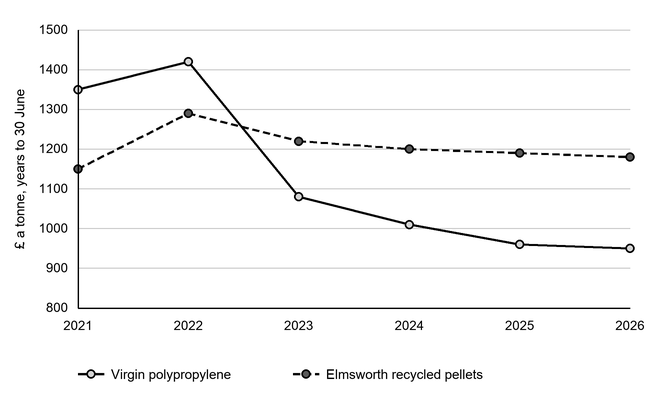
Line chart of polypropylene prices from 2021 to 2026, in pounds per tonne: virgin falls to £950 in 2026, while Elmsworth’s recycled pellets cost £1 180; virgin is cheaper from 2023, and the gap widens to £230 a tonne by 2025.

Price of a tonne, £, years to 30 June

Two tables: the first compares the price of virgin polypropylene with Elmsworth’s recycled pellets from 2021 to 2026; the second gives Plastic Packaging Tax as £217.85 a tonne on packaging with less than 30% recycled plastic.

Source: Elmsworth Recycling

Assess the strength of the threat from substitutes that Elmsworth Recycling faces.

Calculate Elmsworth Recycling's capacity utilisation in the year to 30 June 2026 to support your answer. Give your answer to one decimal place.

2
9 marks

Source A: Co-op Group

The Co-operative Group, known as Co-op, began in Rochdale in 1844. It is a co-operative owned by its members, who can vote at its annual general meeting (AGM). Co-op says that because it is owned by its members, it "can make decisions that other businesses can't, from our Net Zero goals to our community support".

It runs more than 2 300 food stores and supplies others through Co-op Wholesale, partners and franchises, close to 8 000 stores in all. It also provides funerals, insurance and legal services.

Changes in 2025 included:

  • Prices. It price-matched over 100 everyday items to Aldi for members; these items reached 40% of members' baskets.

  • Online. Its online quick-commerce business, selling through its own website and delivery apps Uber Eats, Just Eat and Deliveroo, grew by 15%. Online services were added to 279 more stores, and 90% of the UK population can shop online with Co-op.

In April 2025 Co-op suffered a criminal cyber attack. To contain it, Co-op restricted its own computer systems, which caused shortages of goods in stores. Group revenue fell 2.3% to £11 025 million, and Co-op made an underlying operating loss of £35 million. In 2026 Co-op says its market share has returned to or passed pre-attack levels in every business area.

Its Chief Executive, Shirine Khoury-Haq, stepped down on 29 March 2026, almost seven years after joining Co-op, and Kate Allum was appointed interim Group Chief Executive.

Co-op plans to remove £200 million of annual operating costs in 2026, and has set a target of 10 million active members by 2030.

Source: Co-operative Group, Members' Annual Report 2025 and 2025 trading update

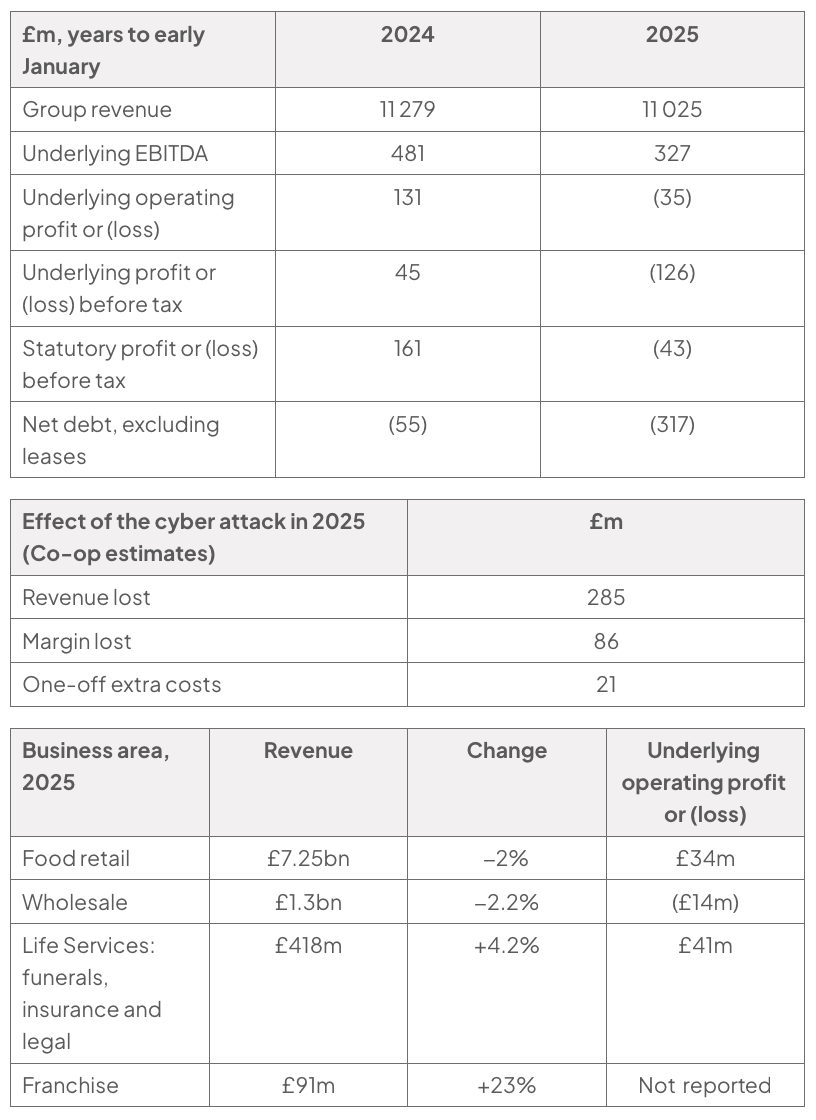
Appendix A: Co-op financial data

Three tables of Co-op data. Table 1, £m, years to early January 2024 and 2025: group revenue 11 279 and 11 025; underlying EBITDA 481 and 327; underlying operating profit or (loss) 131 and (35); underlying profit or (loss) before tax 45 and (126); statutory profit or (loss) before tax 161 and (43); net debt, excluding leases, (55) and (317). Table 2, effect of the cyber attack in 2025 (Co-op estimates), £m: revenue lost 285; margin lost 86; one-off extra costs 21. Table 3, business area in 2025, showing revenue, change and underlying operating profit or (loss): food retail £7.25bn, −2%, £34m; wholesale £1.3bn, −2.2%, (£14m); Life Services (funerals, insurance and legal) £418m, +4.2%, £41m; franchise £91m, +23%, operating profit not reported.
  • Costs. About £150m of cost increases in 2025, including £47m of regulatory costs from higher employers' National Insurance and new packaging charges, and investment in colleague pay.

  • Investment. £318m in stores and technology in 2025.

  • Distributions. Members were not asked to approve any distribution of profits for 2025.

Source: Co-operative Group

Appendix B: Markets and competition

  • Convenience. Co-op describes "a contracting convenience market" and "a competitive grocery convenience market", with "health-led consumer behaviour shifts" and cautious consumers.

  • Price. Matching over 100 items to Aldi prices reached 40% of members' baskets.

  • Online. 90% of the UK population can shop online with Co-op; member prices are available through Uber Eats, Just Eat and Deliveroo. Online services were added to 279 more stores in 2025.

  • Range. A partnership with Holland & Barrett brought its vitamins and supplements into Co-op stores; 447 new product lines were launched.

  • Buying. A new Commercial and Logistics business centralises buying for close to 8 000 stores to improve prices by "buying at scale".

  • Recovery. In 2026 Co-op says its market share has returned to or passed pre-attack levels in every business area.

Source: Analyst, using Co-operative Group

Assess whether competition in the convenience market was more important than the cyber attack in explaining the fall in Co-op's profit in 2025.

Calculate what Co-op's underlying operating profit or loss would have been in 2025 without the estimated £86m effect of the cyber attack on its margin to support your answer.

3
9 marks

Source A: Glastonbury Festival

Glastonbury Festival Events Limited organises the Glastonbury Festival of Contemporary and Performing Arts at Worthy Farm, a working dairy farm in Pilton, Somerset, where the festival has been held since 1970. The company is owned by Emily Eavis, who replaced her father, the festival's founder Michael Eavis, as the person with significant control in October 2024. Both are directors. The company employs an average of 105 people.

The company's objective is "to host an event that joyfully celebrates music and culture". It aims to keep ticket prices "as low as possible" so that the festival remains accessible, and it supports charities including Oxfam, Greenpeace and WaterAid.

The festival's licence allows up to 210 000 people on site. Tickets are sold online under three rules:

  • Registration. Everyone aged 13 or over must register before buying a ticket.

  • Photo tickets. Each ticket carries the holder's photo and cannot be transferred.

  • One ticket agent. Tickets are sold only through See Tickets and are "not available for sale on any secondary sales sites".

Every five or six years the festival takes a fallow year, with no festival, so that the farmland can recover. 2026 is a fallow year, and the company expects "a significant cost". Tickets for the 2027 festival went on sale in October 2026.

The company finances its operations through retained profits and paid no dividends. It describes its main risk as cancellation because of "extremely bad weather or a global pandemic". In the year to March 2025 it spent £3.5 million buying land to "protect the future of the Festival".

Source: Glastonbury Festival Events Limited, annual report and financial statements for the year ended 31 March 2025, and press reports

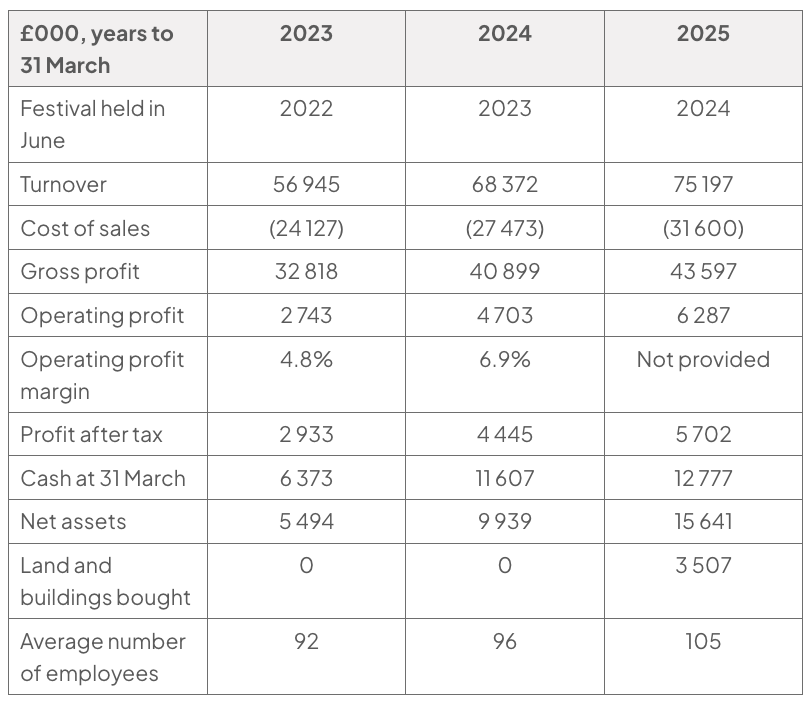
Appendix A: Glastonbury Festival financial data

Table of Glastonbury Festival financial data in £000 for years to 31 March 2023, 2024 and 2025, covering turnover, profits, cash, net assets, land and buildings bought, and average employees.
  • Charitable donations: £1.9m in 2023, £5.2m in 2024 (including £2m to NHS Somerset) and over £2.7m in 2025.

  • Cash. Since 2009 the company has kept its profits "to provide a float for the next year's Festival as well as mitigate the potential impact of unforeseen events". All tickets are paid for in advance, and most ticket money is held in a separate account until after the festival.

  • Covid. The festival was cancelled in 2020 and could not be held in 2021. The company says "the cash reserves were significantly depleted post COVID".

Source: Glastonbury Festival Events Limited

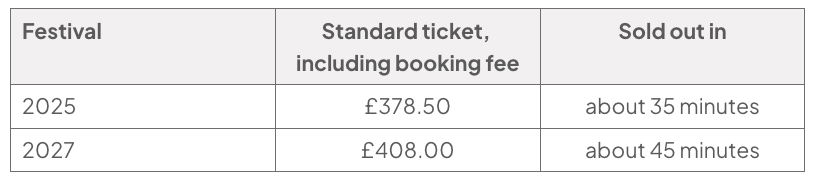
Appendix B: Tickets and the UK festival market

Table comparing standard ticket prices and sell-out times: 2025, £378.50 including booking fee, sold out in about 35 minutes; 2027, £408.00, sold out in about 45 minutes.
  • 2027 tickets went on sale on 4 October 2026, before any performers were announced. Buyers paid a £100 deposit, with the balance due in April 2027.

  • Capacity. The festival's licence allows up to 210 000 people on site, including staff and performers. The company describes "demand for tickets far outweighing supply".

  • Scale. Over 4 000 performances on more than 100 stages, and nearly 900 traders.

  • Performers' fees. Rod Stewart said he was paid about £120 000 to perform in 2025, and that bringing his band and equipment from America cost him about £300 000.

  • Other festivals. The Association of Independent Festivals reported in June 2025 that 39 UK festivals had been cancelled, postponed or closed that year, and 249 since 2019. Festival Republic, majority-owned by Live Nation, runs Reading & Leeds, Latitude and Wireless.

Source: Analyst, using Glastonbury Festival Events Limited, the Association of Independent Festivals and press reports

Assess whether Glastonbury faces strong competitive forces.

Calculate Glastonbury Festival Events Limited's operating profit margin for the year to 31 March 2025 to support your answer. Give your answer to one decimal place.

4
9 marks

Source B: Elvaston Food Hub

Elvaston Food Hub Limited is a private limited company, founded in Derby in 2017. It sells fresh food online from 60 farms and producers in Derbyshire and Nottinghamshire, all within 40 miles of Derby, and employs 38 people. Its range includes:

  • fruit and vegetables

  • meat and dairy products

  • bread

Customers order through the company's website and app, which records each customer's order history. They choose a delivery slot at least one day ahead, and food is delivered within 15 miles of Derby. Elvaston buys from its producers only what customers have ordered.

All deliveries are made by electric van; the last of the company's diesel vans was replaced in 2025. Electric vans cost more to buy than diesel vans, but less to run. Food is delivered in reusable crates, which customers return.

In a customer survey, most customers said they buy from Elvaston mainly because its food is local.

The company faces two main pressures:

  • Speed. Supermarkets and delivery apps in Derby offer grocery deliveries within one hour.

  • Price. Elvaston's prices are higher than supermarket prices for most products.

Its directors are considering whether to launch a lower-priced range.

Source: Elvaston Food Hub

Appendix D: Elvaston Food Hub selected data

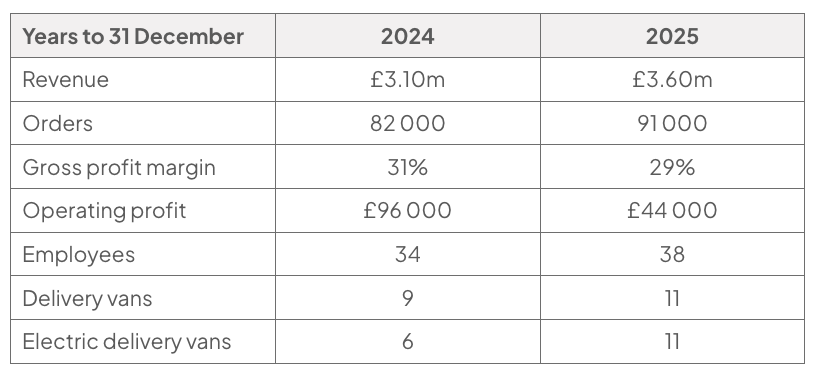
Table of Elvaston Food Hub selected data for the years to 31 December 2024 and 2025: revenue £3.10m and £3.60m; orders 82 000 and 91 000; gross profit margin 31% and 29%; operating profit £96 000 and £44 000; employees 34 and 38; delivery vans 9 and 11; electric delivery vans 6 and 11.

Source: Elvaston Food Hub

Appendix E: Customers and competition

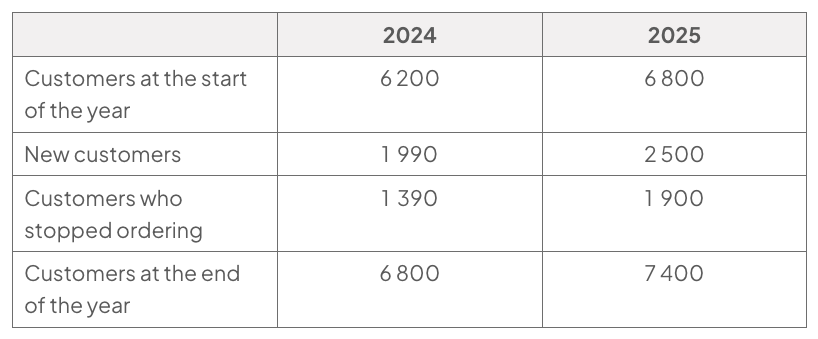
Customer table for 2024 and 2025: customers at the start of the year 6 200 and 6 800; new customers 1 990 and 2 500; customers who stopped ordering 1 390 and 1 900; customers at the end of the year 6 800 and 7 400.
  • Why customers stopped, 2025 survey: price 41%; wanted faster delivery 23%; moved away 14%; other reasons 22%.

  • Price. A basket of 30 products cost 18% more from Elvaston than from the nearest large supermarket.

  • Speed. Supermarkets and delivery apps in Derby offer deliveries within one hour.

Source: Elvaston Food Hub

Assess whether faster delivery by rivals is the biggest competitive threat to Elvaston Food Hub.

Calculate Elvaston Food Hub's operating profit margin in 2025 to support your answer. Give your answer to one decimal place.

5
9 marks

Source A: Card Factory

Card Factory plc is a UK retailer of greeting cards, gifts and party products, listed on the London Stock Exchange. It employs about 10 000 people and has its own printing business, Printcraft. It sells through three channels:

  • Stores. 1 117 stores in the UK and the Republic of Ireland.

  • Online. Its own website, cardfactory.co.uk, and Funky Pigeon.

  • Wholesale partnerships. Supplying other retailers, including Aldi.

In August 2025 Card Factory bought Funky Pigeon, an online card business, from WH Smith for £25.7 million, making it "the second largest online UK card and attached gift retailer". Moonpig Group is a larger online rival. Card Factory plans to run both websites on one shared platform, saving at least £5 million a year from 2027/28.

In the year to 31 January 2026 revenue rose by 7.4% to £582.7 million, but profit and the gross profit margin both fell. Like-for-like sales on cardfactory.co.uk also fell. In December 2025 the company warned that profit would be lower than expected.

The company faces two main pressures:

  • Wage costs. Changes to the National Living Wage and employers' National Insurance from April 2025 added an estimated £15 million to its wage costs. In response, it cut store hours by 9% and used fewer temporary and seasonal staff.

  • Consumer confidence. The company reported weak consumer confidence, "particularly among lower-income demographics".

Card Factory has trialled an artificial intelligence system that manages energy use in about 200 stores, with a rollout to 800 planned. It is also replacing its diesel vans with plug-in hybrids.

Source: Card Factory plc, results for the year ended 31 January 2026 and half-year results to 31 July 2026

Appendix A: Card Factory financial data

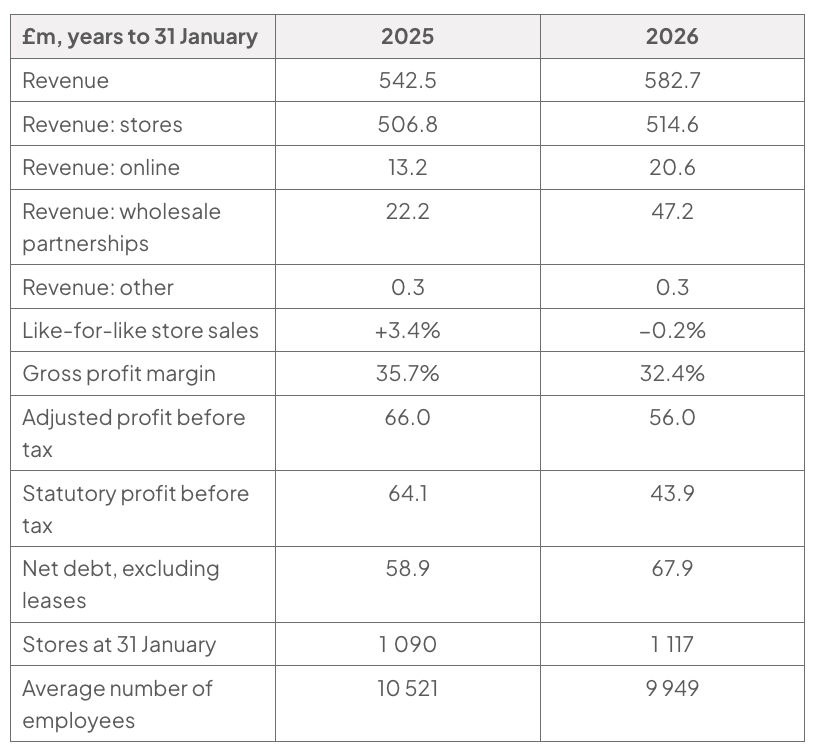
Table of Card Factory financial data in £m for the years to 31 January 2025 and 2026: revenue 542.5 and 582.7; revenue from stores 506.8 and 514.6; revenue online 13.2 and 20.6; revenue from wholesale partnerships 22.2 and 47.2; other revenue 0.3 and 0.3; like-for-like store sales +3.4% and −0.2%; gross profit margin 35.7% and 32.4%; adjusted profit before tax 66.0 and 56.0; statutory profit before tax 64.1 and 43.9; net debt, excluding leases, 58.9 and 67.9; stores at 31 January 1 090 and 1 117; average number of employees 10 521 and 9 949.
  • Like-for-like store sales compare stores open in both years. In 2025/26 the number of customer transactions fell 3.7%, while the average basket rose 3.5%.

  • Online. 2025/26 online revenue includes £13.5m from Funky Pigeon. Like-for-like sales on cardfactory.co.uk fell 19.9%.

  • Half year to 31 July 2026. Revenue £260.8m, up from £247.6m; online revenue £16.0m, up from £3.2m. Like-for-like store sales fell 2.0%. Stores were 87% of revenue.

Source: Card Factory plc

Appendix B: Competition and growth

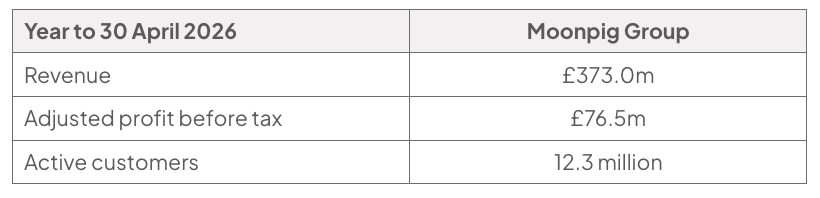
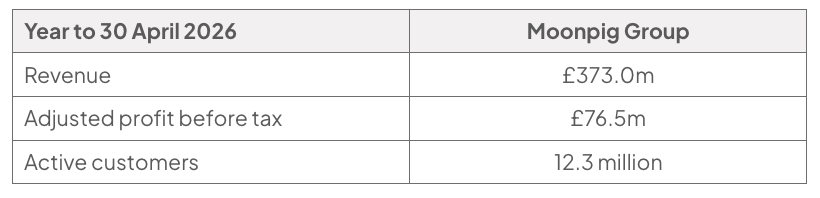
Table of Moonpig Group data for the year to 30 April 2026: revenue £373.0m, adjusted profit before tax £76.5m and 12.3 million active customers.
  • Customers. Card Factory serves 24 million different customers a year in its stores.

  • Funky Pigeon. Card Factory wrote off its old cardfactory.co.uk technology platform (£3.2m) and plans to run both websites on one shared platform, saving at least £5m a year from 2027/28.

  • Wholesale and international. Partners include Aldi in the UK and Ireland, The Reject Shop in Australia and a US retailer with more than 1 100 stores. In December 2024 Card Factory bought Garven, a US business, for 25 million US dollars. Its South African partner, SA Greetings, is "performing behind our expectations".

Source: Analyst, using Card Factory plc and Moonpig Group plc

Assess whether Card Factory can compete effectively with online card retailers.

Calculate Card Factory's sales per employee in 2026 to support your answer. Give your answer to the nearest pound.

1
15 marks

Source B: Draycote Soap Co

Draycote Soap Co Limited makes solid shampoo bars, conditioner bars and soaps by hand in a workshop near Rugby, Warwickshire. It was founded in 2016 by Hannah Okafor, who began making soap at her kitchen table; she remains its Managing Director and sole owner. The company employs 14 people. Its products contain no palm oil, are sold without any plastic packaging, and have an average customer rating of 4.8 out of 5 from more than 6 000 reviews.

The company sells through five channels:

  • Its own website, where a shampoo bar costs £8.50.

  • Amazon.

  • About 240 independent shops, many of which specialise in reducing waste.

  • Markets and fairs.

  • TikTok Shop, since 2024/25, where people who post videos of its products earn a commission on each sale they generate.

All of its staff are paid at least the Real Living Wage, a voluntary rate set by the Living Wage Foundation which is higher than the legal minimum wage. Several large distribution warehouses close to the workshop also recruit local staff. Every product is packed in a card box which costs 11p, compared with about 4p for a plastic wrapper.

Supermarkets have begun to sell their own-label shampoo bars, priced from about £3. Lush, a much larger business with its own shops, has sold solid shampoo bars for many years. In 2026 a national supermarket chain offered Draycote Soap Co a three-year contract to make shampoo bars to be sold under the supermarket's own label.

Source: Draycote Soap Co

Appendix D: Competing for solid toiletries

  • Own-label bars. Several supermarkets now sell their own-label shampoo bars, priced from about £3, alongside their liquid shampoos.

  • Specialist rivals. Lush sells solid shampoo bars in its own shops and online. The Body Shop is considering selling its products through other retailers such as Boots, and supplying miniature products to hotels.

  • Social media. TikTok Shop, which lets viewers buy products shown in videos without leaving the app, launched in the UK in 2021. Sellers pay commission to the people who post the videos and a fee to TikTok.

  • Independent shops. Shops which specialise in reducing waste buy from small producers and expect products that are not sold in supermarkets.

Source: Analyst

Appendix E: Draycote Soap Co selected data

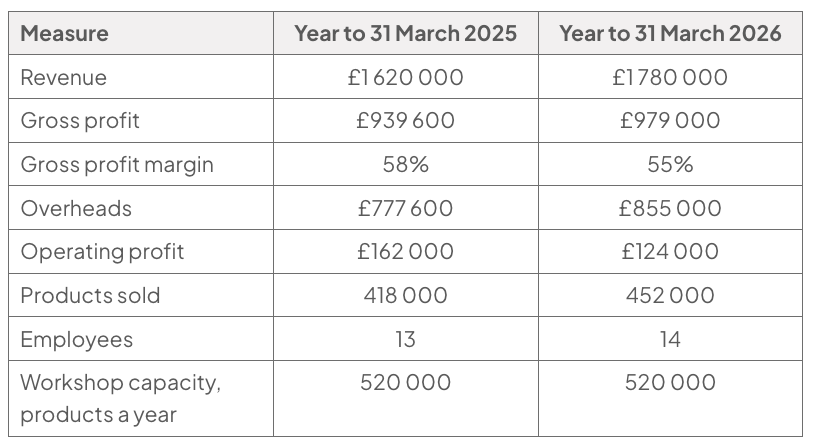
Table comparing 2025 and 2026: revenue £1.62m/£1.78m, gross profit £939 600/£979 000, margin 58%/55%, overheads £777 600/£855 000, operating profit £162 000/£124 000, products 418 000/452 000, employees 13/14 and capacity 520 000 each year.

Source: Draycote Soap Co

Appendix F: Where Draycote Soap Co's sales come from

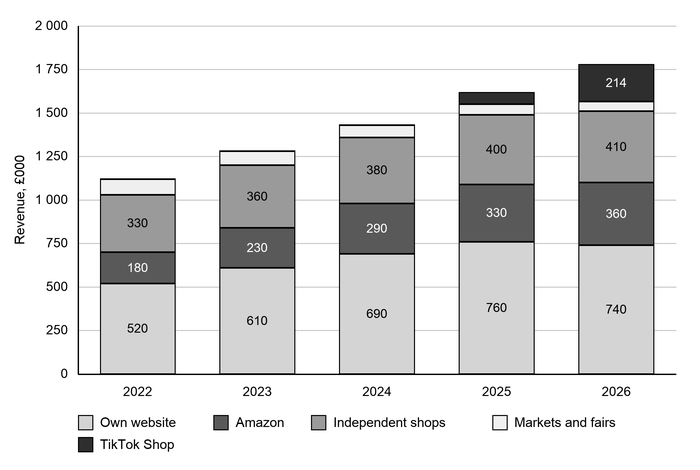
Stacked bar chart of Draycote Soap Co revenue by channel, 2022 to 2026, in £000 (vertical scale 0 to 2 000). Total revenue rises each year; own website is largest, while TikTok Shop appears in 2025 and grows sharply in 2026.

Revenue by channel, £000, years to 31 March

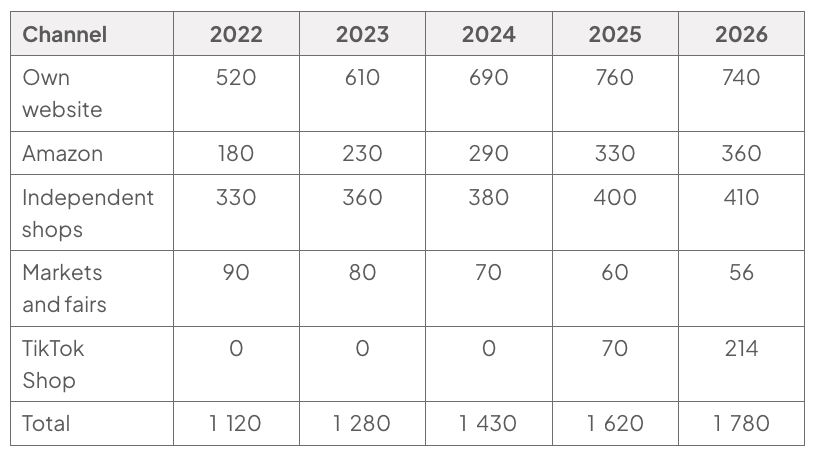
Table of revenue by sales channel (£000) for the years to 31 March 2022 to 2026: own website 520, 610, 690, 760 and 740; Amazon 180, 230, 290, 330 and 360; independent shops 330, 360, 380, 400 and 410; markets and fairs 90, 80, 70, 60 and 56; TikTok Shop 0, 0, 0, 70 and 214; total 1 120, 1 280, 1 430, 1 620 and 1 780.

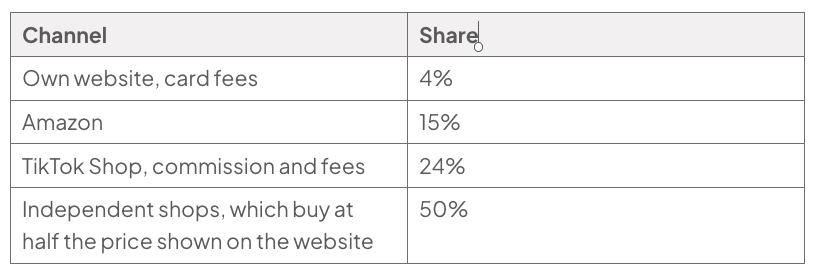
Share of the selling price taken by fees and commission, 2026

Table of Draycote’s 2026 selling-price share: own website, card fees 4%; Amazon 15%; TikTok Shop, commission and fees 24%; independent shops buying at half website price 50%.

Source: Draycote Soap Co

Appendix G: The supermarket's offer

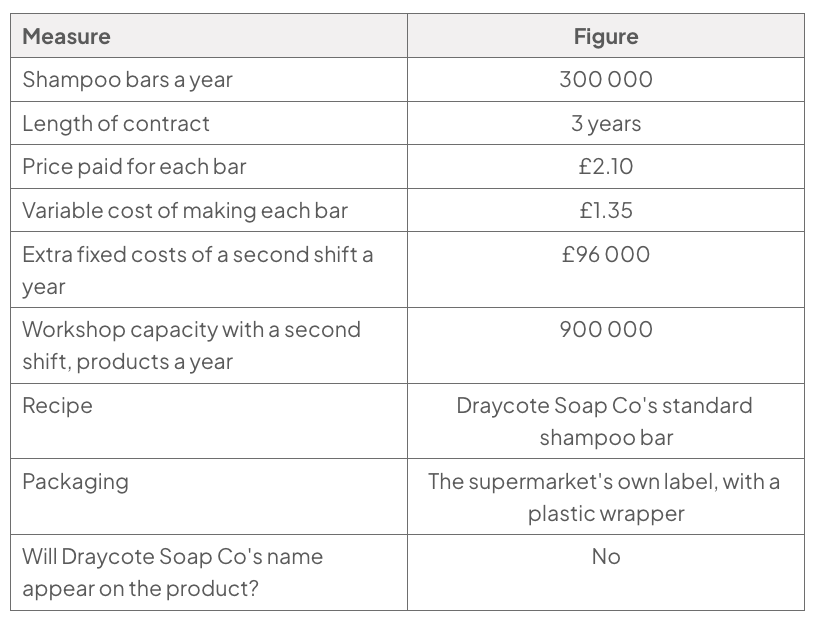
Two-column table outlining the supermarket offer: 300 000 bars annually for three years at £2.10 each, £1.35 variable cost, £96 000 extra annual fixed costs and 900 000-bar capacity. Packaging is plastic own-label with no Draycote name.

Source: Draycote Soap Co

Appendix H: Three ways to respond to competition

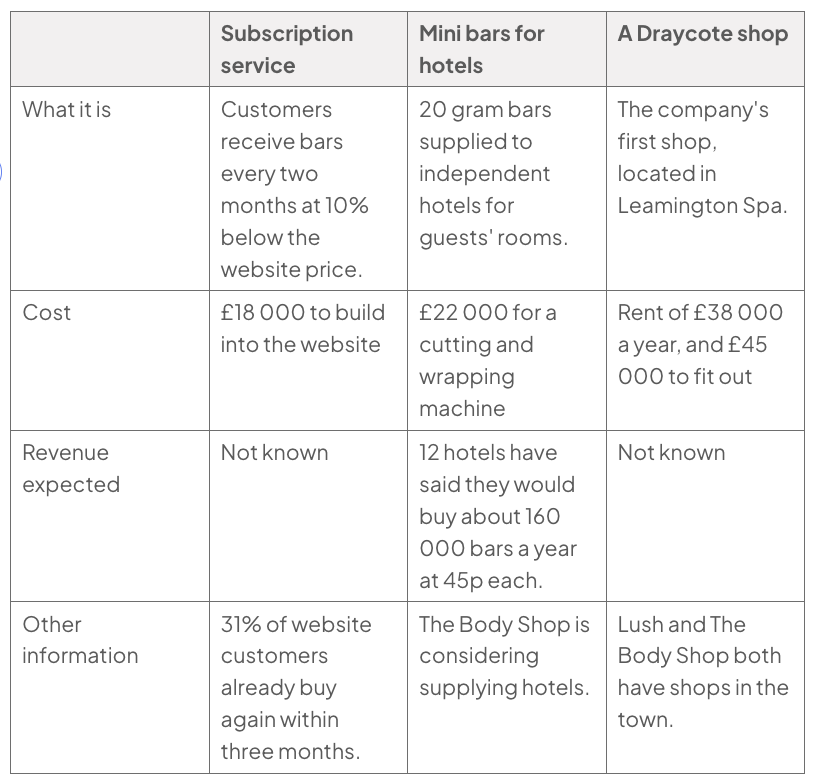
Comparison table assessing three responses to competition (subscription service, mini bars for hotels and a Draycote shop) across what each is, cost, expected revenue and other relevant information.

Source: Draycote Soap Co

Supermarkets now sell own-label shampoo bars from about £3, and The Body Shop is considering selling its products through other retailers.

Evaluate two ways Draycote Soap Co could respond to increasing competition and recommend which one it should do first.

Use information from Appendices D to H to support your answer.

2
15 marks

Source A: Wickes

Wickes Group plc is a UK home improvement retailer listed on the London Stock Exchange. It became an independent company in 2021, when it separated from Travis Perkins. It has 230 stores and about 7 800 employees, and serves three groups of customers:

  • Tradespeople, through its TradePro membership scheme. Sales to TradePro members rose in 2025.

  • Do-it-yourself customers.

  • Design & Installation customers, whose kitchens and bathrooms it designs and fits.

It reports a "market-leading price position" against its wider peer group.

Wickes describes itself as "a digitally-led, service-enabled home improvement retailer". Two-thirds of its sales are digitally enabled, but 96% are fulfilled from its stores. Wickes has cut the time to prepare a Click & Collect order from 30 minutes to 15 minutes, and Wickes Rapid delivers orders of up to 800kg to a home or building site within three hours. Its strategy rests on seven "growth levers", including winning trade customers, digital capability and store investment.

Several rivals, including Homebase, have left the market since 2023. Homebase went into administration at the end of 2024, and Carpetright, CTD Tiles and Wilko have also left. Four of Wickes's five new stores in 2025 were former Homebase stores, and it employed 54 former Homebase staff.

In March 2026 the chief executive, David Wood, announced an ambition to reach 300 stores, creating more than 2 000 new jobs. Wickes plans 4 to 5 new stores in 2026, 7 to 9 in 2027 and at least 10 a year from 2028. It reports "ever-increasing demand for prime retail locations".

Source: Wickes Group plc, results for the year ended December 2025, annual report 2025 and half-year results 2026

Appendix A: Wickes financial data

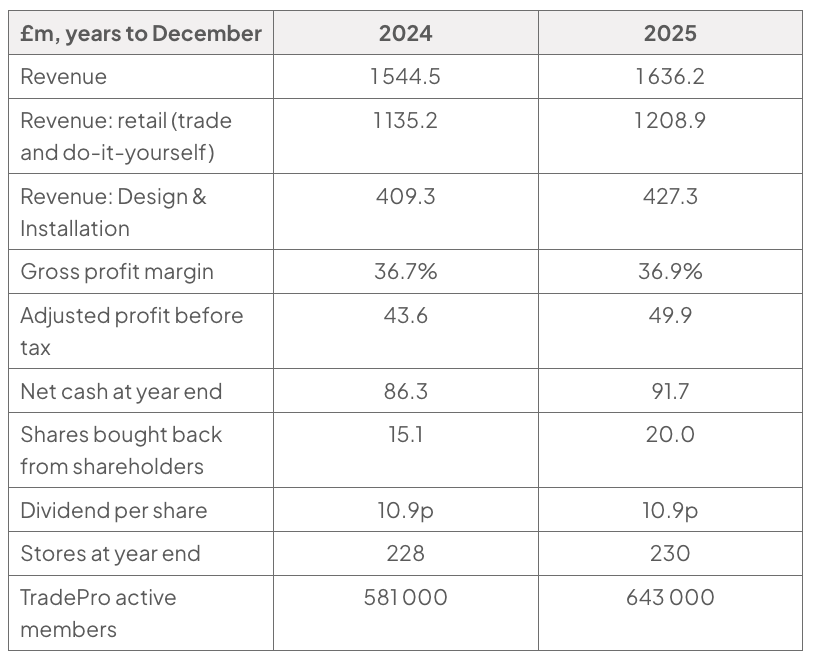
Table of Wickes financial data for years ending December 2024 and 2025, comparing revenue, margins, profit, cash, buybacks, dividends, stores and TradePro membership.
  • 2024 figures are restated on the 2025 basis.

  • TradePro. Sales to TradePro members rose 9% in 2025; growth in members "was partially offset by a slight decline in average basket size".

  • Half year to June 2026. Revenue rose 2.1% to £865.3m. Like-for-like sales, from stores open in both periods, fell 0.3% in retail and rose 3.6% in Design & Installation. Retail prices were cut by 2.4%. Very heavy rain hit outdoor sales early in the year.

Source: Wickes Group plc

Appendix B: The market and competition

  • Market. Wickes estimates its market at about £35bn and its share at "around 5%".

  • Rivals leaving. Homebase went into administration at the end of 2024; Carpetright, CTD Tiles and Wilko have also left the market. Four of Wickes's five new stores in 2025 were former Homebase stores, and it employed 54 former Homebase staff.

  • Price. "We maintain a market-leading price position against our wider peer group." Its strategy is "everyday low pricing with limited use of targeted promotions".

  • Stores. Wickes plans 4 to 5 new stores in 2026, 7 to 9 in 2027 and at least 10 a year from 2028. It reports "ever-increasing demand for prime retail locations".

  • Costs. Wickes expected higher employers' National Insurance from April 2025 to add about £6m a year to its costs.

Source: Analyst, using Wickes Group plc

Appendix C: Digital and Design & Installation

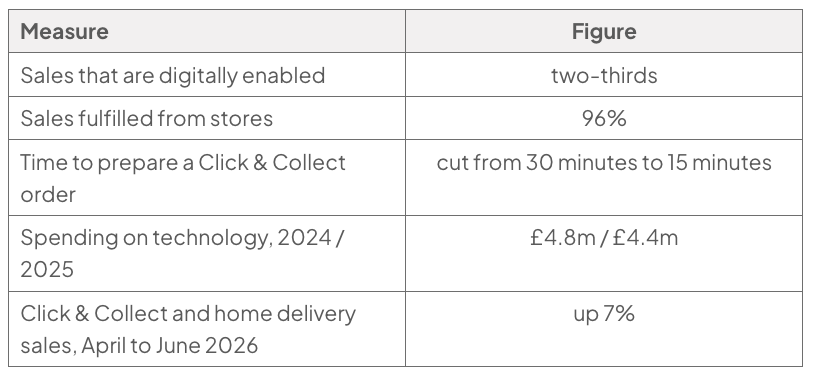
Table of Wickes digital measures: digitally enabled sales two-thirds; store-fulfilled sales 96%; Click & Collect preparation cut from 30 to 15 minutes; technology spending £4.8m in 2024 to £4.4m in 2025; Click & Collect and home-delivery sales up 7% in April to June 2026.
  • Wickes Rapid delivers orders of up to 800kg to a home or building site within three hours, from a range of more than 10 000 products.

  • Design & Installation. In 2024 revenue fell as customers cut back on large purchases. Wickes added about 160 Design Consultants, replaced two separate kitchen services with one, and replaced "a more cumbersome telephone booking system" with instant online booking.

  • 2026. "Orders for Wickes Bespoke Kitchens have been in slight decline, as customers are being more considered for larger purchases."

  • Plans changed in 2026. The plan to refit or refresh 15 to 20 stores in 2026 was cut to 12. A new order management system, planned in two phases in 2026 and 2027, will now be introduced "from 2027".

Source: Wickes Group plc

Evaluate two ways Wickes could respond to the exit of rivals such as Homebase and recommend which one it should choose.

3
15 marks

Source A: Card Factory

Card Factory plc is a UK retailer of greeting cards, gifts and party products, listed on the London Stock Exchange. It employs about 10 000 people and has its own printing business, Printcraft. It sells through three channels:

  • Stores. 1 117 stores in the UK and the Republic of Ireland.

  • Online. Its own website, cardfactory.co.uk, and Funky Pigeon.

  • Wholesale partnerships. Supplying other retailers, including Aldi.

In August 2025 Card Factory bought Funky Pigeon, an online card business, from WH Smith for £25.7 million, making it "the second largest online UK card and attached gift retailer". Moonpig Group is a larger online rival. Card Factory plans to run both websites on one shared platform, saving at least £5 million a year from 2027/28.

In the year to 31 January 2026 revenue rose by 7.4% to £582.7 million, but profit and the gross profit margin both fell. Like-for-like sales on cardfactory.co.uk also fell. In December 2025 the company warned that profit would be lower than expected.

The company faces two main pressures:

  • Wage costs. Changes to the National Living Wage and employers' National Insurance from April 2025 added an estimated £15 million to its wage costs. In response, it cut store hours by 9% and used fewer temporary and seasonal staff.

  • Consumer confidence. The company reported weak consumer confidence, "particularly among lower-income demographics".

Card Factory has trialled an artificial intelligence system that manages energy use in about 200 stores, with a rollout to 800 planned. It is also replacing its diesel vans with plug-in hybrids.

Source: Card Factory plc, results for the year ended 31 January 2026 and half-year results to 31 July 2026

Appendix A: Card Factory financial data

Table of Card Factory financial data in £m for the years to 31 January 2025 and 2026: revenue 542.5 and 582.7; revenue from stores 506.8 and 514.6; revenue online 13.2 and 20.6; revenue from wholesale partnerships 22.2 and 47.2; other revenue 0.3 and 0.3; like-for-like store sales +3.4% and −0.2%; gross profit margin 35.7% and 32.4%; adjusted profit before tax 66.0 and 56.0; statutory profit before tax 64.1 and 43.9; net debt, excluding leases, 58.9 and 67.9; stores at 31 January 1 090 and 1 117; average number of employees 10 521 and 9 949.
  • Like-for-like store sales compare stores open in both years. In 2025/26 the number of customer transactions fell 3.7%, while the average basket rose 3.5%.

  • Online. 2025/26 online revenue includes £13.5m from Funky Pigeon. Like-for-like sales on cardfactory.co.uk fell 19.9%.

  • Half year to 31 July 2026. Revenue £260.8m, up from £247.6m; online revenue £16.0m, up from £3.2m. Like-for-like store sales fell 2.0%. Stores were 87% of revenue.

Source: Card Factory plc

Appendix B: Competition and growth

Table of Moonpig Group data for the year to 30 April 2026: revenue £373.0 million, adjusted profit before tax £76.5 million and 12.3 million active customers.
  • Customers. Card Factory serves 24 million different customers a year in its stores.

  • Funky Pigeon. Card Factory wrote off its old cardfactory.co.uk technology platform (£3.2m) and plans to run both websites on one shared platform, saving at least £5m a year from 2027/28.

  • Wholesale and international. Partners include Aldi in the UK and Ireland, The Reject Shop in Australia and a US retailer with more than 1 100 stores. In December 2024 Card Factory bought Garven, a US business, for 25 million US dollars. Its South African partner, SA Greetings, is "performing behind our expectations".

Source: Analyst, using Card Factory plc and Moonpig Group plc

Appendix C: Costs, technology and responsibility

Table of store and warehouse wages (£m, years to 31 January): £134.4 million in 2025 and £143.3 million in 2026.
  • Wage costs. The £15m rise from April 2025 was partly offset by a 9% cut in store hours and fewer temporary and seasonal staff. Card Factory says it has absorbed "£60m+" of cost increases in three years; its efficiency programme saved £21m in 2025/26.

  • Currency. About half its inventory is bought in US dollars from suppliers in the Far East. Its US dollar needs for 2026/27 are fully hedged, fixing the exchange rate in advance.

  • Technology. An artificial intelligence system that manages energy use was trialled in about 200 stores, with a rollout to 800 planned. New tills were installed in 2025/26.

  • Environment. Cellophane wrap has been removed from all own-label gift wrap rolls, and bubble wrap from Printcraft. Diesel vans are being replaced by plug-in hybrids.

  • Charity. The Card Factory Foundation received £1.4m from carrier bag sales in 2024/25.

Source: Card Factory plc

Evaluate whether Card Factory should focus on growing its online business or its wholesale partnerships to compete in the UK cards and gifts market.