Technology in Operations (AQA A Level Business): Exam Questions

Exam code: 7132

Syllabus Edition

First teaching 2026

First exams 2028

2 hours15 questions
1
6 marks

Source B: Dyson

Dyson designs and sells vacuum cleaners, hair care products, air purifiers and robots. It began in the United Kingdom, it is privately owned by its founder's family, and its global headquarters is now in Singapore. It employs over 14 500 people worldwide.

The company competes by inventing things other manufacturers have not, and then stopping them from copying it. In 2025 it spent more than £400 million on research and development, including on artificial intelligence and machine learning, and filed 252 patents to protect what it had invented. It filed 238 the year before. In the same year it launched 13 new products, more than in any previous year.

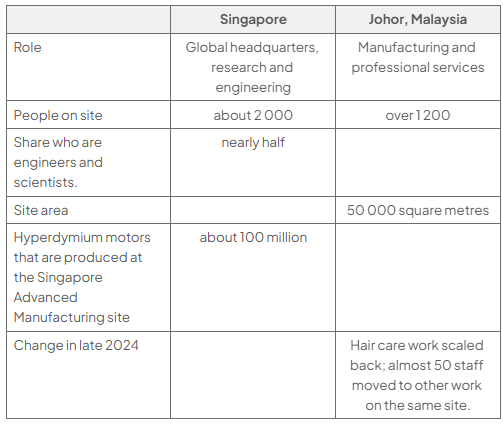
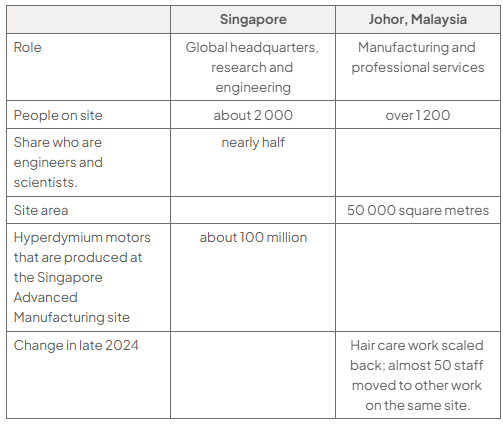
Dyson designs in one place and makes in another. Around 2 000 people work in Singapore, nearly half of them engineers and scientists, and its Singapore Advanced Manufacturing site has produced roughly 100 million of the Hyperdymium motors that go inside its machines. In Johor, Malaysia, it has a 50 000 square metre site with over 1 200 professionals. In late 2024 it scaled back the hair care work in Malaysia and moved almost 50 staff to other work on the same site.

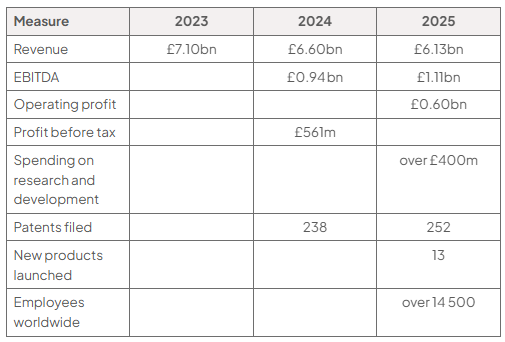
Trading has been hard. Revenue fell from £7.1 billion in 2023 to £6.6 billion in 2024 and £6.13 billion in 2025, and tariffs and movements in exchange rates both hurt. Even so, earnings before interest, tax, depreciation and amortisation rose 18% in 2025 to £1.11 billion and operating profit rose 15% to £0.6 billion.

Getting a new machine from an idea to a shop shelf is a project with many stages, and some of those stages cannot start until others have finished.

Source: Dyson financial results for 2024 and 2025

Appendix F: Where Dyson designs and where it makes

Table comparing Dyson’s Singapore and Johor sites: Singapore has about 2,000 staff, nearly half engineers and scientists, and produces about 100 million Hyperdymium motors; Johor covers 50,000 square metres and employs over 1,200 people.

Source: Dyson

Analyse one way in which automating the production of its motors might affect Dyson's competitiveness.

2
6 marks

Source B: Rolls-Royce

Rolls-Royce makes the engines that power large passenger aircraft, equipment that generates electricity, and nuclear systems for submarines. It is one of a very small number of companies in the world that can design a large civil aero engine at all.

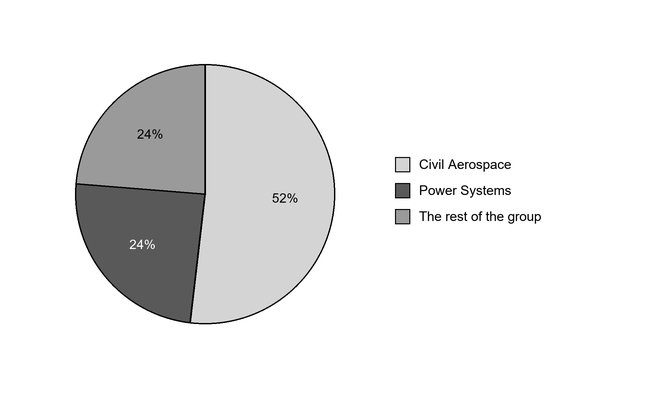
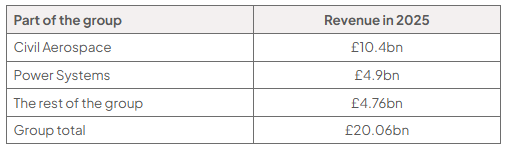
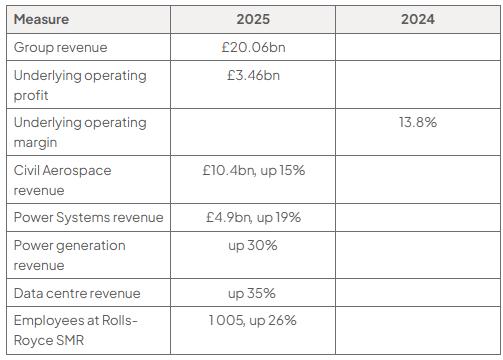
The business has recovered strongly. In 2025 group revenue reached £20.06 billion and underlying operating profit £3.46 billion, lifting the underlying operating margin to 17.3% from 13.8% the year before. Civil Aerospace revenue rose 15% to £10.4 billion, helped by more engines coming in for overhaul. Power Systems revenue rose 19% to £4.9 billion, with power generation up 30% and the part of it that supplies data centres up 35%.

Almost everything Rolls-Royce does takes a very long time. A new civil aero engine is designed, tested, certified by regulators and then flown for decades, and the company spends the money years before any of it comes back. Its UltraFan technology programme is developing the next generation of ducted engine.

It is also trying to build something it has never built before. Rolls-Royce SMR is developing a small modular reactor: a nuclear power station small enough that most of it can be made in a factory and delivered to site, rather than built from scratch in the open. The idea is that making the same thing many times is cheaper and more predictable than building each one by hand. The unit employed 1 005 people and grew its headcount 26% in a year. It was treated as a separate company in the 2025 results rather than being consolidated into the group.

The question that follows is how to make them: in one large factory that Rolls-Royce owns and controls, or through a network of suppliers.

Source: Rolls-Royce Holdings plc 2025 full year results

Appendix F: Where Rolls-Royce's revenue comes from

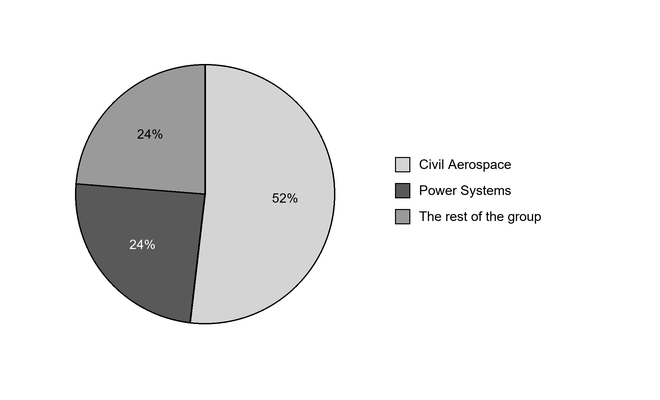
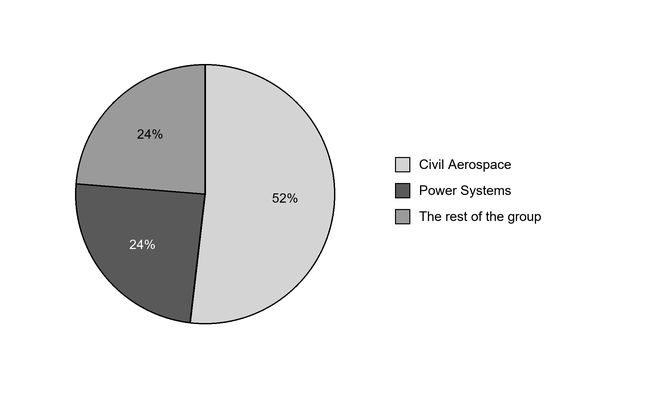
Pie chart showing Rolls-Royce’s 2025 group revenue by segment: Civil Aerospace 52%, Power Systems 24%, and the rest of the group 24%.
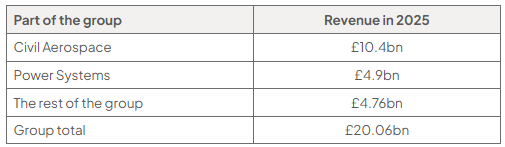
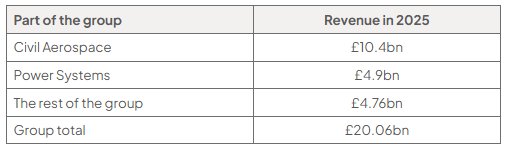
Table of Rolls-Royce group revenue in 2025: Civil Aerospace £10.4bn, Power Systems £4.9bn, the rest of the group £4.76bn, and group total £20.06bn.

Source: Rolls-Royce Holdings plc

Analyse one way in which supplying engines to data centres might affect Rolls-Royce's competitiveness.

3
6 marks

Source B: Arm Holdings

Arm designs the processors at the centre of almost every mobile phone in the world, and increasingly of the computers in data centres and cars. It does not make a single chip. It designs them, licenses those designs to companies such as Apple, Qualcomm and Nvidia, and then collects a royalty on every chip those companies ship.

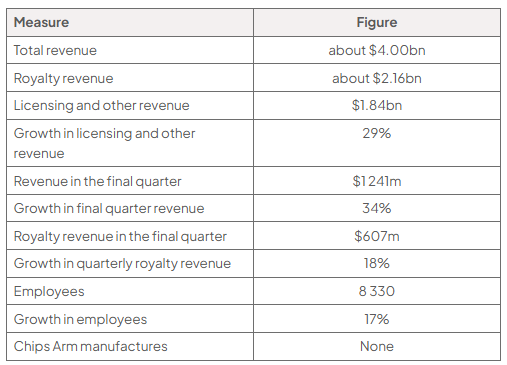
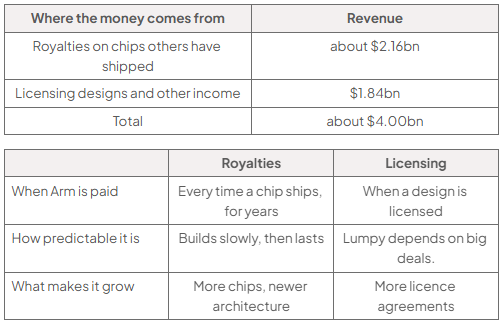
That is an unusual way to run a technology business, and a very profitable one. In the financial year to March 2025 Arm's revenue passed $4 billion for the first time. Royalties brought in about $2.16 billion and licensing about $1.84 billion, up 29%. In the final quarter alone revenue rose 34% to a record $1 241 million, with royalty revenue up 18% to $607 million as customers moved to the newer Armv9 architecture and as Arm-based chips spread through data centres. Headcount reached 8 330, up 17%.

Because Arm does not manufacture, almost everything it spends goes on people and on the years of design work before a single chip exists. A new processor architecture is designed, verified, licensed, built into a customer's own chip, manufactured by a third party and only then sold, by which time several years have passed and the royalties begin.

Much of the testing of a new design is done automatically, by computers running simulations of how the processor will behave. In 2020 Arm began moving most of this computing from its own data centres to cloud servers run by Amazon Web Services, with the aim of reducing the computing capacity it keeps on its own premises by 80%. Arm reported that the design and testing work it had moved was running six times faster.

The question the company is asked repeatedly is whether it should go further. It could design and sell complete chips itself rather than licensing the designs to others. That would earn far more for each chip. It would also mean competing with the customers who currently pay it.

Source: Arm Holdings plc results for the financial year ended 31 March 2025 and Arm newsroom, December 2020

Appendix E: Selected data for Arm Holdings, year to 31 March 2025

Table of Arm Holdings figures: total revenue about 4.00 billion US dollars; royalty revenue about 2.16 billion US dollars; licensing and other revenue 1.84 billion US dollars, up 29%; revenue in the final quarter 1 241 million US dollars, up 34%; royalty revenue in the final quarter 607 million US dollars, up 18%; 8 330 employees, up 17%; Arm manufactures no chips.

Source: Arm Holdings plc

Analyse one way in which automating the testing of its designs on cloud computing might affect Arm's competitiveness.

4
6 marks

Source B: Quenby Instruments Ltd

Quenby Instruments Ltd designs and builds bedside patient monitors for hospitals from a single site in Leicester. It employs 140 people, had revenue of £21.5 million in the year to March 2025 and an operating profit of £1.6 million. Nine out of ten of its monitors are sold to NHS trusts.

For the past three years a team of eleven engineers has been developing a sensor that measures a patient's oxygen level continuously rather than every few minutes. Quenby has spent £2.9 million on it, has filed a patent application in the United Kingdom, and believes two competitors are working on something similar.

Nothing can be sold until the regulator approves it. A medical device cannot reach a ward in Britain without approval, and approval cannot be hurried: the file has to be complete, the testing has to be finished, and the regulator takes as long as it takes. On Quenby's own project plan, obtaining approval is the single longest activity and sits squarely on the critical path.

Everything else is ready to move. The prototypes work. The assembly line can be built in twelve weeks and there is time in hand to do it. The sales team can be trained in a month. All of it waits on one activity that Quenby does not control.

Abbie Thornton, who runs the project, has told the board that the company has two realistic ways of reaching hospitals sooner, and that neither of them is comfortable.

Source: Quenby Instruments Ltd

Appendix F: The new sensor, how it is protected and how it will be assembled

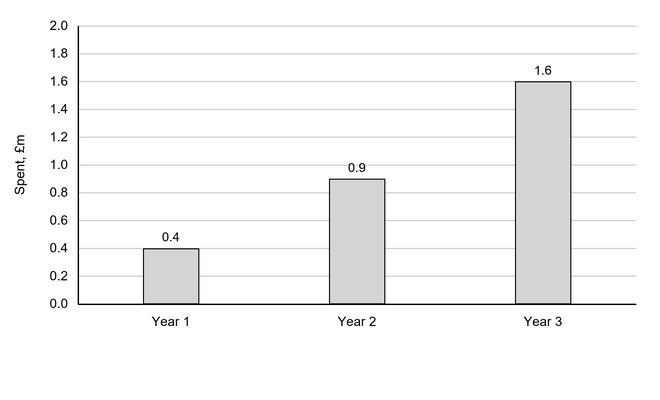
Spending on developing the new sensor

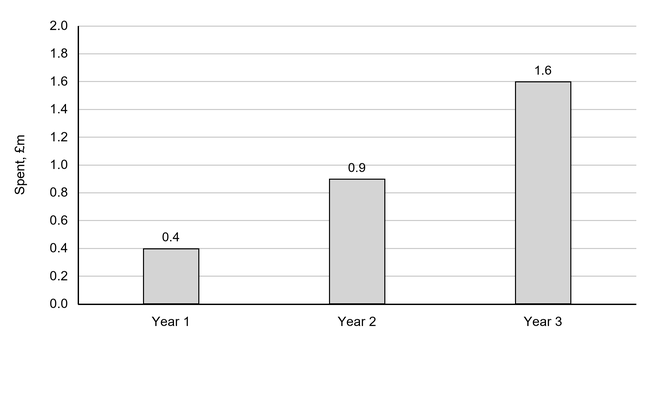
Bar chart of sensor development spending, increasing from £0.4 million in Year 1 to £0.9 million in Year 2 and £1.6 million in Year 3; vertical axis ranges from £0 to £2 million.
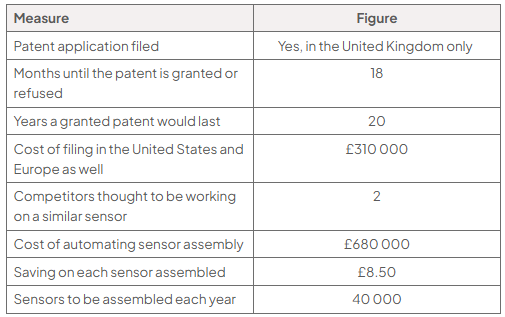
Table of patent and assembly figures: UK application filed; decision in 18 months; patent lasts 20 years; overseas filing costs £310 000; 2 competitors; automation costs £680 000; saving £8.50 per sensor; 40 000 yearly.

Source: Analyst

Analyse one way in which automating sensor assembly might affect Quenby Instruments Ltd's unit costs.

5
6 marks

Source B: Oxford Nanopore Technologies

Oxford Nanopore Technologies makes devices that read DNA by passing a single strand of it through a hole a few atoms wide. It spent more than a decade in research before it sold anything, holds over a hundred patent families, and in 2024 had revenue of £183.2 million against £169.7 million the year before. Underlying growth, setting aside £16.0 million from two large programmes coming to an end, was 23.3%.

The money arrives in an unusual shape. A customer buys a device once, and then buys flow cells and reagents to use in it again and again. Three quarters of revenue comes from those consumables rather than from selling devices, so every device placed with a customer is the start of a stream of orders rather than the end of a sale.

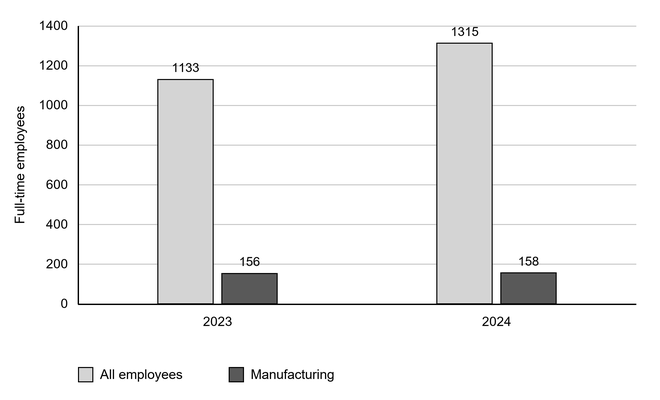
The company grew from 1 133 full-time employees to 1 315 during 2024, a rise of 16%. Almost none of that growth was in manufacturing, which went from 156 people to 158. Making the flow cells is highly automated, and the design is difficult to copy from a finished product.

What now has to happen is a change of scale rather than a change of idea. A new flow cell is ready, and getting it made in volume means finalising a design, ordering tooling, validating the product with regulators and customers, training operators and proving a line. On the project plan, the tooling is the activity nothing else can get past.

Every week the new flow cell is not on sale is a week of orders not taken.

Source: Oxford Nanopore Technologies plc annual results for the year ended 31 December 2024

Appendix F: Where the growth went, and how the technology is protected

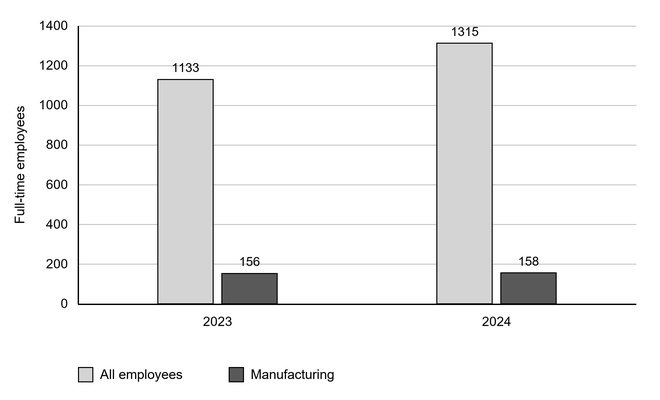
Full-time employees

Bar chart of full-time employees showing total staff rising from 1 133 in 2023 to 1 315 in 2024, while manufacturing staff rises only from 156 to 158. The vertical axis ranges from 0 to 1 400 employees.
Table of measures: growth in total employees during 2024 16%; a customer buys a device once; a customer buys a flow cell every time one is used; over 10 years of research before the first device was sold; over 100 patent families held; about 54% of revenue spent on research and development; a competitor cannot easily read the design from a finished flow cell; devices sold in over 120 countries.

Source: Analyst

Analyse one way in which manufacturing growing from 156 people to 158 while the company grew by 16% might affect Oxford Nanopore Technologies' unit costs.

6
6 marks

Source A: Halewood Robotics Ltd

Halewood Robotics Ltd designs and builds robots that pick items in warehouses. It employs 196 people near Warrington, delivered about 240 robots last year, and in the year to March 2025 had revenue of £31.5 million and an operating profit of £2.1 million. Thirty-four customers buy from it and the five largest provide 51% of revenue.

It spends heavily on being first. Research and development cost £4.2 million last year, up from £2.1 million five years ago, and six new designs were completed. Sixty-two per cent of revenue now comes from products launched in the last three years, and the company holds forty-eight patents across nine patent families.

The factory practises what it sells. Seventy-one per cent of its own assembly is automated and fourteen of its own robots work on its own lines, which is how a business of 196 people builds 240 machines a year.

Selling a robot is not the end of the job. Each customer gets an installation that runs from surveying the site to training their staff, and building the robots is the activity nothing else can get past. Eleven installations were completed last year and 73% finished on time.

The decision in front of the board is about a new gripper that lets a robot pick soft items such as clothing. Nobody else can do it yet. Patenting it means publishing how it works and waiting; launching now means a rival can take it apart and copy it.

Source: Halewood Robotics Ltd

Appendix A: Halewood Robotics Ltd selected data, year to March 2025

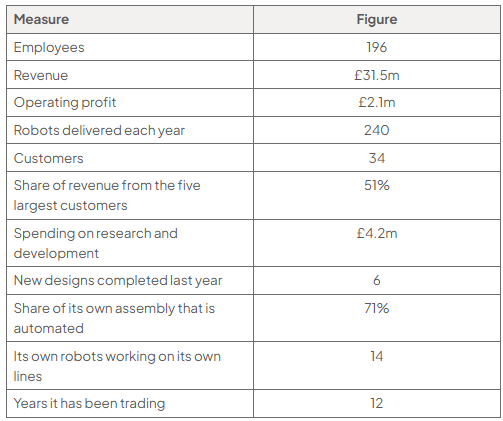
Table of Halewood Robotics Ltd selected data: 196 employees; revenue £31.5m; operating profit £2.1m; 240 robots delivered each year; 34 customers; 51% of revenue from the five largest customers; spending on research and development £4.2m; 6 new designs completed last year; 71% of its own assembly is automated; 14 of its own robots working on its own lines; trading for 12 years.

Source: Halewood Robotics Ltd

Analyse one way in which automating 71% of its own assembly might affect Halewood Robotics Ltd.

7
6 marks

Source A: Ryeworth Bakeries Ltd

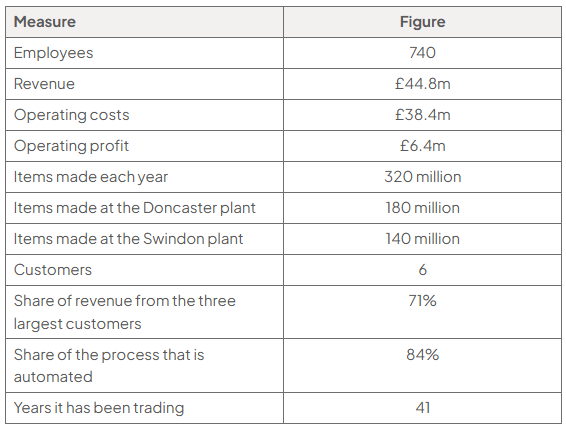
Ryeworth Bakeries Ltd bakes bread and morning goods for supermarkets from two plants, one in Doncaster and one in Swindon. It employs 740 people, makes about 320 million items a year, and in the year to March 2025 had revenue of £44.8 million against operating costs of £38.4 million, leaving an operating profit of £6.4 million. Six customers buy from it and the three largest provide 71% of revenue.

Size buys its inputs cheaply. Ryeworth takes 20 000 tonnes of flour a year and pays £318 a tonne; a baker buying 2 000 tonnes pays £347. On 20 000 tonnes that difference is worth more than half a million pounds a year.

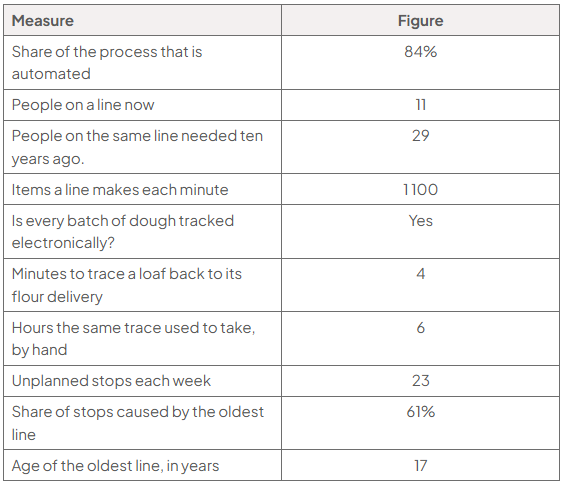
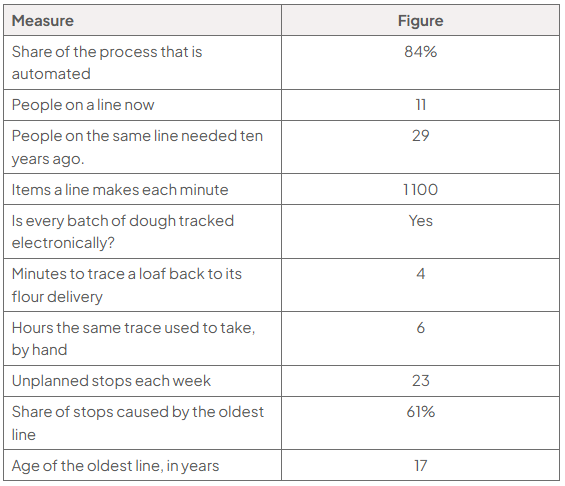
Size has also bought it machinery that a smaller baker could not justify. Eighty-four per cent of the process is automated, a line that needed twenty-nine people ten years ago now needs eleven, and every batch of dough is tracked electronically, so a loaf can be traced back to the flour delivery it came from in four minutes rather than the six hours it used to take by hand.

What size has not bought is tidiness. There are now five levels between the managing director and a baker, and fourteen items are made at both plants to different recipes, because each plant developed its own. The oldest line is seventeen years old and causes 61% of the twenty-three unplanned stops the company has each week.

A supermarket has asked for 130 million more items a year. The board has to decide where to make them.

Source: Ryeworth Bakeries Ltd

Appendix C: How the plants run

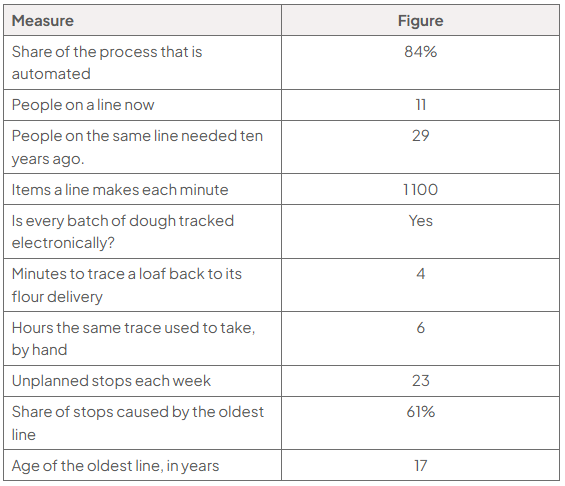
Table of plant-operation measures: 84% automated; 11 people per line now versus 29 ten years ago; 1,100 items per minute; electronic tracking takes 4 minutes versus 6 hours by hand; 23 weekly stops, 61% from the 17-year-old line.

Source: Analyst

Analyse one way in which tracking every batch of dough electronically might affect Ryeworth Bakeries Ltd.

1
9 marks

Source B: Dyson

Dyson designs and sells vacuum cleaners, hair care products, air purifiers and robots. It began in the United Kingdom, it is privately owned by its founder's family, and its global headquarters is now in Singapore. It employs over 14 500 people worldwide.

The company competes by inventing things other manufacturers have not, and then stopping them from copying it. In 2025 it spent more than £400 million on research and development, including on artificial intelligence and machine learning, and filed 252 patents to protect what it had invented. It filed 238 the year before. In the same year it launched 13 new products, more than in any previous year.

Dyson designs in one place and makes in another. Around 2 000 people work in Singapore, nearly half of them engineers and scientists, and its Singapore Advanced Manufacturing site has produced roughly 100 million of the Hyperdymium motors that go inside its machines. In Johor, Malaysia, it has a 50 000 square metre site with over 1 200 professionals. In late 2024 it scaled back the hair care work in Malaysia and moved almost 50 staff to other work on the same site.

Trading has been hard. Revenue fell from £7.1 billion in 2023 to £6.6 billion in 2024 and £6.13 billion in 2025, and tariffs and movements in exchange rates both hurt. Even so, earnings before interest, tax, depreciation and amortisation rose 18% in 2025 to £1.11 billion and operating profit rose 15% to £0.6 billion.

Getting a new machine from an idea to a shop shelf is a project with many stages, and some of those stages cannot start until others have finished.

Source: Dyson financial results for 2024 and 2025

Appendix E: Selected data for Dyson

Table of selected Dyson data. Revenue: £7.10bn in 2023, £6.60bn in 2024 and £6.13bn in 2025. EBITDA: £0.94bn in 2024 and £1.11bn in 2025. Operating profit: £0.60bn in 2025. Profit before tax: £561m in 2024. Spending on research and development: over £400m in 2025. Patents filed: 238 in 2024 and 252 in 2025. New products launched: 13 in 2025. Employees worldwide: over 14 500 in 2025.

Source: Dyson

Appendix F: Where Dyson designs and where it makes

Table comparing Dyson’s Singapore and Johor, Malaysia sites: roles, staffing, engineering share, site area, motor production and late-2024 change. Singapore has about 2 000 staff and 100 million motors; Johor has over 1 200 staff and 50 000 square metres.

Source: Dyson

Assess the impact on Dyson's profit of designing its machines in one country and making them in another.

2
9 marks

Source B: Rolls-Royce

Rolls-Royce makes the engines that power large passenger aircraft, equipment that generates electricity, and nuclear systems for submarines. It is one of a very small number of companies in the world that can design a large civil aero engine at all.

The business has recovered strongly. In 2025 group revenue reached £20.06 billion and underlying operating profit £3.46 billion, lifting the underlying operating margin above the 13.8% of the year before. Civil Aerospace revenue rose 15% to £10.4 billion, helped by more engines coming in for overhaul. Power Systems revenue rose 19% to £4.9 billion, with power generation up 30% and the part of it that supplies data centres up 35%.

Almost everything Rolls-Royce does takes a very long time. A new civil aero engine is designed, tested, certified by regulators and then flown for decades, and the company spends the money years before any of it comes back. Its UltraFan technology programme is developing the next generation of ducted engine.

It is also trying to build something it has never built before. Rolls-Royce SMR is developing a small modular reactor: a nuclear power station small enough that most of it can be made in a factory and delivered to site, rather than built from scratch in the open. The idea is that making the same thing many times is cheaper and more predictable than building each one by hand. The unit employed 1 005 people and grew its headcount 26% in a year. It was treated as a separate company in the 2025 results rather than being consolidated into the group.

The question that follows is how to make them: in one large factory that Rolls-Royce owns and controls, or through a network of suppliers.

Source: Rolls-Royce Holdings plc 2025 full year results

Appendix E: Selected data for Rolls-Royce, 2025

Table of selected Rolls-Royce data, with a 2025 column and a 2024 column: group revenue £20.06bn in 2025; underlying operating profit £3.46bn in 2025; underlying operating margin not provided in 2025 and 13.8% in 2024; Civil Aerospace revenue £10.4bn in 2025, up 15%; Power Systems revenue £4.9bn in 2025, up 19%; power generation revenue up 30%; data centre revenue up 35%; 1 005 employees at Rolls-Royce SMR, up 26%.

Source: Rolls-Royce Holdings plc

Appendix F: Where Rolls-Royce's revenue comes from

Pie chart of Rolls-Royce’s 2025 revenue: Civil Aerospace 52%, Power Systems 24%, and the rest of the group 24%.
Table of Rolls-Royce 2025 revenue by group part: Civil Aerospace £10.4bn, Power Systems £4.9bn, rest of group £4.76bn, and group total £20.06bn.

Source: Rolls-Royce Holdings plc

Assess the importance of Civil Aerospace to Rolls-Royce's profitability.

Calculate Rolls-Royce's operating profit margin in 2025 to support your answer.

3
9 marks

Source B: Quenby Instruments Ltd

Quenby Instruments Ltd designs and builds bedside patient monitors for hospitals from a single site in Leicester. It employs 140 people, had revenue of £21.5 million in the year to March 2025 and an operating profit of £1.6 million. Nine out of ten of its monitors are sold to NHS trusts.

For the past three years a team of eleven engineers has been developing a sensor that measures a patient's oxygen level continuously rather than every few minutes. Quenby has spent £2.9 million on it, has filed a patent application in the United Kingdom, and believes two competitors are working on something similar.

Nothing can be sold until the regulator approves it. A medical device cannot reach a ward in Britain without approval, and approval cannot be hurried: the file has to be complete, the testing has to be finished, and the regulator takes as long as it takes. On Quenby's own project plan, obtaining approval is the single longest activity and sits squarely on the critical path.

Everything else is ready to move. The prototypes work. The assembly line can be built in twelve weeks and there is time in hand to do it. The sales team can be trained in a month. All of it waits on one activity that Quenby does not control.

Abbie Thornton, who runs the project, has told the board that the company has two realistic ways of reaching hospitals sooner, and that neither of them is comfortable.

Source: Quenby Instruments Ltd

Appendix E: Quenby Instruments Ltd selected data, year to March 2025

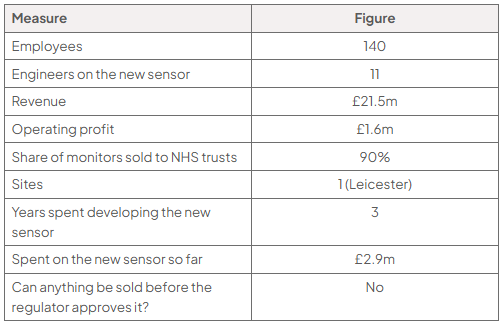
Table of Quenby Instruments Ltd selected data for the year to March 2025: 140 employees; 11 engineers on the new sensor; revenue £21.5m; operating profit £1.6m; 90% of monitors sold to NHS trusts; 1 site, in Leicester; 3 years spent developing the new sensor; £2.9m spent on the new sensor so far; nothing can be sold before the regulator approves it.

Source: Quenby Instruments Ltd

Appendix F: The new sensor, how it is protected and how it will be assembled

Spending on developing the new sensor

Bar chart of Quenby’s sensor development spending, rising from £0.4 million in Year 1 to £0.9 million in Year 2 and £1.6 million in Year 3; vertical axis ranges from £0 to £2 million.

Total spent: £2.9m

Table of measures: a patent application filed, in the United Kingdom only; 18 months until the patent is granted or refused; a granted patent would last 20 years; cost of filing in the United States and Europe as well £310 000; 2 competitors thought to be working on a similar sensor; cost of automating sensor assembly £680 000; saving on each sensor assembled £8.50; 40 000 sensors to be assembled each year.

Source: Analyst

Assess whether Quenby Instruments Ltd should automate the assembly of its new sensor.

Calculate the annual return on investment from automating assembly to support your answer.

4
9 marks

Source B: Oxford Nanopore Technologies

Oxford Nanopore Technologies makes devices that read DNA by passing a single strand of it through a hole a few atoms wide. It spent more than a decade in research before it sold anything, holds over a hundred patent families, and in 2024 had revenue of £183.2 million against £169.7 million the year before. Underlying growth, setting aside £16.0 million from two large programmes coming to an end, was 23.3%.

The money arrives in an unusual shape. A customer buys a device once, and then buys flow cells and reagents to use in it again and again. Three quarters of revenue comes from those consumables rather than from selling devices, so every device placed with a customer is the start of a stream of orders rather than the end of a sale.

The company grew from 1 133 full-time employees to 1 315 during 2024, a rise of 16%. Almost none of that growth was in manufacturing, which went from 156 people to 158. Making the flow cells is highly automated, and the design is difficult to copy from a finished product.

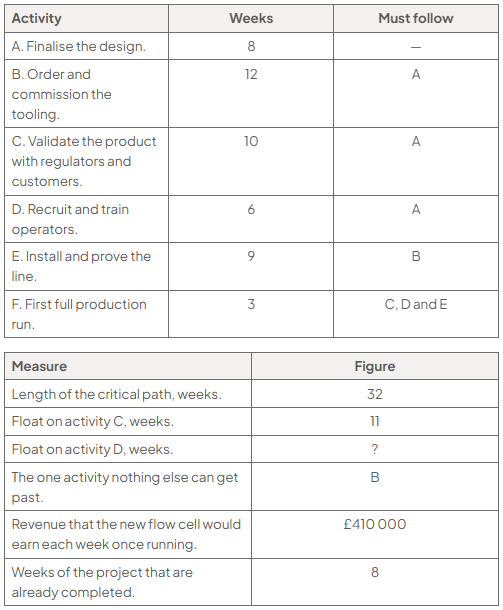
What now has to happen is a change of scale rather than a change of idea. A new flow cell is ready, and getting it made in volume means finalising a design, ordering tooling, validating the product with regulators and customers, training operators and proving a line. On the project plan, the tooling is the activity nothing else can get past.

Every week the new flow cell is not on sale is a week of orders not taken.

Source: Oxford Nanopore Technologies plc annual results for the year ended 31 December 2024

Appendix F: Where the growth went, and how the technology is protected

Full-time employees

Bar chart of full-time employees: total staff rose from 1,133 in 2023 to 1,315 in 2024, while manufacturing employees increased only from 156 to 158. Y-axis: 0–1,400 employees.
Two-column table of company facts: employee growth 16%; device bought once; flow cell bought after each use; research over 10 years; over 100 patent families; R&D about 54%; design not easily copied; sales in over 120 countries.

Source: Analyst

Appendix G: The project to make the new flow cell in volume

Project schedule: A design 8 weeks; B tooling 12 after A; C validation 10 after A; D training 6 after A; E line 9 after B; F production 3 after C, D and E. Measures: critical path 32 weeks; C float 11; D float ?; bottleneck B; £410,000 weekly; 8 completed.

Source: Analyst

Assess the role of automation in Oxford Nanopore Technologies' ability to grow.

5
9 marks

Source A: Ryeworth Bakeries Ltd

Ryeworth Bakeries Ltd bakes bread and morning goods for supermarkets from two plants, one in Doncaster and one in Swindon. It employs 740 people, makes about 320 million items a year, and in the year to March 2025 had revenue of £44.8 million against operating costs of £38.4 million, leaving an operating profit of £6.4 million. Six customers buy from it and the three largest provide 71% of revenue.

Size buys its inputs cheaply. Ryeworth takes 20 000 tonnes of flour a year and pays £318 a tonne; a baker buying 2 000 tonnes pays £347. On 20 000 tonnes that difference is worth more than half a million pounds a year.

Size has also bought it machinery that a smaller baker could not justify. Eighty-four per cent of the process is automated, a line that needed twenty-nine people ten years ago now needs eleven, and every batch of dough is tracked electronically, so a loaf can be traced back to the flour delivery it came from in four minutes rather than the six hours it used to take by hand.

What size has not bought is tidiness. There are now five levels between the managing director and a baker, and fourteen items are made at both plants to different recipes, because each plant developed its own. The oldest line is seventeen years old and causes 61% of the twenty-three unplanned stops the company has each week.

A supermarket has asked for 130 million more items a year. The board has to decide where to make them.

Source: Ryeworth Bakeries Ltd

Appendix A: Ryeworth Bakeries Ltd selected data, year to March 2025

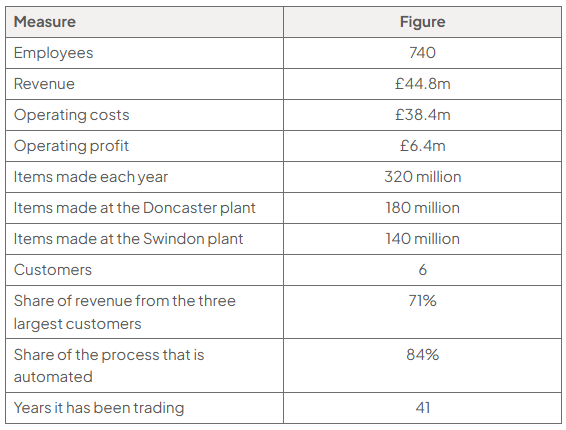
Table of Ryeworth Bakeries’ selected data: 740 employees; revenue £44.8m; costs £38.4m; profit £6.4m; 320m items (180m Doncaster, 140m Swindon); 6 customers; 71% revenue from three largest; 84% automated; trading 41 years.

Source: Ryeworth Bakeries Ltd

Appendix C: How the plants run

Table of plant-operation data: 84% automated; staffing reduced from 29 to 11; 1,100 items per minute; electronic tracking cuts tracing from 6 hours to 4 minutes; 23 weekly stops, 61% caused by the 17-year-old line.

Source: Analyst

Assess the importance of automation to Ryeworth Bakeries Ltd's competitiveness.

1
15 marks

Source B: Rolls-Royce

Rolls-Royce makes the engines that power large passenger aircraft, equipment that generates electricity, and nuclear systems for submarines. It is one of a very small number of companies in the world that can design a large civil aero engine at all.

The business has recovered strongly. In 2025 group revenue reached £20.06 billion and underlying operating profit £3.46 billion, lifting the underlying operating margin to 17.3% from 13.8% the year before. Civil Aerospace revenue rose 15% to £10.4 billion, helped by more engines coming in for overhaul. Power Systems revenue rose 19% to £4.9 billion, with power generation up 30% and the part of it that supplies data centres up 35%.

Almost everything Rolls-Royce does takes a very long time. A new civil aero engine is designed, tested, certified by regulators and then flown for decades, and the company spends the money years before any of it comes back. Its UltraFan technology programme is developing the next generation of ducted engine.

It is also trying to build something it has never built before. Rolls-Royce SMR is developing a small modular reactor: a nuclear power station small enough that most of it can be made in a factory and delivered to site, rather than built from scratch in the open. The idea is that making the same thing many times is cheaper and more predictable than building each one by hand. The unit employed 1 005 people and grew its headcount 26% in a year. It was treated as a separate company in the 2025 results rather than being consolidated into the group.

The question that follows is how to make them: in one large factory that Rolls-Royce owns and controls, or through a network of suppliers.

Source: Rolls-Royce Holdings plc 2025 full year results

Appendix F: Where Rolls-Royce's revenue comes from

Pie chart of Rolls-Royce’s 2025 group revenue: Civil Aerospace accounts for 52%, Power Systems 24%, and the rest of the group 24%.
Table of Rolls-Royce 2025 revenue: Civil Aerospace £10.4bn, Power Systems £4.9bn, the rest of the group £4.76bn, and group total £20.06bn.

Source: Rolls-Royce Holdings plc

Appendix H: Two ways of making small modular reactors

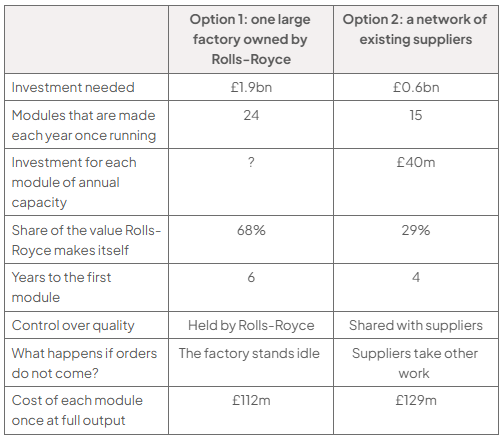
Table comparing Option 1, one large factory owned by Rolls-Royce, with Option 2, a network of existing suppliers: investment needed £1.9bn and £0.6bn; modules made each year once running 24 and 15; investment for each module of annual capacity not provided for Option 1 and £40m for Option 2; share of the value Rolls-Royce makes itself 68% and 29%; years to the first module 6 and 4; control over quality held by Rolls-Royce and shared with suppliers; if orders do not come, the factory stands idle, and suppliers take other work; cost of each module once at full output £112m and £129m.

Source: Analyst

Rolls-Royce is considering two ways of making its small modular reactors:

Option 1: one large factory owned by Rolls-Royce

Option 2: a network of existing suppliers

Evaluate both options and recommend which one Rolls-Royce should choose.

Calculate the investment for each module of annual capacity under Option 1 to support your answer.

2
15 marks

Source B: Arm Holdings

Arm designs the processors at the centre of almost every mobile phone in the world, and increasingly of the computers in data centres and cars. It does not make a single chip. It designs them, licenses those designs to companies such as Apple, Qualcomm and Nvidia, and then collects a royalty on every chip those companies ship.

That is an unusual way to run a technology business, and a very profitable one. In the financial year to March 2025 Arm's revenue passed $4 billion for the first time. Royalties brought in about $2.16 billion and licensing about $1.84 billion, up 29%. In the final quarter alone revenue rose 34% to a record $1 241 million, with royalty revenue up 18% to $607 million as customers moved to the newer Armv9 architecture and as Arm-based chips spread through data centres. Headcount reached 8 330, up 17%.

Because Arm does not manufacture, almost everything it spends goes on people and on the years of design work before a single chip exists. A new processor architecture is designed, verified, licensed, built into a customer's own chip, manufactured by a third party and only then sold, by which time several years have passed and the royalties begin.

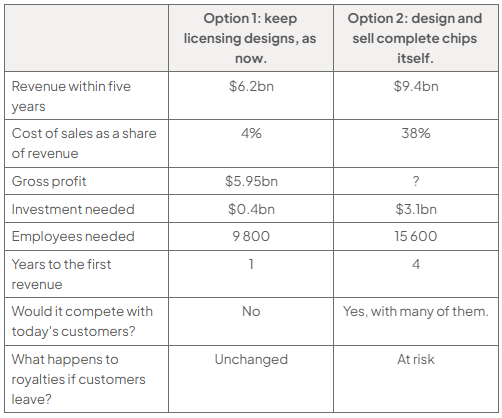
The question the company is asked repeatedly is whether it should go further. It could design and sell complete chips itself rather than licensing the designs to others. That would earn far more for each chip. It would also mean competing with the customers who currently pay it.

Source: Arm Holdings plc results for the financial year ended 31 March 2025

Appendix F: Where Arm's revenue comes from

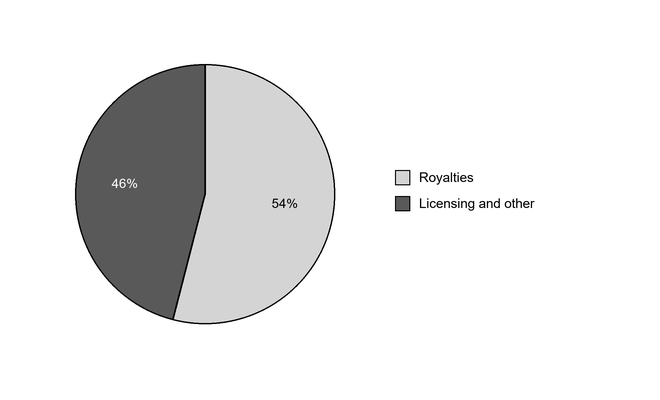
Pie chart of Arm’s revenue by source: royalties account for 54%, while licensing and other income account for 46% of total revenue.
Two tables show Arm’s revenue: royalties on shipped chips generate about $2.16bn and licensing and other income $1.84bn, totalling about $4bn. Royalties build gradually; licensing depends on larger, less predictable deals.

Source: Arm Holdings plc

Appendix H: Two ways for Arm to grow

Comparison table: licensing versus complete chips: revenue $6.2bn/$9.4bn, sales costs 4%/38%, gross profit $5.95bn/?, investment $0.4bn/$3.1bn, employees 9 800/15 600, first revenue 1/4 years, customer competition no/many, royalties unchanged/at risk.

Source: Analyst

Arm is considering two ways of growing:

Option 1: keep licensing its designs, as now

Option 2: design and sell complete chips itself

Evaluate both options and recommend which one Arm should choose.

Calculate the gross profit under Option 2 to support your answer.

3
15 marks

Source A: Ryeworth Bakeries Ltd

Ryeworth Bakeries Ltd bakes bread and morning goods for supermarkets from two plants, one in Doncaster and one in Swindon. It employs 740 people, makes about 320 million items a year, and in the year to March 2025 had revenue of £44.8 million against operating costs of £38.4 million, leaving an operating profit of £6.4 million. Six customers buy from it and the three largest provide 71% of revenue.

Size buys its inputs cheaply. Ryeworth takes 20 000 tonnes of flour a year and pays £318 a tonne; a baker buying 2 000 tonnes pays £347. On 20 000 tonnes that difference is worth more than half a million pounds a year.

Size has also bought it machinery that a smaller baker could not justify. Eighty-four per cent of the process is automated, a line that needed twenty-nine people ten years ago now needs eleven, and every batch of dough is tracked electronically, so a loaf can be traced back to the flour delivery it came from in four minutes rather than the six hours it used to take by hand.

What size has not bought is tidiness. There are now five levels between the managing director and a baker, and fourteen items are made at both plants to different recipes, because each plant developed its own. The oldest line is seventeen years old and causes 61% of the twenty-three unplanned stops the company has each week.

A supermarket has asked for 130 million more items a year. The board has to decide where to make them.

Source: Ryeworth Bakeries Ltd

Appendix A: Ryeworth Bakeries Ltd selected data, year to March 2025

Table of Ryeworth’s selected data: 740 employees; £44.8m revenue; £38.4m operating costs; £6.4m operating profit; 320m items; six customers; 71% concentrated revenue; 84% automated; 41 years trading.

Source: Ryeworth Bakeries Ltd

Appendix C: How the plants run

Plant-operation data table: 84% automated; 11 people per line now versus 29 ten years ago; 1 100 items per minute; every batch tracked electronically, tracing takes 4 minutes instead of 6 hours; 23 weekly stops, 61% from a 17-year-old line.

Source: Analyst

Evaluate two ways in which Ryeworth Bakeries Ltd could use technology to reduce the twenty-three unplanned stops it has each week, and recommend which one it should do first.