Political Environment (AQA A Level Business): Exam Questions

Exam code: 7132

Syllabus Edition

First teaching 2026

First exams 2028

2 hours16 questions
1
6 marks

Source A: Severn Trent

Severn Trent Plc provides water and wastewater services to more than 9 million people across the Midlands and mid-Wales through its regulated business, Severn Trent Water. It is a public limited company listed on the London Stock Exchange and employs more than 11 000 people. In the year to 31 March 2026 its revenue rose 16.6% to £2 831 million and its profit before interest and tax rose 46% to £861 million. It invested £1 954 million in its water and wastewater networks, the largest investment programme in its history. The full-year dividend rose 3.5% to 126.02 pence a share, in line with the company's policy of increasing the dividend by at least the rate of inflation each year.

Water companies in England and Wales are the only suppliers of water and wastewater services in their regions. The prices they may charge, and the investment they must deliver, are set by the economic regulator, Ofwat, for five years at a time; the current period runs from 2025 to 2030. Companies receive financial rewards from Ofwat when they beat performance targets and pay penalties when they miss them. From April 2026 the average Severn Trent household bill for water and wastewater rose by £52, or 10%, to £587.

The discharge of sewage into rivers has become a major political issue. Severn Trent reports that:

  • average spills from its storm overflows fell by 41% in 2025, to 15 for each overflow, beating its regulatory target and earning a reward of £10 million;

  • pollution incidents fell by 35% to 178, two of which were confirmed as serious;

  • it has committed to invest £450 million by 2030 to reduce spills to an average of fewer than 14 for each overflow.

The company supports customers who struggle to pay. During the year it provided £127 million of bill support to around 330 000 households, an average reduction of 64% on their bills, and it aims to help around 1 in 6 households in its region by 2030. Its employability programmes reached more than 15 000 people.

The company also works to improve the natural environment. During the year it planted almost 100 000 trees and 45 kilometres of hedgerow and restored 207 acres of habitat, and its performance on biodiversity reached the maximum financial reward available from the regulator. It generates renewable energy at its own sites.

Among its principal risks, Severn Trent lists uncertainty over regulatory, legislative and government reforms which could fundamentally change its operating environment.

Source: Severn Trent Plc, Preliminary Announcement of Annual Results, 20 May 2026

Severn Trent's prices and investment are set by the regulator for five years at a time, and the current period runs from 2025 to 2030. The government has confirmed that it intends to replace Ofwat with a single new regulator for the water industry.

Analyse one way in which replacing the regulator might affect Severn Trent's ability to plan its investment.

2
6 marks

Source B: Wrenbury Castings

Wrenbury Castings Limited makes iron castings at a foundry near Crewe, Cheshire. It was founded in 1921 and is owned by the Fairclough family; its Managing Director is Tom Fairclough. It employs 118 people. It melts scrap iron and steel in two electric induction furnaces and pours the metal into sand moulds to make castings weighing between 2 and 8 tonnes, such as counterweights for excavators, pump housings and parts for agricultural machinery. Its largest customer, a UK manufacturer of construction machinery, buys 41% of its output, and customers in the EU buy 18%.

When the moulds are broken open and the castings are cleaned by grinding, a process called fettling, fine silica dust is released. The law sets a limit on the amount of this dust that workers may breathe, and the Health and Safety Executive inspects foundries to check that employers control it.

Electricity is the company's second-largest cost, after scrap metal. Wrenbury Castings competes with imported castings, many of them made in foundries which melt iron using coke, a process that emits more carbon dioxide.

Several changes in government policy affect the business:

  • The EU carbon border charge. From 2026, businesses in the EU which import iron and steel goods, including castings, must pay a charge for the carbon dioxide emitted in making them, unless a similar carbon price has already been paid. In May 2025 the UK and the EU agreed to work towards linking their carbon markets, which would remove the charge on UK goods.

  • The UK carbon border charge. From 1 January 2027 the UK will charge a similar levy on imports of iron and steel and some other goods.

  • Electricity costs. In June 2025 the government's Industrial Strategy promised to cut electricity costs by up to 25% from 2027 for manufacturers which use large amounts of electricity.

Wrenbury Castings has been offered the chance to buy Lyme Foundry, a smaller rival in Staffordshire whose owner is retiring. Its largest customer has asked it to supply 3 000 more tonnes of castings a year from 2028.

Source: Wrenbury Castings

From 1 January 2027 the UK will charge a levy on imports of iron and steel goods, based on the carbon dioxide emitted in making them. Wrenbury Castings competes with imported castings, many made in foundries which melt iron using coke.

Analyse one way in which this levy might affect Wrenbury Castings' sales in the UK.

3
6 marks

Source A: Barratt Redrow

Barratt Redrow plc, listed on the London Stock Exchange, is the UK's largest housebuilder by number of homes. Formed when Barratt Developments bought Redrow in October 2024, it builds under three brands: Barratt Homes, David Wilson Homes and Redrow.

In the 52 weeks to 28 June 2026:

  • homes completed rose by 5.0% to 17 667

  • revenue rose by 6.6% to £6 055.0 million

  • adjusted profit before tax fell by 7.1% to £572.8 million

To keep sales moving while mortgages were expensive, the company increased incentives for buyers, such as help with a deposit and part-exchange, and sold more homes to housing associations and to investors building up homes to rent.

The company faces three main pressures:

  • Planning. It describes planning as a constraint on output. Delays in gaining planning permission meant it expected to open fewer new sales sites, and in September 2026 it reduced its forecast of completions for the following year. The Planning and Infrastructure Act, intended to speed up decisions, became law in December 2025.

  • Past building work. Under the Building Safety Act it must pay to put right fire-safety defects in buildings it developed, and continues to find and repair problems at older developments.

  • Competition law. A claim filed in June 2026 against seven housebuilders, including Barratt Redrow, alleges that their sharing of information raised prices for buyers.

The company says the government must do more to support demand from first-time buyers, and that regulatory and tax burdens make many sites uneconomic. It plans to return £400 million to shareholders in the year to June 2027.

Source: Barratt Redrow plc, Results for the 52 weeks ended 28 June 2026

Delays in gaining planning permission meant Barratt Redrow expected to open fewer new sales sites, and in September 2026 it reduced its forecast of completions for the following year.

Analyse one way in which delays in the planning system might affect Barratt Redrow's revenue.

4
6 marks

Source B: Oakhanger Lettings

Oakhanger Lettings Limited is a letting agent with branches in Alton and Farnham, Hampshire and Surrey. It was founded in 2004 by Rachel Dunn, who owns it and is its Managing Director, and it employs 28 people. At 30 June 2026 it managed 1 120 rented homes for 640 landlords. It advertises every home on Rightmove.

The company offers landlords two main services:

  • Full management. Oakhanger Lettings finds a tenant, collects the rent, arranges repairs and inspections and makes sure the landlord meets the law. It charges 12% of the rent.

  • Let-only. Oakhanger Lettings finds a tenant and the landlord manages the home. It charges a fee equal to one month's rent.

It also charges landlords for arranging the safety checks and certificates the law requires. By law, letting agents in England may not charge tenants fees.

Most of its landlords own one or two homes, and many have buy-to-let mortgages. Bank Rate was 3.75% at the start of 2026, and financial markets expected further cuts during the year. Rents in its area rose by 1.5% in the year to 30 June 2026.

The law on renting has changed. From 1 May 2026 the Renters' Rights Act ended "no-fault" evictions, under which a landlord could end a tenancy without giving a reason. A landlord must now prove one of the grounds set out in law. All tenancies became periodic, with no fixed end date, and rents may be raised only once a year. In the November 2025 Budget the government announced that, from April 2027, the income tax rates on rental income will be 2 percentage points higher than on other income.

Source: Oakhanger Lettings

From April 2027 the income tax rates on rental income will be 2 percentage points higher than on other income. Most of Oakhanger Lettings' landlords own one or two homes.

Analyse one way in which the higher tax on rental income might affect Oakhanger Lettings' revenue.

5
6 marks

Source B: Fenwick Vale Homes

Fenwick Vale Homes Limited builds houses on small sites, usually of 10 to 60 homes, across Northumberland. It was founded in 1988 by Peter Robson and is owned by the Robson family; his daughter, Kate Robson, is Managing Director. It employs 64 people and uses local subcontractors for most building work. In the year to 31 March 2026 it completed 115 homes at an average price of £315 000.

Fenwick Vale Homes buys land with planning potential and applies for permission to build. It borrows to buy the land and build the homes, from a bank which charges interest at 4 percentage points above Bank Rate; Bank Rate was 3.75% at the start of 2026. The loan is repaid as homes are sold.

Since 2024 the law has required most new developments in England to deliver biodiversity net gain: the habitat for wildlife after development must be at least 10% better than before. A builder that cannot achieve this on the site itself must buy units of habitat elsewhere. The local council also requires 15% of the homes on larger sites to be affordable homes, sold to a housing association at about 55% of their open-market value.

The government has set a target of 1.5 million new homes in England during this Parliament, and the Planning and Infrastructure Act became law in December 2025. Fenwick Vale Homes says that the time it waits for a planning decision has continued to grow.

Source: Fenwick Vale Homes

The government has set a target of 1.5 million new homes in England during this Parliament, and the Planning and Infrastructure Act became law in December 2025.

Analyse one way in which the government's planning reforms might affect the number of homes Fenwick Vale Homes can build.

6
6 marks

Source A: Alexander Dennis

Alexander Dennis Limited (ADL) is a private limited company, owned since 2019 by NFI Group, a Canadian bus and coach maker. It designs and builds single-deck and double-decker buses, including electric buses, and provides spare parts and servicing. It has factories in Scarborough and at Falkirk and Larbert in Scotland, and businesses in Hong Kong, New Zealand, Singapore, Malaysia, Germany and Mexico.

In 2025 ADL's turnover fell by 18.1% to £426.9 million, which it blamed on "increasing Chinese competition for zero-emission vehicles". By market:

  • UK: fell from £482.5 million to £370.7 million

  • Americas: rose from £8.1 million to £31.3 million; firm orders in North America run to 2028

Government grants help bus operators in England and Scotland buy zero-emission buses from any maker. ADL argues that UK rules for buying buses do not reward "local content, job retention and creation". In March 2026 it called the results of Scotland's latest grant scheme "extremely disappointing with the majority of the available funding going overseas".

ADL's Scottish factories have faced two proposals:

  • June 2025: close both, putting 400 jobs at risk, and move all bus-body building to Scarborough. In September 2025, after talks with the UK and Scottish governments and trade unions, ADL kept both.

  • March 2026: close Falkirk and turn Larbert into a site for building chassis, the frame and running gear under a bus body, with up to 115 jobs at risk, about 200 safeguarded and about 350 kept in Scotland. ADL keeps the option of bringing bus-body building back to Larbert if UK volume rises.

Source: Alexander Dennis Limited, annual report and financial statements for the year ended 28 December 2025, and press reports

Alexander Dennis argues that UK rules for buying buses do not reward "local content, job retention and creation".

Analyse one way in which changing these rules might affect Alexander Dennis's sales.

7
6 marks

Source A: AG Barr

A.G. BARR p.l.c. is a UK drinks company listed on the London Stock Exchange. It employs about 1 000 people and has factories at Cumbernauld, near Glasgow, and Milton Keynes. Its brands include:

  • IRN-BRU, the UK's third-biggest flavoured fizzy drink brand, 125 years old in 2026, with about 40% of sales outside Scotland

  • Boost energy and sports drinks, whose revenue rose 12% in 2025/26

  • Rubicon, Barr and MOMA oat drinks

In the 53 weeks to 31 January 2026, revenue rose 4.0% to £437.3 million. In early 2025 it raised some prices by between 1% and 11%, an approach it called "value over volume", and overall volume was "relatively flat". The chief executive, Euan Sutherland, aims to "double the size of the business".

In 2018 the sugar in regular IRN-BRU was cut from 10.3g to 4.7g per 100ml, and 96% of AG Barr's soft drinks by volume contain under 5g of sugar per 100ml.

Soft drinks are closely regulated:

  • Sugar. The Soft Drinks Industry Levy applies to drinks with 5g or more of sugar per 100ml.

  • Advertising. Paid online advertising of less healthy food and drink has been banned since January 2026. AG Barr says it never advertises caffeinated or energy products to under-16s.

  • Energy drinks. The government plans to ban selling drinks with more than 150mg of caffeine per litre to under-16s in England from April 2027.

  • Packaging. A deposit return scheme for plastic bottles and cans is due in October 2027.

The company says: "We view regulation as a catalyst for innovation."

Source: A.G. BARR p.l.c., annual report and final results for the 53 weeks ended 31 January 2026, and interim results for the 26 weeks ended 1 August 2026

AG Barr's brands include Boost energy drinks. The government plans to ban the sale of high-caffeine energy drinks to under-16s in England from April 2027.

Analyse one way in which this ban might affect AG Barr.

1
9 marks

Source A: Severn Trent

Severn Trent Plc provides water and wastewater services to more than 9 million people across the Midlands and mid-Wales through its regulated business, Severn Trent Water. It is a public limited company listed on the London Stock Exchange and employs more than 11 000 people. In the year to 31 March 2026 its revenue rose 16.6% to £2 831 million and its profit before interest and tax rose 46% to £861 million. It invested £1 954 million in its water and wastewater networks, the largest investment programme in its history. The full-year dividend rose 3.5% to 126.02 pence a share, in line with the company's policy of increasing the dividend by at least the rate of inflation each year.

Water companies in England and Wales are the only suppliers of water and wastewater services in their regions. The prices they may charge, and the investment they must deliver, are set by the economic regulator, Ofwat, for five years at a time; the current period runs from 2025 to 2030. Companies receive financial rewards from Ofwat when they beat performance targets and pay penalties when they miss them. From April 2026 the average Severn Trent household bill for water and wastewater rose by £52, or 10%, to £587.

The discharge of sewage into rivers has become a major political issue. Severn Trent reports that:

  • average spills from its storm overflows fell by 41% in 2025, to 15 for each overflow, beating its regulatory target and earning a reward of £10 million;

  • pollution incidents fell by 35% to 178, two of which were confirmed as serious;

  • it has committed to invest £450 million by 2030 to reduce spills to an average of fewer than 14 for each overflow.

The company supports customers who struggle to pay. During the year it provided £127 million of bill support to around 330 000 households, an average reduction of 64% on their bills, and it aims to help around 1 in 6 households in its region by 2030. Its employability programmes reached more than 15 000 people.

The company also works to improve the natural environment. During the year it planted almost 100 000 trees and 45 kilometres of hedgerow and restored 207 acres of habitat, and its performance on biodiversity reached the maximum financial reward available from the regulator. It generates renewable energy at its own sites.

Among its principal risks, Severn Trent lists uncertainty over regulatory, legislative and government reforms which could fundamentally change its operating environment.

Source: Severn Trent Plc, Preliminary Announcement of Annual Results, 20 May 2026

Appendix A: Severn Trent selected data

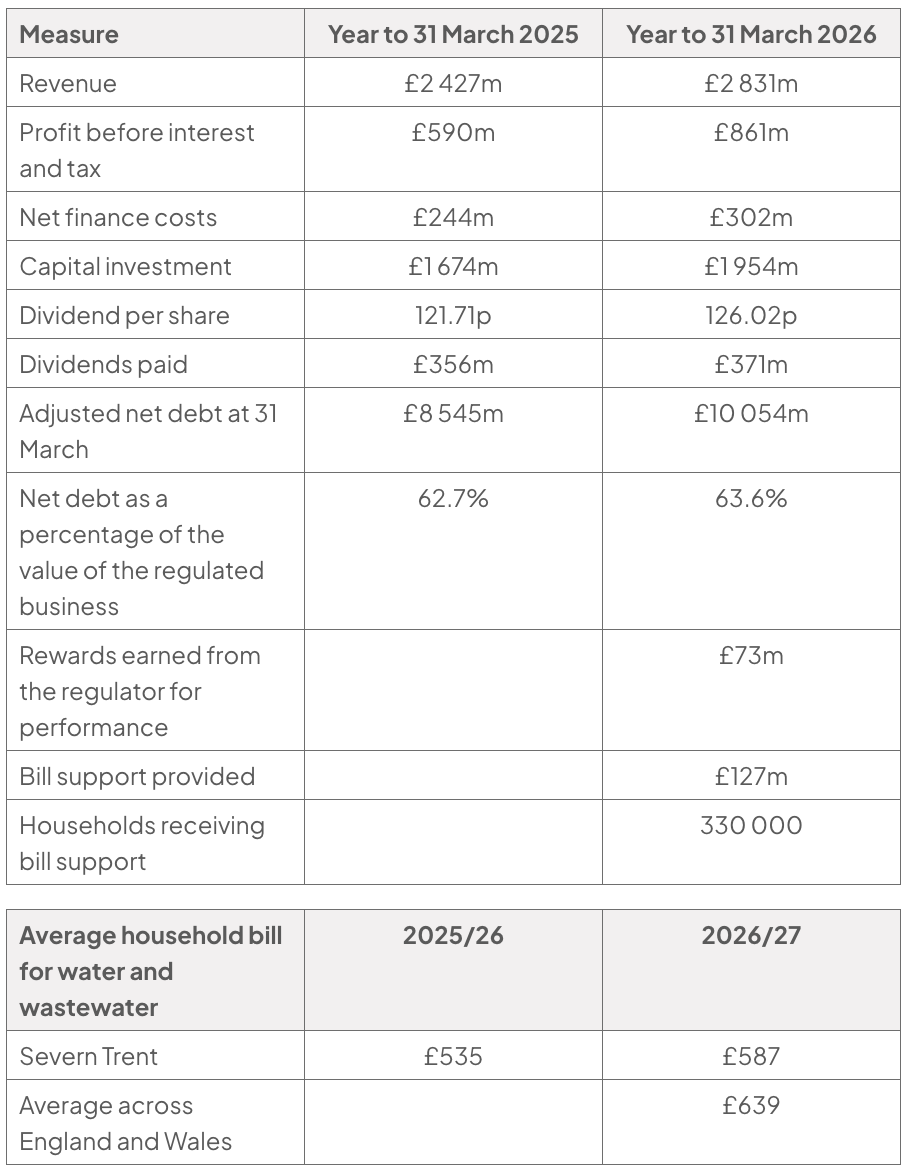
Two tables compare Severn Trent’s 2025 and 2026 figures, including adjusted net debt rising from £8 545m to £10 054m, and household bills: £535 to £587, against a 2026/27 England and Wales average of £639.

Source: Severn Trent Plc and Water UK

Appendix B: Reform of the water industry

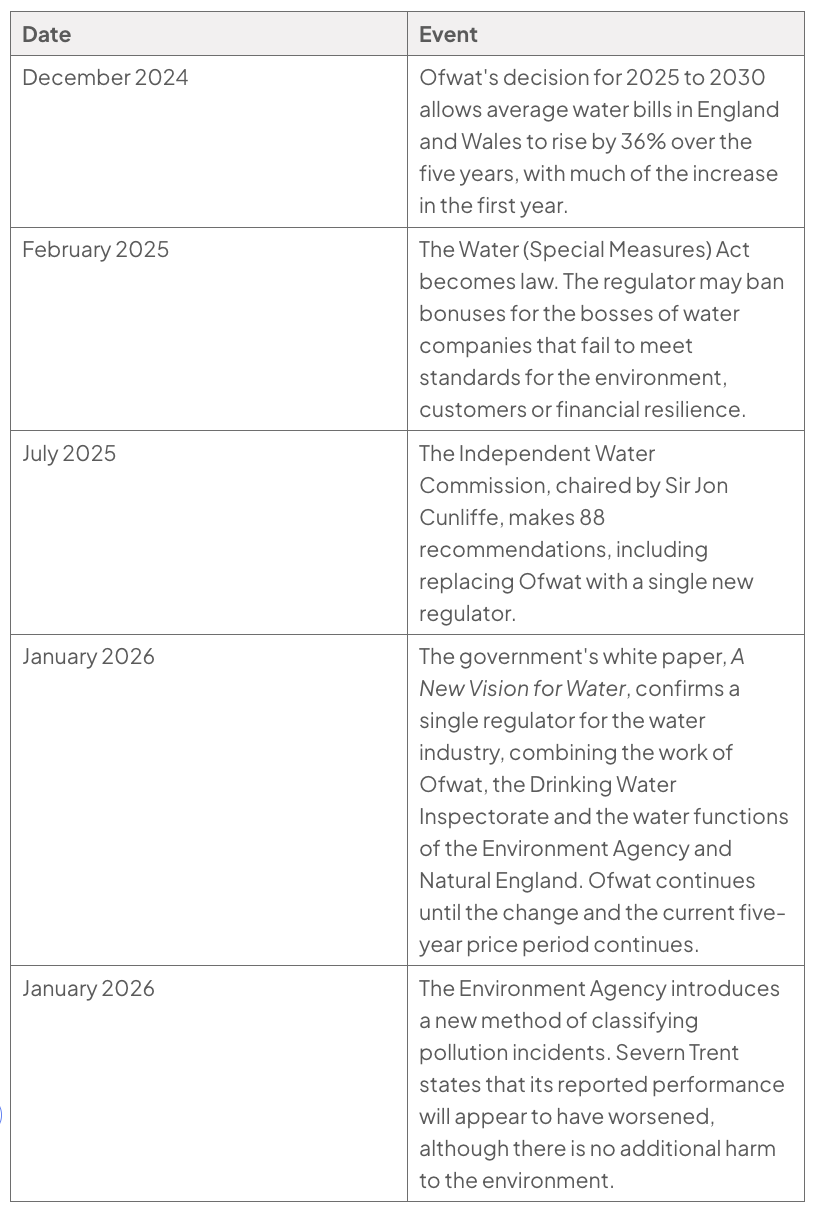
Timeline of water-industry reform: December 2024, Ofwat allows average bills to rise 36% from 2025 to 2030; February 2025, the Water (Special Measures) Act allows bonuses to be banned; July 2025, 88 recommendations propose replacing Ofwat; January 2026, a single regulator is confirmed and new pollution classifications introduced.

Source: Analyst

Assess whether the government's reform of the water industry is likely to reduce Severn Trent's profit.

Calculate Severn Trent's operating profit margin for the year to 31 March 2025 to support your answer. Give your answer to one decimal place.

2
9 marks

Source B: Tarnside Travel

Tarnside Travel Limited organises escorted coach holidays from its base in Kendal, Cumbria. It was founded in 1972 and is owned by the Fell family; its Managing Director is Joanne Fell. It employs 42 people, runs 8 coaches and has two booking offices, in Kendal and Penrith. In the year to 30 September 2026 it carried 10 300 passengers on holidays in the UK and Europe, at an average price of £815.

Most of Tarnside Travel's customers are retired: 76% are aged over 65. Its holidays are priced in a brochure published a year in advance, and include coach travel, hotels and entrance to attractions. A growing share of its customers travel alone; they pay a single supplement of £180 for a room of their own.

Customers can book by telephone, in a branch or, since 2024, online. A booking taken by telephone costs the company about £24 to process, compared with about £6 online.

Changes in government policy affect the company's holidays. Edinburgh introduced a visitor levy of 5% of the cost of accommodation from 24 July 2026, and councils in Wales may charge a levy of £1.30 a person a night from April 2027. In April 2026 the full new state pension rose by 4.8%, from £230.25 to £241.30 a week.

The coaches run on diesel. Tarnside Travel buys its fuel at the price on the day, while the price of each holiday is fixed when the brochure is published.

Source: Tarnside Travel

Appendix D: Tarnside Travel selected data

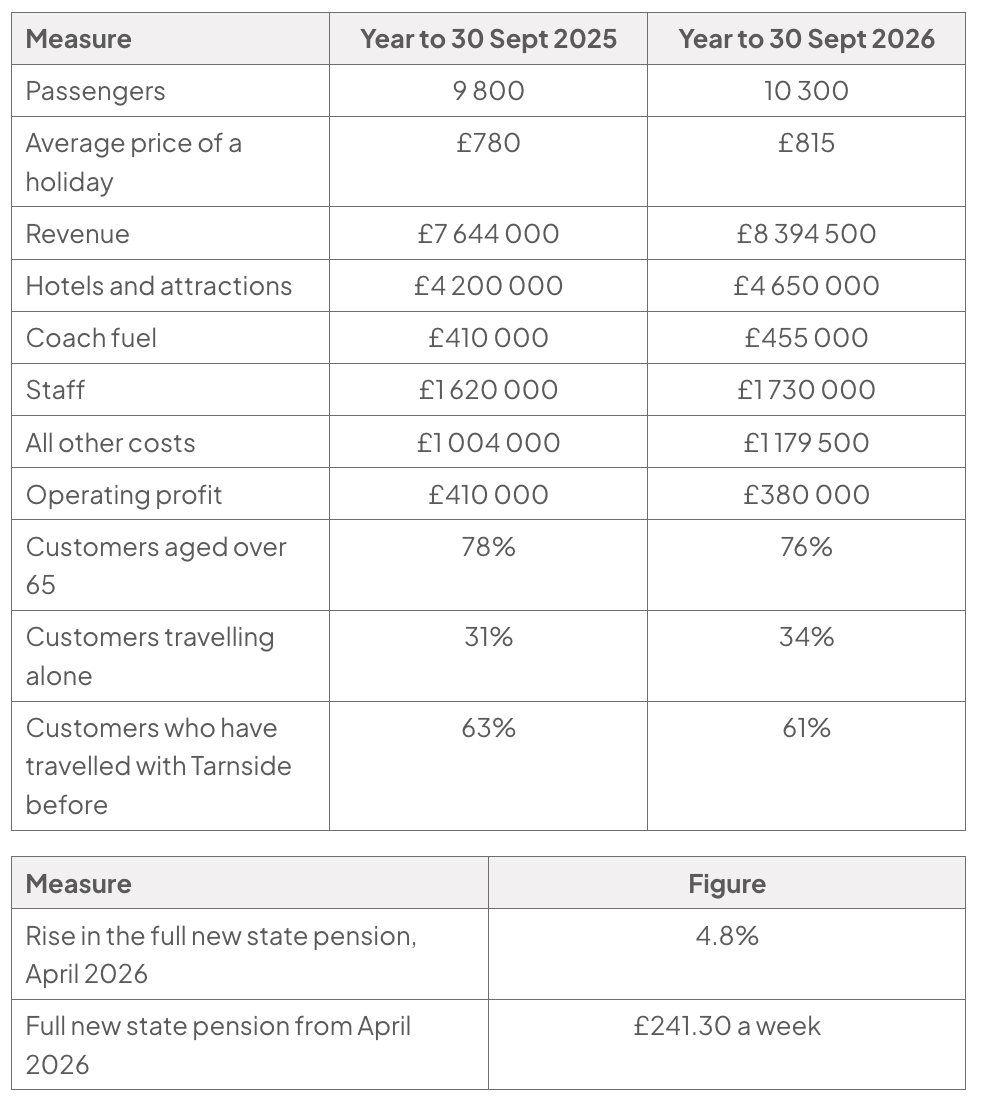
Two tables of Tarnside Travel data: the first compares passenger, financial and customer measures for years ending 30 September 2025 and 2026; the second gives state pension figures.

Source: Tarnside Travel

Appendix F: Visitor levies

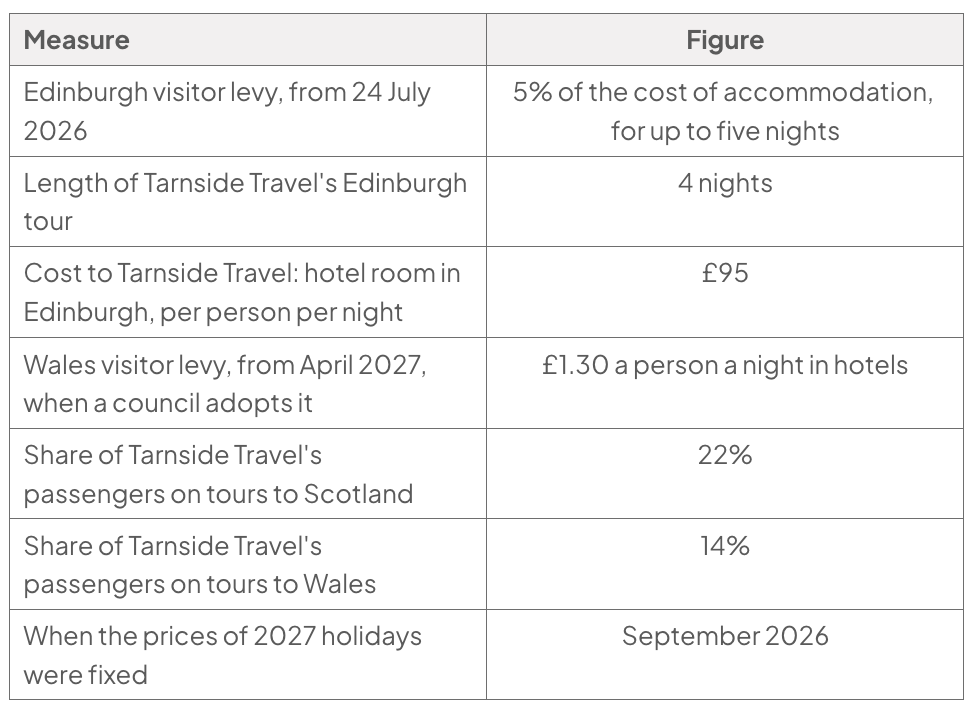
Table of visitor levy data: the Edinburgh levy is 5% of the cost of accommodation for up to five nights, from 24 July 2026; Tarnside Travel's Edinburgh tour lasts four nights and a hotel room costs it £95 per person per night; the Wales levy is £1.30 a person a night in hotels from April 2027 where a council adopts it; 22% of passengers tour Scotland and 14% tour Wales; 2027 prices were fixed in September 2026.

Source: Analyst

Assess whether visitor levies are likely to reduce Tarnside Travel's profit.

Calculate Tarnside Travel's operating profit margin in the year to 30 September 2026 to support your answer. Give your answer to one decimal place.

3
9 marks

Source B: Pukka Pads

Pukka Pads is a stationery business based in Poole, Dorset, owned and controlled by Chris Stott. It sells notebooks, pads, files, packaging and party products to retailers, to other businesses and online. It makes products in its UK factories and buys others from suppliers in China and the Far East, paying them in US dollars. It has companies in the United States, Hong Kong, China and the Netherlands.

In the year to 30 September 2025:

  • turnover fell by 10% to £21.8 million, "primarily as a result of moving away from very low margin product sales in the UK business"

  • gross profit rose, and operating profit rose to £652 055

  • inventory was reduced by £1.57 million

  • the average number of employees fell from 84 to 71

The company faces two main pressures:

  • Currency. No contracts to fix the exchange rate were in place at 30 September 2025, though some were taken out shortly afterwards. Administrative expenses included an exchange loss of £68 483 in 2025, against an exchange gain of £413 141 in 2024.

  • Trade. Since April 2025 the United States has charged a tariff of 10% on most goods imported from the UK, and higher tariffs on many goods from China.

For 2026, Pukka Pads says that "new machines have been acquired to improve manufacturing processes, reduce waste and headcount". In 2024/25, £367 080 of new machinery was financed through hire purchase. It also says that leaving one of its UK warehouses by 30 June 2026 will save more than £700 000 a year.

Source: Pukka Pads UK Limited, group accounts for the year ended 30 September 2025

Appendix D: Pukka Pads financial data

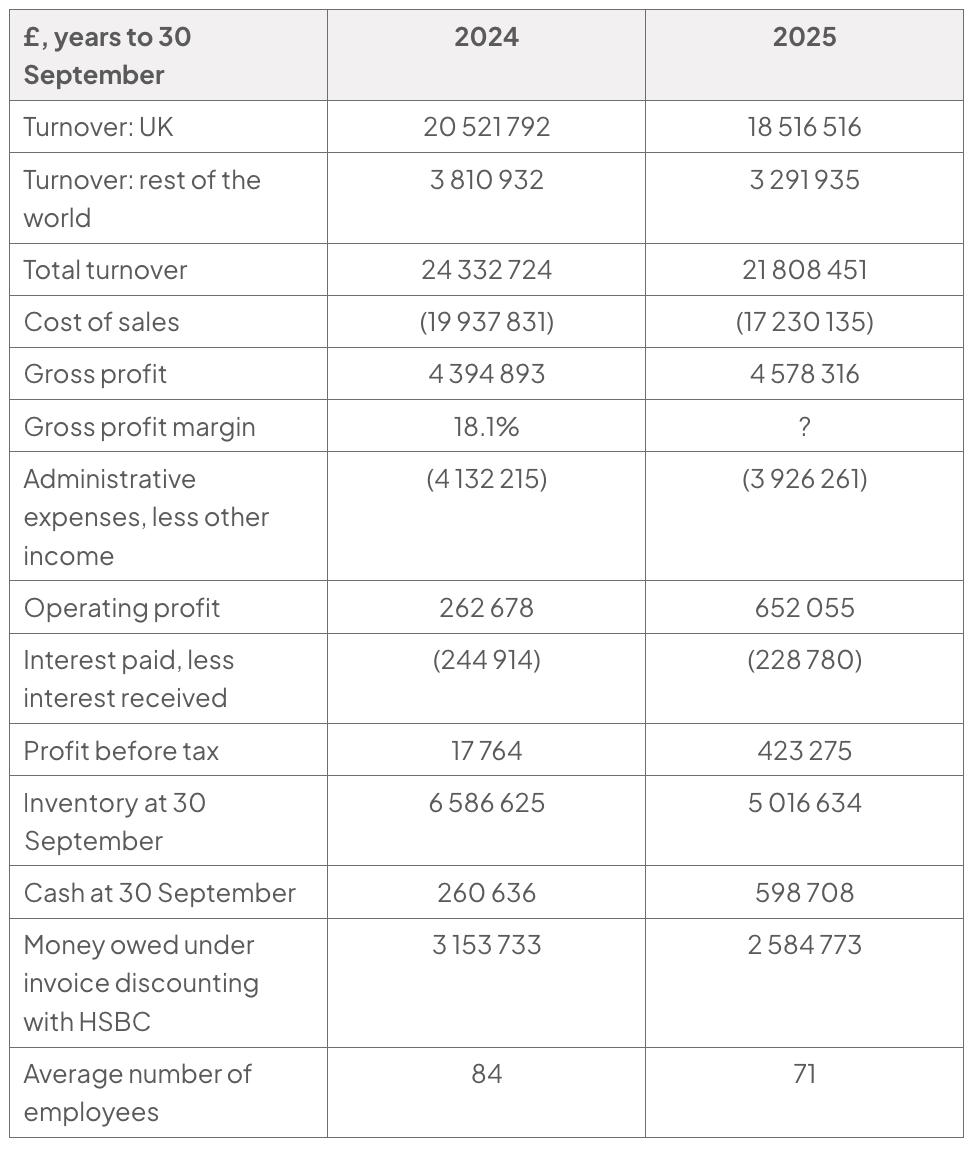
Table of Pukka Pads financial data in pounds for years to 30 September 2024 and 2025. In 2025, total turnover is £21 808 451 and gross profit is £4 578 316; gross profit margin is shown as ?.
  • Invoice discounting is a loan secured on money owed by customers; Pukka Pads pays 2.21 percentage points above Bank Rate.

  • Administrative expenses include an exchange loss of £68 483 in 2025 (2024: an exchange gain of £413 141).

Source: Pukka Pads UK Limited

Appendix F: Risks, costs and the political environment

  • Currency. Purchases from the Far East are made in US dollars. No contracts to fix the exchange rate were in place at 30 September 2025, though some were taken out shortly afterwards; Pukka Pads had committed to buying 1.5 million US dollars.

  • Shipping. Attacks on ships in the Red Sea from late 2023 forced many container ships to sail around Africa, raising shipping costs and delays. Pukka Pads says the impact was "significantly reduced" in 2024/25 and that container costs are now significantly lower.

  • Trade. Since April 2025 the United States has charged a tariff of 10% on most goods imported from the UK, and higher tariffs on many goods from China.

  • Inventory. Pukka Pads holds high levels of inventory, which risks having too much; raw material and container costs are managed through price negotiations with suppliers and customers.

  • Energy. Solar panels on the UK factories and warehouse have reduced energy costs.

Source: Analyst, using Pukka Pads UK Limited and press reports

Assess whether political events are the main influence on Pukka Pads' profitability.

Calculate Pukka Pads' gross profit margin in the year to 30 September 2025 to support your answer. Give your answer to one decimal place.

4
9 marks

Source B: Ravenshall Engineering

Ravenshall Engineering Limited is a private limited company, founded in Burnley, Lancashire, in 1978. It makes aluminium body frames, floors and battery housings for buses and coaches, which bus makers use to build complete vehicles. It employs 240 people. Its customers are:

  • three UK bus makers

  • five bus and coach makers in Poland, the Netherlands and Spain, whom it invoices in euros

Its products can be sold to EU customers without tariffs if they meet the rules of origin in the UK-EU trade agreement, but every shipment needs a customs declaration and delivery takes four days.

In 2025 revenue rose to £38.6 million, helped by growing exports to the European Union. The gross profit margin was 21%, compared with 22% in 2024.

The company faces three main pressures:

  • One large customer. 44% of its sales go to one UK bus maker, up from 39% in 2024. That customer has reduced its workforce and sites in the last two years.

  • Government grants. Most of its UK customers' orders are for buses bought with the help of government grants, which do not require buses to be built in the UK.

  • Chinese competition. Chinese bus makers such as Yutong ship complete buses to the UK, built with their own frames and battery housings.

Ravenshall's board is considering two investments:

  • An automated welding line in Burnley. It would reduce labour costs and rework, with 30 fewer welding jobs and 6 new technician roles.

  • A new factory in Poland, close to its EU customers.

Source: Ravenshall Engineering

Appendix D: Ravenshall Engineering selected data

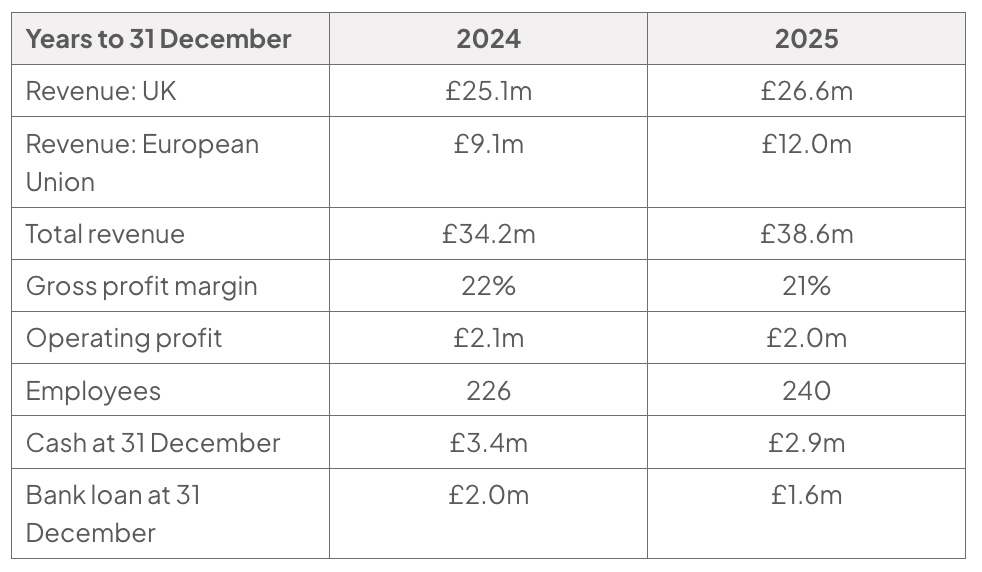
Table of Ravenshall Engineering data for the years to 31 December 2024 and 2025: UK revenue £25.1m and £26.6m; European Union revenue £9.1m and £12.0m; total revenue £34.2m and £38.6m; gross profit margin 22% and 21%; operating profit £2.1m and £2.0m; employees 226 and 240; cash at 31 December £3.4m and £2.9m; bank loan at 31 December £2.0m and £1.6m.

Source: Ravenshall Engineering

Appendix E: Customers and risks

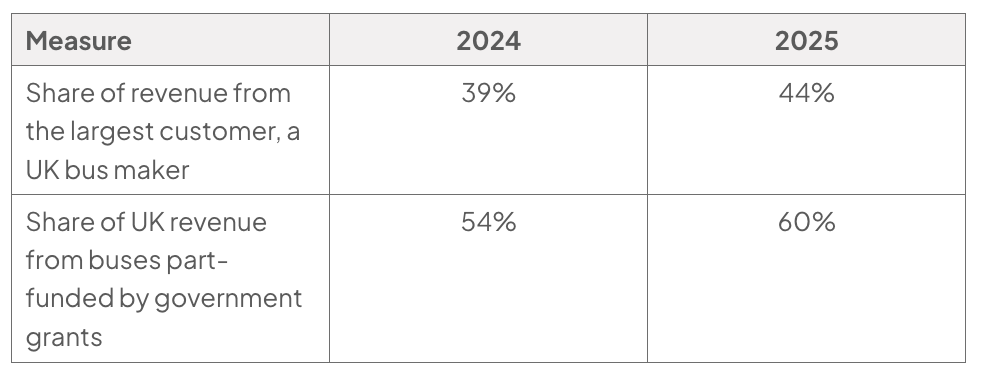
Table of Ravenshall Engineering measures for 2024 and 2025: the largest UK bus maker’s revenue share rose from 39% to 44%, while UK revenue from grant-funded buses increased from 54% to 60%.
  • If the pound rises against the euro, each euro of sales is worth fewer pounds.

  • Chinese bus makers such as Yutong ship complete buses to the UK, built with their own frames and battery housings.

  • Ravenshall's largest customer has reduced its workforce and sites in the last two years.

Source: Ravenshall Engineering

Appendix F: Politics, grants and trade

  • Grants. Bus operators in England and Scotland can apply for government grants towards the cost of zero-emission buses; the grants do not require buses to be built in the UK.

  • Scotland, March 2026. In the third round of the Scottish Zero Emission Bus Challenge Fund, the Chinese maker Yutong won more vehicles, many of them coaches, than the UK maker Alexander Dennis.

  • Local content. UK bus makers have called for buying rules that reward "local content, job retention and creation".

  • Trade. Ravenshall's products can be sold to EU customers without tariffs if they meet the rules of origin in the UK-EU trade agreement, but every shipment needs a customs declaration and delivery takes four days.

Source: Analyst, using UK and Scottish government information and press reports

Assess whether government policy is the biggest threat to Ravenshall Engineering.

Calculate Ravenshall Engineering's operating profit margin in 2025 to support your answer. Give your answer to one decimal place.

5
9 marks

Source B: Brackenfold Outdoor

Brackenfold Outdoor Limited is a private limited company, founded in 1987 in Kendal, Cumbria. It designs and makes waterproof jackets and trousers for walkers and for people who work outdoors, and employs 132 people. Its waterproof fabric is bought from an overseas supplier and priced in US dollars.

Brackenfold sells its products in three markets:

  • United Kingdom. It sells to outdoor shops and through its own website.

  • European Union. It sells to shops in the European Union.

  • United States. It sells to shops through a distributor.

In 2025 its sales to the European Union rose, while its sales to the United States fell.

Brackenfold also offers a repair service for its products. The number of jackets it repaired rose by more than half in 2025. In a survey of its website customers, more than half said they would rather repair a jacket than replace it.

The company faces two main pressures:

  • Trade. Since April 2025 most UK goods sold into the United States have faced an extra US tariff of 10%.

  • Costs. Its wage costs rose in 2025, after increases in the National Living Wage and in employers' National Insurance. The price of its waterproof fabric also rose.

Brackenfold's directors are considering investing in automated cutting machinery.

Source: Brackenfold Outdoor

Appendix D: Brackenfold Outdoor selected data

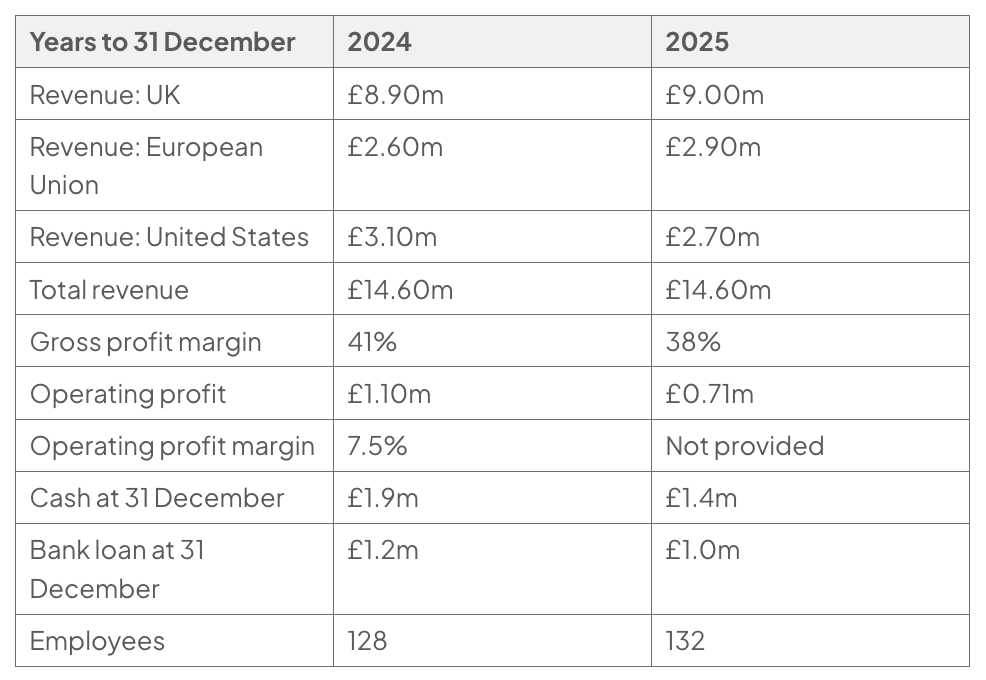
Table of Brackenfold Outdoor data for the years to 31 December 2024 and 2025: revenue UK £8.90m and £9.00m; European Union £2.60m and £2.90m; United States £3.10m and £2.70m; total revenue £14.60m in both years; gross profit margin 41% and 38%; operating profit £1.10m and £0.71m; operating profit margin 7.5% in 2024 and not provided for 2025; cash at 31 December £1.9m and £1.4m; bank loan at 31 December £1.2m and £1.0m; employees 128 and 132.

Source: Brackenfold Outdoor

Appendix F: Trade and politics

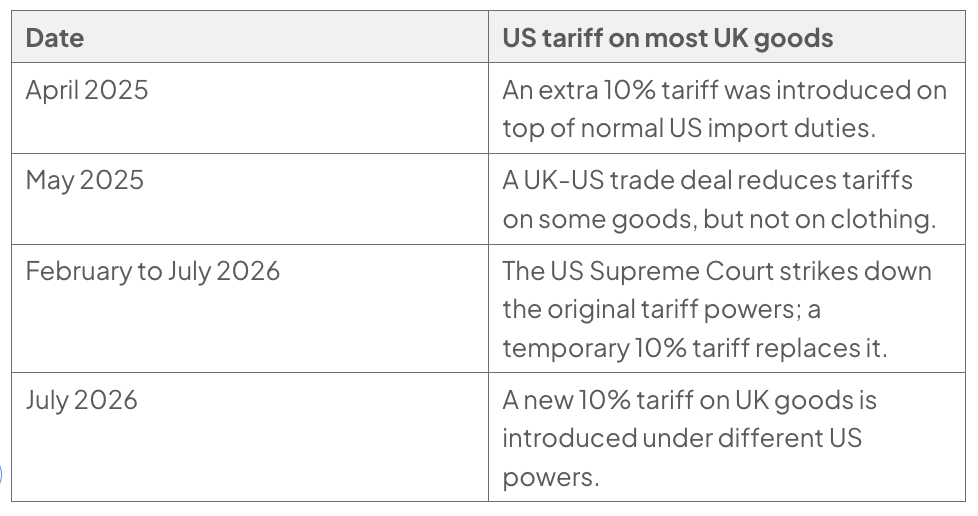
Timeline of US tariffs on most UK goods: April 2025, extra 10% tariff; May, deal reduces tariffs on some goods, not clothing; February to July 2026, court strikes down original powers and temporary 10% tariff replaces it; July, new 10% tariff introduced.
  • Brackenfold's US distributor raised its prices by 8% in mid-2025 to cover the tariff.

  • Brackenfold's products can be sold to the European Union without tariffs if they meet the rules of origin in the UK-EU trade agreement, but every shipment needs a customs declaration.

Source: Analyst, using UK and US government information, trade bodies and Brackenfold Outdoor

Assess whether US trade policy is the biggest threat to Brackenfold Outdoor.

Calculate Brackenfold Outdoor's operating profit margin in 2025 to support your answer. Give your answer to one decimal place.

1
15 marks

Source A: JCB

J.C. Bamford Excavators Limited, known as JCB, makes construction and agricultural machinery, including backhoe loaders, excavators and telescopic handlers. It was founded in 1945 by Joseph Cyril Bamford and is still owned by the Bamford family. Its headquarters are at Rocester, Staffordshire, and it employs more than 20 000 people in 23 factories around the world. It sells its machines through independent dealers. Its competitors include Caterpillar and Komatsu, both of which are larger.

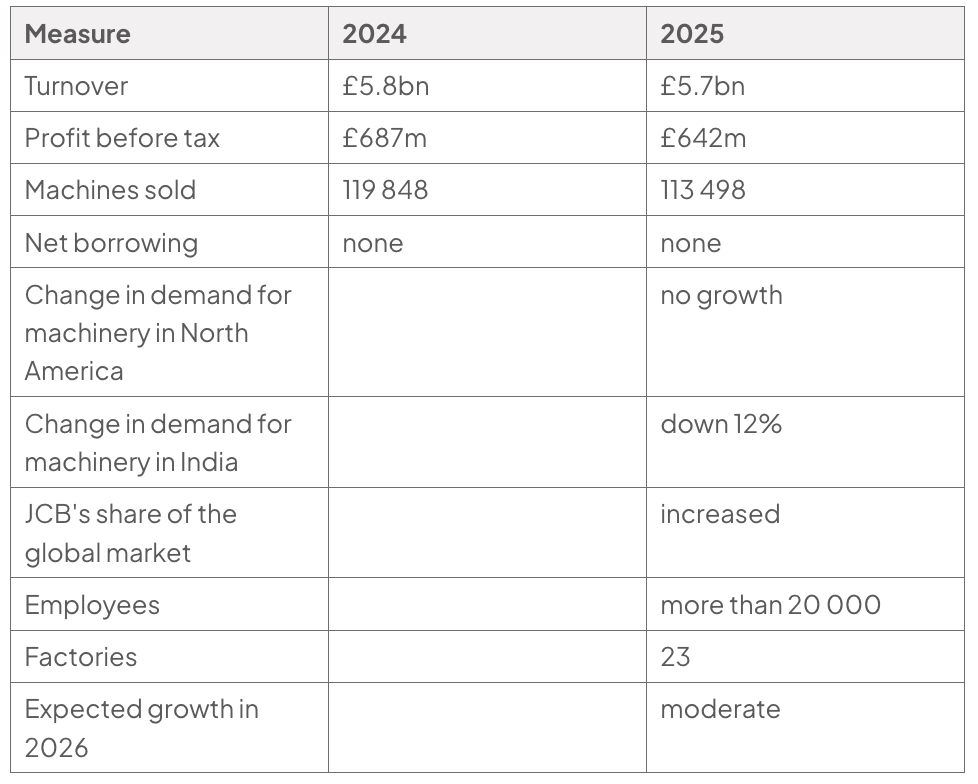
In 2025 JCB's turnover was £5.7 billion, compared with £5.8 billion in 2024, and its profit before tax fell from £687 million to £642 million. It sold 113 498 machines, about 5% fewer than in 2024, although it increased its share of the global market. Demand for machinery was flat in North America and fell by 12% in India. The company has no net borrowing, and it expects moderate growth in 2026.

Demand for construction machinery depends on the amount of building taking place, which tends to fall when interest rates are high. Many machines in the UK are bought by plant hire companies, which buy in large numbers and rent the machines to builders.

JCB is investing £100 million at its Staffordshire headquarters, including £60 million in a fully automated paint plant, which it says will help to secure more than 8 000 UK jobs.

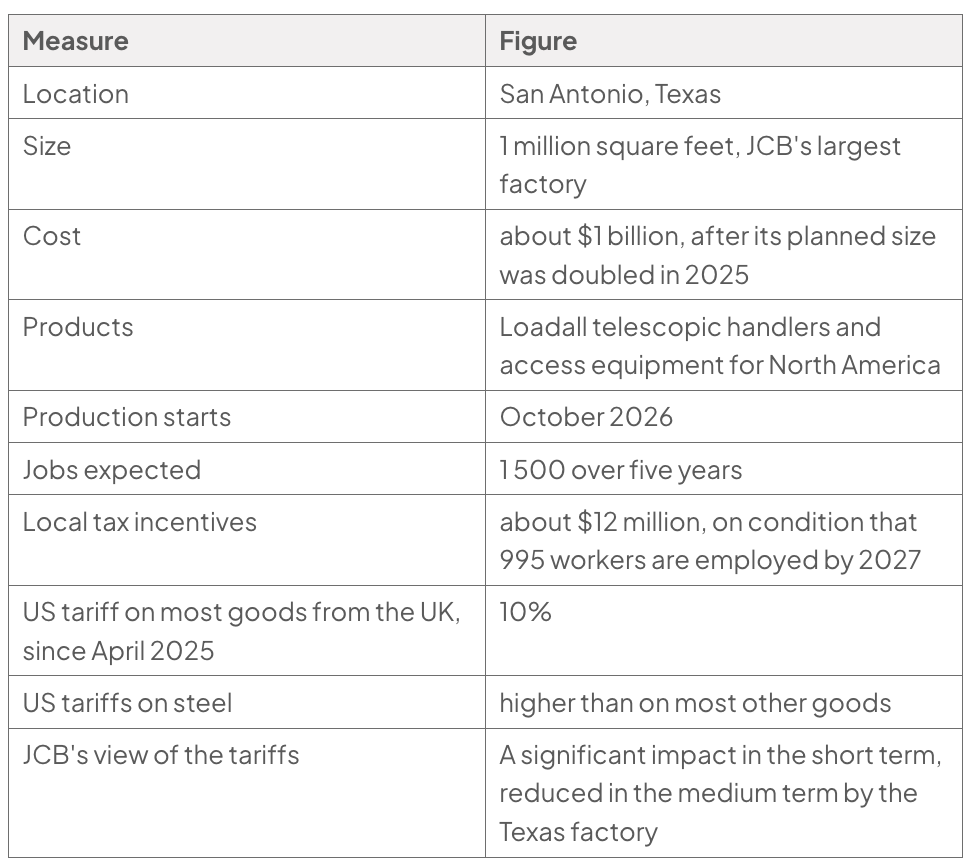
In April 2025 the United States introduced tariffs on imports, including a tariff of 10% on most goods from the UK. JCB responded by doubling the size of the factory it was building in San Antonio, Texas, which will be its largest in the world. It said that in the short term the tariffs would have a significant impact on its business, but that in the medium term the Texas factory would help to reduce that impact.

Over three years JCB spent £100 million, and employed more than 150 engineers, developing an engine which burns hydrogen instead of diesel. In January 2025 the engine was approved for use in Great Britain, Northern Ireland and nine other European countries. JCB also makes machines powered by batteries.

Source: JCB and press reports

Appendix A: JCB selected data

Three-column table of JCB selected data, comparing 2024 and 2025 across financial performance, machines sold, borrowing, demand, market share, employees, factories and expected growth.

Source: JCB

Appendix B: The Texas factory and US tariffs

Table of Texas factory and US tariffs: San Antonio; 1 million square feet; about $1 billion; production from October 2026; 1,500 jobs; 10% UK tariff, higher steel tariffs; JCB expects short-term impact reduced medium term.

Source: Analyst, using JCB and press reports

Since April 2025 most goods exported from the UK to the United States have faced a tariff of 10%.

Evaluate whether JCB should respond to US tariffs by making more of its machines in the United States or by focusing on growing its sales in markets outside the United States.

2
15 marks

Source B: Wrenbury Castings

Wrenbury Castings Limited makes iron castings at a foundry near Crewe, Cheshire. It was founded in 1921 and is owned by the Fairclough family; its Managing Director is Tom Fairclough. It employs 118 people. It melts scrap iron and steel in two electric induction furnaces and pours the metal into sand moulds to make castings weighing between 2 and 8 tonnes, such as counterweights for excavators, pump housings and parts for agricultural machinery. Its largest customer, a UK manufacturer of construction machinery, buys 41% of its output, and customers in the EU buy 18%.

When the moulds are broken open and the castings are cleaned by grinding, a process called fettling, fine silica dust is released. The law sets a limit on the amount of this dust that workers may breathe, and the Health and Safety Executive inspects foundries to check that employers control it.

Electricity is the company's second-largest cost, after scrap metal. Wrenbury Castings competes with imported castings, many of them made in foundries which melt iron using coke, a process that emits more carbon dioxide.

Several changes in government policy affect the business:

  • The EU carbon border charge. From 2026, businesses in the EU which import iron and steel goods, including castings, must pay a charge for the carbon dioxide emitted in making them, unless a similar carbon price has already been paid. In May 2025 the UK and the EU agreed to work towards linking their carbon markets, which would remove the charge on UK goods.

  • The UK carbon border charge. From 1 January 2027 the UK will charge a similar levy on imports of iron and steel and some other goods.

  • Electricity costs. In June 2025 the government's Industrial Strategy promised to cut electricity costs by up to 25% from 2027 for manufacturers which use large amounts of electricity.

Wrenbury Castings has been offered the chance to buy Lyme Foundry, a smaller rival in Staffordshire whose owner is retiring. Its largest customer has asked it to supply 3 000 more tonnes of castings a year from 2028.

Source: Wrenbury Castings

Appendix D: Wrenbury Castings selected data

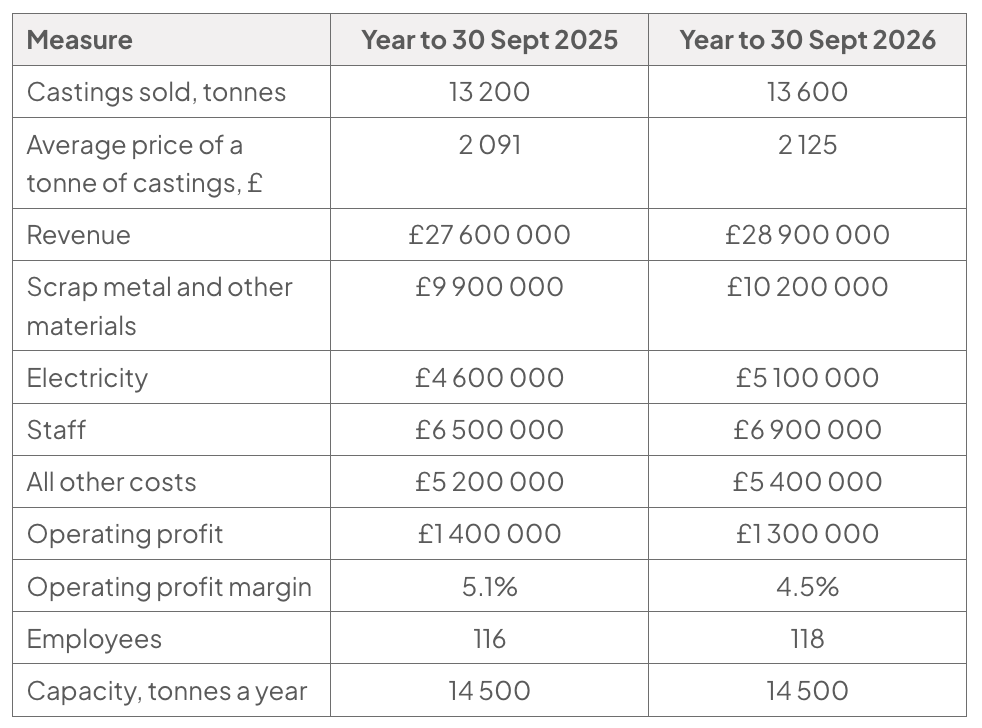
Appendix D table comparing Wrenbury Castings in years to 30 September 2025 and 2026: sales, prices, revenue, costs, profit, margin, employees and capacity. Revenue rises, but profit and margin fall; capacity is unchanged.

Source: Wrenbury Castings

Appendix E: Electricity and the government's promises

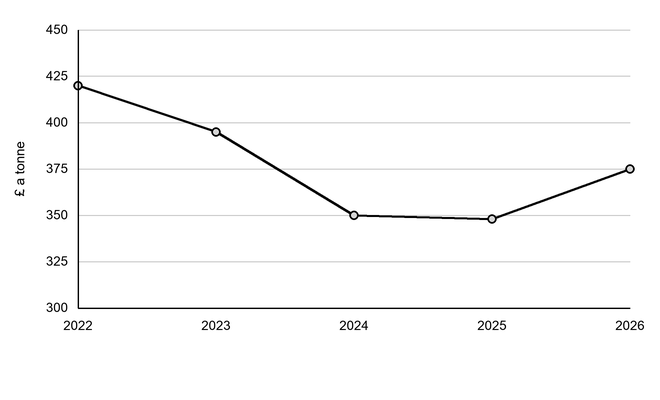
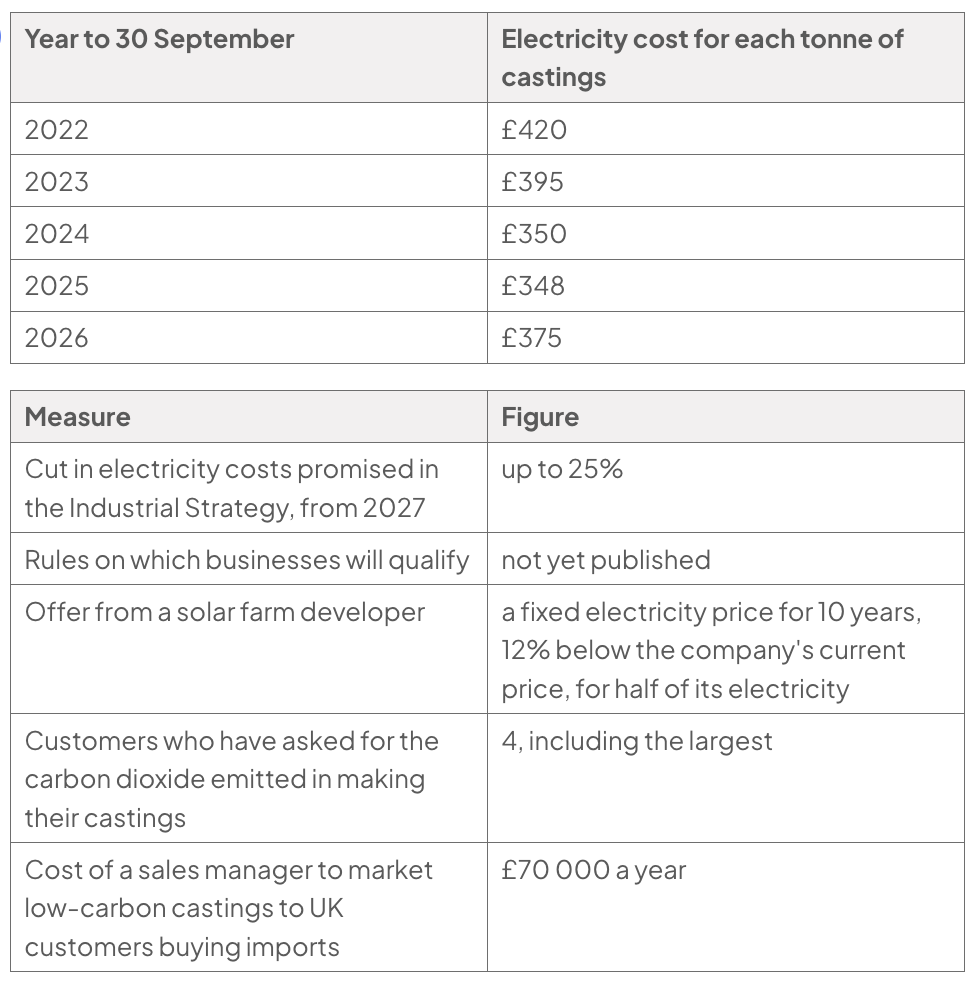
Line chart of electricity cost per tonne from 2022 to 2026: £420, £395, £350, £348 and £375 respectively; costs fell to 2025 before rising in 2026. Y-axis ranges from £300 to £450 per tonne.
Appendix E also states that eligibility rules are not yet published; a solar farm offers a 10-year fixed price for half of electricity at 12% below current price; four customers request emissions data; a sales manager costs £70,000 annually.

Source: Wrenbury Castings

Appendix F: The carbon in a tonne of castings

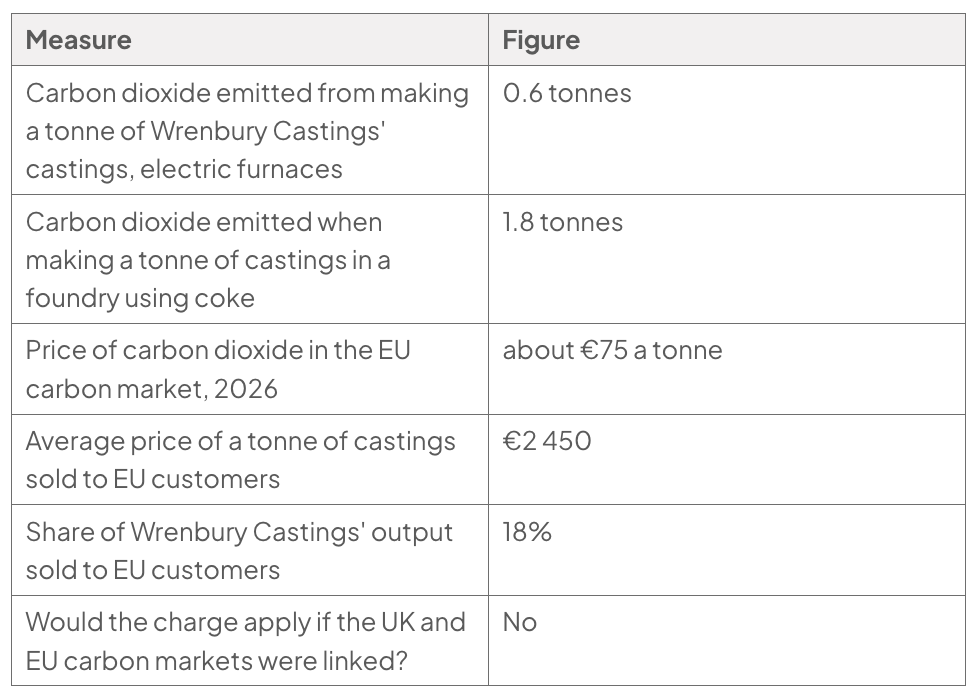
Appendix F table: electric-furnace castings emit 0.6 tonnes of carbon dioxide per tonne, compared with 1.8 tonnes using coke; EU carbon price is about €75 a tonne, sales price €2,450, EU share 18%; linked markets: no charge.

Source: Analyst

Appendix G: A robotic fettling cell

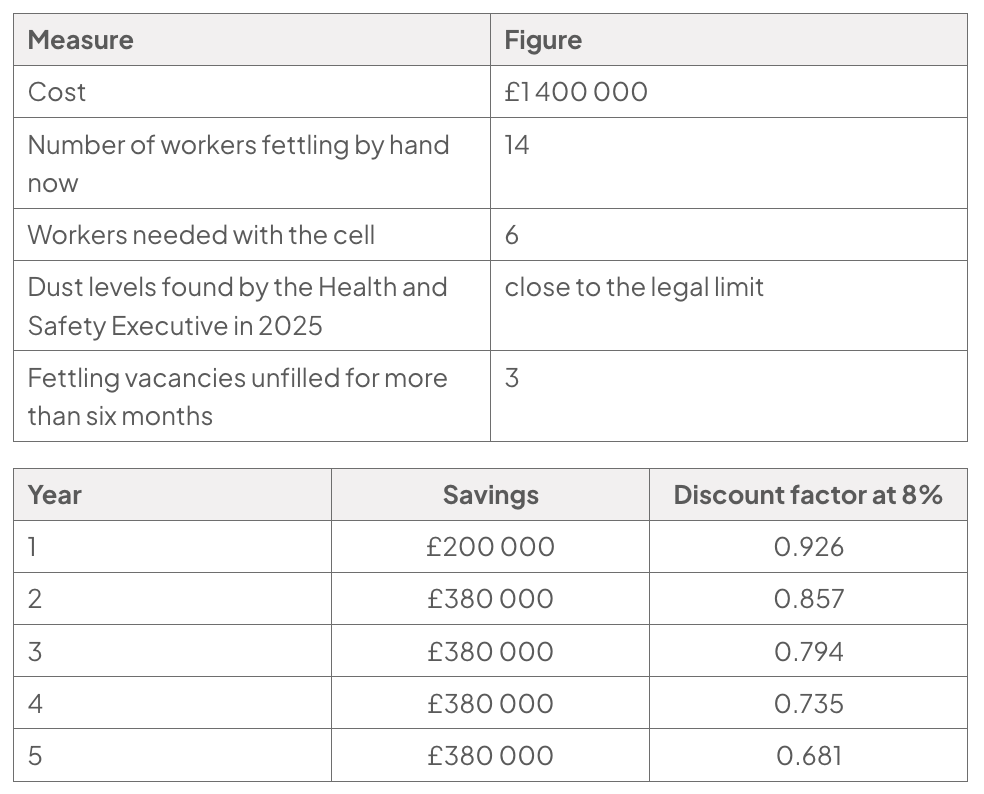
Robotic fettling cell data: cost £1.4m; hand workers fall from 14 to 6; 2025 dust levels were near the legal limit; 3 vacancies lasted over six months. Savings are £200,000 in year 1 and £380,000 in years 2–5; 8% factors: 0.926, 0.857, 0.794, 0.735, 0.681.

Source: Wrenbury Castings

Appendix H: Two ways to grow

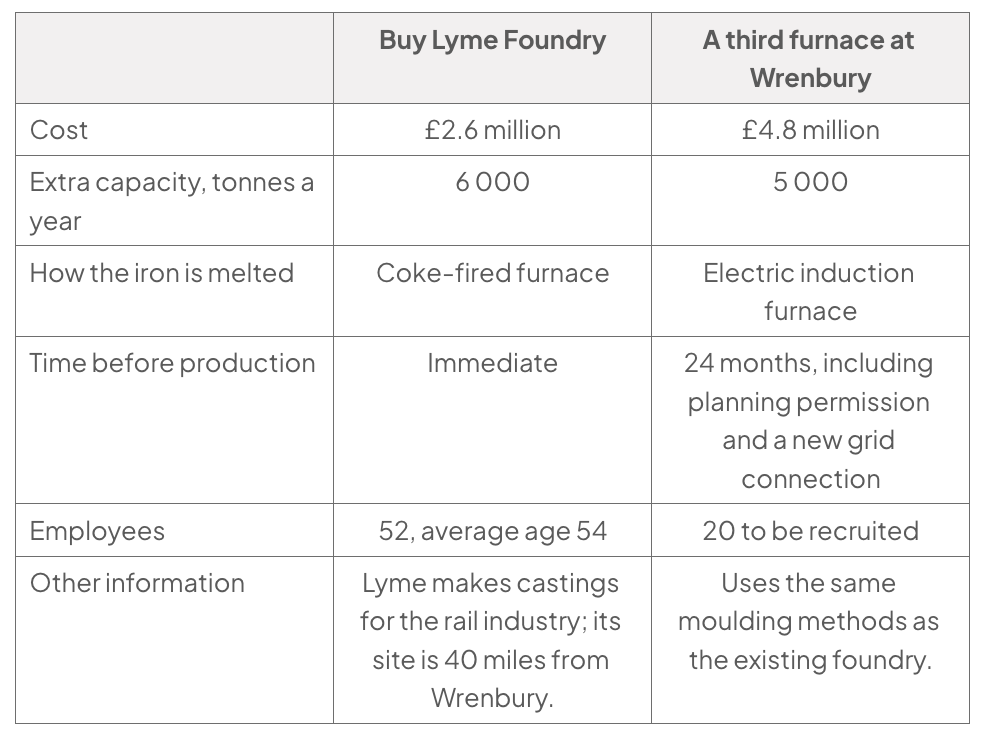
Comparison table: buying Lyme Foundry costs £2.6m and adds 6,000 tonnes a year immediately using coke; a third Wrenbury furnace costs £4.8m, adds 5,000 tonnes after 24 months and uses electricity.

Source: Wrenbury Castings

The government has promised to cut electricity costs for manufacturers which use large amounts of electricity, and will introduce a carbon border charge on imports from 2027.

Evaluate two ways Wrenbury Castings could respond to these changes in government policy and recommend which one it should do first.

Use information from Appendices D to H to support your answer.

3
15 marks

Source B: Fenwick Vale Homes

Fenwick Vale Homes Limited builds houses on small sites, usually of 10 to 60 homes, across Northumberland. It was founded in 1988 by Peter Robson and is owned by the Robson family; his daughter, Kate Robson, is Managing Director. It employs 64 people and uses local subcontractors for most building work. In the year to 31 March 2026 it completed 115 homes at an average price of £315 000.

Fenwick Vale Homes buys land with planning potential and applies for permission to build. It borrows to buy the land and build the homes, from a bank which charges interest at 4 percentage points above Bank Rate; Bank Rate was 3.75% at the start of 2026. The loan is repaid as homes are sold.

Since 2024 the law has required most new developments in England to deliver biodiversity net gain: the habitat for wildlife after development must be at least 10% better than before. A builder that cannot achieve this on the site itself must buy units of habitat elsewhere. The local council also requires 15% of the homes on larger sites to be affordable homes, sold to a housing association at about 55% of their open-market value.

The government has set a target of 1.5 million new homes in England during this Parliament, and the Planning and Infrastructure Act became law in December 2025. Fenwick Vale Homes says that the time it waits for a planning decision has continued to grow.

Source: Fenwick Vale Homes

Appendix D: Fenwick Vale Homes selected data

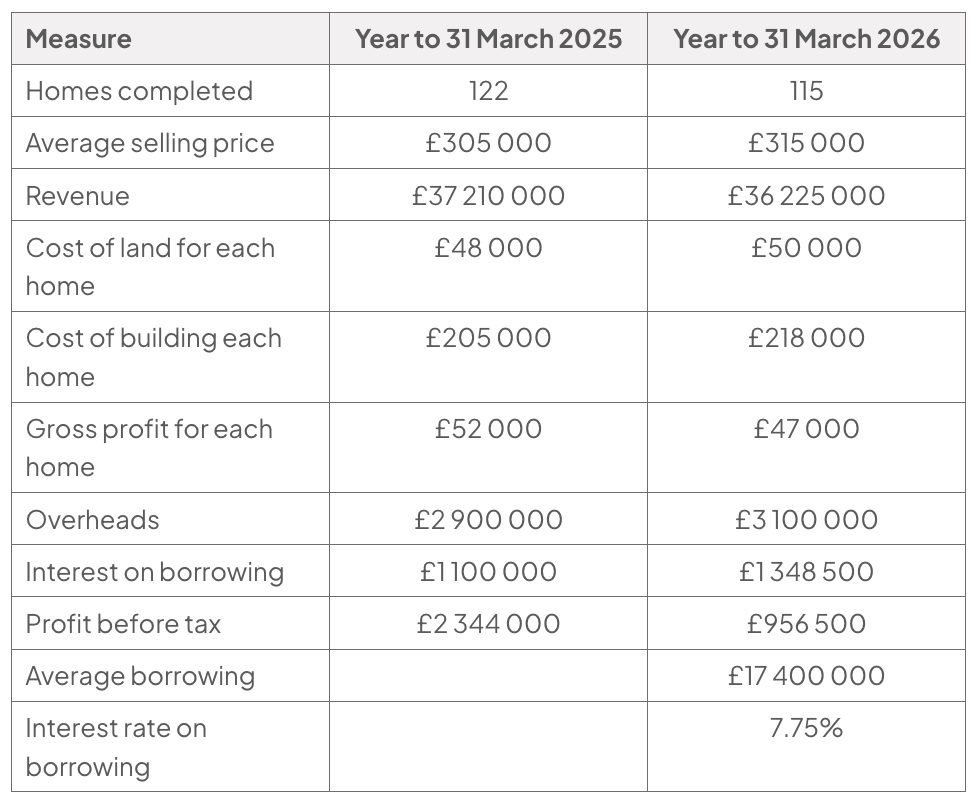
Table comparing Fenwick Vale Homes in 2025 and 2026: homes completed 122/115; average price £305 000/£315 000; revenue £37.21m/£36.225m; profit before tax £2.344m/£956 500. Costs and borrowing increased.

Source: Fenwick Vale Homes

Appendix E: Waiting for planning permission

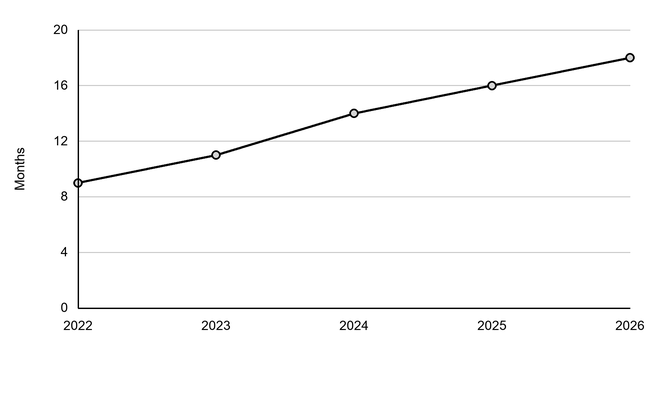
Line graph of average months from planning application to decision, rising steadily from 9 months in 2022 to 11 in 2023, 14 in 2024, 16 in 2025 and 18 in 2026.
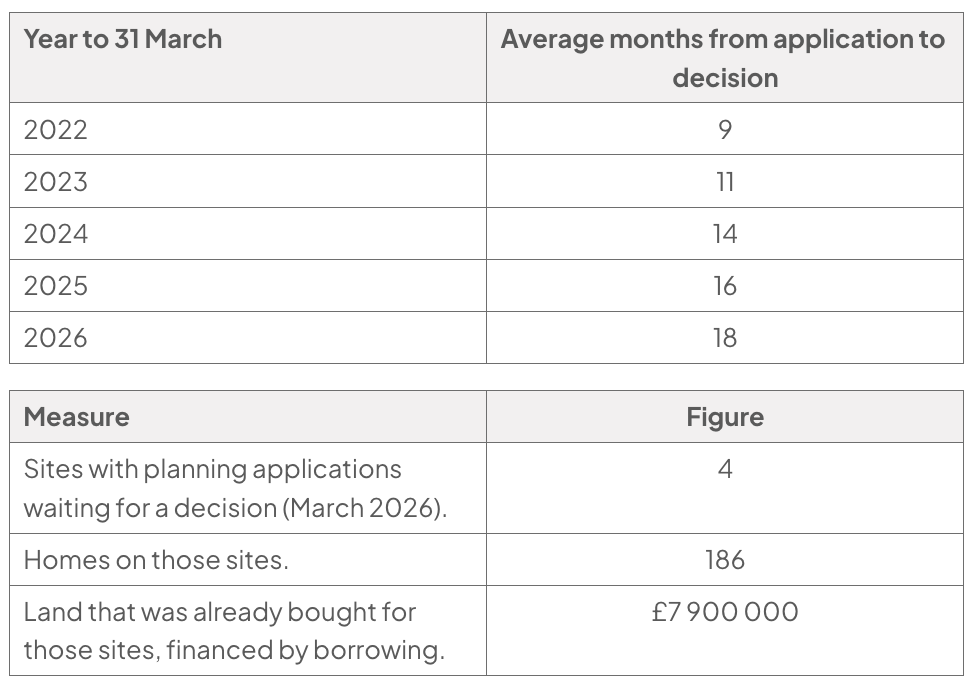
Tables show planning delays rising from 9 months in 2022 to 18 in 2026. In March 2026, four sites awaiting decisions contained 186 homes, with £7.9 million of borrowed land costs.

Source: Fenwick Vale Homes

Appendix F: The Corbridge Road site

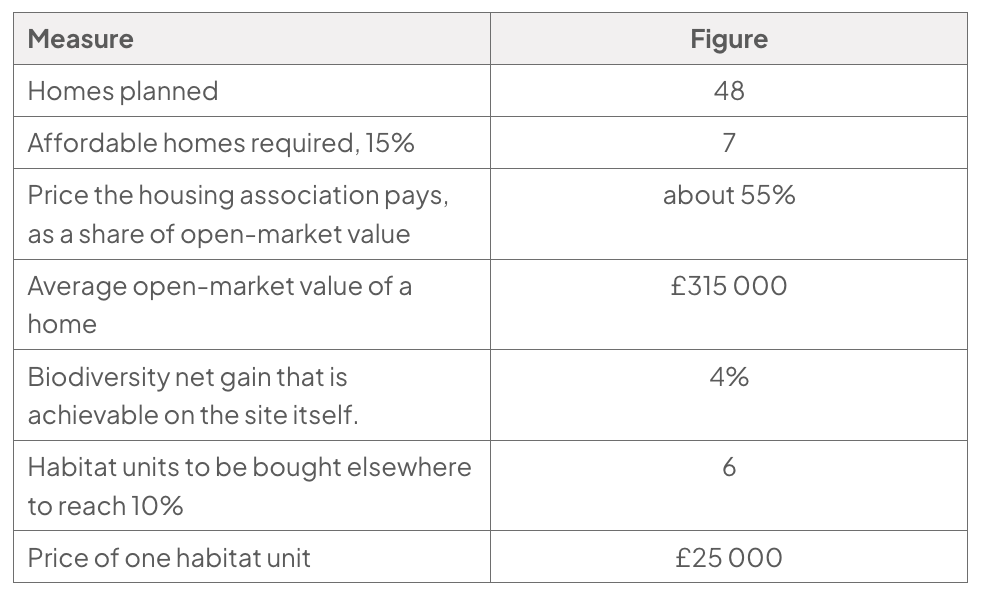
A site for 48 homes, bought in 2025 and awaiting planning permission.

Table: Corbridge Road site: 48 homes; 7 affordable homes (15%); housing association price about 55% of open-market value; average value £315 000; 4% on-site biodiversity gain; six habitat units at £25 000 each.

Source: Fenwick Vale Homes

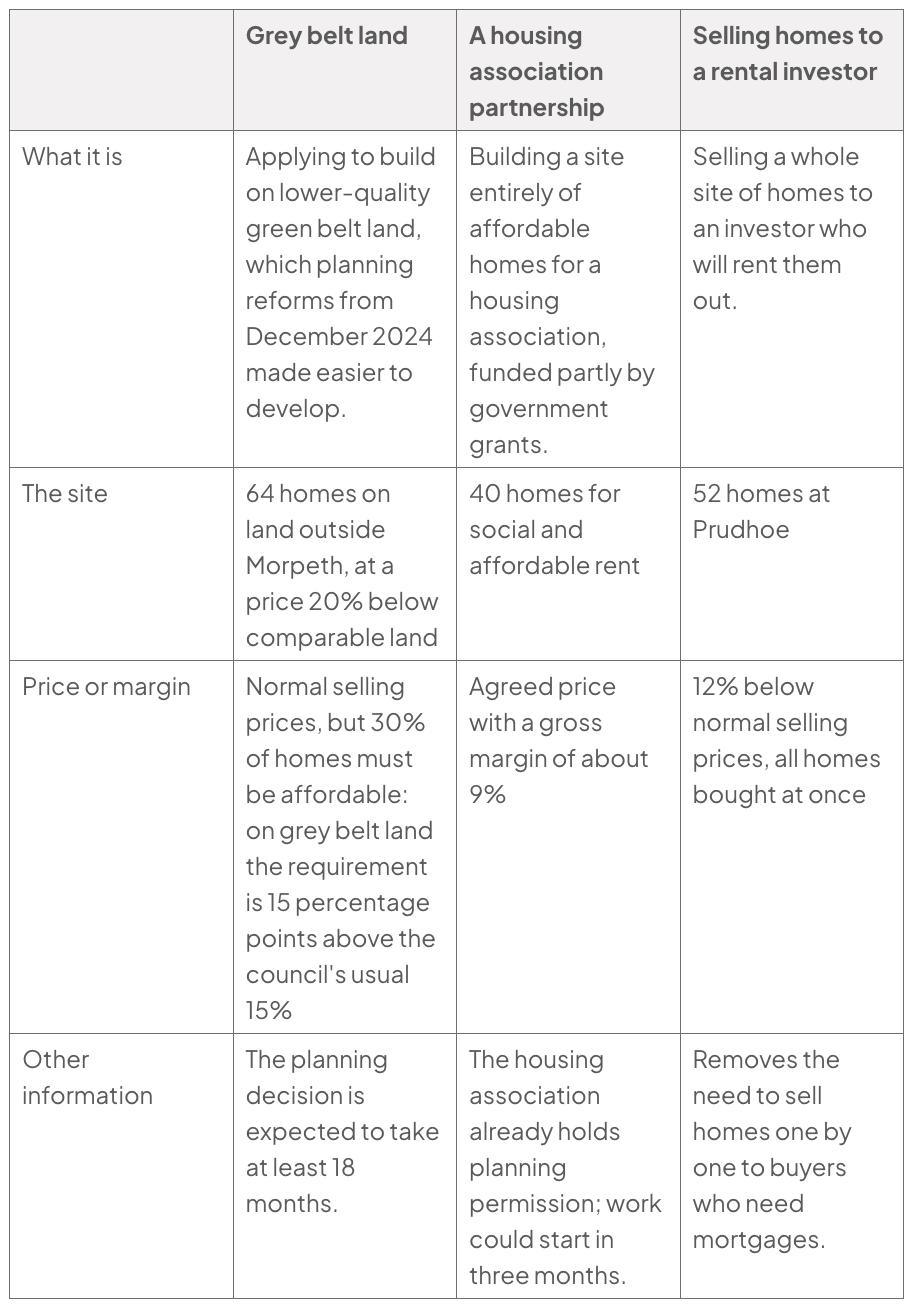
Appendix G: Three ways to respond to government housing policy

Table comparing three responses: grey-belt land (64 homes, land 20% cheaper, 30% affordable, 18-month planning); housing-association partnership (40 affordable homes, 9% margin, permission granted, work in three months); rental investor (52 homes, sold together at 12% below normal prices).

Source: Fenwick Vale Homes

The government wants many more homes to be built, but Fenwick Vale Homes waits longer for planning decisions than ever before.

Evaluate two ways Fenwick Vale Homes could respond to government housing and planning policy and recommend which one it should do first.

Use information from Appendices D to G to support your answer.

4
15 marks

Source B: Oakhanger Lettings

Oakhanger Lettings Limited is a letting agent with branches in Alton and Farnham, Hampshire and Surrey. It was founded in 2004 by Rachel Dunn, who owns it and is its Managing Director, and it employs 28 people. At 30 June 2026 it managed 1 120 rented homes for 640 landlords. It advertises every home on Rightmove.

The company offers landlords two main services:

  • Full management. Oakhanger Lettings finds a tenant, collects the rent, arranges repairs and inspections and makes sure the landlord meets the law. It charges 12% of the rent.

  • Let-only. Oakhanger Lettings finds a tenant and the landlord manages the home. It charges a fee equal to one month's rent.

It also charges landlords for arranging the safety checks and certificates the law requires. By law, letting agents in England may not charge tenants fees.

Most of its landlords own one or two homes, and many have buy-to-let mortgages. Bank Rate was 3.75% at the start of 2026, and financial markets expected further cuts during the year. Rents in its area rose by 1.5% in the year to 30 June 2026.

The law on renting has changed. From 1 May 2026 the Renters' Rights Act ended "no-fault" evictions, under which a landlord could end a tenancy without giving a reason. A landlord must now prove one of the grounds set out in law. All tenancies became periodic, with no fixed end date, and rents may be raised only once a year. In the November 2025 Budget the government announced that, from April 2027, the income tax rates on rental income will be 2 percentage points higher than on other income.

Source: Oakhanger Lettings

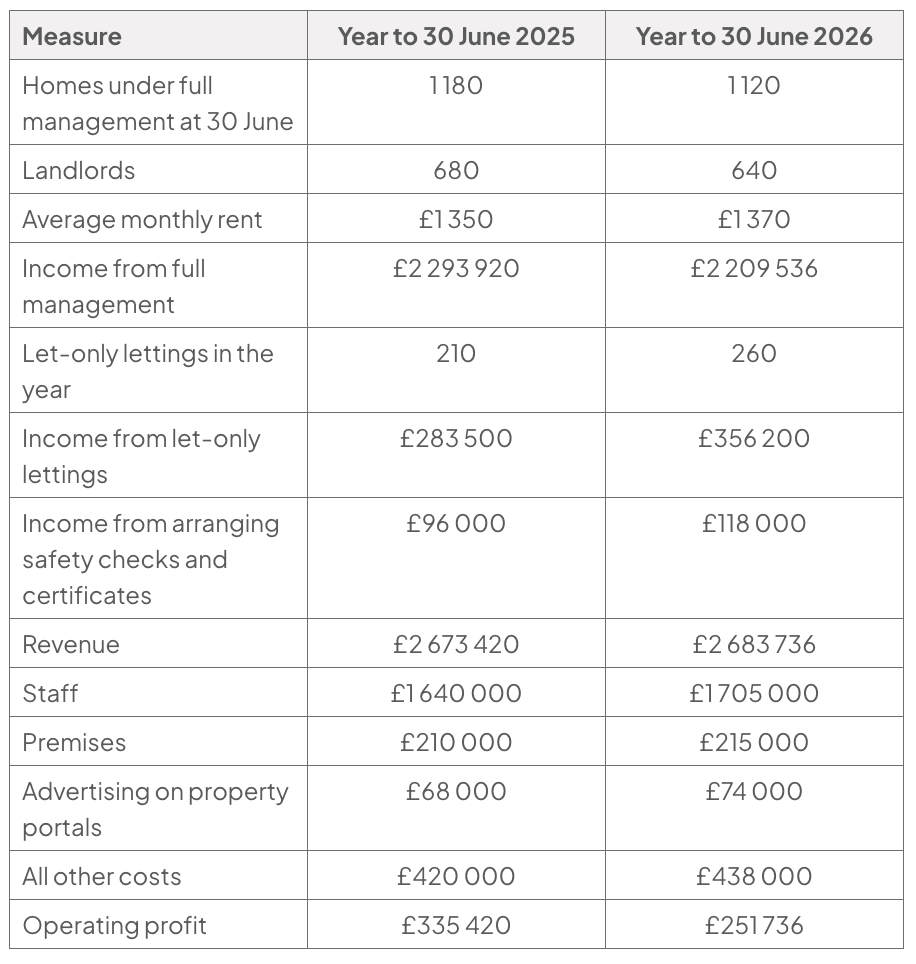
Appendix D: Oakhanger Lettings selected data

Table comparing 2025 and 2026: full-management homes 1,180 to 1,120; landlords 680 to 640; average rent £1,350 to £1,370; let-only 210 to 260; revenue £2,673,420 to £2,683,736; operating profit £335,420 to £251,736.

Source: Oakhanger Lettings

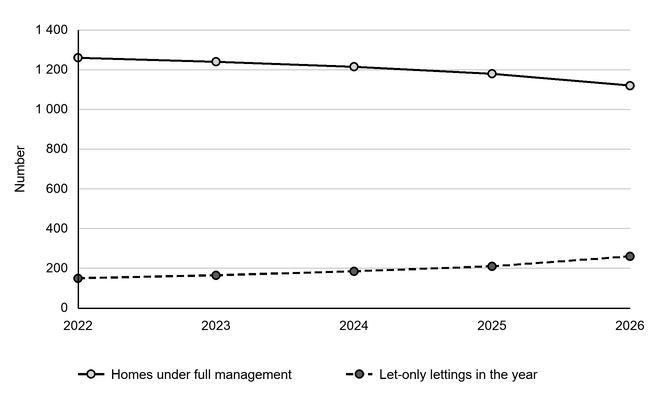
Appendix E: Full management and let-only

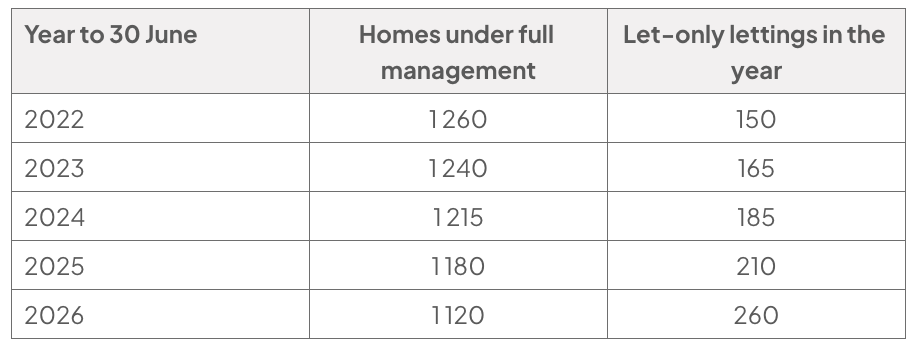
Line chart of Oakhanger Lettings’ homes and lettings from 2022 to 2026: full-management homes decline from 1,260 to 1,120, while let-only lettings rise from 150 to 260.
Table of Oakhanger Lettings’ homes under full management and let-only lettings, for years to 30 June 2022–2026: full management 1,260, 1,240, 1,215, 1,180, 1,120; let-only 150, 165, 185, 210, 260.

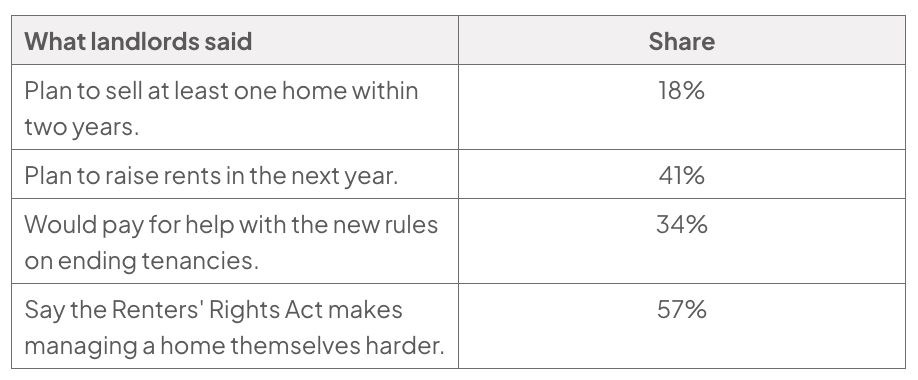
Survey of Oakhanger Lettings' landlords, June 2026

Survey of Oakhanger Lettings’ landlords: 18% plan to sell a home within two years, 41% plan to raise rents, 34% would pay for help with new rules, and 57% find self-management harder.

Source: Oakhanger Lettings

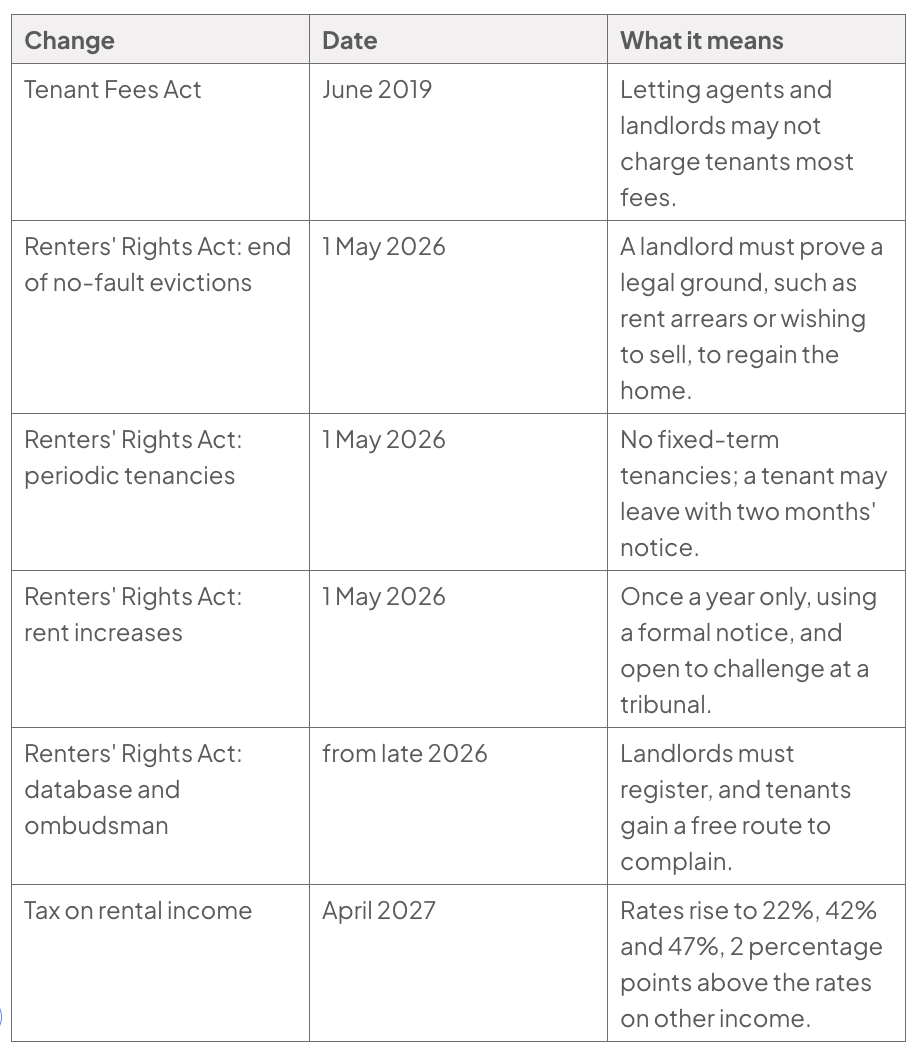
Appendix F: Renting, the law and tax

Table of UK renting policy changes: June 2019 tenant-fee restrictions; 1 May 2026 no-fault evictions end, periodic tenancies and annual rent increases; late 2026 database and ombudsman; April 2027 rental-tax rates rise to 22%, 42% and 47%.

Source: Analyst

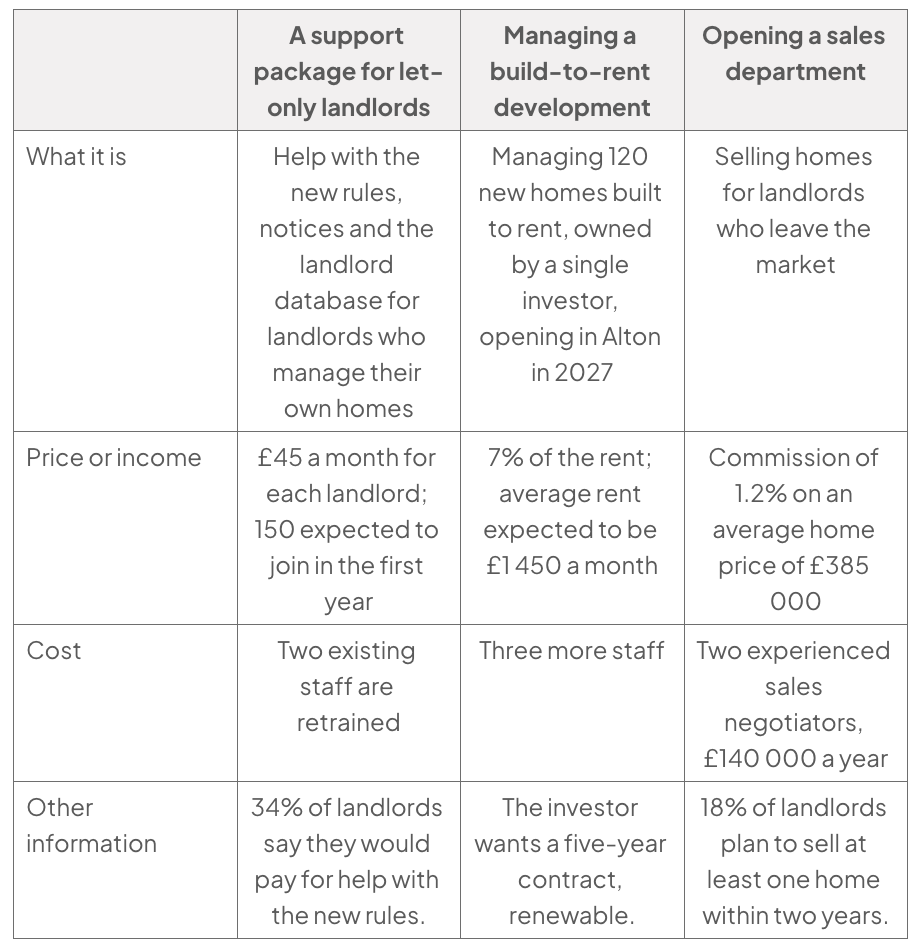
Appendix G: Three ways to respond

Table comparing three responses: support package for let-only landlords (£45/month; 150 expected), managing a 120-home build-to-rent development (7% rent), and opening a sales department (1.2% commission); costs and supporting data are listed.

Source: Oakhanger Lettings

The Renters' Rights Act has changed the rules on renting, and from April 2027 Oakhanger Lettings' landlords will pay more tax on their rental income.

Evaluate two ways Oakhanger Lettings could respond to these changes in government policy and recommend which one it should do first.

Use information from Appendices D to G to support your answer.