Influences on Strategy (AQA A Level Business): Exam Questions

Exam code: 7132

Syllabus Edition

First teaching 2026

First exams 2028

3 hours17 questions
1
6 marks

Source B: Eden Project

The Eden Project opened in 2001 in a former china clay pit near St Austell, Cornwall. Its giant biomes hold plants from the rainforest and the Mediterranean, and in February 2026 it welcomed its 25 millionth visitor. Eden Project Limited runs the site, its shops, cafés and events, including the Eden Sessions summer concerts. It is wholly owned by The Eden Trust, a registered charity whose mission is "to demonstrate and inspire positive action for the planet".

The company "exists only to deliver the charitable objectives of the Trust", and every activity, "including that which might ordinarily be termed commercial", is designed to educate people about the environment or inspire them to change. Visitors are described as "the primary source of earned income". Other income includes grants from funders and Gift Aid, a tax relief on donations which the charity reclaims and passes to the company.

Visitor numbers fell by more than 10% in the year to March 2025. In January 2025 Eden Project announced plans to cut its payroll by about 20%, affecting about 80 jobs. Its accounts describe "a programme of organisational change to simplify structures, reduce costs and strengthen operational control", including "workforce reduction and changes to leadership structures". The board endorsed "a stabilisation strategy, prioritising control, clarity and resilience", to lay the foundations for "scaffolded growth".

In the year to 31 March 2026 visitor numbers rose by about 0.4%, and the company said it had "halted the pattern of decline seen in prior years". It is also developing two new Eden projects, in Morecambe and Dundee.

Source: Eden Project Limited, Annual Report and Consolidated Financial Statements for the year ended 31 March 2026

Eden Project Limited exists only to deliver the charitable objectives of The Eden Trust, whose mission is "to demonstrate and inspire positive action for the planet". Visitors are its main source of earned income.

Analyse one way in which this mission might affect Eden Project's ability to increase its revenue.

2
6 marks

Source B: Linbury Preserves

Linbury Preserves Limited makes jam and marmalade near Leominster, Herefordshire. It was founded in 1952 by Joan Ashby in her farmhouse kitchen and is still owned by the Ashby family; its Managing Director is Tom Ashby, her grandson. It employs 58 people and in the year to 31 March 2026 sold 3.02 million jars, mainly to farm shops, delicatessens and independent food shops, and through its own website.

The company's mission is to make "proper preserves, the slow way": every batch is boiled in open copper pans, and the fruit comes from farms within 30 miles. It buys its fruit from 14 Herefordshire growers on five-year contracts, at prices above the market price, so that the growers can plan and invest. In 2025 the family set an objective of doubling the company's revenue by 2030.

To be sold as "jam", a product must meet the legal standards for fruit and sugar content. In 2024 Linbury Preserves launched a range with less sugar; because its sugar content is below the legal standard, it must be sold as a "fruit spread" rather than as jam.

Many of its customers say they are trying to eat less sugar. At the same time, the company's costs have risen. The National Living Wage rose by 4.1% to £12.71 an hour from April 2026, employers have paid more National Insurance since April 2025, and since 2025 the company has paid fees on the glass jars and lids it uses, under new rules which make businesses pay towards the cost of recycling packaging.

Source: Linbury Preserves

Linbury Preserves' mission is to make "proper preserves, the slow way": every batch is boiled in open copper pans, using fruit from farms within 30 miles.

Analyse one way in which this mission might affect Linbury Preserves' ability to increase its output.

3
6 marks

Source B: Stowe Valley Mutual

Stowe Valley Mutual is a building society founded in 1867 in Buckingham. It takes savings from its members and lends to members who are buying a home. It has nine branches in Buckinghamshire and Oxfordshire and 155 employees. As a building society it has no shareholders: it is owned by its 97 100 members, its savers and borrowers, who each have a vote at its annual general meeting. Its profits are not paid out as dividends but kept as reserves, which the law requires it to hold to protect its savers.

Its mission is "helping members save and own their homes, with a branch in every town we serve". By law, at least half of a building society's funds must come from its members' savings, and at least three-quarters of its lending must be secured on homes.

Stowe Valley Mutual's income comes mainly from the gap between the interest it earns on mortgages and the interest it pays to savers. Bank Rate, the Bank of England's interest rate, has fallen from 5.25% in July 2024 to 3.75% in September 2026.

Its board measures performance with key performance indicators including its cost to income ratio (operating costs as a percentage of income), its profit before tax, and the satisfaction of its members.

Source: Stowe Valley Mutual

Stowe Valley Mutual is owned by its members and has no shareholders. Its profits are kept as reserves, which the law requires it to hold to protect its savers.

Analyse one way in which being owned by its members might affect the interest rates Stowe Valley Mutual pays to its savers.

4
6 marks

Source A: Co-op Group

The Co-operative Group, known as Co-op, began in Rochdale in 1844. It is a co-operative owned by its members, who can vote at its annual general meeting (AGM). Co-op says that because it is owned by its members, it "can make decisions that other businesses can't, from our Net Zero goals to our community support".

It runs more than 2 300 food stores and supplies others through Co-op Wholesale, partners and franchises, close to 8 000 stores in all. It also provides funerals, insurance and legal services.

Changes in 2025 included:

  • Prices. It price-matched over 100 everyday items to Aldi for members; these items reached 40% of members' baskets.

  • Online. Its online quick-commerce business, selling through its own website and delivery apps Uber Eats, Just Eat and Deliveroo, grew by 15%. Online services were added to 279 more stores, and 90% of the UK population can shop online with Co-op.

In April 2025 Co-op suffered a criminal cyber attack. To contain it, Co-op restricted its own computer systems, which caused shortages of goods in stores. Group revenue fell 2.3% to £11 025 million, and Co-op made an underlying operating loss of £35 million. In 2026 Co-op says its market share has returned to or passed pre-attack levels in every business area.

Its Chief Executive, Shirine Khoury-Haq, stepped down on 29 March 2026, almost seven years after joining Co-op, and Kate Allum was appointed interim Group Chief Executive.

Co-op plans to remove £200 million of annual operating costs in 2026, and has set a target of 10 million active members by 2030.

Source: Co-operative Group, Members' Annual Report 2025 and 2025 trading update

Co-op is owned by its members. It says this means it "can make decisions that other businesses can't", and in 2025 it price-matched over 100 everyday items to Aldi for members.

Analyse one way in which being owned by its members might affect Co-op's pricing decisions.

5
6 marks

Source A: ITV

ITV plc is a UK broadcaster and programme maker listed on the London Stock Exchange. It has two divisions:

  • Media & Entertainment (M&E) runs ITV1, ITV2 and other channels and the streaming service ITVX, and earns most of its income from advertising.

  • ITV Studios makes and sells programmes, such as Coronation Street, Emmerdale and Love Island, to ITV and to other broadcasters and streaming services around the world.

ITV follows its "More Than TV" strategy, which has three parts: expanding ITV Studios, "supercharging" streaming and optimising broadcast television. In 2025 ITV made £63 million of permanent cost savings through technology, organisational redesign and growing use of AI.

In 2025 total revenue was £4 121 million, almost unchanged on 2024. The company faces two main pressures:

  • Viewing. ITV says that "linear viewing continues to decline, particularly among younger audiences".

  • Advertising. Total advertising revenue fell 5% in 2025. Digital revenue, mainly from ITVX, rose 10% to £614 million, but most advertising revenue still comes from the broadcast channels.

On 6 July 2026 ITV agreed to sell M&E, including its channels, ITVX and the Channel 3 licences, to Sky for up to £1.6 billion. ITV Studios would remain a separate company listed in London. The sale must be approved by regulators, including the Competition and Markets Authority. ITV and Sky argue that, including online advertising, they would have about 20% of UK advertising spending; on a television-only measure the share would be much higher. The sale is expected to complete in the second half of 2027.

Source: ITV plc, results for 2025 and the first half of 2026, and announcement of 6 July 2026

ITV follows its "More Than TV" strategy, which has three parts: expanding ITV Studios, "supercharging" streaming and optimising broadcast television.

Analyse one way in which this strategy might affect how ITV allocates its resources.

6
6 marks

Source A: JD Sports

JD Sports Fashion plc, founded in 1981 in Bury, Greater Manchester, is listed on the London Stock Exchange. It sells trainers, clothing and accessories from brands such as Nike and Adidas, and some own-brand products, through 4 811 stores in 36 countries and online. Its shop names include JD, Size?, Hibbett, Finish Line, Shoe Palace, Courir and Go Outdoors.

Online made up 20% of sales in the half year to August 2026. Its JD STATUS loyalty programme has more than 10 million active members. In 2026 JD became one of the first US retailers to let customers buy its products and pay directly within an AI platform.

In July 2024 JD bought Hibbett, a US chain of about 1 000 stores, funded mainly by a $1 billion loan, and in November 2024 the French chain Courir. It is converting many of its US stores that trade as Finish Line to the JD name. It follows a "fewer, bigger, better" approach to its UK stores, and in 2026 JD Germany was reduced from 91 to 62 stores.

In the year to 31 January 2026 sales rose 10.5% to £12 662 million. Organic sales, which exclude acquisitions, rose 2.1%, and like-for-like sales, from stores and websites open in both years, fell 2.1%. Free cash flow rose. JD describes its market as "highly promotional".

Its medium-term priorities are sales growth ahead of its markets, a rising operating margin and strong free cash flow. It aims to generate more than £1.4 billion of free cash flow over the three years to January 2028.

Source: JD Sports Fashion plc, results for the year to 31 January 2026 and the half year to 1 August 2026

JD Sports aims to generate more than £1.4 billion of free cash flow over the three years to January 2028.

Analyse one way in which this objective might affect JD Sports' decisions about opening new stores.

7
6 marks

Source B: Culverton Biotech

Culverton Biotech Limited was founded in 2017 by two scientists from the University of Oxford and is based at a science park near Abingdon, Oxfordshire. It has 46 employees. It is developing one medicine, CLV-201, for a rare inherited liver disease that affects about 1 in 25 000 people and for which there is no approved treatment in the UK.

Culverton Biotech's mission is "to turn rare-disease science into medicines that patients can actually get". Its objective is to have CLV-201 approved in the UK by 2029.

In 2025 CLV-201 completed a Phase II clinical trial. To be approved, it must now pass a larger Phase III trial, expected to cost £45 million over three years. The company has no revenue: it is funded by venture capital investors, who own most of its shares, and by research grants. It made a loss of £19.6 million in the year to 30 June 2026.

Two large pharmaceutical companies have approached Culverton Biotech about licensing CLV-201.

Source: Culverton Biotech

Culverton Biotech's mission is "to turn rare-disease science into medicines that patients can actually get". It is funded by venture capital investors, who own most of its shares.

Analyse one way in which this mission might affect the price Culverton Biotech plans to charge for CLV-201.

8
6 marks

Source B: Royal Shakespeare Company

The Royal Shakespeare Company (RSC) is a registered charity based in Stratford-upon-Avon, the town where Shakespeare was born. Its Co-Artistic Directors are Daniel Evans and Tamara Harvey. Its mission is to "redefine how Shakespeare and great story-telling connects us, creates opportunities and brings joy".

The RSC performs in three theatres in Stratford, transfers productions to London, tours the UK and abroad, and works with schools nationwide. It also earns income from licensing its productions, including the musical Matilda, which has had more than 5 000 performances in London since 2011 and began a UK tour in October 2025.

Its income comes from ticket sales, an annual grant from Arts Council England, Theatre Tax Relief, donations, catering and retail.

In 2024/25 the RSC sold more than 25 000 tickets at £25 or less, and in Stratford it sold 77% of its seats but achieved 64% of its potential ticket income. It sold more than 23 000 tickets at £10 to young people aged 14 to 25, in a partnership with the social media company TikTok. Linear television viewing is declining, particularly among younger audiences.

The RSC faces two pressures:

  • Income. In the year to 31 March 2025 income fell from £92.1 million to £82.0 million, partly because the previous year's income from Matilda and other productions was not repeated, and spending exceeded income.

  • Audiences. The RSC sees cost-of-living pressures as a risk to audience levels.

In 2025 it announced plans to reduce its workforce by 11%, first through voluntary redundancy, to close a shortfall of about £5 million.

Source: Royal Shakespeare Company, Report and Financial Statements for the year ended 31 March 2025, and press reports

The RSC's mission is to "redefine how Shakespeare and great story-telling connects us, creates opportunities and brings joy". It is a registered charity.

Analyse one way in which this mission might affect the prices the RSC charges for tickets.

1
9 marks

Source B: Eden Project

The Eden Project opened in 2001 in a former china clay pit near St Austell, Cornwall. Its giant biomes hold plants from the rainforest and the Mediterranean, and in February 2026 it welcomed its 25 millionth visitor. Eden Project Limited runs the site, its shops, cafés and events, including the Eden Sessions summer concerts. It is wholly owned by The Eden Trust, a registered charity whose mission is "to demonstrate and inspire positive action for the planet".

The company "exists only to deliver the charitable objectives of the Trust", and every activity, "including that which might ordinarily be termed commercial", is designed to educate people about the environment or inspire them to change. Visitors are described as "the primary source of earned income". Other income includes grants from funders and Gift Aid, a tax relief on donations which the charity reclaims and passes to the company.

Visitor numbers fell by more than 10% in the year to March 2025. In January 2025 Eden Project announced plans to cut its payroll by about 20%, affecting about 80 jobs. Its accounts describe "a programme of organisational change to simplify structures, reduce costs and strengthen operational control", including "workforce reduction and changes to leadership structures". The board endorsed "a stabilisation strategy, prioritising control, clarity and resilience", to lay the foundations for "scaffolded growth".

In the year to 31 March 2026 visitor numbers rose by about 0.4%, and the company said it had "halted the pattern of decline seen in prior years". It is also developing two new Eden projects, in Morecambe and Dundee.

Source: Eden Project Limited, Annual Report and Consolidated Financial Statements for the year ended 31 March 2026

Appendix D: Eden Project financial data

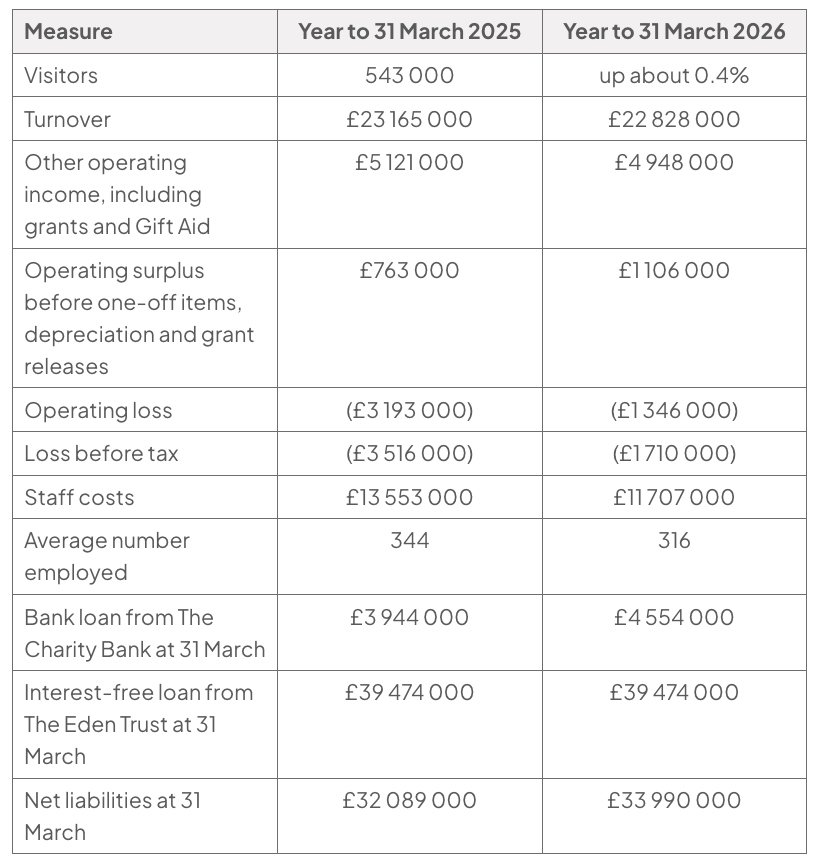
Table of Eden Project financial data for the years to 31 March 2025 and 2026: visitors 543 000 in 2025, up about 0.4% in 2026; turnover £23 165 000 and £22 828 000; other operating income, including grants and Gift Aid, £5 121 000 and £4 948 000; operating surplus before one-off items, depreciation and grant releases £763 000 and £1 106 000; operating loss £3 193 000 and £1 346 000; loss before tax £3 516 000 and £1 710 000; staff costs £13 553 000 and £11 707 000; average number employed 344 and 316; bank loan from The Charity Bank at 31 March £3 944 000 and £4 554 000; interest-free loan from The Eden Trust at 31 March £39 474 000 in both years; net liabilities at 31 March £32 089 000 and £33 990 000.

Visitors in the year to 31 March 2024: 604 000. Staff restructuring costs in the year to 31 March 2025: £587 000.

Source: Eden Project Limited and press reports

Appendix F: Income, funders and supporters

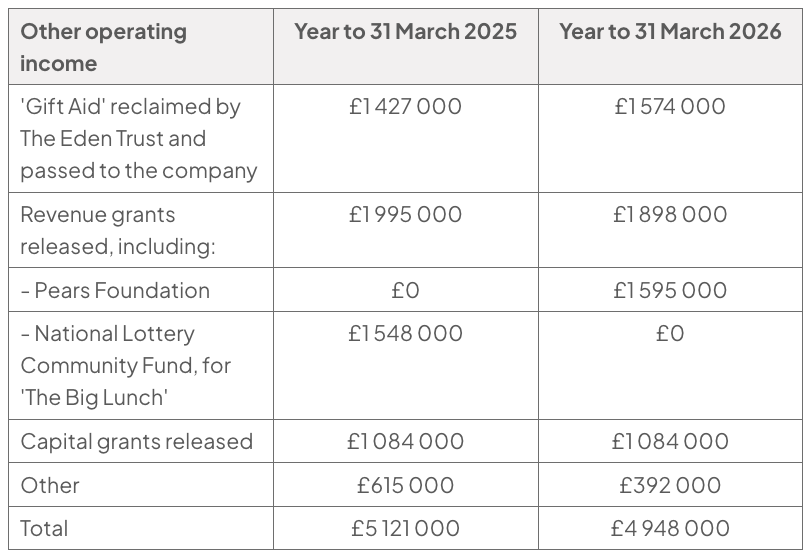
Table of Eden Project other operating income for the years to 31 March 2025 and 2026: Gift Aid reclaimed by The Eden Trust and passed to the company £1 427 000 and £1 574 000; revenue grants released £1 995 000 and £1 898 000, including Pears Foundation £0 and £1 595 000 and National Lottery Community Fund, for The Big Lunch, £1 548 000 and £0; capital grants released £1 084 000 in both years; other £615 000 and £392 000; total £5 121 000 and £4 948 000.
  • The Big Lunch, Eden's national community programme, had over 10 million participants in 2024.

  • Eden has over 13 000 members and regular donors, and about 100 regular volunteers.

  • The 2026 Eden Sessions concerts attracted almost 60 000 people to 10 shows.

  • Eden's carbon emissions fell 5.7% in the year to March 2026 and are 38.5% below 2019/20, which is behind its target of a 10% reduction a year.

Source: Analyst, using Eden Project Limited, the Eden Project Annual Review 2024/25 and press reports

Assess whether being owned by a charity is more of a strength than a weakness for Eden Project.

Calculate Eden Project's operating profit margin in the year to 31 March 2026 to support your answer. Give your answer to one decimal place.

2
9 marks

Source A: Co-op Group

The Co-operative Group, known as Co-op, began in Rochdale in 1844. It is a co-operative owned by its members, who can vote at its annual general meeting (AGM). Co-op says that because it is owned by its members, it "can make decisions that other businesses can't, from our Net Zero goals to our community support".

It runs more than 2 300 food stores and supplies others through Co-op Wholesale, partners and franchises, close to 8 000 stores in all. It also provides funerals, insurance and legal services.

Changes in 2025 included:

  • Prices. It price-matched over 100 everyday items to Aldi for members; these items reached 40% of members' baskets.

  • Online. Its online quick-commerce business, selling through its own website and delivery apps Uber Eats, Just Eat and Deliveroo, grew by 15%. Online services were added to 279 more stores, and 90% of the UK population can shop online with Co-op.

In April 2025 Co-op suffered a criminal cyber attack. To contain it, Co-op restricted its own computer systems, which caused shortages of goods in stores. Group revenue fell 2.3% to £11 025 million, and Co-op made an underlying operating loss of £35 million. In 2026 Co-op says its market share has returned to or passed pre-attack levels in every business area.

Its Chief Executive, Shirine Khoury-Haq, stepped down on 29 March 2026, almost seven years after joining Co-op, and Kate Allum was appointed interim Group Chief Executive.

Co-op plans to remove £200 million of annual operating costs in 2026, and has set a target of 10 million active members by 2030.

Source: Co-operative Group, Members' Annual Report 2025 and 2025 trading update

Appendix A: Co-op financial data

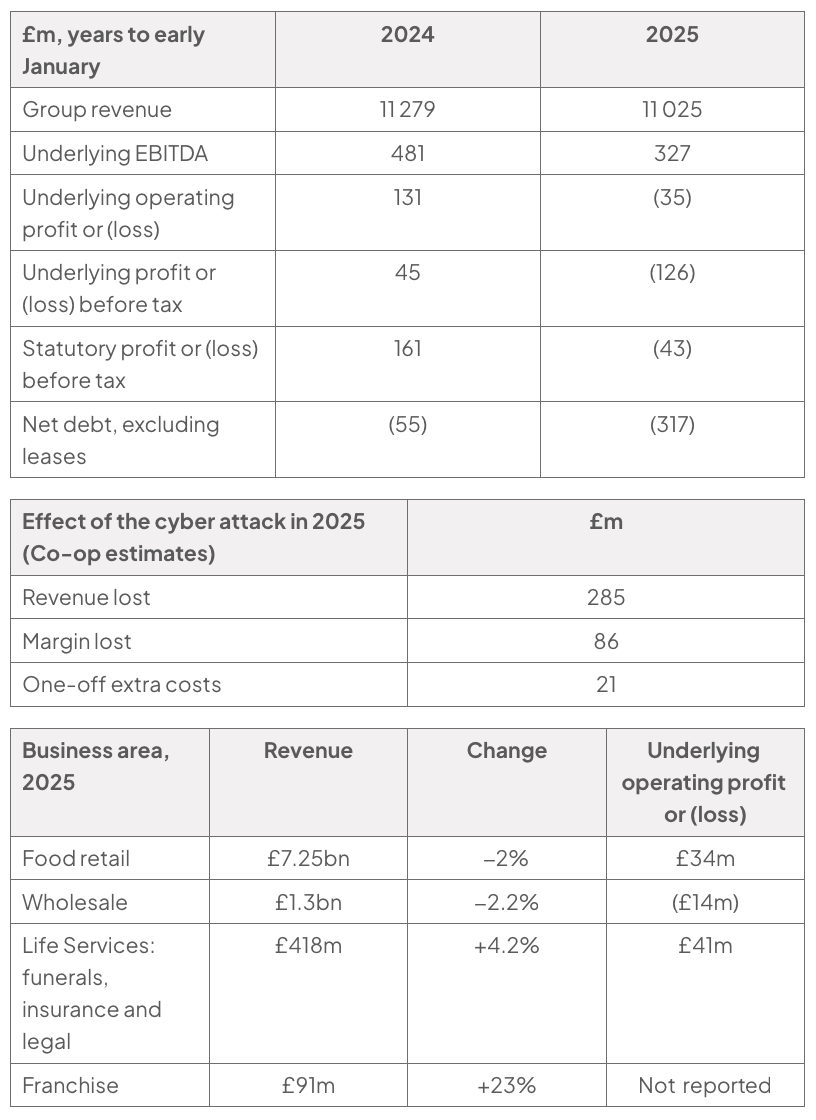
Three tables of Co-op data. Table 1, £m, years to early January 2024 and 2025: group revenue 11 279 and 11 025; underlying EBITDA 481 and 327; underlying operating profit or (loss) 131 and (35); underlying profit or (loss) before tax 45 and (126); statutory profit or (loss) before tax 161 and (43); net debt, excluding leases, (55) and (317). Table 2, effect of the cyber attack in 2025 (Co-op estimates), £m: revenue lost 285; margin lost 86; one-off extra costs 21. Table 3, business area in 2025, showing revenue, change and underlying operating profit or (loss): food retail £7.25bn, −2%, £34m; wholesale £1.3bn, −2.2%, (£14m); Life Services (funerals, insurance and legal) £418m, +4.2%, £41m; franchise £91m, +23%, operating profit not reported.
  • Costs. About £150m of cost increases in 2025, including £47m of regulatory costs from higher employers' National Insurance and new packaging charges, and investment in colleague pay.

  • Investment. £318m in stores and technology in 2025.

  • Distributions. Members were not asked to approve any distribution of profits for 2025.

Source: Co-operative Group

Appendix C: Members, colleagues and communities

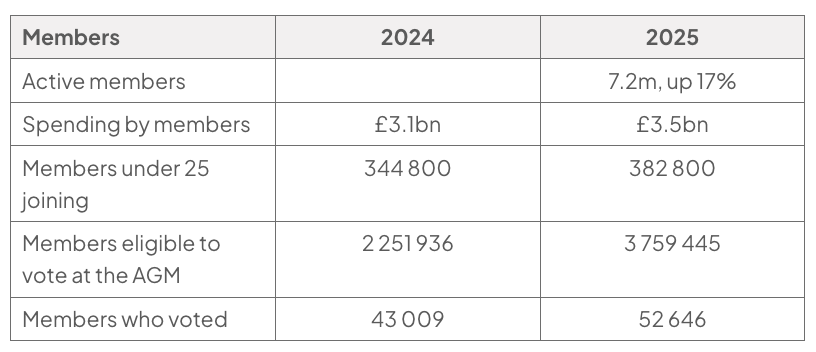
Table of Co-op members for 2024 and 2025: active members 7.2m in 2025, up 17%; spending by members £3.1bn and £3.5bn; members under 25 joining 344 800 and 382 800; members eligible to vote at the AGM 2 251 936 and 3 759 445; members who voted 43 009 and 52 646.
  • Communities. £15m shared with causes and communities in 2025; the Local Community Fund has shared £120m since 2016. Co-op supports 38 Co-op Academies.

  • Suppliers. Over £700m spent with UK farmers and agriculture suppliers; 100% of fresh and frozen own-brand meat is British. Members' priorities led to a pledge to stop sourcing from countries where the international community has identified serious risks of human rights violations.

  • Colleagues. A 30% colleague discount; physical assaults on colleagues in stores fell from 1 217 to 839 after new security measures.

  • Target. 10 million active members by 2030, raised from 8 million.

Source: Analyst, using Co-operative Group

Assess whether a target of 10 million active members by 2030 is the right objective for Co-op.

Calculate Co-op's underlying operating profit margin in 2025 to support your answer. Give your answer to two decimal places.

3
9 marks

Source B: Bretforton Facilities

Bretforton Facilities Limited was founded in 1989 by Anne Fielding in Bretforton, near Evesham, and is still owned by her family. Her son, Mark Fielding, is Managing Director. It cleans and maintains about 180 schools, 64 GP surgeries and health centres, and a number of offices across Worcestershire and the West Midlands, and employs 640 people, most of them part-time cleaners and caretakers.

Its mission is "clean, safe buildings, looked after by local people who are paid fairly". Since 2016 it has been an accredited Real Living Wage employer, which means it pays all its staff at least the Real Living Wage, a voluntary rate set by the Living Wage Foundation that is higher than the legal National Living Wage. Its objective is to reach £30 million of revenue by 2030 while remaining a Real Living Wage employer.

Bretforton Facilities competes for contracts against national facilities management companies, which can often offer lower prices. Its largest customer, a county council, wants to cut the price of its contract when it is renewed next year.

Anne Fielding is 71 and wants to sell the business. A national competitor, Corvane Group, has made an offer, and the family is also considering selling to an employee ownership trust.

Source: Bretforton Facilities

Appendix D: Bretforton Facilities selected data

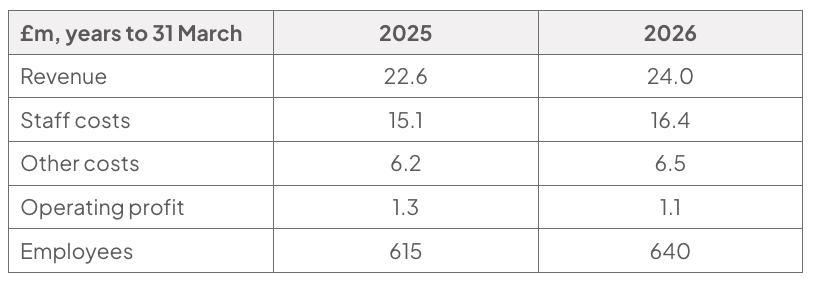
Table of Bretforton Facilities’ selected data for years to 31 March: revenue £22.6m to £24.0m, staff costs £15.1m to £16.4m, other costs £6.2m to £6.5m, operating profit £1.3m to £1.1m, and employees 615 to 640, from 2025 to 2026.

Source: Bretforton Facilities

Appendix E: Pay and people

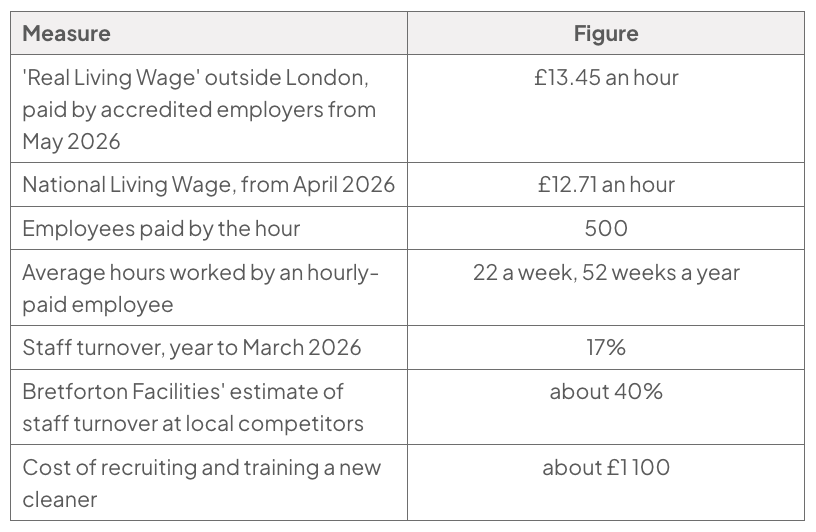
Table of pay and staffing data: Real Living Wage £13.45 an hour versus National Living Wage £12.71; 500 hourly-paid employees work 22 hours weekly for 52 weeks. Turnover is 17% versus competitors’ 40%; recruitment costs about £1,100 per cleaner.
  • In 2026 the company introduced an app that gives cleaners their schedules and lets them report problems with photos. Many cleaners are older and some have asked to keep paper rotas.

  • Head teachers' survey, 2026: 88% said the same cleaners working in their school every week was "very important".

Source: Bretforton Facilities and the Living Wage Foundation

Assess whether being a Real Living Wage employer helps Bretforton Facilities to achieve its objective.

Calculate the extra cost a year of paying Bretforton Facilities' hourly-paid employees the Real Living Wage instead of the National Living Wage to support your answer.

4
9 marks

Source B: Culverton Biotech

Culverton Biotech Limited was founded in 2017 by two scientists from the University of Oxford and is based at a science park near Abingdon, Oxfordshire. It has 46 employees. It is developing one medicine, CLV-201, for a rare inherited liver disease that affects about 1 in 25 000 people and for which there is no approved treatment in the UK.

Culverton Biotech's mission is "to turn rare-disease science into medicines that patients can actually get". Its objective is to have CLV-201 approved in the UK by 2029.

In 2025 CLV-201 completed a Phase II clinical trial. To be approved, it must now pass a larger Phase III trial, expected to cost £45 million over three years. The company has no revenue: it is funded by venture capital investors, who own most of its shares, and by research grants. It made a loss of £19.6 million in the year to 30 June 2026.

Two large pharmaceutical companies have approached Culverton Biotech about licensing CLV-201.

Source: Culverton Biotech

Appendix D: Culverton Biotech selected data

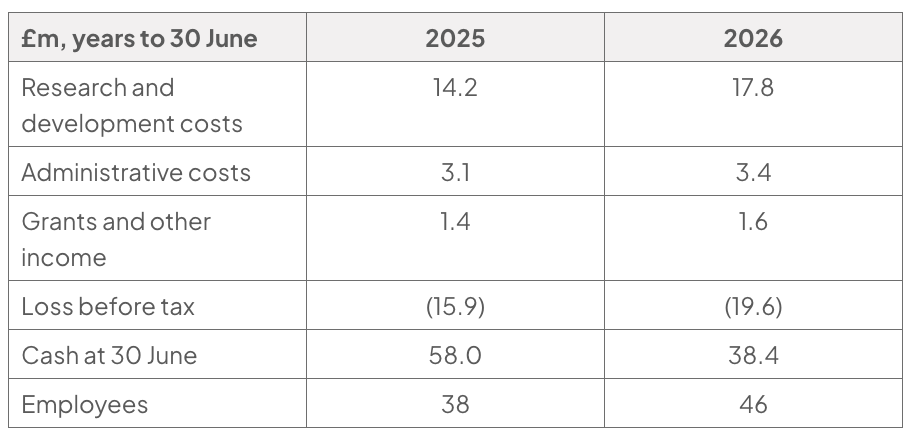
Table of Culverton Biotech data in £m for years to 30 June: research and development costs 14.2 and 17.8; administrative costs 3.1 and 3.4; grants and other income 1.4 and 1.6; losses 15.9 and 19.6; cash 58.0 and 38.4; employees 38 and 46 in 2025 and 2026.

In the year to 30 June 2026 the company raised no new funding, so its cash fell by the amount of its loss. The board expects spending to continue at the same rate until the Phase III trial begins.

Source: Culverton Biotech

Appendix E: Strengths, weaknesses, opportunities and threats

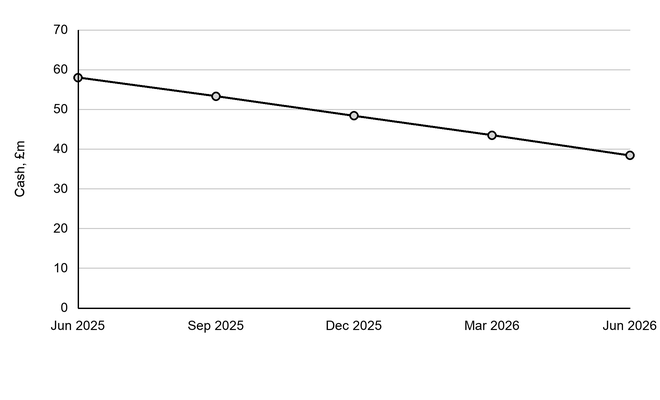
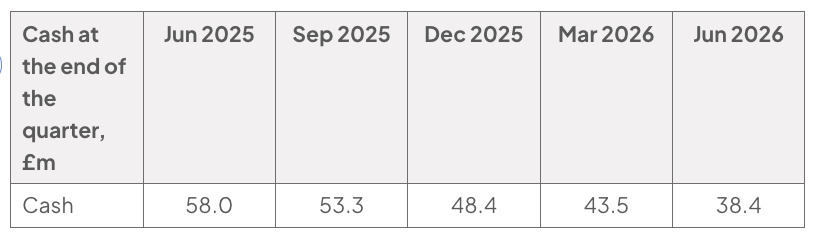
Line graph of Culverton Biotech’s cash, in £m, falling each quarter from 58.0 in June 2025 to 38.4 in June 2026: 53.3 in September, 48.4 in December and 43.5 in March.
Table of Culverton Biotech’s cash at the end of each quarter, in £m: Jun 2025 58.0, Sep 2025 53.3, Dec 2025 48.4, Mar 2026 43.5 and Jun 2026 38.4.
  • Phase II result. CLV-201 reduced the build-up of harmful bile acids by 58% compared with a placebo; there were no serious side effects.

  • Patent. Filed in 2018; patents last 20 years from filing.

  • Team. 31 of the 46 employees are scientists. The company has no sales force and no manufacturing.

  • Phase III. The board estimates a 55% chance that the Phase III trial succeeds.

  • Patients. About 2 700 people in the UK and about 13 500 in the United States have the disease.

  • Investors. The venture capital investors expect to sell their shares within five years.

Source: Culverton Biotech

Assess whether Culverton Biotech's strengths outweigh its weaknesses.

5
9 marks

Source B: Gadderby Sportswear

Gadderby Sportswear Limited is a private limited company, founded in 2008 by Martin Ashworth, a former rugby league player, and based in Huddersfield, West Yorkshire. It is owned by the Ashworth family, and Martin's daughter, Jo Ashworth, is Managing Director.

The company makes custom kit, including shirts, shorts, socks and training wear in each team's colours with names, numbers and sponsors' logos, for about 2 300 amateur rugby, football and netball clubs and 410 schools. Its mission is "kit made in Yorkshire for every grassroots team".

Every garment is cut, printed and sewn in its own factory, which allows it to deliver an order in 10 working days. The company repairs damaged kit free of charge for the first season and keeps each club's designs on file for quick reorders.

Revenue rose from £12.6 million to £14.2 million in 2025, and the factory made 610 000 garments. In 2025 the company began supplying clubs in Ireland and the Netherlands, which are in the European Union. Three rules apply to sales to EU customers:

  • Tariffs. UK-made goods are free of tariffs if they meet the "rules of origin" in the UK-EU trade agreement.

  • Customs. Every shipment needs a customs declaration.

  • VAT. EU customers pay VAT when their goods arrive.

Many competitors sell online and import kit from factories in Asia, at lower prices but with deliveries that take four to six weeks.

The company's objective is to reach revenue of £20 million by 2030 with an operating profit margin of at least 10%.

Source: Gadderby Sportswear

Appendix D: Gadderby Sportswear selected data

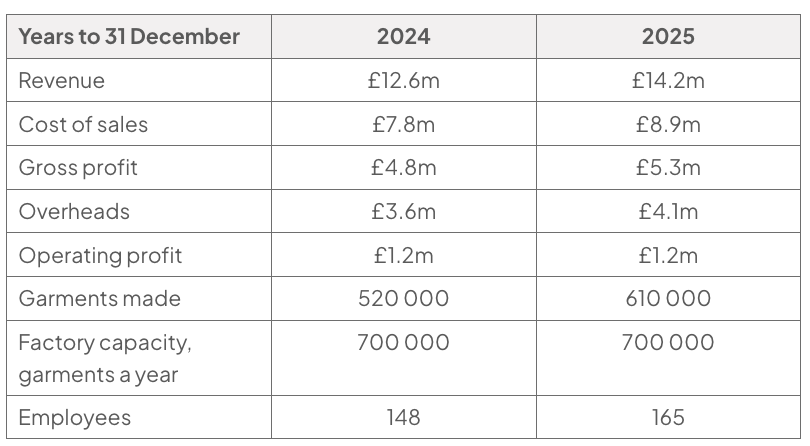
Table of Gadderby Sportswear data for the years to 31 December 2024 and 2025: revenue £12.6m and £14.2m; cost of sales £7.8m and £8.9m; gross profit £4.8m and £5.3m; overheads £3.6m and £4.1m; operating profit £1.2m in both years; garments made 520 000 and 610 000; factory capacity 700 000 garments a year in both years; employees 148 and 165.

Source: Gadderby Sportswear

Appendix E: Customers, competitors and trade

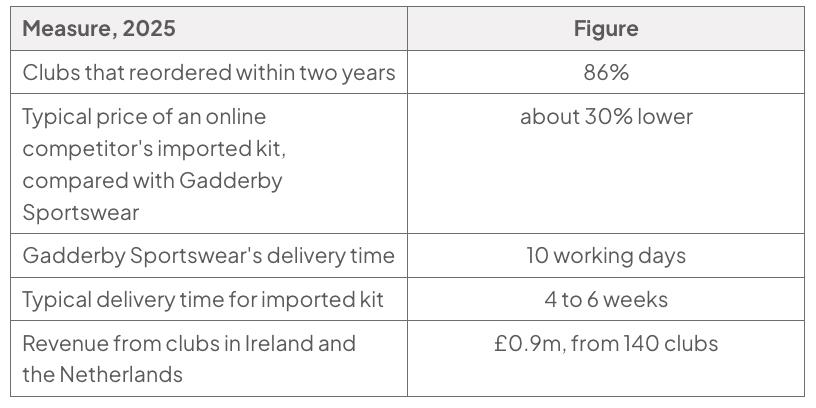
Table of 2025 measures: 86% of clubs reordered within two years; imported kit is about 30% cheaper; delivery is 10 working days versus 4 to 6 weeks; EU revenue is £0.9 million from 140 clubs.
  • Trade with the EU. Goods made in the UK can be sold to EU customers without tariffs if they meet the "rules of origin" in the UK-EU trade agreement, but every shipment needs a customs declaration, and EU customers pay VAT when their goods arrive.

  • Service. Gadderby Sportswear repairs damaged kit free of charge for the first season and keeps each club's designs on file for quick reorders.

Source: Gadderby Sportswear and UK government guidance

Appendix F: Making in Yorkshire

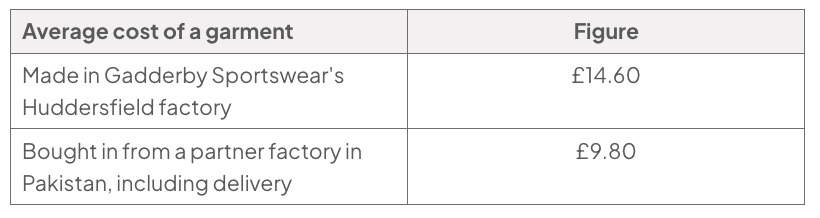
Table of average garment costs: made in Gadderby Sportswear’s Huddersfield factory, £14.60; bought from a partner factory in Pakistan, including delivery, £9.80.
  • 41 of the 165 employees have worked for the company for more than ten years; 12 apprentices joined in 2025.

  • Club survey, 2025: 64% of club secretaries said "made in the UK" was important to their choice of supplier; 71% said delivery time was important.

  • A partner factory would need about six weeks to deliver, and minimum order sizes of 500 garments.

Source: Gadderby Sportswear

Assess whether making all its kit in Yorkshire helps Gadderby Sportswear to achieve its objective.

Calculate how much more it cost Gadderby Sportswear to make its 2025 garments in its own factory than it would have cost to buy them from the partner factory to support your answer.

1
15 marks

Source A: Red Funnel

Red Funnel Limited provides ferry services across the Solent between Southampton and Cowes on the Isle of Wight, trading as Red Funnel. It has served the island since 1861. It runs vehicle ferries between Southampton and East Cowes, a freight ferry, and the Red Jet Hi-Speed passenger service between Southampton and West Cowes. Its passengers include island residents, visitors, commuters and patients travelling to mainland hospitals, and for many of them the service is a lifeline. Competitors, such as Wightlink, operate other routes across the Solent.

Red Funnel's mission is "to be the preferred ferry service to and from the Isle of Wight". Its strategy includes:

  • operating a safe, reliable and year-round lifeline service

  • offering customer service that exceeds expectations

  • gaining market share through a superior value proposition based on safety, reliability, service, price and value for money

  • improving its environmental footprint on the pathway to Net Zero

  • managing the business efficiently, with robust financial stewardship and investment discipline.

In 2025 Red Funnel carried 2.71 million passengers, including about 922 000 on the Red Jet, and 163 000 freight vehicles. Turnover rose by 0.7% to £60.4 million. Costs rose faster, including the effects of increases in the National Living Wage and employers' National Insurance contributions.

On 28 November 2025 the company was bought by a business controlled by Njord Partners, an investment firm, after government approval. As part of the deal, banks wrote off loans, the debt was restructured, and the owners provided new capital. The company says this provides a "materially strengthened financial platform from which to invest in operations, infrastructure and customer experience".

Source: Red Funnel Limited, Annual Report and Financial Statements for the year ended 31 December 2025

Appendix A: Red Funnel financial data

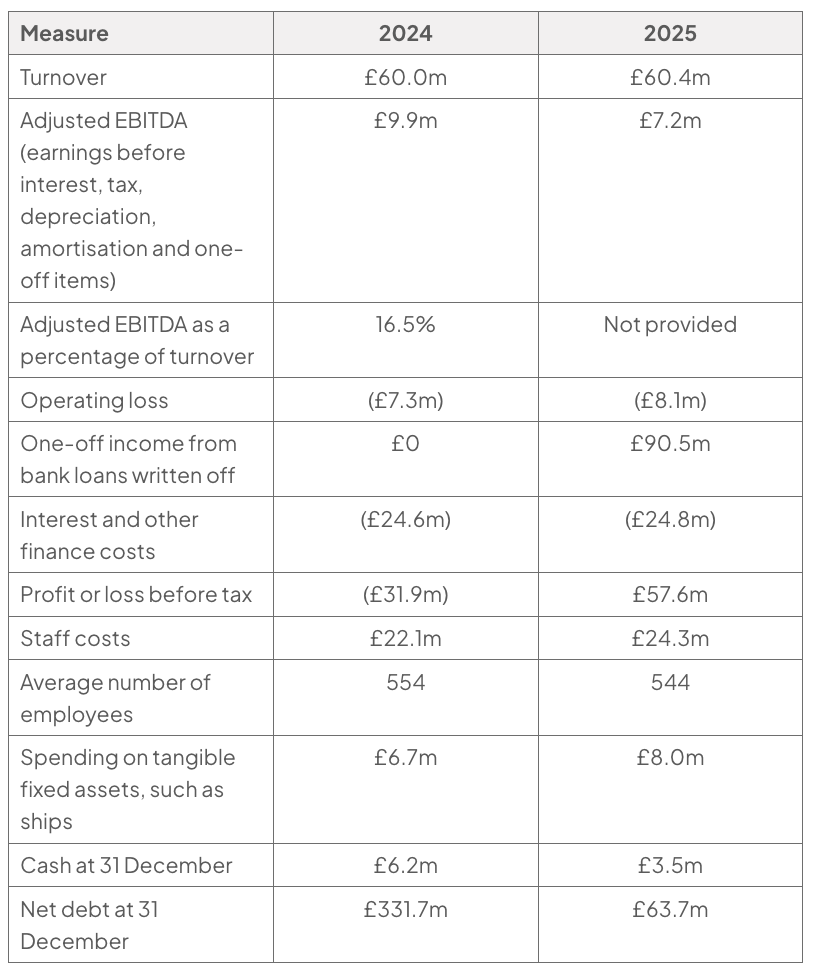
Table comparing Red Funnel’s 2024 and 2025 finances: turnover rose slightly, EBITDA fell, operating loss widened, and profit before tax changed from a £31.9m loss to £57.6m profit after £90.5m loan write-off.

Adjusted EBITDA in 2024: £9 893 000. In 2025: £7 220 000. Turnover in 2025: £60 380 000.

Source: Red Funnel Limited

Appendix B: Red Funnel operations and market

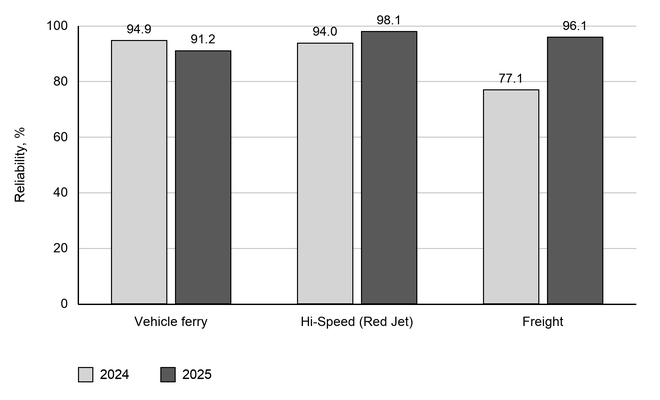
Grouped bar chart of Red Funnel reliability by service, 2024 versus 2025, on a 0–100% scale: vehicle ferry 94.9% to 91.2%, Hi-Speed 94.0% to 98.1%, freight 77.1% to 96.1%.
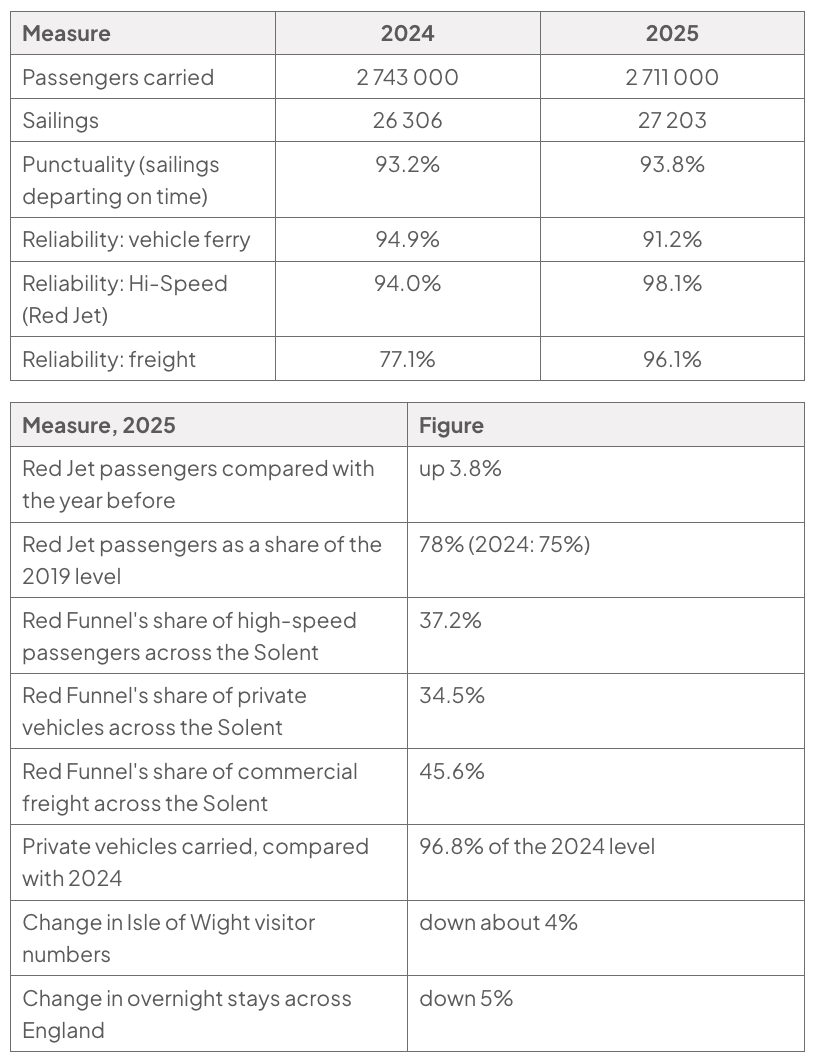
Two Red Funnel operations tables: 2024–2025 figures for passengers, sailings, punctuality and reliability, followed by 2025 passenger, market-share, vehicle and visitor measures.

Red Funnel describes the cross-Solent ferry market as "highly competitive", which "limits the ability to pass on external cost increases". It says early bookings for 2026 have been "encouraging".

Source: Red Funnel Limited and Isle of Wight Council

Appendix C: Finance, fleet and plans

  • Debt. In May 2026 the remaining bank loans were replaced by a single loan of £37.5m, repayable in September 2030. No cash interest is payable on it in 2026 or 2027.

  • Vehicle ferries. Red Funnel's three vehicle ferries, Red Falcon, Red Osprey and Red Eagle, entered service in 1994, 1994 and 1996. The company says it is "actively reviewing fleet renewal plans" and will keep investing in refits, spare parts and engineering planning.

  • East Cowes. Planning permission was granted in 2025 to redevelop the East Cowes terminal, which relies on a single linkspan (the ramp vehicles use to board). The plans include a new terminal building, automated check-in and a marshalling yard for more than 350 vehicles.

  • Electric ferry. Throughout 2025 Red Funnel worked with partners, "on a no-risk partnership basis", on a zero emission electric passenger ferry: a 150-passenger hydrofoil being developed by Artemis Technologies, reported to cost £10 million to £12 million to build. It is also working with government and local partners to increase the supply of electricity to Southampton and the port.

  • Digital. Investment will continue in technology that "removes friction from the booking and travel experience".

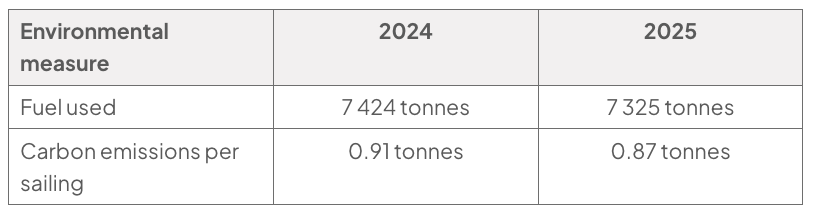
Table of Red Funnel environmental measures comparing 2024 and 2025: fuel used fell from 7,424 to 7,325 tonnes, and carbon emissions per sailing fell from 0.91 to 0.87 tonnes.

Source: Analyst, using Red Funnel Limited, Isle of Wight Council and press reports

Red Funnel's mission is "to be the preferred ferry service to and from the Isle of Wight". Its new owners have reduced its debt, but it must repay a bank loan of £37.5m by September 2030.

Evaluate whether Red Funnel should give priority to replacing its vehicle ferries or to redeveloping its East Cowes terminal.

2
15 marks

Source B: Linbury Preserves

Linbury Preserves Limited makes jam and marmalade near Leominster, Herefordshire. It was founded in 1952 by Joan Ashby in her farmhouse kitchen and is still owned by the Ashby family; its Managing Director is Tom Ashby, her grandson. It employs 58 people and in the year to 31 March 2026 sold 3.02 million jars, mainly to farm shops, delicatessens and independent food shops, and through its own website.

The company's mission is to make "proper preserves, the slow way": every batch is boiled in open copper pans, and the fruit comes from farms within 30 miles. It buys its fruit from 14 Herefordshire growers on five-year contracts, at prices above the market price, so that the growers can plan and invest. In 2025 the family set an objective of doubling the company's revenue by 2030.

To be sold as "jam", a product must meet the legal standards for fruit and sugar content. In 2024 Linbury Preserves launched a range with less sugar; because its sugar content is below the legal standard, it must be sold as a "fruit spread" rather than as jam.

Many of its customers say they are trying to eat less sugar. At the same time, the company's costs have risen. The National Living Wage rose by 4.1% to £12.71 an hour from April 2026, employers have paid more National Insurance since April 2025, and since 2025 the company has paid fees on the glass jars and lids it uses, under new rules which make businesses pay towards the cost of recycling packaging.

Source: Linbury Preserves

Appendix D: Linbury Preserves selected data

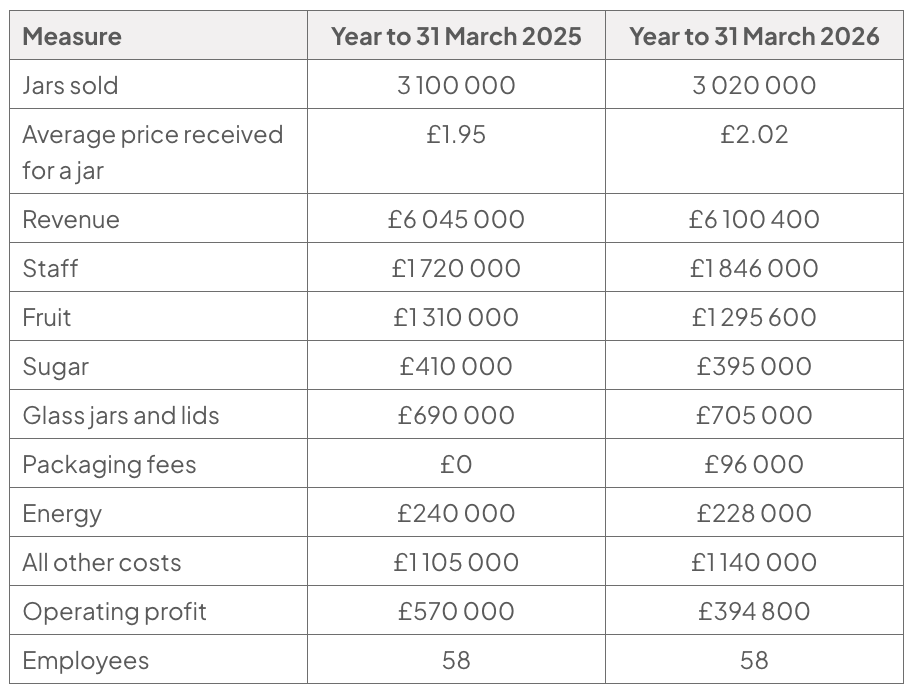
Table comparing Linbury Preserves in the years to 31 March 2025 and 2026: jars sold fell, revenue rose, staff costs and packaging fees increased, and operating profit fell from £570,000 to £394,800.

Source: Linbury Preserves

Appendix E: What customers are buying

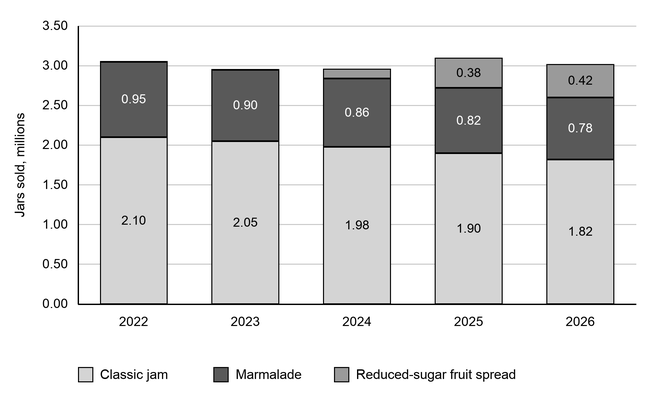
Stacked column chart of jars sold by range, in millions, from 2022 to 2026. Classic jam falls from 2.10 to 1.82 and marmalade from 0.95 to 0.78, while reduced-sugar fruit spread rises to 0.42 in 2026.

Jars sold, millions, years to 31 March

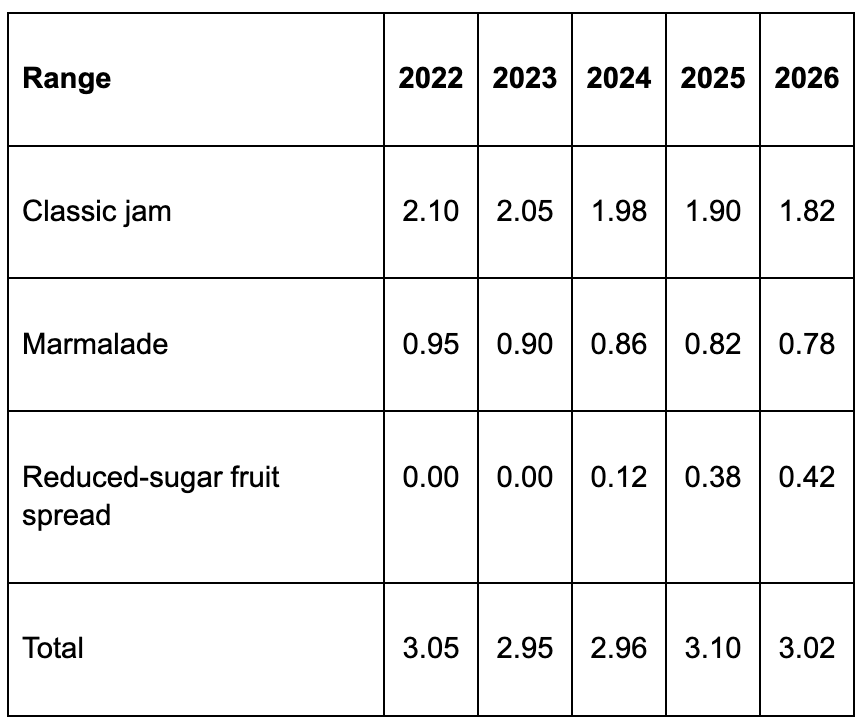
Table of jars sold by range, in millions, from 2022 to 2026: classic jam falls from 2.10 to 1.82 and marmalade from 0.95 to 0.78, while reduced-sugar fruit spread rises from 0.00 to 0.42.

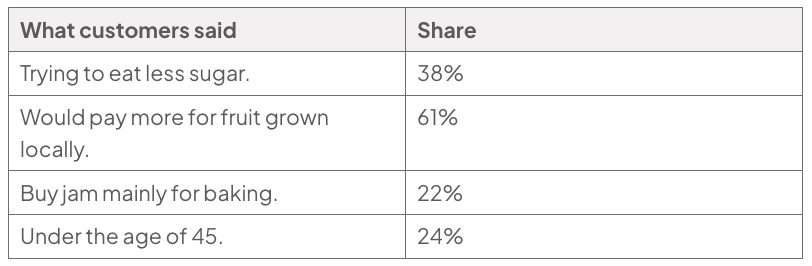
Survey of Linbury Preserves' website customers, 2026

Table of survey responses: 38% are trying to eat less sugar, 61% would pay more for locally grown fruit, 22% buy jam mainly for baking, and 24% are under 45.

Source: Linbury Preserves

Appendix F: Fruit, growers and costs

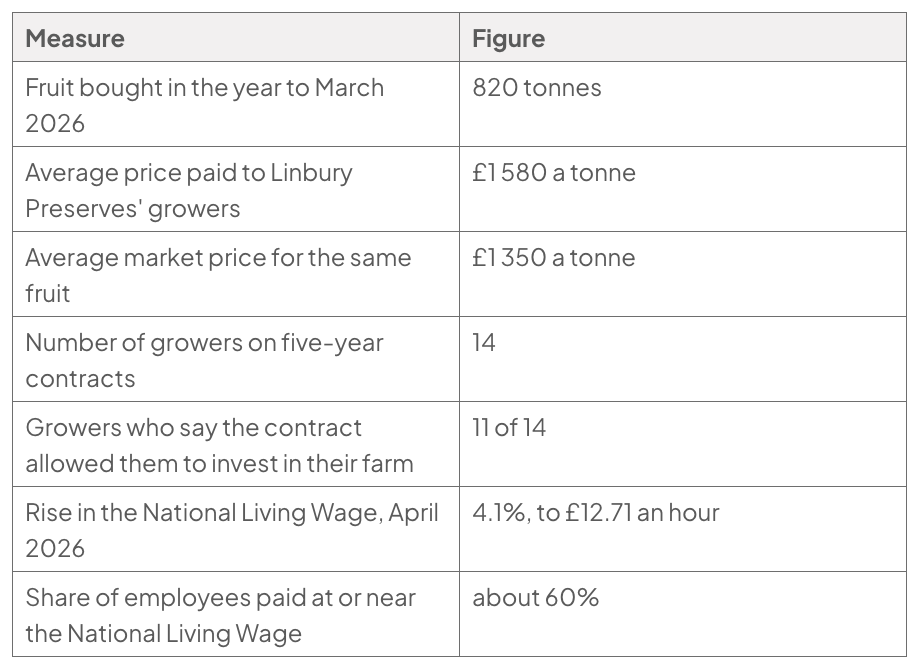
Table of Linbury Preserves data: 820 tonnes of fruit bought; growers paid £1,580 a tonne versus £1,350 market price; 14 five-year contracts, 11 enabling investment; wage up 4.1% to £12.71, with 60% of staff affected.

Source: Linbury Preserves

Appendix G: Three ways to grow

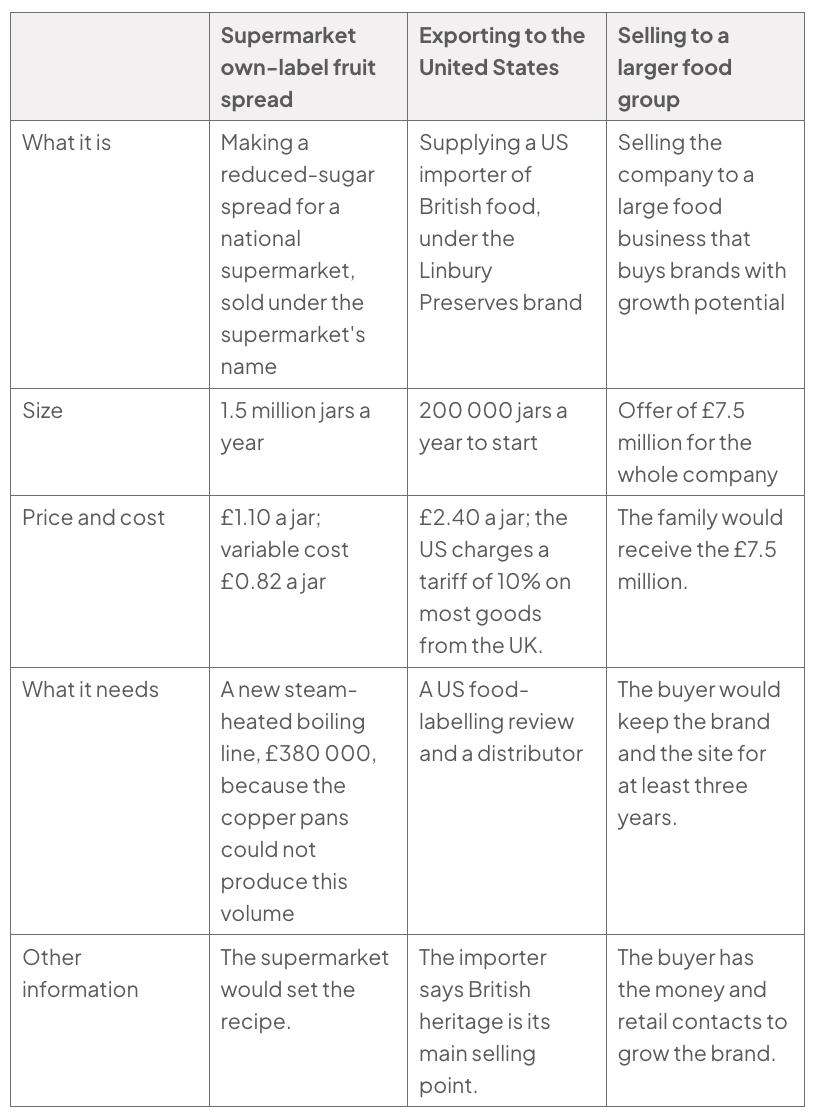
Table of three ways to grow: supermarket own-label reduced-sugar spread (1.5 million jars a year; £1.10 price, £0.82 cost; £380,000 line); US export (200,000 jars; £2.40, 10% tariff); sell to food group for £7.5 million.

Source: Linbury Preserves

Linbury Preserves' objective is to double its revenue by 2030, and its mission is to make preserves "the slow way".

Evaluate two ways Linbury Preserves could achieve its objective and recommend which one it should choose.

Use information from Appendices D to G to support your answer.

3
15 marks

Source B: Bretforton Facilities

Bretforton Facilities Limited was founded in 1989 by Anne Fielding in Bretforton, near Evesham, and is still owned by her family. Her son, Mark Fielding, is Managing Director. It cleans and maintains about 180 schools, 64 GP surgeries and health centres, and a number of offices across Worcestershire and the West Midlands, and employs 640 people, most of them part-time cleaners and caretakers.

Its mission is "clean, safe buildings, looked after by local people who are paid fairly". Since 2016 it has been an accredited Real Living Wage employer, which means it pays all its staff at least the Real Living Wage, a voluntary rate set by the Living Wage Foundation that is higher than the legal National Living Wage. Its objective is to reach £30 million of revenue by 2030 while remaining a Real Living Wage employer.

Bretforton Facilities competes for contracts against national facilities management companies, which can often offer lower prices. Its largest customer, a county council, wants to cut the price of its contract when it is renewed next year.

Anne Fielding is 71 and wants to sell the business. A national competitor, Corvane Group, has made an offer, and the family is also considering selling to an employee ownership trust.

Source: Bretforton Facilities

Appendix D: Bretforton Facilities selected data

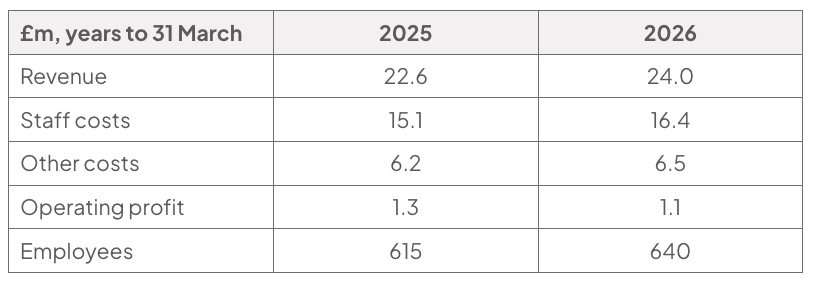
Table of selected data (£ millions, years to 31 March): 2025 versus 2026. Revenue 22.6 to 24.0; staff costs 15.1 to 16.4; other costs 6.2 to 6.5; operating profit 1.3 to 1.1; employees 615 to 640.

Source: Bretforton Facilities

Appendix E: Pay and people

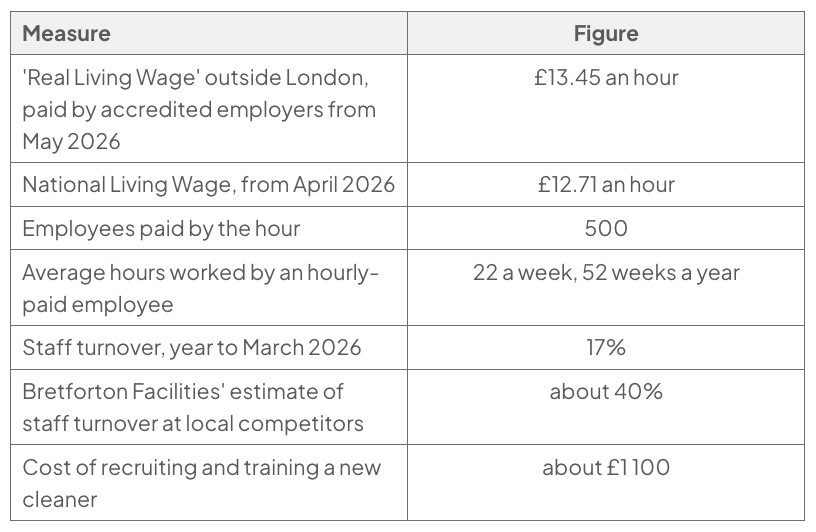
Table of pay and staffing data: Real Living Wage £13.45 an hour; National Living Wage £12.71 an hour; 500 hourly-paid employees working 22 hours weekly. Turnover is 17% versus 40% at local competitors; recruitment costs about £1 100 per cleaner.
  • In 2026 the company introduced an app that gives cleaners their schedules and lets them report problems with photos. Many cleaners are older and some have asked to keep paper rotas.

  • Head teachers' survey, 2026: 88% said the same cleaners working in their school every week was "very important".

Source: Bretforton Facilities and the Living Wage Foundation

Appendix F: Customers and competitors

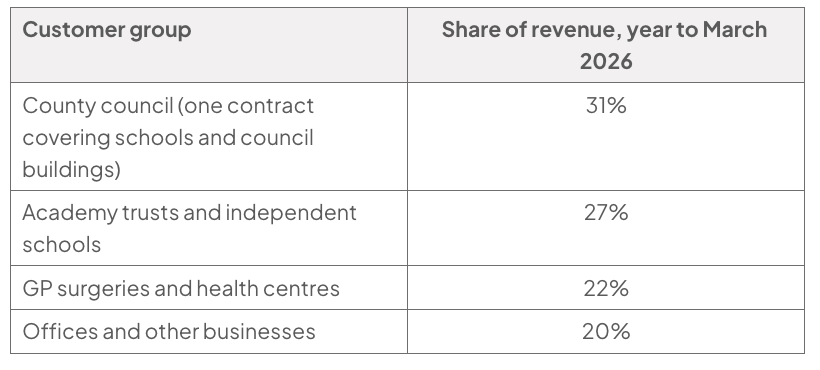
Table of customer groups and share of revenue for the year to March 2026: county council 31%; academy trusts and independent schools 27%; GP surgeries and health centres 22%; offices and other businesses 20%.
  • The county council contract is worth £7.44m a year. The council wants a price 6% lower when the contract is renewed in April 2027, and has said it will also invite bids from national companies.

  • Bretforton Facilities has never lost a school contract on quality, but lost four in 2025 to national competitors bidding about 8% lower.

Source: Bretforton Facilities

Appendix G: Two ways to sell the business

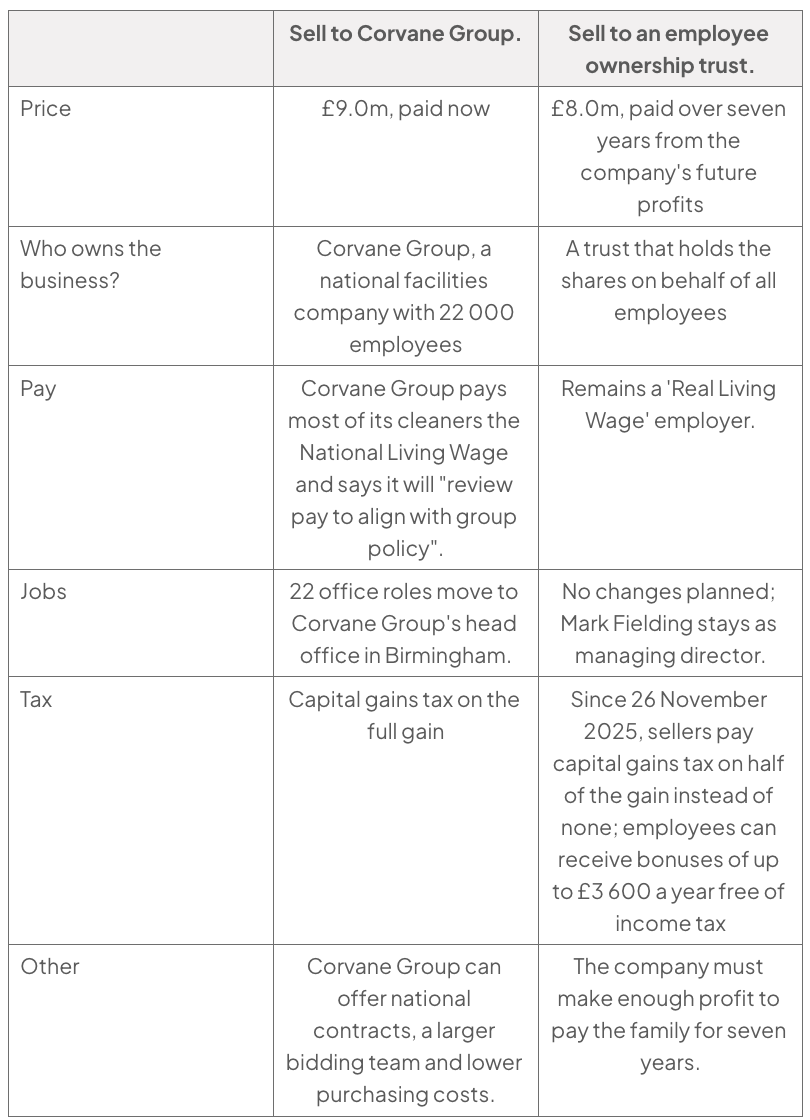
Appendix G compares sale options: Corvane pays £9m now; an employee ownership trust pays £8m over seven years. Corvane uses National Living Wage, moves 22 office jobs and taxes the full gain; the trust keeps Real Living Wage and jobs.

Source: Bretforton Facilities and HMRC guidance

Anne Fielding wants to sell Bretforton Facilities. Its mission is "clean, safe buildings, looked after by local people who are paid fairly".

Evaluate whether the Fielding family should sell Bretforton Facilities to Corvane Group or to an employee ownership trust.

Use information from Appendices D to G to support your answer.

4
15 marks

Source B: Macknade

Macknade is a family-owned food hall on the edge of Faversham, Kent, on the site of a farm the Neame family began farming in 1847. The company, Macknade Fine Foods Ltd, employed an average of 82 people in the year to 31 March 2025.

In 1979 Patricia Neame and her husband Renato Cuomo, who was born on the Italian island of Ischia, opened a pick-your-own business on the farm. In 2001 the family stopped farming to concentrate on retail. Their son, Stefano Cuomo, the sixth generation to run the business, became managing director in 2013 and later Chief Executive.

The seven-acre site is dominated by a 10 000 square foot food hall, which sells:

  • local and Mediterranean produce

  • more than 100 cheeses

  • meat from its own butchery, which opened in 2016 and buys whole carcasses from farms using regenerative "Pasture for Life" methods

The site also has a café and an outdoor food village of street-food traders. Other businesses rent space on the site, including a vet, a fitness studio and a sauna.

In 2021 Macknade's managing director said that "community is at our core". Its Chief Executive has described a shopper with a "dual shopping list", who buys some items in supermarkets and others from independent shops.

In 2020 Macknade opened a second shop, in Ashford, Kent. Its website now lists only the Faversham site.

Source: Macknade, Macknade Fine Foods Ltd accounts and press interviews

Appendix D: Macknade Fine Foods Ltd balance sheet data

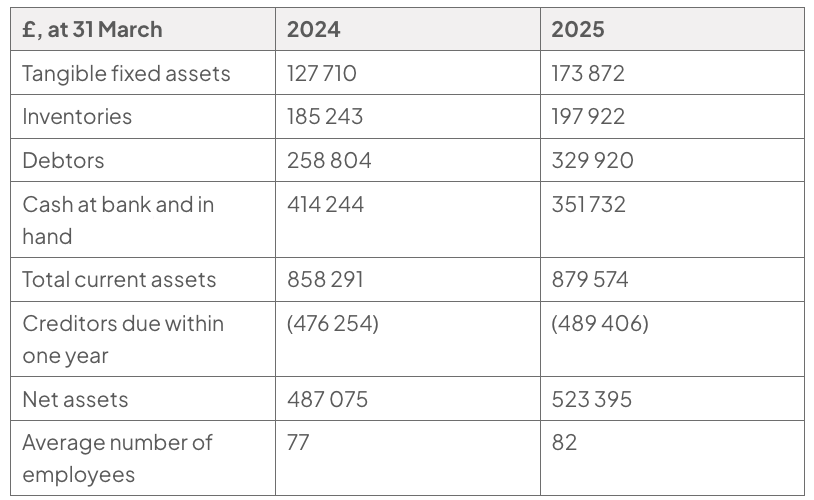
Balance-sheet table in pounds at 31 March 2024 and 2025: tangible fixed assets 127 710 and 173 872; inventories 185 243 and 197 922; debtors 258 804 and 329 920; cash 414 244 and 351 732; total current assets 858 291 and 879 574; creditors due within one year 476 254 and 489 406; net assets 487 075 and 523 395; employees 77 and 82.
  • In the year to 31 March 2025 Macknade spent £107 559 on new fixed assets, including property improvements, equipment and fixtures, and charged £59 714 of depreciation.

  • As a small company, Macknade is not required to publish its profit and loss account, and does not.

Source: Macknade Fine Foods Ltd

Appendix E: The Faversham site

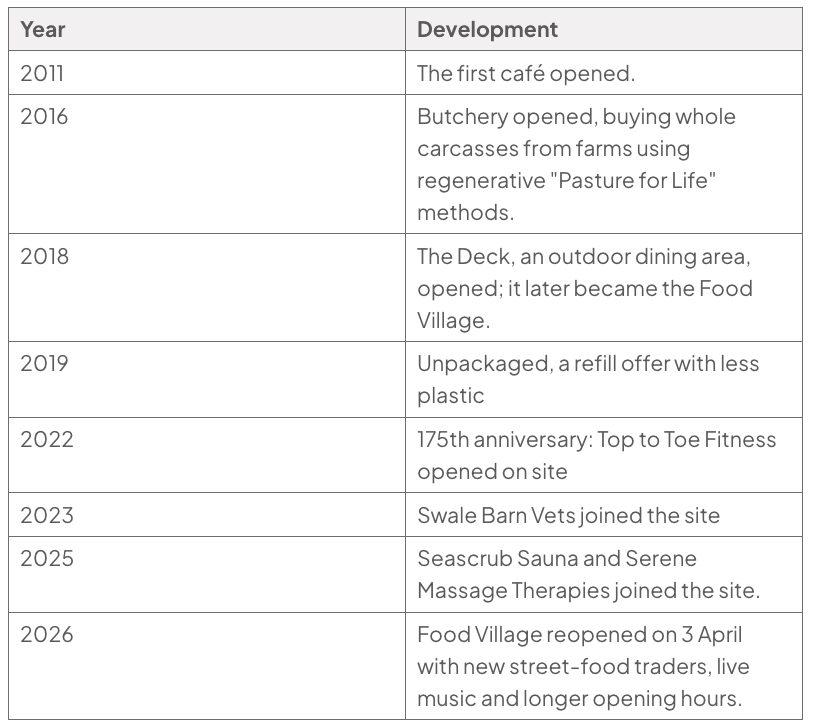
Timeline table of Faversham-site developments: 2011 first café; 2016 butchery; 2018 Deck opened, later becoming Food Village; 2019 Unpackaged refill offer; 2022 Top to Toe Fitness; 2023 Swale Barn Vets; 2025 Seascrub Sauna and Serene Massage Therapies; 2026 Food Village reopened with new traders, live music and longer hours.
  • The site also offers an online shop for hampers and gift boxes, events, venue hire and catering.

  • Macknade won a Farm Shop & Deli Retailer Award in 2023.

Source: Macknade and press reports

Appendix F: Customers and community

  • Shoppers. The Chief Executive says: "We're seeing more of what we called the dual shopping list grocery shopper."

  • Older customers. "They have cash in their pockets, they're loyal, but often get overlooked because they're not seen as the trend."

  • Community. "What gels a community is regular grocery retail, and it is very difficult to do outside of the supermarkets."

  • Travel. Macknade has promoted e-bikes, with test-ride events on site.

  • Values. The family says its "heart is, just as it has always been, in our food and the people we share it with".

Source: Analyst, using Macknade and press interviews

Appendix G: Growing beyond Faversham

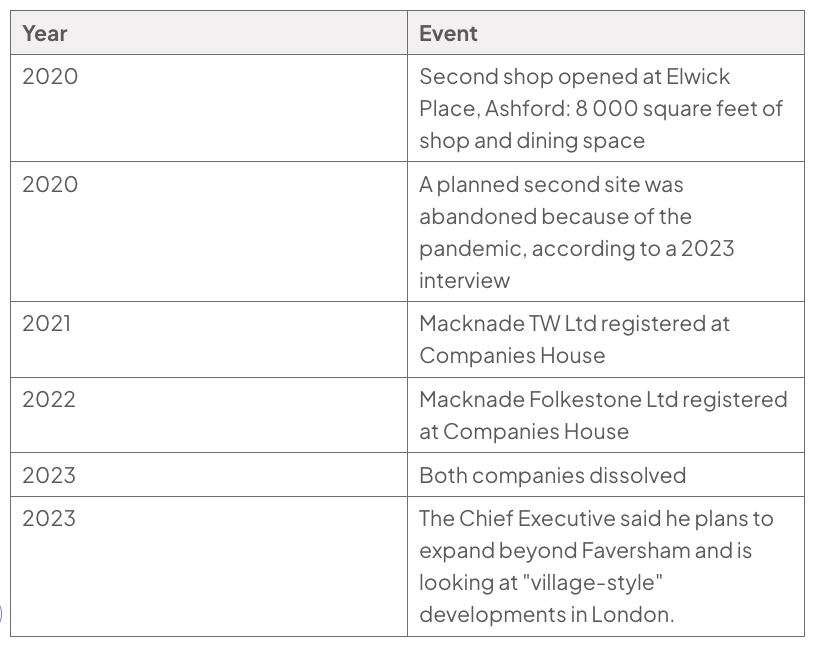
Timeline of Macknade’s expansion beyond Faversham, 2020 to 2023: 2020, second shop opened at Elwick Place, Ashford: 8 000 square feet of shop and dining space; planned second site abandoned due to pandemic. 2021, Macknade TW Ltd registered. 2022, Macknade Folkestone Ltd registered. 2023, both companies dissolved; Chief Executive planned expansion beyond Faversham and “village-style” developments in London.

Source: Analyst, using Companies House and press reports

In 2021 Macknade's managing director said that "community is at our core". Its Chief Executive has said he plans to expand beyond Faversham.

Evaluate whether Macknade should open another food hall or continue to develop its Faversham site.

Use information from Appendices D to G to support your answer.