Technological Change (AQA A Level Business): Exam Questions

Exam code: 7132

Syllabus Edition

First teaching 2026

First exams 2028

2 hours16 questions
1
6 marks

Source A: Trainline

Trainline plc, which is listed on the London Stock Exchange, sells rail and coach tickets through its app and website in the UK and across Europe. It also provides ticketing technology to train operators and to travel management companies, which book travel for businesses. Its app is the most downloaded rail app in Europe.

Trainline earns its revenue mainly as commission on the tickets it sells. In April 2025 its commission on UK online ticket sales fell from 5.0% to 4.5%, under a rail industry agreement announced in 2022.

In the year to 28 February 2026:

  • it sold tickets worth £6 319 million, up 7%, to 27 million customers, 18 million of them in the UK

  • revenue rose by 2% to £453 million, while UK revenue fell by 2%

  • adjusted EBITDA was 2.80% of the value of tickets sold; the target for the year to February 2027 is about 2.9%

Growth in the UK slowed in the second half of the year. Trainline identified three causes:

  • Contactless payment. Transport for London is expanding contactless payment, which lets passengers travel by tapping a bank card without buying a ticket.

  • Operators' websites. Train operators have encouraged customers to use their own websites, including by offering automatic delay compensation, which independent retailers such as Trainline were not allowed to offer.

  • Fares. The government has frozen regulated rail fares until March 2027.

The government is creating Great British Railways to run most of the railway; its online retailer is expected eventually to replace the operators' websites. In March 2026 the government announced that passengers will then be able to claim delay compensation wherever they bought their ticket, including through Trainline.

In the first half of the year, sales to foreign travellers fell after Google changed its search results page. Trainline has made its app available within ChatGPT and introduced artificial intelligence features which help customers when trains are disrupted. Young people are among its most important customers: 45% of railcard holders aged 16 to 30 use a Trainline digital railcard, held on their phone.

Source: Trainline plc, Results for the twelve months ended 28 February 2026

Trainline has made its app available within ChatGPT. Earlier, its sales to foreign travellers fell after Google changed its search results page.

Analyse one way in which making its app available within ChatGPT might affect Trainline's marketing costs.

2
6 marks

Source B: Swanmoor Knitwear

Swanmoor Knitwear Limited makes knitted jumpers, cardigans and scarves at a factory in Hinckley, Leicestershire, a town with a long history of knitwear manufacturing. The company was founded in 1958 and has been owned and run since 2015 by Priya Desai. It employs 92 people.

For most of its history Swanmoor Knitwear made knitwear for other brands, including luxury fashion houses, to their designs and under their labels. Since 2015 it has also sold its own brand, Swanmoor, online. Own-brand jumpers sell for an average of £165. They are designed to last for at least twenty years, and the company repairs them free of charge.

Customers can choose the colour of an own-brand jumper on Swanmoor's website and have it knitted to order, for delivery within ten days.

Swanmoor's managers use data on the workforce to judge the success of their decisions. After a new training scheme was introduced in 2025, the share of employees leaving each year fell from 18% to 9%.

The company is considering buying four seamless knitting machines, which knit a whole garment in a single piece. At present, the separate pieces of each garment are knitted and then joined by hand, a skilled process called linking.

Second-hand clothing is increasingly bought and sold through apps such as Vinted, where Swanmoor jumpers resell for around £70.

Source: Swanmoor Knitwear

Customers can choose the colour of a Swanmoor jumper on its website and have it knitted to order, for delivery within ten days.

Analyse one way in which knitting to order might affect Swanmoor Knitwear's costs of holding inventory.

3
6 marks

Source A: Premier Foods

Premier Foods plc is one of the UK's largest food manufacturers. Its brands include Ambrosia, Batchelors, Bisto, Loyd Grossman, Mr Kipling, Oxo and Sharwood's, and it makes Cadbury cakes under licence. It has bought three newer brands: The Spice Tailor, FUEL10K and, in 2025, Merchant Gourmet, for £46.1 million. It is listed on the London Stock Exchange.

In the 52 weeks to 28 March 2026 Premier Foods' headline revenue rose by 2.5% to £1 175.2 million and its trading profit rose by 6.7% to £200.4 million. Sales of its branded products grew by 3.4%. Mr Kipling had its biggest ever year, helped by new products such as cake bites tubs, and the company gained market share in both of its divisions, Grocery and Sweet Treats.

The company's strategy has five pillars:

  • Grow the UK core through brand investment and new products.

  • Enter new categories, such as FUEL10K yogurt and granola pots.

  • Build international businesses in Australia and New Zealand, North America and Europe.

  • Acquire brands with strong growth potential.

  • Invest in its factories to increase efficiency and automation.

During the year capital investment rose by 25% to £51.9 million. It included a solar farm at its cake factory near Barnsley, which can supply up to 70% of the site's electricity, and an investment that made the pot filling and packing line at its Ambrosia site in Devon faster and more efficient.

Many of the company's products, including most cakes, are classed by law as less healthy because they are high in fat, sugar or salt. From 5 January 2026 such products may not be advertised on television or on-demand services between 5.30am and 9pm, or in paid-for online adverts at any time. Adverts which show a brand without showing a less healthy product are still allowed.

Source: Premier Foods plc, Full Year Results for the 52 weeks ending 28 March 2026

Premier Foods invested in its Ambrosia site in Devon, making its pot filling and packing line faster and more efficient.

Analyse one way in which this investment might affect the cost of making each Ambrosia pot.

4
6 marks

Source A: Rightmove

Rightmove plc runs the UK's largest property portal, where estate agents, letting agents and housebuilders advertise homes for sale and to rent. It is listed on the London Stock Exchange. Its customers are the agents and developers, who pay a monthly subscription; people looking for a home use the website and app free of charge. In 2025 users spent 16.8 billion minutes on Rightmove, which had 89% of all the time spent on UK property portals in December 2025, and more than 85% of visits came to the site directly rather than through a search engine or advertisement.

In the year to 31 December 2025 Rightmove's revenue rose 9% to £425.1 million and its underlying operating profit rose 9% to £297.7 million, a margin of 70%. Average revenue per advertiser rose by 6%, while the number of advertisers rose by 1%. Most agents choose a package of products, and a growing share choose the most expensive one.

Rightmove has three newer areas of business, which it calls its strategic growth areas: commercial property, mortgages and services for landlords and tenants. Together their revenue grew by 25% in 2025.

The company is using artificial intelligence across its business. It had 46 strategic AI initiatives in progress by June 2026. It has also launched a conversational search tool developed with Google Cloud and has submitted an app for use within ChatGPT. In November 2025 it announced that it would increase its investment in technology and AI, and that its underlying operating profit would therefore grow by only 3% to 5% in 2026. Its share price fell by more than 25% that day.

Source: Rightmove plc, Results for the year ended 31 December 2025, and Half Year Results 2026

Rightmove has launched a conversational search tool and has submitted an app for use within ChatGPT.

Analyse one way in which an app within ChatGPT might affect the number of people who visit Rightmove's own website and app.

5
6 marks

Source A: Red Funnel

Red Funnel Limited provides ferry services across the Solent between Southampton and Cowes on the Isle of Wight, trading as Red Funnel. It has served the island since 1861. It runs vehicle ferries between Southampton and East Cowes, a freight ferry, and the Red Jet Hi-Speed passenger service between Southampton and West Cowes. Its passengers include island residents, visitors, commuters and patients travelling to mainland hospitals, and for many of them the service is a lifeline. Competitors, such as Wightlink, operate other routes across the Solent.

Red Funnel's mission is "to be the preferred ferry service to and from the Isle of Wight". Its strategy includes:

  • operating a safe, reliable and year-round lifeline service

  • offering customer service that exceeds expectations

  • gaining market share through a superior value proposition based on safety, reliability, service, price and value for money

  • improving its environmental footprint on the pathway to Net Zero

  • managing the business efficiently, with robust financial stewardship and investment discipline.

In 2025 Red Funnel carried 2.71 million passengers, including about 922 000 on the Red Jet, and 163 000 freight vehicles. Turnover rose by 0.7% to £60.4 million. Costs rose faster, including the effects of increases in the National Living Wage and employers' National Insurance contributions.

On 28 November 2025 the company was bought by a business controlled by Njord Partners, an investment firm, after government approval. As part of the deal, banks wrote off loans, the debt was restructured, and the owners provided new capital. The company says this provides a "materially strengthened financial platform from which to invest in operations, infrastructure and customer experience".

Source: Red Funnel Limited, Annual Report and Financial Statements for the year ended 31 December 2025

Red Funnel will continue to invest in technology that "removes friction from the booking and travel experience". It describes the cross-Solent ferry market as highly competitive.

Analyse one way in which this investment in digital technology might affect Red Funnel's share of the cross-Solent ferry market.

6
6 marks

Source A: JD Sports

JD Sports Fashion plc, founded in 1981 in Bury, Greater Manchester, is listed on the London Stock Exchange. It sells trainers, clothing and accessories from brands such as Nike and Adidas, and some own-brand products, through 4 811 stores in 36 countries and online. Its shop names include JD, Size?, Hibbett, Finish Line, Shoe Palace, Courir and Go Outdoors.

Online made up 20% of sales in the half year to August 2026. Its JD STATUS loyalty programme has more than 10 million active members. In 2026 JD became one of the first US retailers to let customers buy its products and pay directly within an AI platform.

In July 2024 JD bought Hibbett, a US chain of about 1 000 stores, funded mainly by a $1 billion loan, and in November 2024 the French chain Courir. It is converting many of its US stores that trade as Finish Line to the JD name. It follows a "fewer, bigger, better" approach to its UK stores, and in 2026 JD Germany was reduced from 91 to 62 stores.

In the year to 31 January 2026 sales rose 10.5% to £12 662 million. Organic sales, which exclude acquisitions, rose 2.1%, and like-for-like sales, from stores and websites open in both years, fell 2.1%. Free cash flow rose. JD describes its market as "highly promotional".

Its medium-term priorities are sales growth ahead of its markets, a rising operating margin and strong free cash flow. It aims to generate more than £1.4 billion of free cash flow over the three years to January 2028.

Source: JD Sports Fashion plc, results for the year to 31 January 2026 and the half year to 1 August 2026

In 2026 JD Sports became one of the first retailers in the United States to let customers buy its products and pay directly within an AI platform.

Analyse one way in which selling through AI platforms might affect JD Sports' sales.

7
6 marks

Source A: Card Factory

Card Factory plc is a UK retailer of greeting cards, gifts and party products, listed on the London Stock Exchange. It employs about 10 000 people and has its own printing business, Printcraft. It sells through three channels:

  • Stores. 1 117 stores in the UK and the Republic of Ireland.

  • Online. Its own website, cardfactory.co.uk, and Funky Pigeon.

  • Wholesale partnerships. Supplying other retailers, including Aldi.

In August 2025 Card Factory bought Funky Pigeon, an online card business, from WH Smith for £25.7 million, making it "the second largest online UK card and attached gift retailer". Moonpig Group is a larger online rival. Card Factory plans to run both websites on one shared platform, saving at least £5 million a year from 2027/28.

In the year to 31 January 2026 revenue rose by 7.4% to £582.7 million, but profit and the gross profit margin both fell. Like-for-like sales on cardfactory.co.uk also fell. In December 2025 the company warned that profit would be lower than expected.

The company faces two main pressures:

  • Wage costs. Changes to the National Living Wage and employers' National Insurance from April 2025 added an estimated £15 million to its wage costs. In response, it cut store hours by 9% and used fewer temporary and seasonal staff.

  • Consumer confidence. The company reported weak consumer confidence, "particularly among lower-income demographics".

Card Factory has trialled an artificial intelligence system that manages energy use in about 200 stores, with a rollout to 800 planned. It is also replacing its diesel vans with plug-in hybrids.

Source: Card Factory plc, results for the year ended 31 January 2026 and half-year results to 31 July 2026

Card Factory has trialled an artificial intelligence system that manages energy use in about 200 of its stores.

Analyse one benefit to Card Factory of using artificial intelligence to manage its energy use.

1
9 marks

Source A: JCB

J.C. Bamford Excavators Limited, known as JCB, makes construction and agricultural machinery, including backhoe loaders, excavators and telescopic handlers. It was founded in 1945 by Joseph Cyril Bamford and is still owned by the Bamford family. Its headquarters are at Rocester, Staffordshire, and it employs more than 20 000 people in 23 factories around the world. It sells its machines through independent dealers. Its competitors include Caterpillar and Komatsu, both of which are larger.

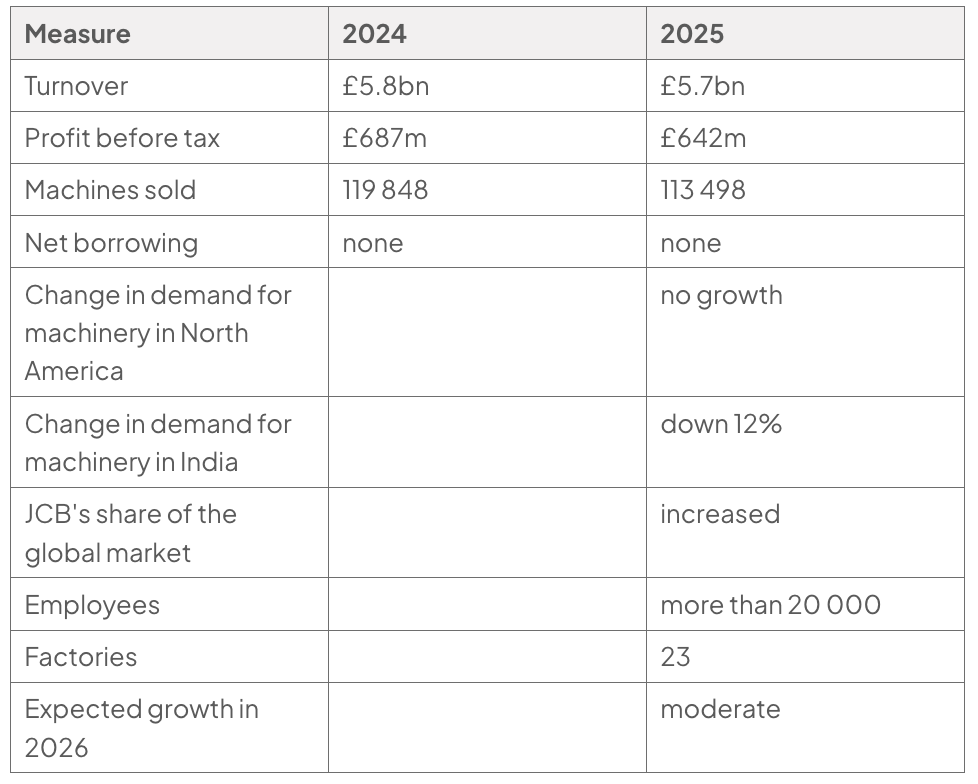
In 2025 JCB's turnover was £5.7 billion, compared with £5.8 billion in 2024, and its profit before tax fell from £687 million to £642 million. It sold 113 498 machines, about 5% fewer than in 2024, although it increased its share of the global market. Demand for machinery was flat in North America and fell by 12% in India. The company has no net borrowing, and it expects moderate growth in 2026.

Demand for construction machinery depends on the amount of building taking place, which tends to fall when interest rates are high. Many machines in the UK are bought by plant hire companies, which buy in large numbers and rent the machines to builders.

JCB is investing £100 million at its Staffordshire headquarters, including £60 million in a fully automated paint plant, which it says will help to secure more than 8 000 UK jobs.

In April 2025 the United States introduced tariffs on imports, including a tariff of 10% on most goods from the UK. JCB responded by doubling the size of the factory it was building in San Antonio, Texas, which will be its largest in the world. It said that in the short term the tariffs would have a significant impact on its business, but that in the medium term the Texas factory would help to reduce that impact.

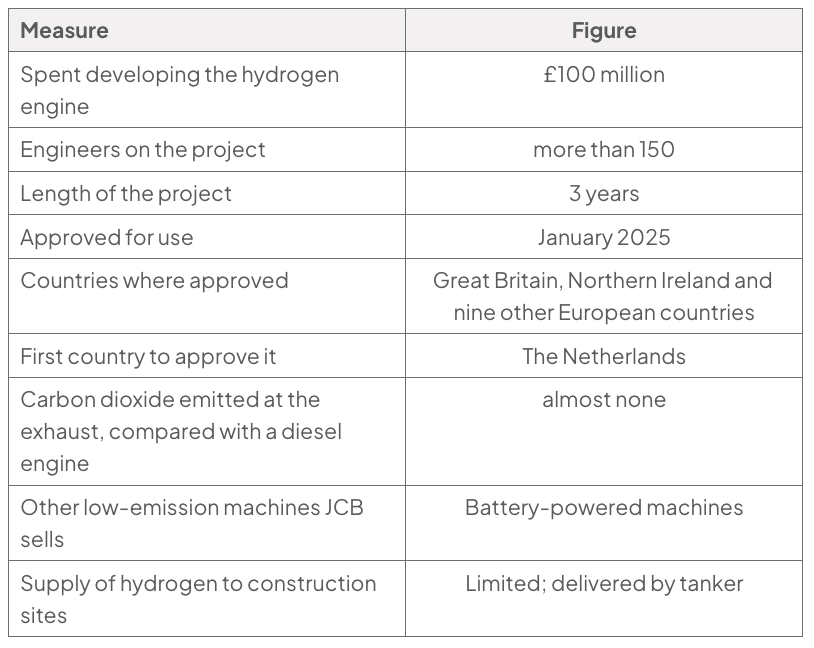
Over three years JCB spent £100 million, and employed more than 150 engineers, developing an engine which burns hydrogen instead of diesel. In January 2025 the engine was approved for use in Great Britain, Northern Ireland and nine other European countries. JCB also makes machines powered by batteries.

Source: JCB and press reports

Appendix A: JCB selected data

Table comparing JCB’s 2024 and 2025 performance, including turnover, profit before tax, machines sold, net borrowing, market demand, global market share, employees, factories and expected growth.

Source: JCB

Appendix C: New engine technology

Table of hydrogen-engine data: approved January 2025, first in the Netherlands; emits almost no exhaust carbon dioxide. JCB also sells battery-powered machines; hydrogen supply is limited and tanker-delivered.

Source: Analyst

Assess whether developing a hydrogen engine is likely to give JCB a competitive advantage.

2
9 marks

Source A: Trainline

Trainline plc, which is listed on the London Stock Exchange, sells rail and coach tickets through its app and website in the UK and across Europe. It also provides ticketing technology to train operators and to travel management companies, which book travel for businesses. Its app is the most downloaded rail app in Europe.

Trainline earns its revenue mainly as commission on the tickets it sells. In April 2025 its commission on UK online ticket sales fell from 5.0% to 4.5%, under a rail industry agreement announced in 2022.

In the year to 28 February 2026:

  • it sold tickets worth £6 319 million, up 7%, to 27 million customers, 18 million of them in the UK

  • revenue rose by 2% to £453 million, while UK revenue fell by 2%

  • adjusted EBITDA was 2.80% of the value of tickets sold; the target for the year to February 2027 is about 2.9%

Growth in the UK slowed in the second half of the year. Trainline identified three causes:

  • Contactless payment. Transport for London is expanding contactless payment, which lets passengers travel by tapping a bank card without buying a ticket.

  • Operators' websites. Train operators have encouraged customers to use their own websites, including by offering automatic delay compensation, which independent retailers such as Trainline were not allowed to offer.

  • Fares. The government has frozen regulated rail fares until March 2027.

The government is creating Great British Railways to run most of the railway; its online retailer is expected eventually to replace the operators' websites. In March 2026 the government announced that passengers will then be able to claim delay compensation wherever they bought their ticket, including through Trainline.

In the first half of the year, sales to foreign travellers fell after Google changed its search results page. Trainline has made its app available within ChatGPT and introduced artificial intelligence features which help customers when trains are disrupted. Young people are among its most important customers: 45% of railcard holders aged 16 to 30 use a Trainline digital railcard, held on their phone.

Source: Trainline plc, Results for the twelve months ended 28 February 2026

Appendix A: Trainline selected data

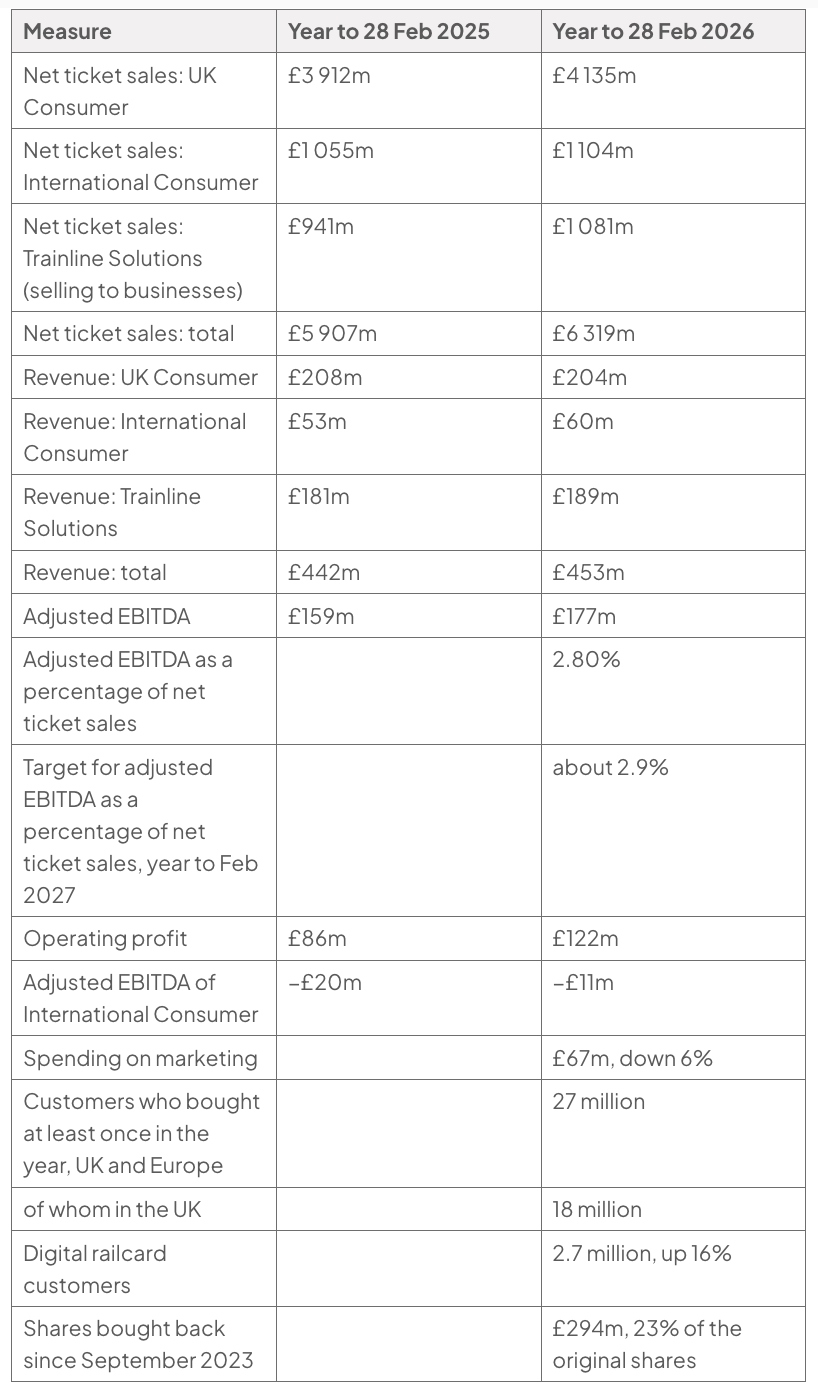
Table of selected Trainline data for years to 28 February 2025 and 2026: UK revenue fell from £208m to £204m, while adjusted EBITDA rose from £159m to £177m and operating profit from £86m to £122m.

Net ticket sales are the total value of tickets sold. The three segments do not add exactly to the total because of rounding.

Source: Trainline plc

Appendix B: Changes in the UK rail market

  • Commission. The commission on online ticket sales in the UK fell from 5.0% to 4.5% in April 2025, under an agreement announced in 2022.

  • Contactless payment. Transport for London is extending pay-as-you-go contactless payment to more stations outside London.

  • Train operators' own websites. Operators have offered their customers automatic compensation for delays, which independent retailers were not allowed to offer.

  • Great British Railways. The government is creating Great British Railways. Its online retailer is expected eventually to replace the operators' own websites. In March 2026 the government said that once it is established, passengers will be able to claim delay compensation wherever they bought their ticket. Trainline's legal and public affairs costs rose as it engaged with the process.

  • Fares and refunds. Regulated fares are frozen until March 2027. Rules on refunds were tightened from April 2026, which Trainline expects to reduce its income from refund fees.

  • Contracts. Trainline lost its contract to run CrossCountry's ticket website during the year and expects to lose its contract with ScotRail.

Source: Analyst, using Trainline plc

Assess whether the spread of contactless payment on the railway is likely to reduce Trainline's profit.

3
9 marks

Source B: Swanmoor Knitwear

Swanmoor Knitwear Limited makes knitted jumpers, cardigans and scarves at a factory in Hinckley, Leicestershire, a town with a long history of knitwear manufacturing. The company was founded in 1958 and has been owned and run since 2015 by Priya Desai. It employs 92 people.

For most of its history Swanmoor Knitwear made knitwear for other brands, including luxury fashion houses, to their designs and under their labels. Since 2015 it has also sold its own brand, Swanmoor, online. Own-brand jumpers sell for an average of £165. They are designed to last for at least twenty years, and the company repairs them free of charge.

Customers can choose the colour of an own-brand jumper on Swanmoor's website and have it knitted to order, for delivery within ten days.

Swanmoor's managers use data on the workforce to judge the success of their decisions. After a new training scheme was introduced in 2025, the share of employees leaving each year fell from 18% to 9%.

The company is considering buying four seamless knitting machines, which knit a whole garment in a single piece. At present, the separate pieces of each garment are knitted and then joined by hand, a skilled process called linking.

Second-hand clothing is increasingly bought and sold through apps such as Vinted, where Swanmoor jumpers resell for around £70.

Source: Swanmoor Knitwear

Appendix D: Swanmoor Knitwear selected data

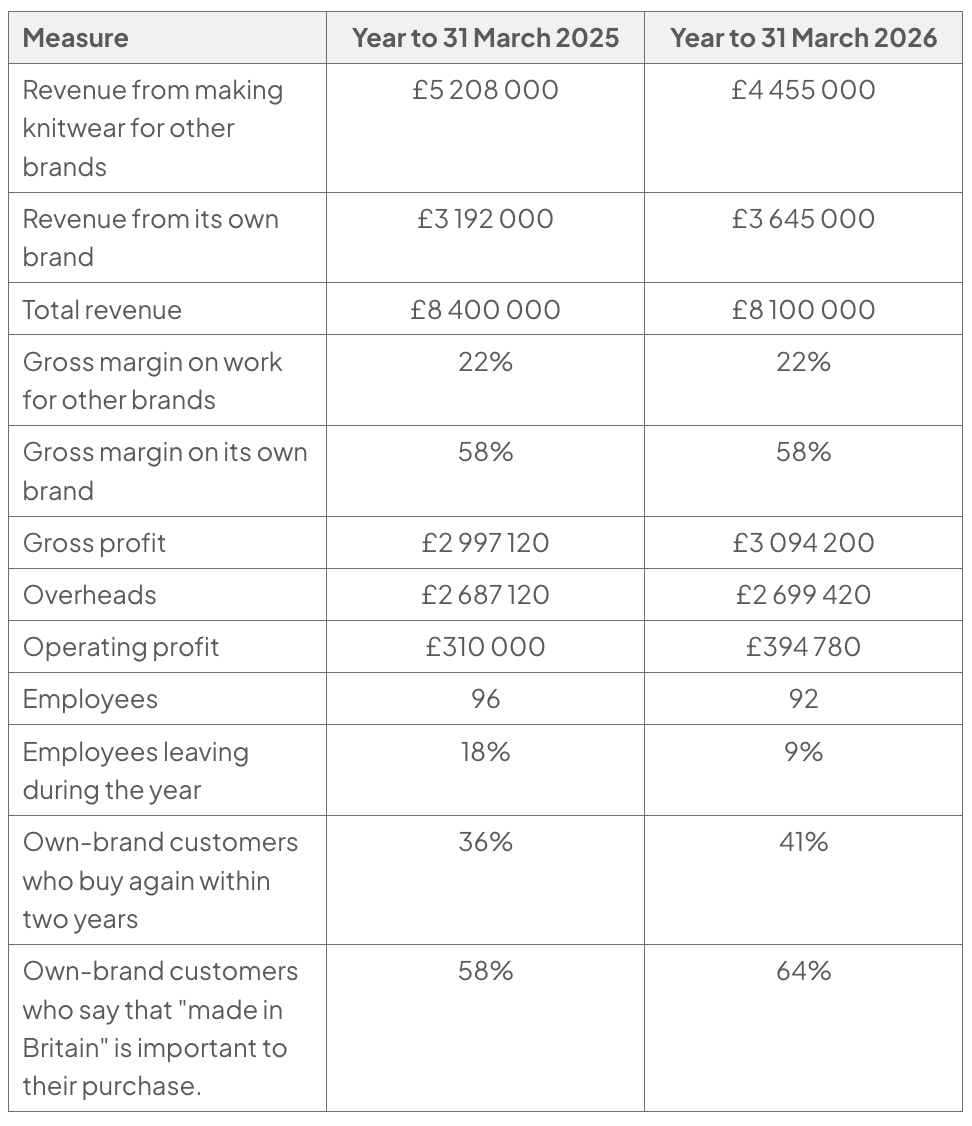
Table comparing Swanmoor Knitwear’s 2025 and 2026 data: total revenue falls from £8.4m to £8.1m, but operating profit rises from £310,000 to £394,780; staff turnover falls from 18% to 9%.

Source: Swanmoor Knitwear

Appendix F: Seamless knitting machines

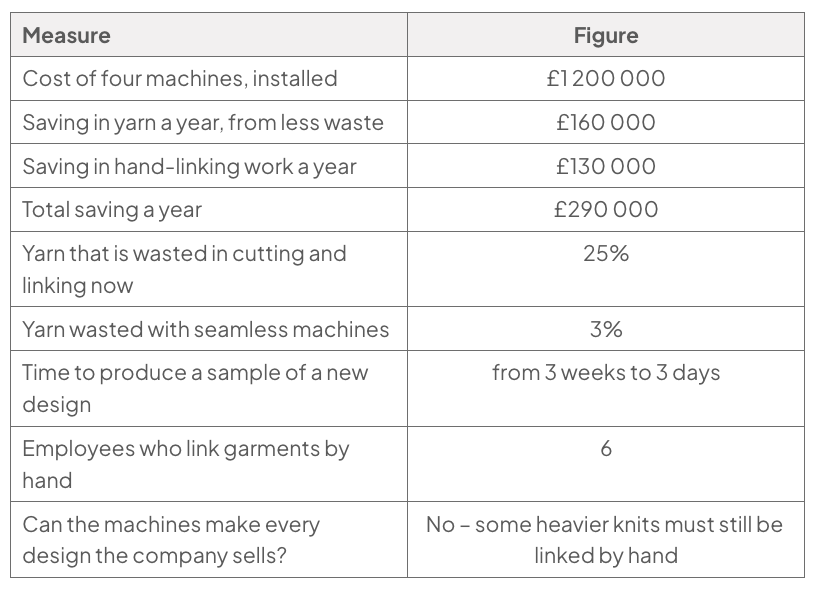
Table of seamless-machine data: cost £1,200,000; annual savings £160,000 in yarn and £130,000 in linking; total £290,000; waste falls from 25% to 3%; samples take 3 weeks to 3 days; six employees link by hand; some heavy knits still need linking.

Source: Swanmoor Knitwear

Assess whether investing in seamless knitting machines is likely to make Swanmoor Knitwear more competitive.

Calculate the payback period of the seamless knitting machines to support your answer. Give your answer to one decimal place.

4
9 marks

Source A: Red Funnel

Red Funnel Limited provides ferry services across the Solent between Southampton and Cowes on the Isle of Wight, trading as Red Funnel. It has served the island since 1861. It runs vehicle ferries between Southampton and East Cowes, a freight ferry, and the Red Jet Hi-Speed passenger service between Southampton and West Cowes. Its passengers include island residents, visitors, commuters and patients travelling to mainland hospitals, and for many of them the service is a lifeline. Competitors, such as Wightlink, operate other routes across the Solent.

Red Funnel's mission is "to be the preferred ferry service to and from the Isle of Wight". Its strategy includes:

  • operating a safe, reliable and year-round lifeline service

  • offering customer service that exceeds expectations

  • gaining market share through a superior value proposition based on safety, reliability, service, price and value for money

  • improving its environmental footprint on the pathway to Net Zero

  • managing the business efficiently, with robust financial stewardship and investment discipline.

In 2025 Red Funnel carried 2.71 million passengers, including about 922 000 on the Red Jet, and 163 000 freight vehicles. Turnover rose by 0.7% to £60.4 million. Costs rose faster, including the effects of increases in the National Living Wage and employers' National Insurance contributions.

On 28 November 2025 the company was bought by a business controlled by Njord Partners, an investment firm, after government approval. As part of the deal, banks wrote off loans, the debt was restructured, and the owners provided new capital. The company says this provides a "materially strengthened financial platform from which to invest in operations, infrastructure and customer experience".

Source: Red Funnel Limited, Annual Report and Financial Statements for the year ended 31 December 2025

Appendix A: Red Funnel financial data

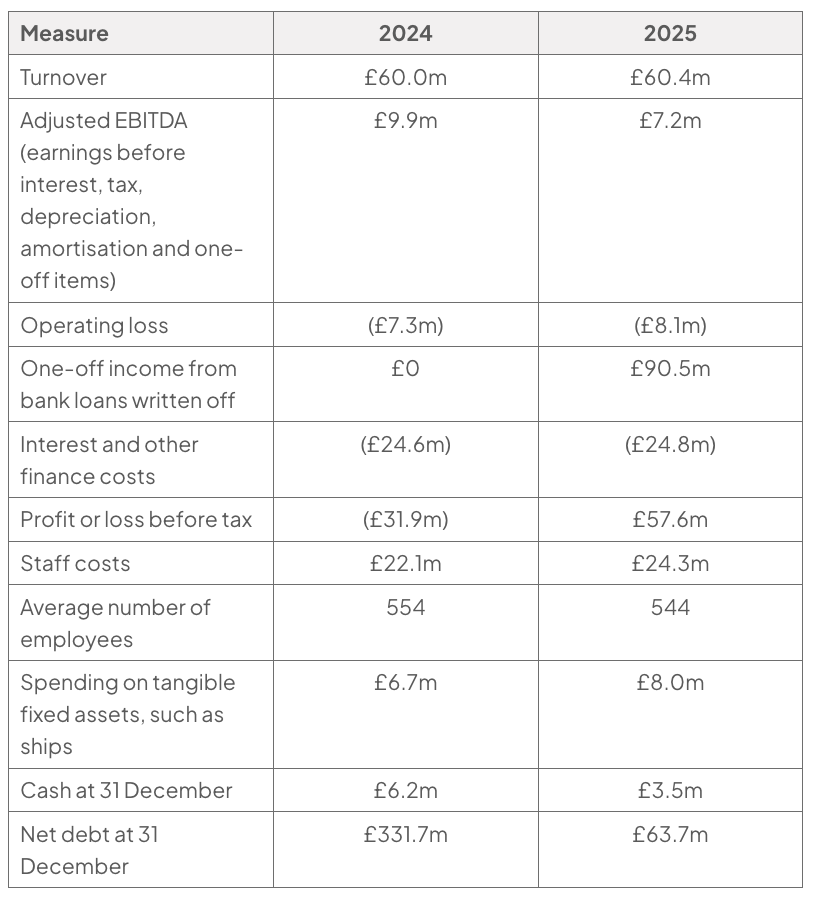
Table comparing Red Funnel’s 2024 and 2025 finances: turnover £60.0m/£60.4m, adjusted EBITDA £9.9m/£7.2m, operating loss £7.3m/£8.1m, staff costs £22.1m/£24.3m, spending on tangible fixed assets £6.7m/£8.0m, cash £6.2m/£3.5m, and net debt £331.7m/£63.7m.

Adjusted EBITDA in 2024: £9 893 000. In 2025: £7 220 000. Turnover in 2025: £60 380 000.

Source: Red Funnel Limited

Appendix B: Finance, fleet and plans

  • Debt. In May 2026 the remaining bank loans were replaced by a single loan of £37.5m, repayable in September 2030. No cash interest is payable on it in 2026 or 2027.

  • Vehicle ferries. Red Funnel's three vehicle ferries, Red Falcon, Red Osprey and Red Eagle, entered service in 1994, 1994 and 1996. The company says it is "actively reviewing fleet renewal plans" and will keep investing in refits, spare parts and engineering planning.

  • East Cowes. Planning permission was granted in 2025 to redevelop the East Cowes terminal, which relies on a single linkspan (the ramp vehicles use to board). The plans include a new terminal building, automated check-in and a marshalling yard for more than 350 vehicles.

  • Electric ferry. Throughout 2025 Red Funnel worked with partners, "on a no-risk partnership basis", on a zero emission electric passenger ferry: a 150-passenger hydrofoil being developed by Artemis Technologies, reported to cost £10 million to £12 million to build. It is also working with government and local partners to increase the supply of electricity to Southampton and the port.

  • Digital. Investment will continue in technology that "removes friction from the booking and travel experience".

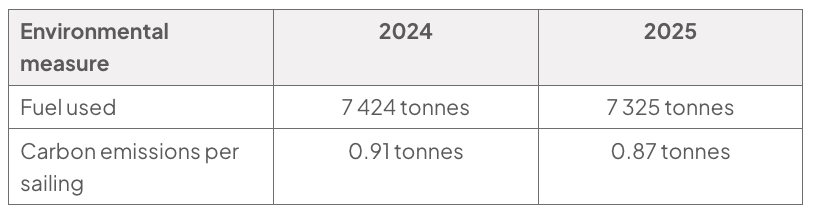
Table of Red Funnel environmental measures: fuel used fell from 7 424 tonnes in 2024 to 7 325 tonnes in 2025; carbon emissions per sailing fell from 0.91 tonnes to 0.87 tonnes.

Source: Analyst, using Red Funnel Limited, Isle of Wight Council and press reports

Assess whether developing a zero emission electric passenger ferry is likely to benefit Red Funnel.

Calculate Red Funnel's operating profit margin in 2025 to support your answer. Give your answer to one decimal place.

5
9 marks

Source A: Wise

Wise Group plc is a public limited company, founded in London in 2011, as TransferWise, by Kristo Käärmann and Taavet Hinrikus. It describes its mission as "building the best way to move and manage the world's money". Its services allow people and businesses to:

  • send money between countries

  • hold more than 40 currencies in one account

  • spend abroad with a Wise card

Banks and other companies also use Wise's technology through Wise Platform to offer international payments to their own customers. Wise Platform partners include UniCredit, Raiffeisen Bank, MBSB Bank and, from April 2026, Capitec.

Wise keeps its prices low. In the year to 31 March 2026 the average fee it charged on a cross-border transfer fell to 0.52% of the amount sent. Its 19 million active customers moved $243 billion across borders, 31% more than in the previous year, and its net revenue rose by 19% to $2.5 billion. In the fourth quarter of the year, 75% of payments arrived in under 20 seconds.

Wise must hold a licence from regulators in each country where it offers its services. In 2025-26 it won licences in South Africa, the UAE and Thailand and connected directly to the domestic payment systems of Brazil and Japan, which Wise says reduces its costs and increases speed.

On 11 May 2026 Wise moved its primary share listing to the Nasdaq stock exchange in New York, keeping a secondary listing in London.

Source: Wise Group plc, Full Year 2026 results

Appendix A: Wise financial data

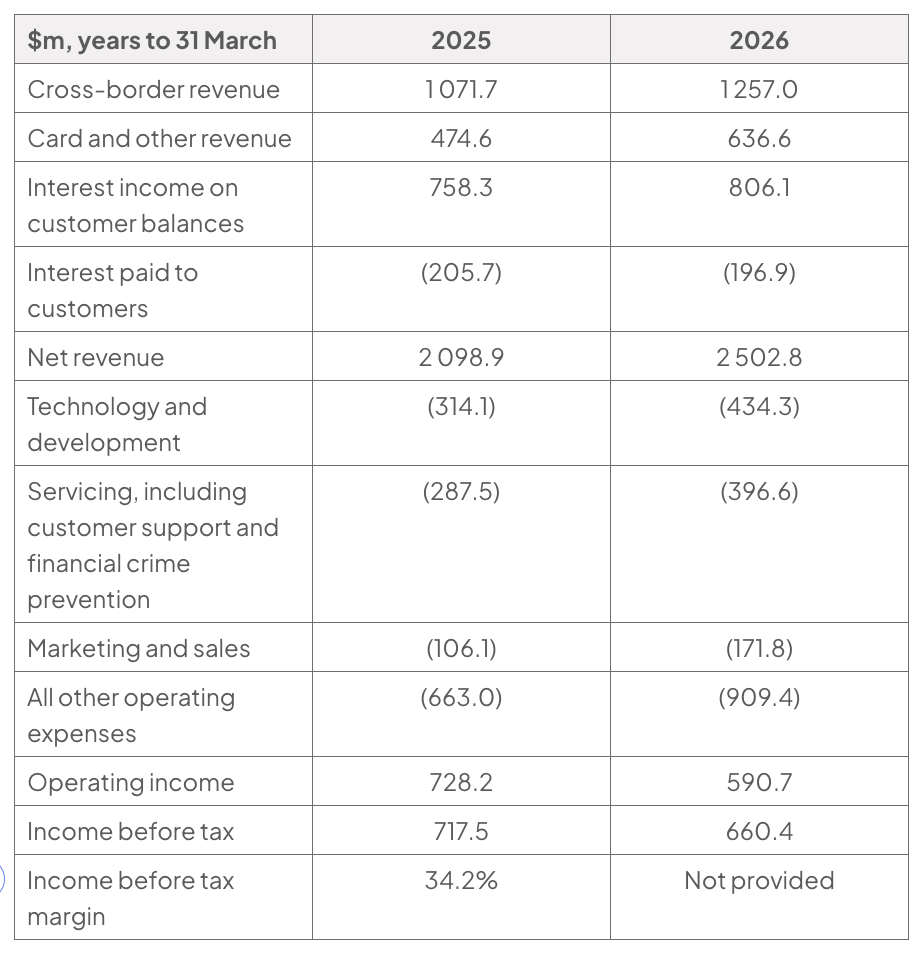
Financial table in millions of dollars for years to 31 March: technology and development costs rise from 314.1 to 434.3; 2026 net revenue is 2,502.8 and income before tax 660.4.
  • Targets. Net revenue growth of 15-20% a year. Wise expects its income before tax margin to be 20-25% while interest rates stay high, and aims for 15-20% in the medium term.

  • Shareholders. In 2025-26 Wise spent $470m buying its own shares for its employee share scheme, and plans to buy more than $500m of shares in 2026-27.

Source: Wise Group plc

Appendix C: Regulators and listing

  • Listing. Shareholders approved the move of Wise's primary listing to the US in July 2025; the High Court approved it in April 2026, and Nasdaq trading began on 11 May 2026. Wise's US operations are based in New York.

  • UK safeguarding rules, from 7 May 2026. Payment firms regulated by the Financial Conduct Authority must check every business day that customers' money is fully protected, and most must have an annual safeguarding audit. At 31 March 2026 Wise held $14.8bn of customer funds in protected accounts.

  • US penalties. In July 2025 regulators in six US states fined Wise $4.2m for weaknesses in its anti-money-laundering controls; it must also use an independent firm to check its improvements and report every quarter for two years. In January 2025 the US Consumer Financial Protection Bureau ordered Wise to pay about $2.5m over its money-transfer practices; in May 2025 the penalty was cut to $45 000, with about $450 000 still to be repaid to customers.

Source: Analyst, using Wise Group plc and press reports

Assess whether Wise's investment in technology is likely to improve its profitability.

Calculate Wise's income before tax margin in the year to 31 March 2026 to support your answer. Give your answer to one decimal place.

1
15 marks

Source B: Tarnside Travel

Tarnside Travel Limited organises escorted coach holidays from its base in Kendal, Cumbria. It was founded in 1972 and is owned by the Fell family; its Managing Director is Joanne Fell. It employs 42 people, runs 8 coaches and has two booking offices, in Kendal and Penrith. In the year to 30 September 2026 it carried 10 300 passengers on holidays in the UK and Europe, at an average price of £815.

Most of Tarnside Travel's customers are retired: 76% are aged over 65. Its holidays are priced in a brochure published a year in advance, and include coach travel, hotels and entrance to attractions. A growing share of its customers travel alone; they pay a single supplement of £180 for a room of their own.

Customers can book by telephone, in a branch or, since 2024, online. A booking taken by telephone costs the company about £24 to process, compared with about £6 online.

Changes in government policy affect the company's holidays. Edinburgh introduced a visitor levy of 5% of the cost of accommodation from 24 July 2026, and councils in Wales may charge a levy of £1.30 a person a night from April 2027. In April 2026 the full new state pension rose by 4.8%, from £230.25 to £241.30 a week.

The coaches run on diesel. Tarnside Travel buys its fuel at the price on the day, while the price of each holiday is fixed when the brochure is published.

Source: Tarnside Travel

Appendix D: Tarnside Travel selected data

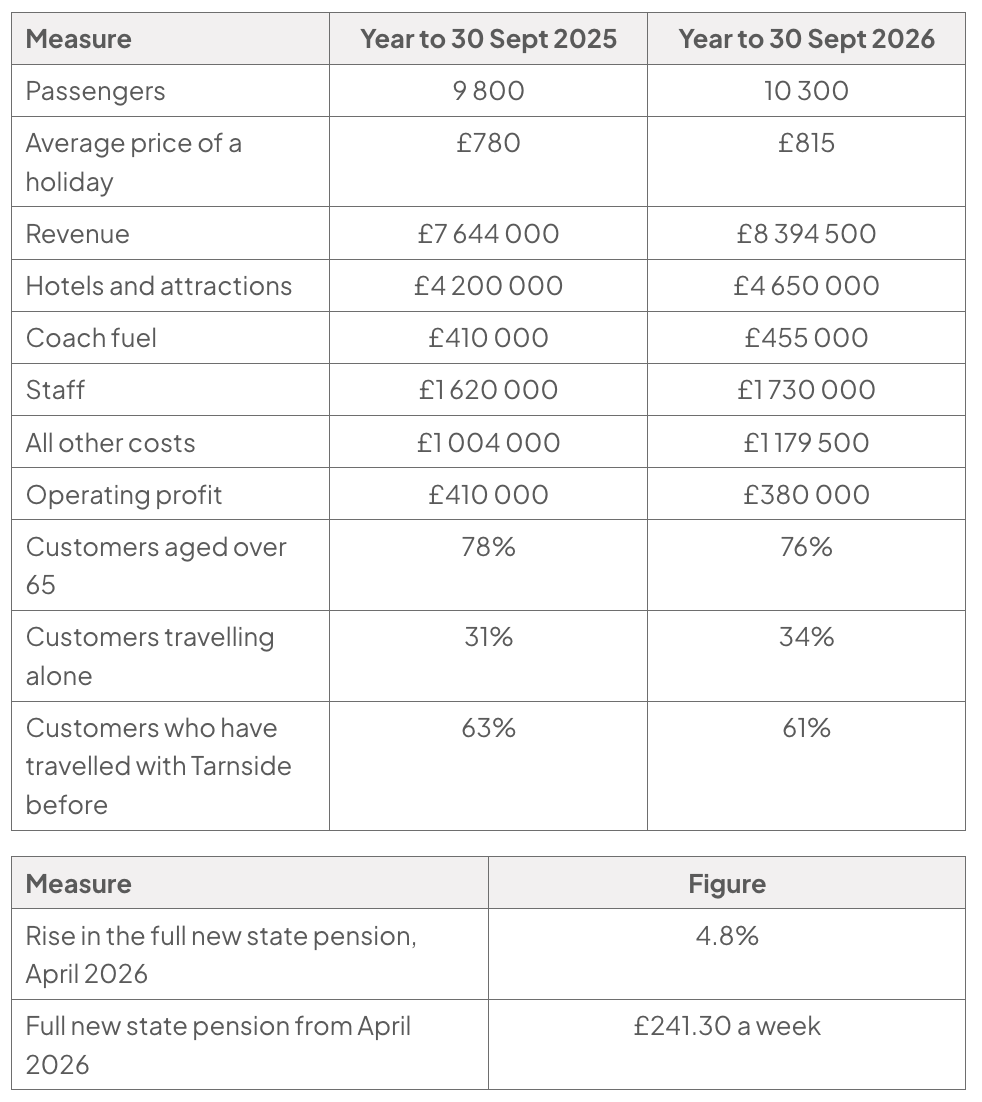
Two tables compare Tarnside Travel in 2025 and 2026: passengers, prices, revenue, costs, profit and customer percentages, plus the 4.8% state pension rise to £241.30 a week.

Source: Tarnside Travel

Appendix E: How customers book

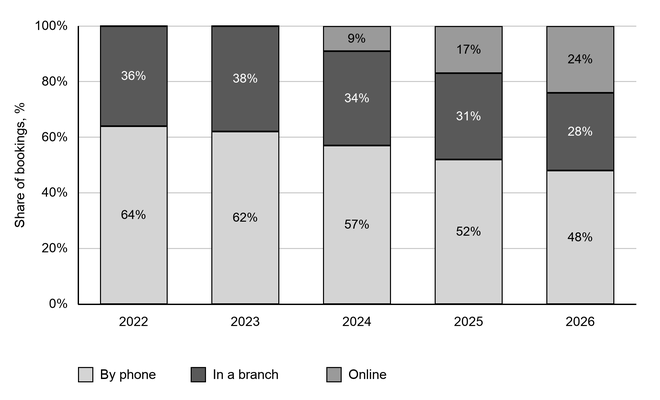
Stacked bar chart of booking shares by channel from 2022 to 2026, with percentage axis from 0 to 100: phone falls from 64% to 48%, branch bookings from 36% to 28%, while online rises from 0% to 24%.

Share of bookings, years to 30 September

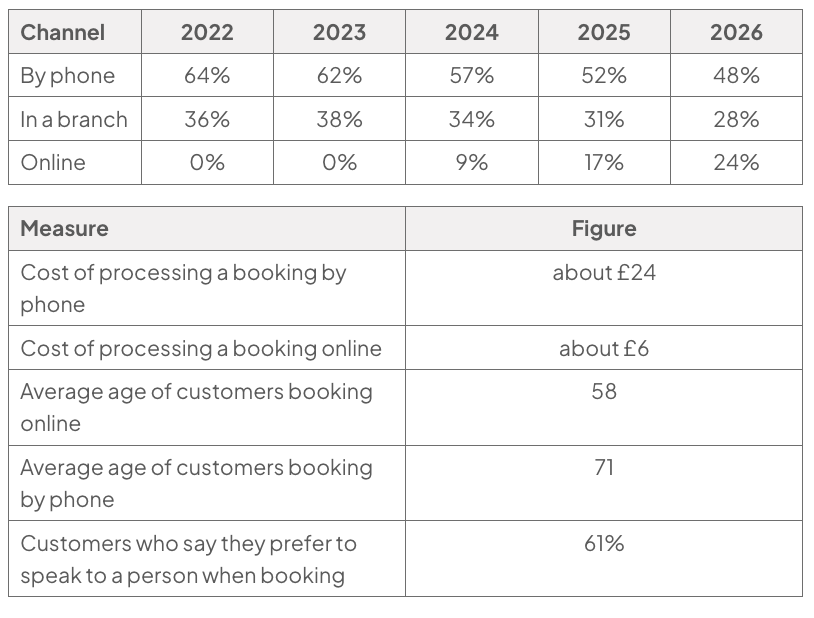
Two tables show booking channels from 2022–2026: phone 64% to 48%, branch 36% to 28%, online 0% to 24%; phone processing costs about £24 versus £6 online, and average ages are 71 and 58 respectively.

Source: Tarnside Travel

Appendix F: Visitor levies

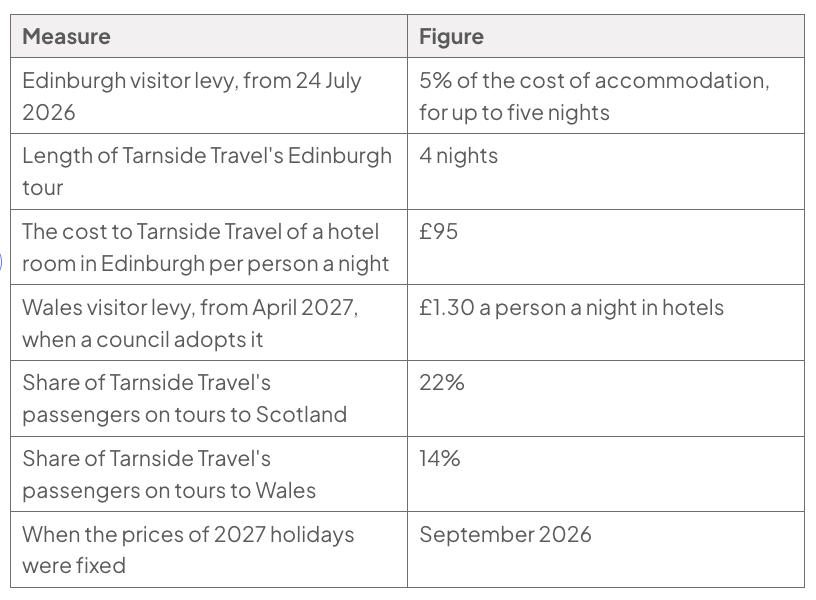
Visitor levy table: Edinburgh from 24 July 2026, 5% of accommodation for up to five nights; four-night tour and £95 hotel cost per person/night. Wales from April 2027: £1.30 per person/night; passenger shares Scotland 22%, Wales 14%; 2027 prices fixed September 2026.

Source: Analyst

Appendix G: Three ways to use technology

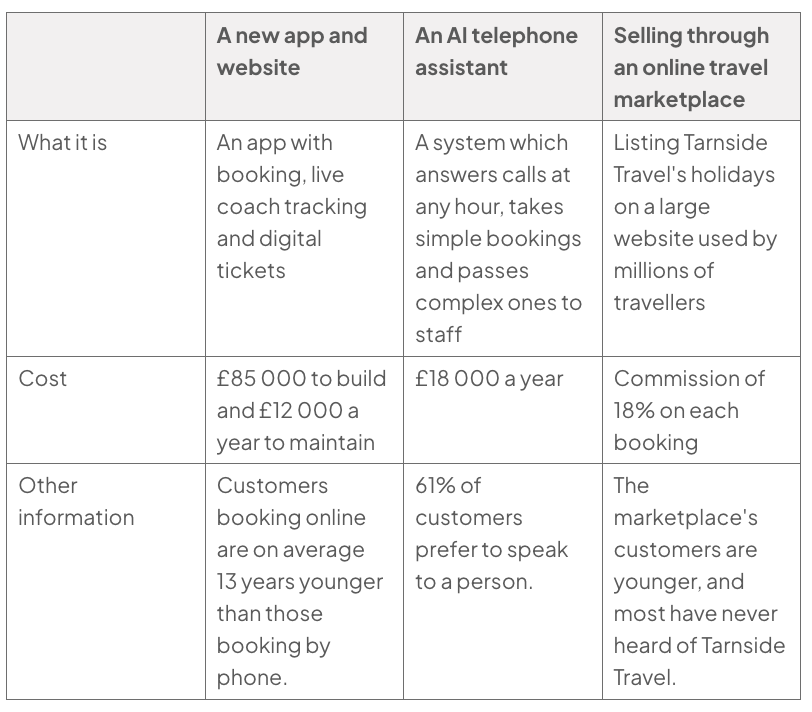
Table comparing three technology options: new app and website (booking, live coach tracking, digital tickets; £85,000 build plus £12,000 yearly maintenance; online bookers 13 years younger); AI telephone assistant (£18,000 yearly; 61% prefer people); online marketplace (18% commission; younger customers unfamiliar with Tarnside).

Source: Tarnside Travel

Most of Tarnside Travel's customers are over 65, and 61% prefer to speak to a person when they book.

Evaluate two ways Tarnside Travel could use technology to grow and recommend which one it should do first.

Use information from Appendices D to G to support your answer.

2
15 marks

Source A: Rightmove

Rightmove plc runs the UK's largest property portal, where estate agents, letting agents and housebuilders advertise homes for sale and to rent. It is listed on the London Stock Exchange. Its customers are the agents and developers, who pay a monthly subscription; people looking for a home use the website and app free of charge. In 2025 users spent 16.8 billion minutes on Rightmove, which had 89% of all the time spent on UK property portals in December 2025, and more than 85% of visits came to the site directly rather than through a search engine or advertisement.

In the year to 31 December 2025 Rightmove's revenue rose 9% to £425.1 million and its underlying operating profit rose 9% to £297.7 million, a margin of 70%. Average revenue per advertiser rose by 6%, while the number of advertisers rose by 1%. Most agents choose a package of products, and a growing share choose the most expensive one.

Rightmove has three newer areas of business, which it calls its strategic growth areas: commercial property, mortgages and services for landlords and tenants. Together their revenue grew by 25% in 2025.

The company is using artificial intelligence across its business. It had 46 strategic AI initiatives in progress by June 2026. It has also launched a conversational search tool developed with Google Cloud and has submitted an app for use within ChatGPT. In November 2025 it announced that it would increase its investment in technology and AI, and that its underlying operating profit would therefore grow by only 3% to 5% in 2026. Its share price fell by more than 25% that day.

Source: Rightmove plc, Results for the year ended 31 December 2025, and Half Year Results 2026

Appendix A: Rightmove selected data

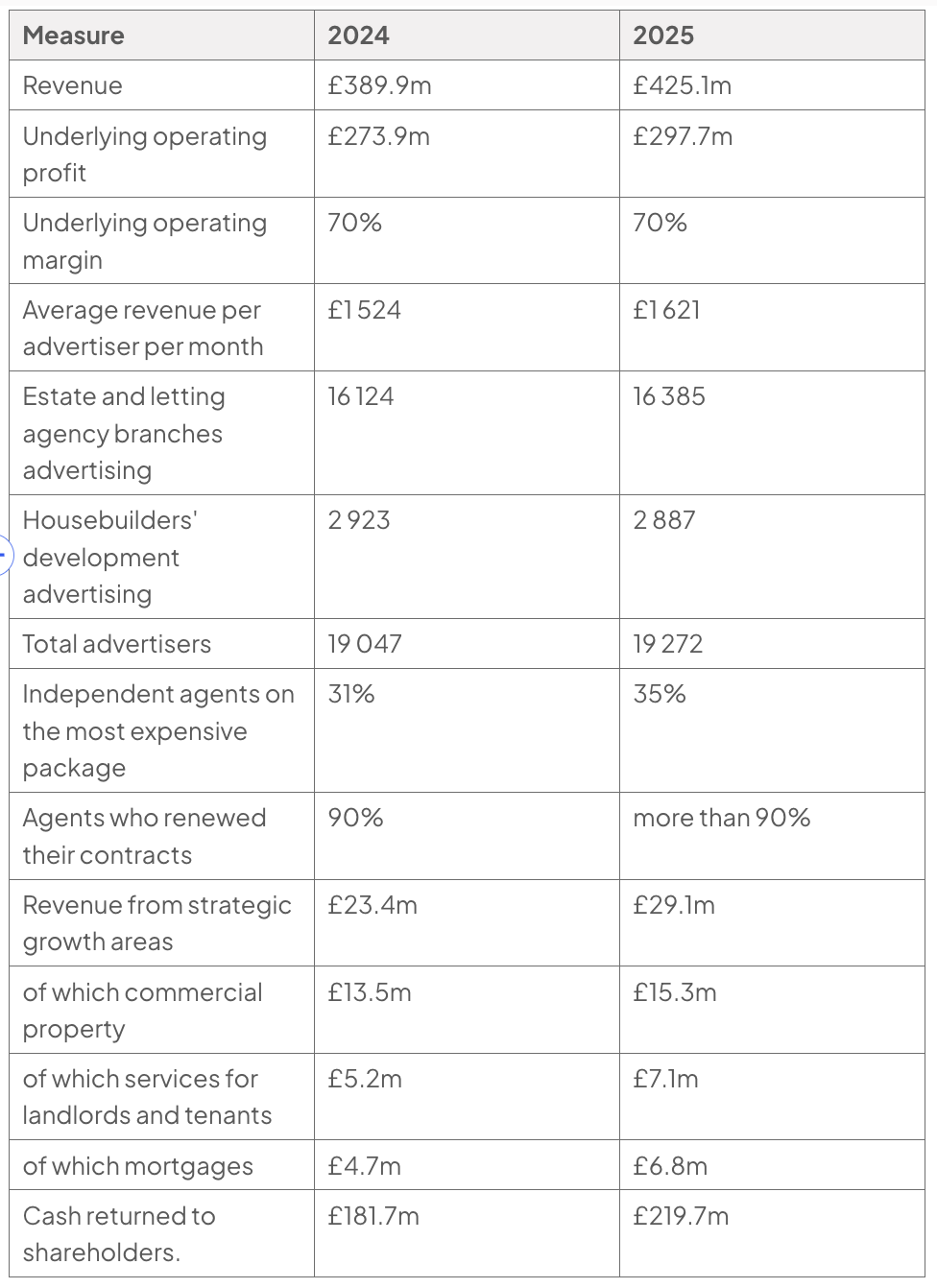
Three-column table of Rightmove’s selected data, comparing 2024 and 2025 across financial performance, advertisers, contract renewals, strategic growth areas and cash returned to shareholders.

The three strategic growth areas do not add exactly to the published total because of rounding.

Source: Rightmove plc

Appendix B: Rightmove and artificial intelligence

  • Data. Rightmove holds 4 petabytes of data on homes, prices and searches, more than 90% of it its own, used by about 200 of its own models.

  • New tools. A conversational search tool, built with Google Cloud, lets users describe the home they want in their own words. An app for use within ChatGPT has been submitted. Other AI tools include an online valuation tool for agents, which became the fastest-growing product Rightmove has launched.

  • Visitors from AI tools. Visits referred to Rightmove by large language model tools such as ChatGPT were less than 0.5% of its traffic in May 2026, unchanged since the end of 2025.

  • The investment. About £12 million more in operating costs and £6 million more in capital spending in 2026, including more than 100 new staff in data, product and engineering.

  • The reaction. When the investment and its effect on 2026 profit were announced in November 2025, Rightmove's share price fell by more than 25% in a day.

Source: Analyst, using Rightmove plc and press reports

Appendix C: Rightmove in 2026

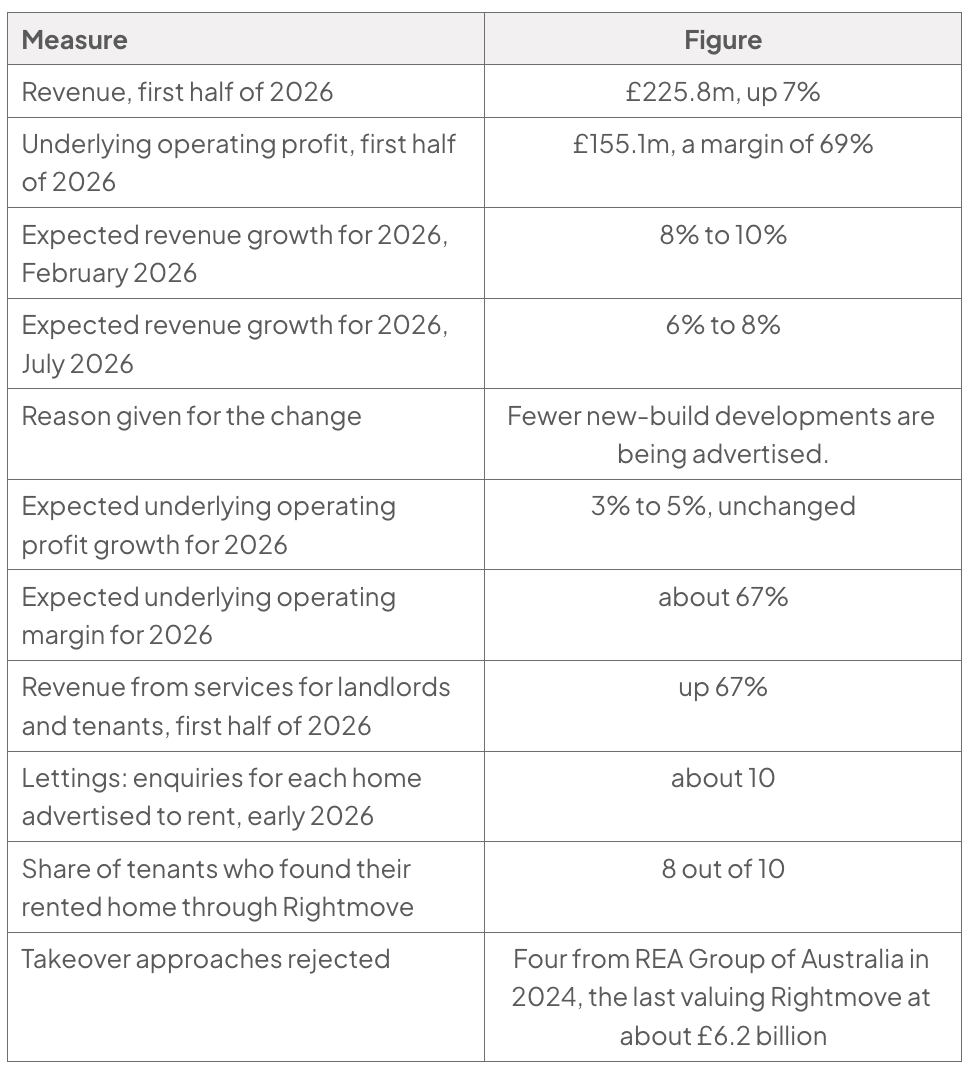
Two-column table of Rightmove’s 2026 measures and figures, covering revenue, profit and margins, forecasts, AI-related growth, lettings demand, tenant reach and rejected takeover bids.

Source: Analyst, using Rightmove plc and press reports

Rightmove has increased its investment in AI, and expects its underlying operating margin to fall from 70% to about 67% in 2026.

Evaluate whether Rightmove should continue to increase its investment in AI or protect its operating margin.

3
15 marks

Source A: Premier Foods

Premier Foods plc is one of the UK's largest food manufacturers. Its brands include Ambrosia, Batchelors, Bisto, Loyd Grossman, Mr Kipling, Oxo and Sharwood's, and it makes Cadbury cakes under licence. It has bought three newer brands: The Spice Tailor, FUEL10K and, in 2025, Merchant Gourmet, for £46.1 million. It is listed on the London Stock Exchange.

In the 52 weeks to 28 March 2026 Premier Foods' headline revenue rose by 2.5% to £1 175.2 million and its trading profit rose by 6.7% to £200.4 million. Sales of its branded products grew by 3.4%. Mr Kipling had its biggest ever year, helped by new products such as cake bites tubs, and the company gained market share in both of its divisions, Grocery and Sweet Treats.

The company's strategy has five pillars:

  • Grow the UK core through brand investment and new products.

  • Enter new categories, such as FUEL10K yogurt and granola pots.

  • Build international businesses in Australia and New Zealand, North America and Europe.

  • Acquire brands with strong growth potential.

  • Invest in its factories to increase efficiency and automation.

During the year capital investment rose by 25% to £51.9 million. It included a solar farm at its cake factory near Barnsley, which can supply up to 70% of the site's electricity, and an investment that made the pot filling and packing line at its Ambrosia site in Devon faster and more efficient.

Many of the company's products, including most cakes, are classed by law as less healthy because they are high in fat, sugar or salt. From 5 January 2026 such products may not be advertised on television or on-demand services between 5.30am and 9pm, or in paid-for online adverts at any time. Adverts which show a brand without showing a less healthy product are still allowed.

Source: Premier Foods plc, Full Year Results for the 52 weeks ending 28 March 2026

Appendix A: Premier Foods selected data

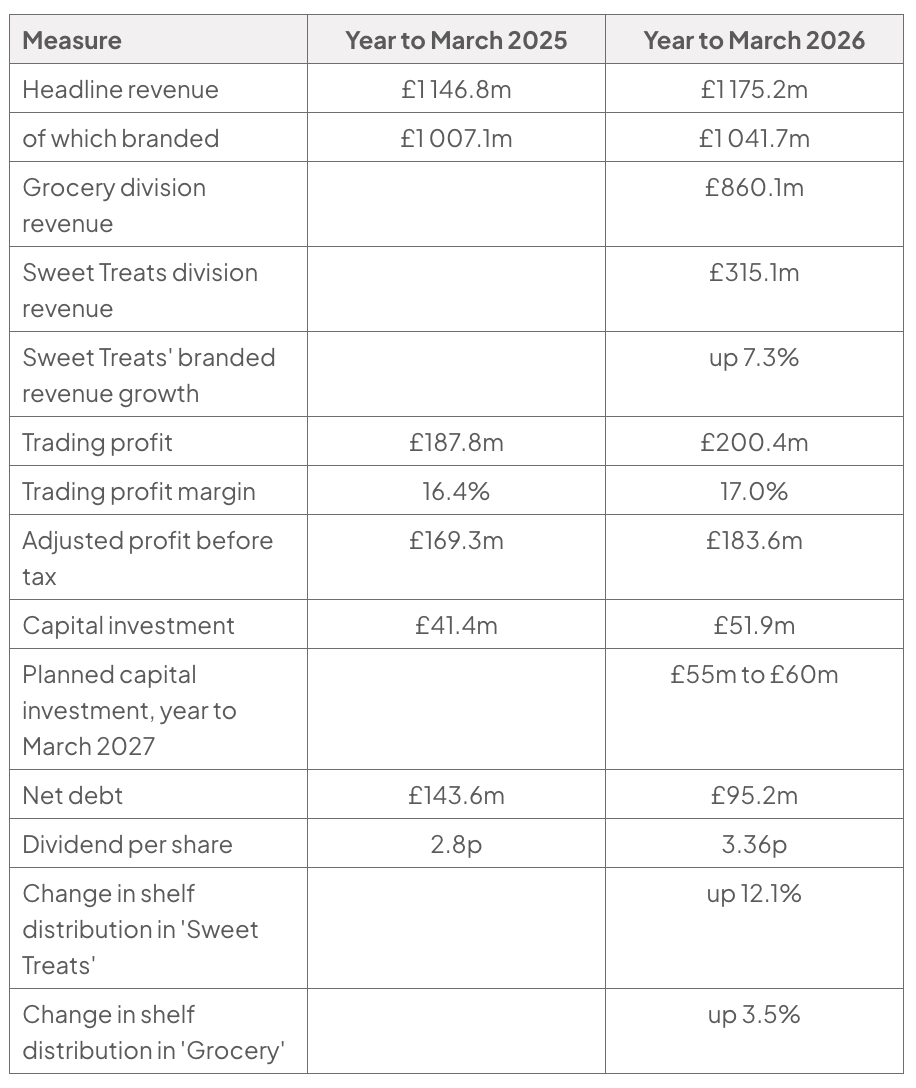
A three-column table compares Premier Foods’ measures for the years to March 2025 and March 2026, including revenue, profit, investment, debt, dividend and shelf distribution.

Source: Premier Foods plc

Appendix B: Rules on less healthy food and packaging

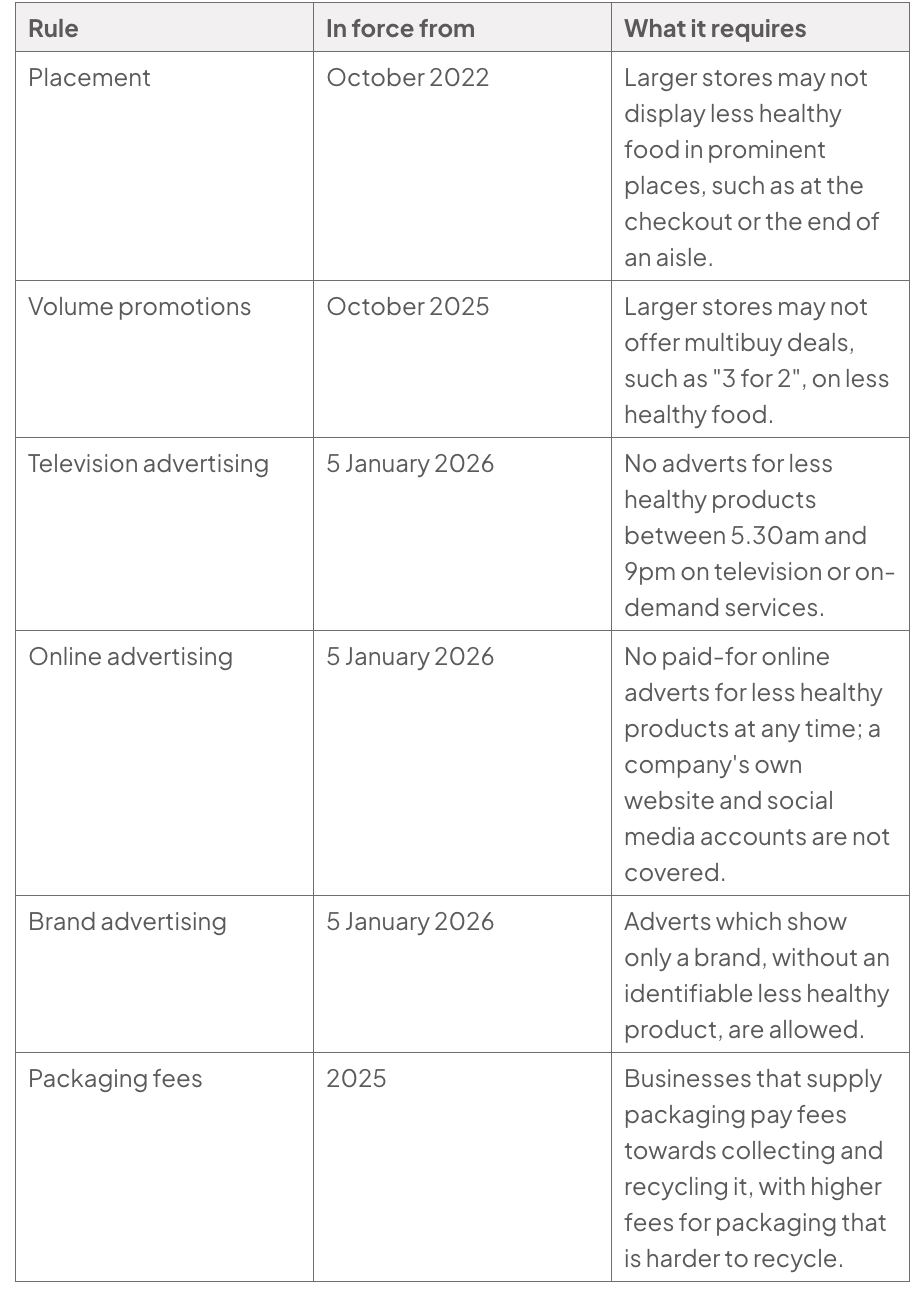
Three-column table summarising rules on placement, volume promotions, television and online advertising, brand advertising and packaging fees, with their dates and requirements.
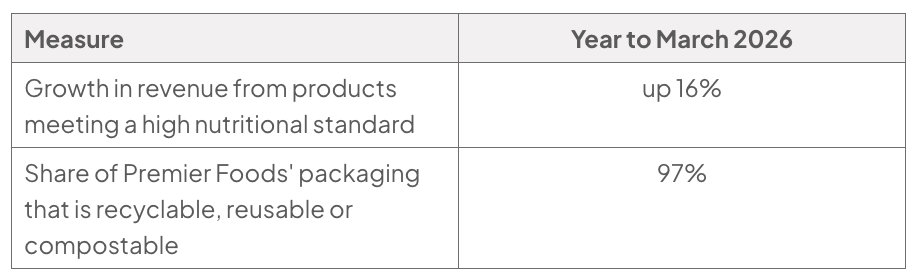
Table for the year to March 2026: revenue from products meeting a high nutritional standard grew by 16%; 97% of Premier Foods’ packaging was recyclable, reusable or compostable.

Source: Analyst, using Premier Foods plc and government guidance

Appendix C: Strategy and investment in the year to March 2026

  • UK core. UK branded revenue up 3.7%, and up 5.0% in the second half of the year. Market share gained in Grocery and Sweet Treats. Marketing uses television, radio, outdoor, digital and social media, "the latter to drive greater connection with younger demographic audiences".

  • New categories. Revenue up 37%, from a small base, led by FUEL10K yogurt and granola pots.

  • International. Revenue £50.4m, down 1.8%, because retailers in Australia reduced their inventories of cake; revenue up 17% in the US and 9% in Europe.

  • Acquisitions. The Spice Tailor, FUEL10K and Merchant Gourmet all grew revenue by more than 10%. Merchant Gourmet's annual revenue is about £30m.

  • Factories. Investment aimed at automation and efficiency. Planned for the year to March 2027: more cooking sauce capacity at Worksop, more flexible production lines at the Mr Kipling site near Barnsley, and upgrades to IT systems. The company says efficiency benefits from capital investment contributed to the growth in profit.

  • Finance. Net debt is 0.4 times adjusted EBITDA, low enough to fund further investment or acquisitions.

Source: Analyst, using Premier Foods plc

Premier Foods plans to invest further in its factories and markets its brands through television, digital and social media.

Evaluate whether Premier Foods should focus its investment in technology on automating its factories or on digital and social media marketing.

4
15 marks

Source A: ITV

ITV plc is a UK broadcaster and programme maker listed on the London Stock Exchange. It has two divisions:

  • Media & Entertainment (M&E) runs ITV1, ITV2 and other channels and the streaming service ITVX, and earns most of its income from advertising.

  • ITV Studios makes and sells programmes, such as Coronation Street, Emmerdale and Love Island, to ITV and to other broadcasters and streaming services around the world.

ITV follows its "More Than TV" strategy, which has three parts: expanding ITV Studios, "supercharging" streaming and optimising broadcast television. In 2025 ITV made £63 million of permanent cost savings through technology, organisational redesign and growing use of AI.

In 2025 total revenue was £4 121 million, almost unchanged on 2024. The company faces two main pressures:

  • Viewing. ITV says that "linear viewing continues to decline, particularly among younger audiences".

  • Advertising. Total advertising revenue fell 5% in 2025. Digital revenue, mainly from ITVX, rose 10% to £614 million, but most advertising revenue still comes from the broadcast channels.

On 6 July 2026 ITV agreed to sell M&E, including its channels, ITVX and the Channel 3 licences, to Sky for up to £1.6 billion. ITV Studios would remain a separate company listed in London. The sale must be approved by regulators, including the Competition and Markets Authority. ITV and Sky argue that, including online advertising, they would have about 20% of UK advertising spending; on a television-only measure the share would be much higher. The sale is expected to complete in the second half of 2027.

Source: ITV plc, results for 2025 and the first half of 2026, and announcement of 6 July 2026

Appendix A: ITV financial data

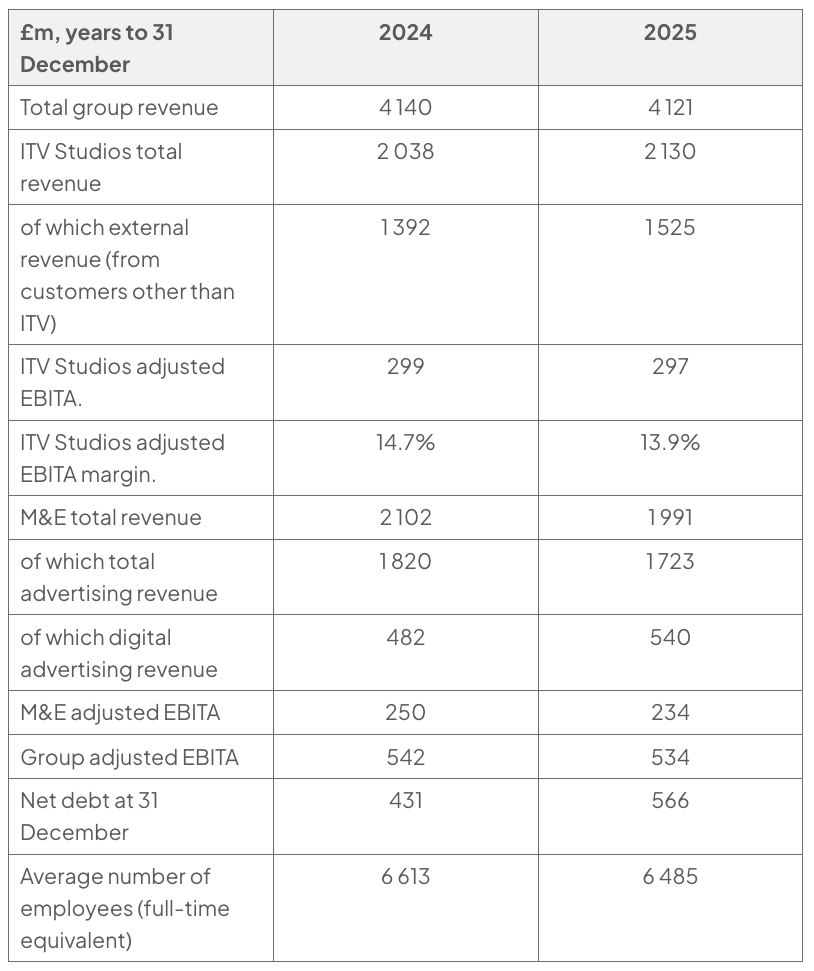
Table comparing ITV figures for 2024 and 2025 (£m to 31 December): total revenue 4 140/4 121; Studios revenue 2 038/2 130, of which external revenue 1 392/1 525, adjusted EBITA 299/297 and adjusted EBITA margin 14.7%/13.9%; M&E revenue 2 102/1 991, total advertising revenue 1 820/1 723, digital advertising revenue 482/540 and adjusted EBITA 250/234; net debt 431/566; average employees 6 613/6 485.

Adjusted EBITA is profit before interest, tax, amortisation and one-off items.

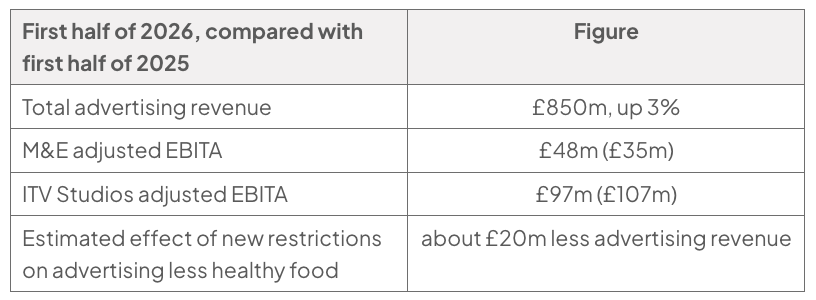
Table comparing ITV’s first-half 2026 with 2025: total advertising revenue £850m, up 3%; M&E adjusted EBITA £48m (£35m); ITV Studios adjusted EBITA £97m (£107m); less-healthy-food restrictions may reduce advertising revenue by about £20m.

Source: ITV plc

Appendix B: Viewers, streaming and technology

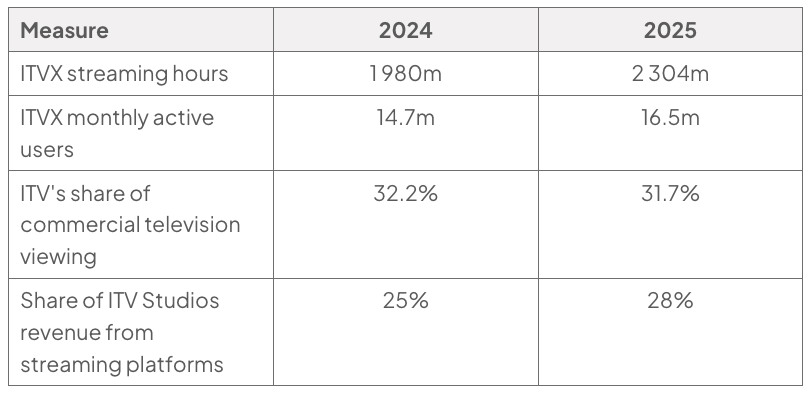
Table comparing ITV measures in 2024 and 2025: ITVX streaming hours rose from 1 980m to 2 304m; monthly active users from 14.7m to 16.5m; viewing share fell from 32.2% to 31.7%; Studios streaming revenue share rose from 25% to 28%.
  • Digital target. In 2022 ITV set a target of £750m of digital revenue. After deciding to give less priority to paid subscriptions, it says reaching it "will take slightly longer".

  • YouTube. ITV shows its programmes on YouTube; over 40% of the viewing of ITV content on YouTube is by people under 35.

  • ITV Studios. 59% of its revenue comes from outside the UK.

  • Costs. £63m of permanent cost savings in 2025, and £253m since 2019, through technology, organisational redesign and growing use of AI; a further £20m is planned for 2026.

Source: Analyst, using ITV plc

Appendix C: The sale to Sky

  • Price. Up to £1.6bn: £1.2bn in cash, Sky's Love Productions (maker of The Great British Bake Off) valued at £200m, and up to £200m more depending on advertising revenue in 2027.

  • What Sky would buy. ITV's channels, ITVX, the Channel 3 licences to 2034, ITV Sport and a 20% stake in ITN, which makes ITV News.

  • Shareholders. About £950m, or 25p a share, would be returned to shareholders, after transaction and separation costs of about £185m.

  • ITV Studios. Would become "a distinctive pure-play global content business", with a minimum of £2.1bn of programme spending committed by ITV M&E and Sky over 2028-2032.

  • Public service broadcasting. ITV's duties as a public service broadcaster, "including nations, regional and national news", continue under the Channel 3 licences, which Sky would take over.

  • Regulators. The Competition and Markets Authority invited comments in July and August 2026. ITV and Sky argue that, including online advertising, they would have about 20% of UK advertising spending; on a television-only measure the share would be much higher.

  • Views. Chief Executive Carolyn McCall: Sky "will be a strong and responsible custodian" of ITV M&E. Chair Andrew Cosslett: the deal creates "a UK champion with the scale and resources to better compete with global streaming platforms".

Source: Analyst, using ITV plc, the Competition and Markets Authority and press reports

ITV says that "linear viewing continues to decline, particularly among younger audiences".

Evaluate whether ITV should respond to changes in technology by investing more in ITVX or by focusing on growing ITV Studios.