Ethics in Finance (AQA A Level Business): Exam Questions

Exam code: 7132

Syllabus Edition

First teaching 2026

First exams 2028

2 hours15 questions
1
6 marks

Source A: Nationwide Building Society

Nationwide is the world's largest building society and the second largest mortgage lender in the United Kingdom. It is a mutual, which means it has no shareholders. It is owned by its members, who are the people who bank, save or hold a mortgage with it, and in principle every member is an owner. Nobody outside the membership has a claim on its profit.

That changes what profit is for. A listed bank divides its profit between dividends to shareholders and money kept in the business. Nationwide has no shareholders to pay, so it keeps almost all of its profit in the business to build its financial strength, and gives value to members in two other ways. The first is pricing, through better savings rates and lower mortgage rates. In the year to 31 March 2025 it put this at £1 795 million of member financial benefit, which is its estimate of how much better off its members were than they would have been with a typical high street bank. The second is direct payments: £1 000 million paid to eligible members through the Fairer Share Payment and a one-off reward called The Big Nationwide Thank You. Both reach members before profit is calculated, so neither is paid out of profit.

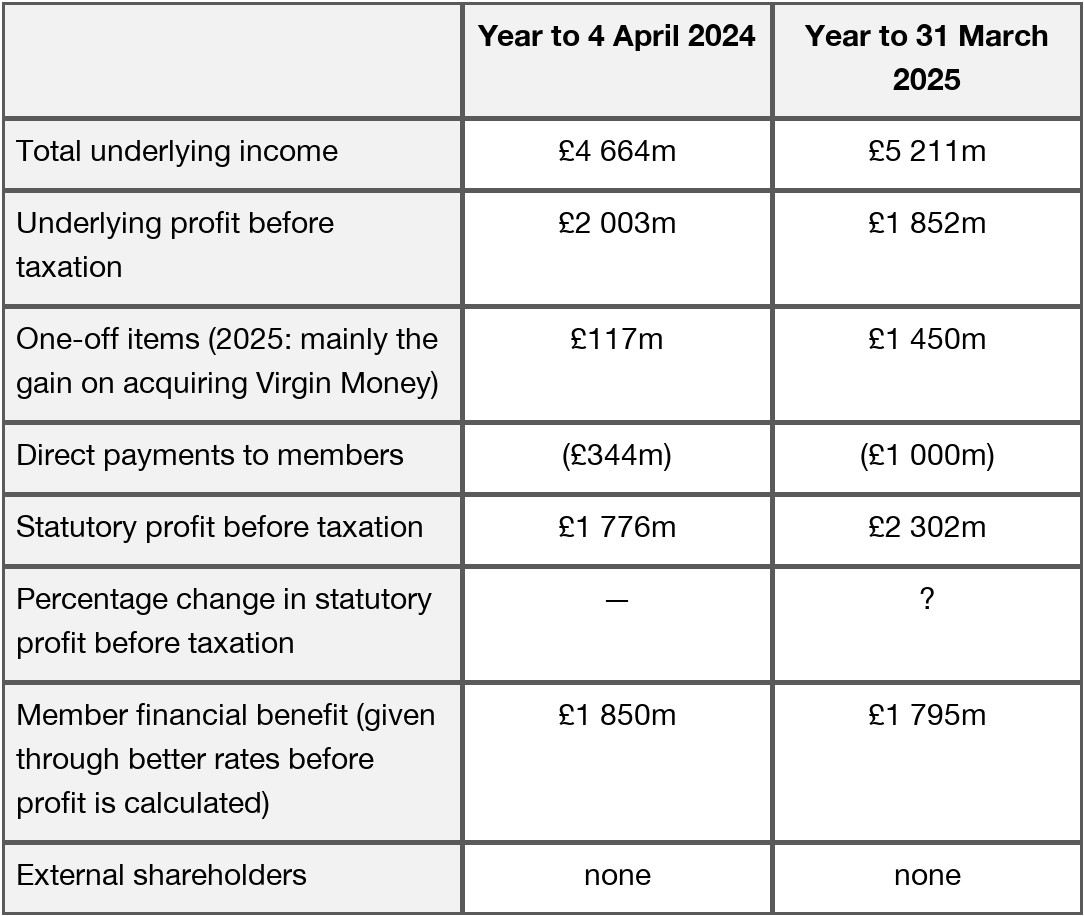
The year was a large one. On 1 October 2024 Nationwide completed the acquisition of Virgin Money, a bank with its own customers, brand and business lending arm. Statutory profit before tax rose to £2 302 million from £1 776 million, even after the direct payments to members. The rise was mainly due to a one-off accounting gain of £2.3 billion on buying Virgin Money, which arose because the assets acquired were valued at more than the £2.8 billion price. Underlying profit before tax, which leaves out one-off items and the direct payments, fell to £1 852 million from £2 003 million, which the society put down to its decision to pay members better rates. Total underlying income reached £5.2 billion, and Pay.UK switching data for the nine months to December 2024 showed more current account switchers moving to Nationwide than to any other brand.

Buying a bank is an unusual thing for a mutual to do. Virgin Money's customers did not choose a mutual, and integrating it will take years and a great deal of money. Every pound spent on that integration is a pound not returned to members this year, which is the tension the society is now living with.

Source: information sourced from Nationwide Building Society preliminary results for the year ended 31 March 2025

Appendix B: What being a mutual means

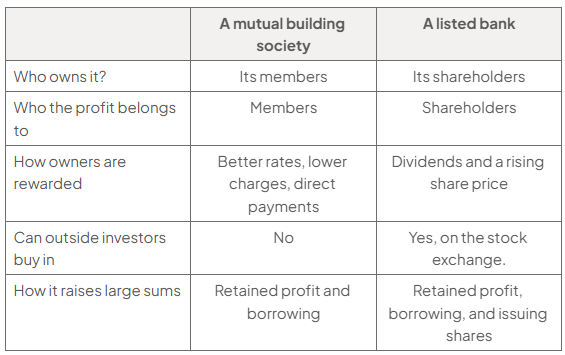
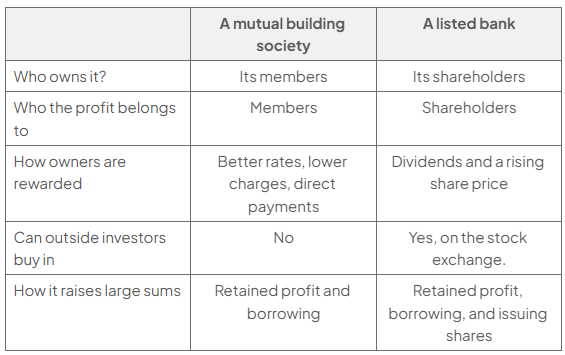
Table comparing a mutual building society with a listed bank: members versus shareholders own it and receive profits; outside investment is unavailable versus available on the stock exchange; both retain profit and borrow, while banks can issue shares.

Source: Analyst

Nationwide Building Society has no external shareholders.

Analyse one way in which having no shareholders might affect how Nationwide Building Society sets its mortgage rates.

2
6 marks

Source A: Nationwide Building Society

Nationwide is the world's largest building society and the second largest mortgage lender in the United Kingdom. It is a mutual, which means it has no shareholders. It is owned by its members, who are the people who bank, save or hold a mortgage with it, and in principle every member is an owner. Nobody outside the membership has a claim on its profit.

That changes what profit is for. A listed bank divides its profit between dividends to shareholders and money kept in the business. Nationwide has no shareholders to pay, so it keeps almost all of its profit in the business to build its financial strength, and gives value to members in two other ways. The first is pricing, through better savings rates and lower mortgage rates. In the year to 31 March 2025 it put this at £1 795 million of member financial benefit, which is its estimate of how much better off its members were than they would have been with a typical high street bank. The second is direct payments: £1 000 million paid to eligible members through the Fairer Share Payment and a one-off reward called The Big Nationwide Thank You. Both reach members before profit is calculated, so neither is paid out of profit.

The year was a large one. On 1 October 2024 Nationwide completed the acquisition of Virgin Money, a bank with its own customers, brand and business lending arm. Statutory profit before tax rose to £2 302 million from £1 776 million, even after the direct payments to members. The rise was mainly due to a one-off accounting gain of £2.3 billion on buying Virgin Money, which arose because the assets acquired were valued at more than the £2.8 billion price. Underlying profit before tax, which leaves out one-off items and the direct payments, fell to £1 852 million from £2 003 million, which the society put down to its decision to pay members better rates. Total underlying income reached £5.2 billion, and Pay.UK switching data for the nine months to December 2024 showed more current account switchers moving to Nationwide than to any other brand.

Buying a bank is an unusual thing for a mutual to do. Virgin Money's customers did not choose a mutual, and integrating it will take years and a great deal of money. Every pound spent on that integration is a pound not returned to members this year, which is the tension the society is now living with.

Source: information sourced from Nationwide Building Society preliminary results for the year ended 31 March 2025

Appendix A: Nationwide Building Society selected results

Table comparing Nationwide results for 2024 and 2025: underlying income £4,664m/£5,211m; underlying profit £2,003m/£1,852m; one-off items £117m/£1,450m; member payments £344m/£1,000m; statutory profit £1,776m/£2,302m; member benefit £1,850m/£1,795m; no external shareholders.

Source: Nationwide Building Society

Appendix B: What being a mutual means

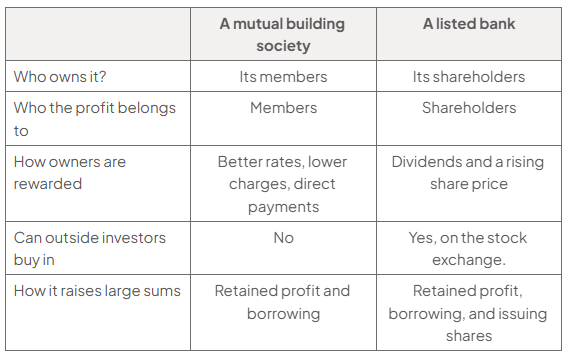
Table comparing a mutual building society with a listed bank: members own the mutual and receive profits via better rates, lower charges and direct payments; shareholders own the bank and receive dividends and rising share price. Investors cannot buy into the mutual but can buy bank shares.

Source: Analyst

Nationwide Building Society reported member financial benefit of £1 795 million for the year to 31 March 2025.

Analyse one reason why member financial benefit might be a difficult figure for members to check.

3
6 marks

Source B: Calder Vale Ceramics Ltd

Calder Vale Ceramics Ltd makes tableware: plates, bowls and serving dishes, thrown and glazed at a single factory in Lancashire. It is a private limited company owned by its two directors, Nadia Okonjo and Rob Hartley, and it employs 19 people.

It does not sell to the public. Its customers are restaurant groups, hotels and independent homeware shops, who order in batches and expect the same glaze to be available again in two years' time. Last year it fired and sold 77 500 pieces at an average price of £16.00, which brought in £1 240 000.

Two kilns do all the work. They cost £14 200 a month to run, staff, maintain and insure, and that is paid whether or not a single piece is fired. A third kiln would cost £180 000 and would let the company take the larger restaurant contracts it currently turns down.

The difficulty is not profit. The difficulty is when the money arrives. Calder Vale Ceramics Ltd's largest customers are restaurant groups, and they take 62 days to pay. Its own clay and glaze come from two small family firms, and Calder Vale Ceramics Ltd pays them within 30 days, because it always has. Finished inventory sits in the warehouse for about seven weeks before a customer calls it off.

Last year it made a gross profit of £558 000 on its £1 240 000 of revenue, once the £682 000 of clay, glaze, packaging and firing was paid for. Wages came to £298 000 and the kiln, factory, insurance and other fixed costs to £170 400, leaving a profit for the year of £89 600. It ended the year with £18 300 in the bank.

Calder Vale Ceramics Ltd buys its clay and glaze from two small family firms and pays them within 30 days, while its own largest customers take 62 days to pay.

Analyse one way in which extending its own payment period to 60 days might affect Calder Vale Ceramics Ltd's relationship with those two suppliers.

4
6 marks

Source B: Galliford Try Holdings plc

Galliford Try Holdings plc builds things: schools, hospitals, water treatment works, roads and defence sites. It is a public limited company listed in London and it works almost entirely in the United Kingdom, mostly for public sector clients and regulated utilities. It does not build houses for sale.

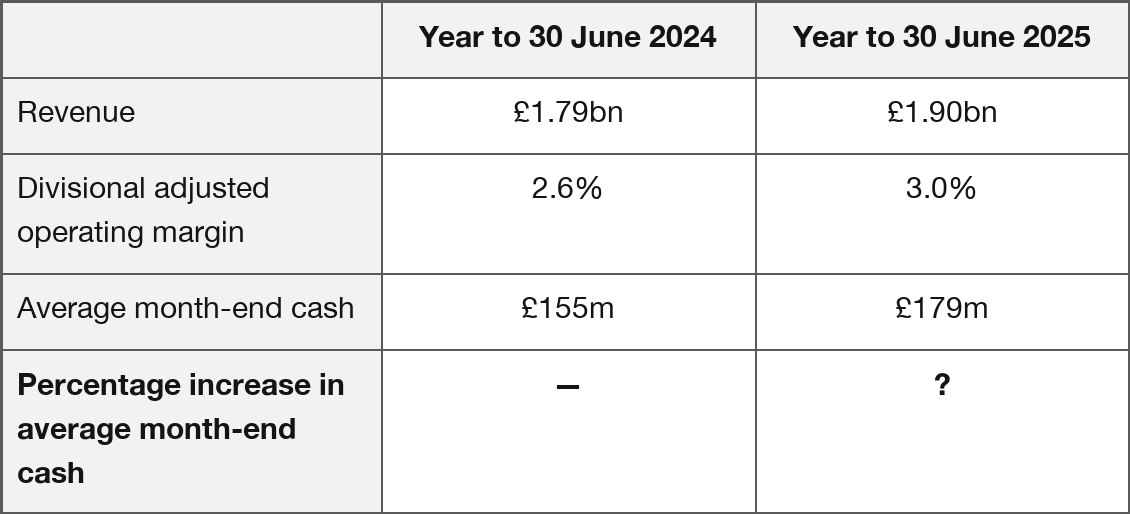
Construction is a low-margin business and Galliford Try Holdings plc says so. In the year to 30 June 2025 revenue was £1.9 billion, 6% up on the year before, and the divisional adjusted operating margin was 3.0%. The company had set itself a target of 3.0% and reached it a year earlier than it had planned.

On a job of this size almost nothing is built by Galliford Try Holdings plc's own employees. The work is done by subcontractors: groundworkers, electricians, roofers, most of them small firms. In construction the usual way to hold on to cash is to pay those firms slowly, and the industry has a long record of doing exactly that. In the six months to 31 December 2025 Galliford Try Holdings plc paid its supply chain in an average of 29 days, and it publishes how quickly it pays.

It also holds a great deal of cash. The figure it reports is the average of its cash balance at the end of each month, which was £179 million, up from £155 million. It reports the average rather than the year-end figure because a construction company's cash moves a long way from month to month, and the balance on any single day says very little.

Source: information sourced from Galliford Try Holdings plc results for the year ended 30 June 2025 and the six months ended 31 December 2025

Appendix D: Galliford Try Holdings plc selected results

Table comparing years to 30 June 2024 and 2025: revenue £1.79bn and £1.90bn; adjusted operating margin 2.6% and 3.0%; average month-end cash £155m and £179m. Percentage cash increase is shown as ? for 2025.

Source: Galliford Try Holdings plc

Galliford Try Holdings plc publishes how many days it takes to pay the small firms that work for it.

Analyse one way in which publishing this figure might affect the subcontractors who choose to work for Galliford Try Holdings plc.

5
6 marks

Source B: Whitbourne Coaches Ltd

Whitbourne Coaches Ltd runs 18 coaches out of a depot in Herefordshire. It is a private limited company owned by Carol Whitbourne and her son Ryan, and it employs 22 people, most of them drivers.

Rather more than half its work is school contracts, run for the county council and for three private schools, which together brought in £1.36 million last year. The rest is private hire and day trips, which brought in £0.98 million. Total revenue was £2.34 million.

The company thinks in coach-days. A coach out on the road for a day earns an average of £420 and costs £180 in fuel, tolls and cleaning, leaving £240. Last year its coaches were out for 5 570 days. Against that it pays £1 200 000 a year in costs that do not change with use: the depot, insurance, vehicle finance and the drivers' basic wages. Profit for the year was £136 800.

The difficulty is that the profit is not in the bank. The council and the schools pay on their own timetable, which is usually somewhere between 60 and 90 days, and at the year end Whitbourne Coaches Ltd was owed £286 000. It had £31 000 in the bank and £18 000 of fuel in the tank. Against that it owed £142 000 to suppliers, £198 000 of vehicle finance falling due within the year, and £64 000 of VAT and PAYE.

Carol and Ryan Whitbourne take most of their own pay as dividends rather than salary, which is legal and costs the company less in national insurance than paying themselves the same amount as wages.

Carol and Ryan Whitbourne take most of their own pay as dividends rather than salary. This is legal, but it means less national insurance is paid than if they paid themselves the same amount as wages.

Analyse one way in which this arrangement might affect how Whitbourne Coaches Ltd's stakeholders judge whether the business behaves ethically.

6
6 marks

Source B: Ashgrove Print Ltd

Ashgrove Print Ltd is a commercial printer in Dewsbury. Ken Ashgrove started it in 1994 after fifteen years at a firm that lost its only large customer and closed in a fortnight, and he told his daughter Nadia more than once that he built Ashgrove Print Ltd so that nobody would ever again be able to tell him what to charge. Nadia Ashgrove has run it since 2021. It is a private limited company and employs 34 people.

The work comes in two kinds. Long-run work is leaflets and shelf-edge cards for Fenwold Stores, a supermarket group: high volume, printed to a price Fenwold Stores fixes, and paid for in 74 days. It brought in £2 472 000 last year and cost £2 100 000 in paper, ink, plates and press time. Short-run work is menus, packaging, programmes and art prints for about 300 small local customers: low volume, priced job by job, and paid for in 21 days, often on collection. It brought in £1 648 000 and cost £784 000.

Across all its customers, Ashgrove Print Ltd waits an average of 53 days to be paid. It buys paper from two mills on 30-day terms. Its agreed terms with its own smaller suppliers, the plate makers, the bindery, the finishers and the courier, are also 30 days. Last year it paid them on average in 61 days. Its overdraft facility is £150 000 and it was £96 000 into it at the year end.

Fenwold Stores has now offered Ashgrove Print Ltd all of its print work on a three-year contract. It would need a new press costing £340 000, which the bank will lend against. Appendix F sets out that future and the one Nadia Ashgrove has been building towards instead.

Ashgrove Print Ltd's agreed terms with its smaller suppliers are 30 days. Last year it paid them on average in 61 days.

Analyse one way in which paying its smaller suppliers late might affect the terms and prices those suppliers offer Ashgrove Print Ltd.

7
6 marks

Source B: Mishcon de Reya LLP

Mishcon de Reya LLP is a law firm. It advises businesses and wealthy individuals on disputes, property, corporate deals and private matters, and it is led by managing partner James Libson. It has offices in London, Cambridge and Oxford, and overseas in Hong Kong, Singapore and the United Arab Emirates. About 1 250 people work there, including more than 650 lawyers.

It is not a company. It is a limited liability partnership, which means it is owned by its members, the partners, rather than by shareholders. Members put capital into the firm when they join and take a share of the profit rather than a salary. Nobody outside the partnership owns any part of it.

The year to 31 March 2025 was the firm's best. Revenue rose 9% to £330 million and profit rose 14% to £110 million, the first time it has passed £100 million. The firm says it has tripled in size over the past decade. Its work during the year included advising Wayve on what it describes as Europe's largest artificial intelligence investment and defending O2 in a collusion claim.

Growing has meant admitting people. Sixteen new partners joined during the year and a further 27 people were promoted to partner from inside the firm, alongside 13 promotions to legal director. There are now more than 200 partners. As in any partnership, some members retire or leave each year, so membership grows by less than the number admitted.

That is the tension the firm is sitting with. In a partnership the profit is divided between the members, so every partner admitted is another share of the same pool. The firm now has to decide where its next stage of growth should come from: more partners in the United Kingdom, where it already has three offices and knows the market, or a bigger presence in Hong Kong, Singapore and the United Arab Emirates, where the offices exist but are small. Appendix F sets out the two options.

Source: information sourced from Mishcon de Reya LLP, results for 2024/25

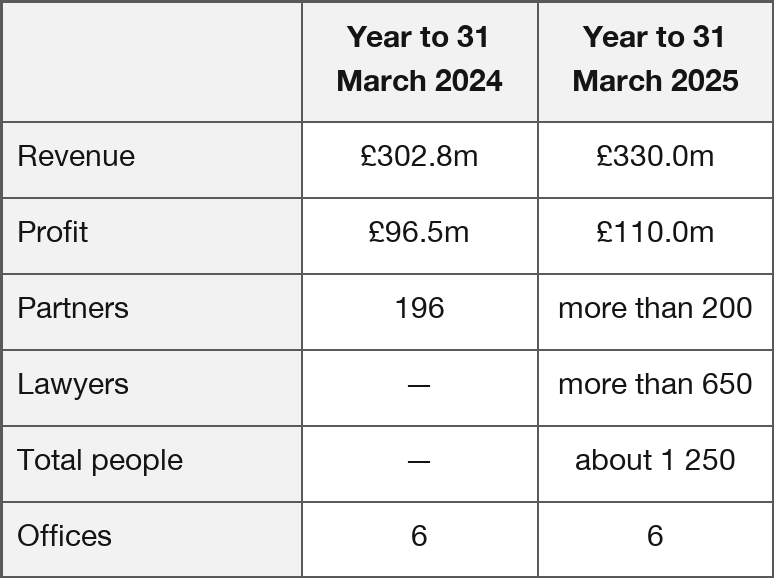
Appendix D: Mishcon de Reya LLP selected results

Selected results for years to 31 March 2024/2025: revenue £302.8m/£330.0m; profit £96.5m/£110.0m; partners 196/over 200; lawyers —/over 650; total people —/about 1,250; offices 6/6.

Source: Mishcon de Reya LLP; 2024 partner number from analyst estimates

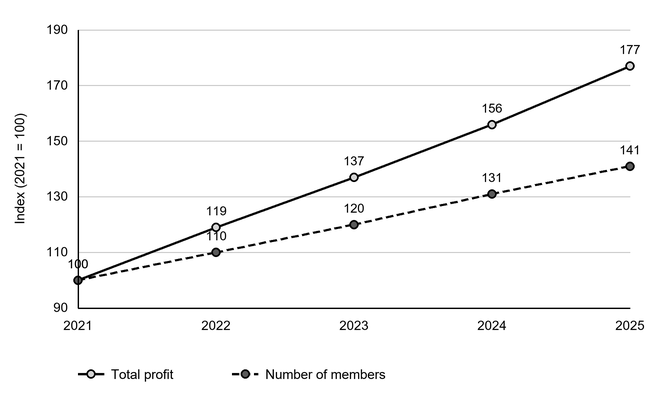
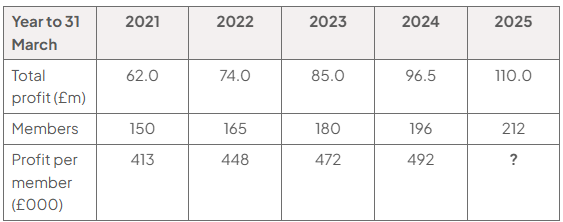
Appendix E: Mishcon de Reya LLP profit and members, analyst estimates

Line chart comparing indexed total profit and number of members, 2021 to 2025 (2021 = 100). Profit rises from 100 to 177; members increase from 100 to 141, with values shown for each year.
Table of total profit (£m), members and profit per member (£000) for 2021 to 2025: profit 62.0, 74.0, 85.0, 96.5, 110.0; members 150, 165, 180, 196, 212; per member 413, 448, 472, 492, ?.

Source: Analyst

Mishcon de Reya LLP's £110 million profit is paid out to its owners, who take a share of the profit rather than a salary.

Analyse one way in which paying out the profit to its owners might affect the decisions Mishcon de Reya LLP takes about which clients it acts for.

1
9 marks

Source A: Nationwide Building Society

Nationwide is the world's largest building society and the second largest mortgage lender in the United Kingdom. It is a mutual, which means it has no shareholders. It is owned by its members, who are the people who bank, save or hold a mortgage with it, and in principle every member is an owner. Nobody outside the membership has a claim on its profit.

That changes what profit is for. A listed bank divides its profit between dividends to shareholders and money kept in the business. Nationwide has no shareholders to pay, so it keeps almost all of its profit in the business to build its financial strength, and gives value to members in two other ways. The first is pricing, through better savings rates and lower mortgage rates. In the year to 31 March 2025 it put this at £1 795 million of member financial benefit, which is its estimate of how much better off its members were than they would have been with a typical high street bank. The second is direct payments: £1 000 million paid to eligible members through the Fairer Share Payment and a one-off reward called The Big Nationwide Thank You. Both reach members before profit is calculated, so neither is paid out of profit.

The year was a large one. On 1 October 2024 Nationwide completed the acquisition of Virgin Money, a bank with its own customers, brand and business lending arm. Statutory profit before tax rose to £2 302 million from £1 776 million, even after the direct payments to members. The rise was mainly due to a one-off accounting gain of £2.3 billion on buying Virgin Money, which arose because the assets acquired were valued at more than the £2.8 billion price. Underlying profit before tax, which leaves out one-off items and the direct payments, fell to £1 852 million from £2 003 million, which the society put down to its decision to pay members better rates. Total underlying income reached £5.2 billion, and Pay.UK switching data for the nine months to December 2024 showed more current account switchers moving to Nationwide than to any other brand.

Buying a bank is an unusual thing for a mutual to do. Virgin Money's customers did not choose a mutual, and integrating it will take years and a great deal of money. Every pound spent on that integration is a pound not returned to members this year, which is the tension the society is now living with.

Source: information sourced from Nationwide Building Society preliminary results for the year ended 31 March 2025

Appendix B: What being a mutual means

Table comparing a mutual building society with a listed bank: members own the mutual and receive profits via better rates, lower charges and direct payments; shareholders own the bank and receive dividends and rising share price. Investors cannot buy into the mutual but can buy bank shares.

Source: Analyst

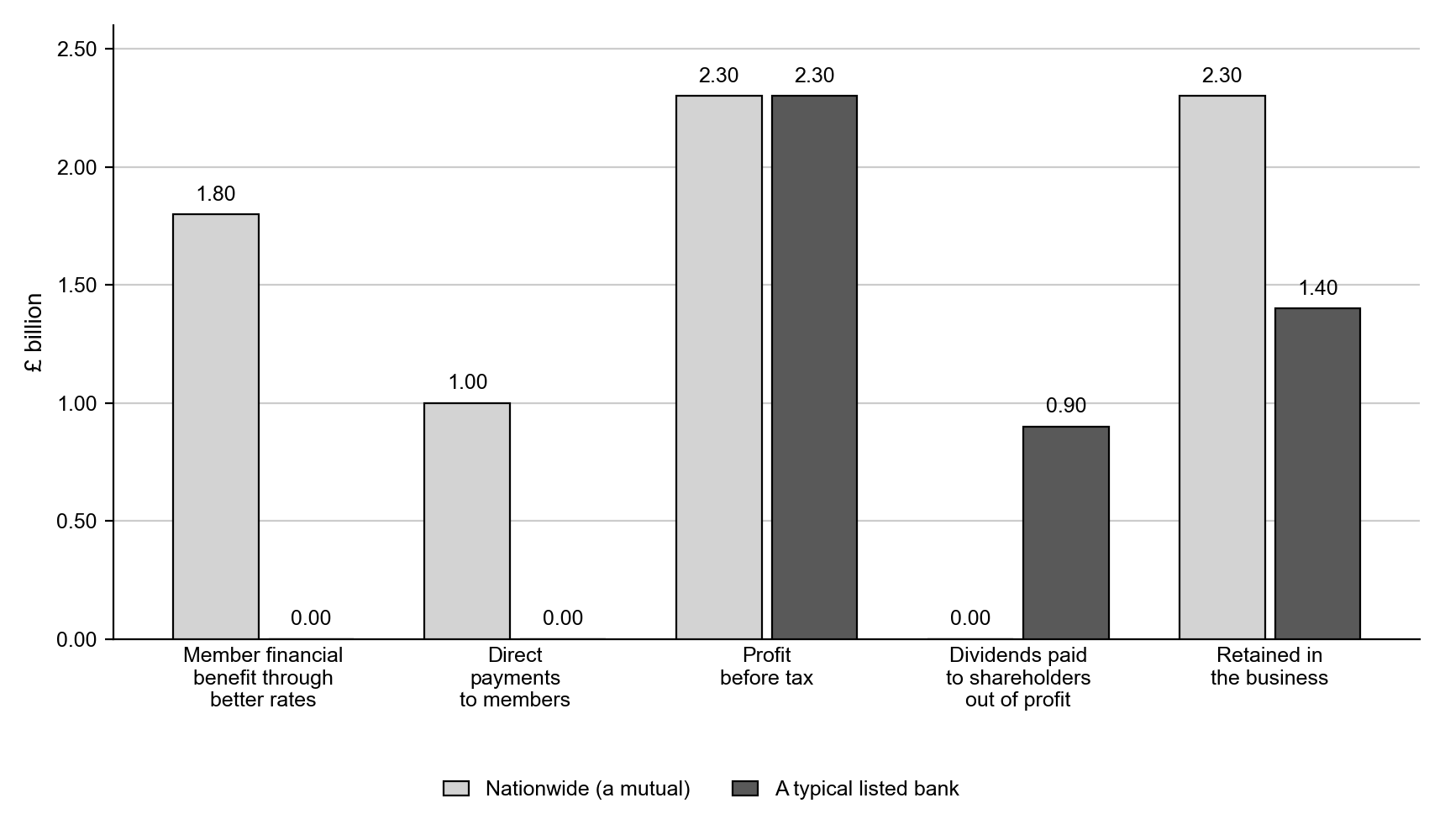
Appendix C: Where the value went, Nationwide and a typical listed bank with the same profit before tax

Bar chart (£ billions, scale 0–2.5) comparing Nationwide with a typical listed bank: member benefit 1.80 versus 0; direct payments 1.00 versus 0; profit before tax 2.30 each; dividends 0 versus 0.90; retained 2.30 versus 1.40.

Source: Analyst

Assess whether Nationwide Building Society's members are better off than the shareholders of a listed bank would be.

2
9 marks

Source B: Fairhurst Linen Ltd

Fairhurst Linen Ltd is a commercial laundry on an industrial estate outside Leeds. It is a private limited company owned by Dev Anand and his sister Rani Anand, and it employs 24 people. It washes, presses and delivers bed linen, towels and table linen for hotels and restaurants across Yorkshire, and it charges by the kilogram.

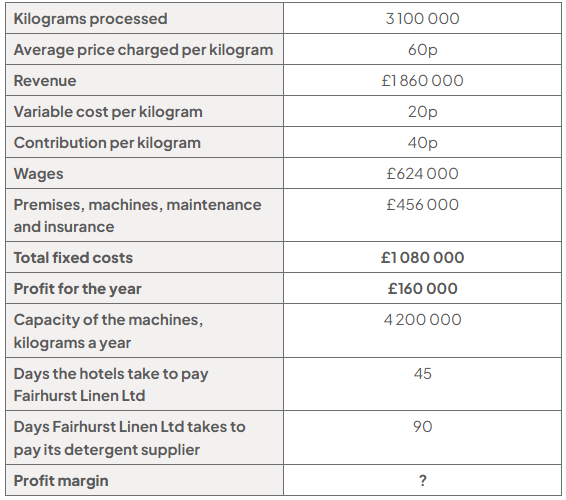
Last year it processed 3.1 million kilograms at an average of 60p a kilogram, which brought in £1 860 000. Detergent, water, energy and packaging cost 20p for every kilogram put through the machines. Everything else is fixed: wages of £624 000 and premises, machines, maintenance and insurance of £456 000, which together come to £1 080 000 a year and are paid whether the machines run or not. Profit for the year was £160 000.

The machines are not full. They could handle 4.2 million kilograms a year, and last year they did 3.1 million. A new tunnel washer costing £320 000 would raise that ceiling further, and Dev Anand has been talking to the bank about it.

The Anands have set themselves an objective: a profit margin of 15% within three years.

Two things stand between them and it. The first is a contract. A hotel group has offered Fairhurst Linen Ltd 900 000 kilograms a year, which would nearly fill the machines, but only at 44p a kilogram. The second is that Fairhurst Linen Ltd pays its detergent supplier, a small chemicals firm in Rotherham, after 90 days, while its own hotel customers pay it after 45.

Appendix D: Fairhurst Linen Ltd, summary of last year

Appendix D summary table: contribution per kilogram is 40p, and the profit margin is left as a question mark; it also consolidates the company’s costs, capacity and payment timings.

Source: Analyst

Assess whether Fairhurst Linen Ltd should pay its detergent supplier sooner than it does.

3
9 marks

Source B: Galliford Try Holdings plc

Galliford Try Holdings plc builds things: schools, hospitals, water treatment works, roads and defence sites. It is a public limited company listed in London and it works almost entirely in the United Kingdom, mostly for public sector clients and regulated utilities. It does not build houses for sale.

Construction is a low-margin business and Galliford Try Holdings plc says so. In the year to 30 June 2025 revenue was £1.9 billion, 6% up on the year before, and the divisional adjusted operating margin was 3.0%. The company had set itself a target of 3.0% and reached it a year earlier than it had planned.

On a job of this size almost nothing is built by Galliford Try Holdings plc's own employees. The work is done by subcontractors: groundworkers, electricians, roofers, most of them small firms. In construction the usual way to hold on to cash is to pay those firms slowly, and the industry has a long record of doing exactly that. In the six months to 31 December 2025 Galliford Try Holdings plc paid its supply chain in an average of 29 days, and it publishes how quickly it pays.

It also holds a great deal of cash. The figure it reports is the average of its cash balance at the end of each month, which was £179 million, up from £155 million. It reports the average rather than the year-end figure because a construction company's cash moves a long way from month to month, and the balance on any single day says very little.

Source: information sourced from Galliford Try Holdings plc results for the year ended 30 June 2025 and the six months ended 31 December 2025

Appendix D: Galliford Try Holdings plc selected results

Table comparing Galliford Try results for years to 30 June 2024 and 2025: revenue £1.79bn and £1.90bn; operating margin 2.6% and 3.0%; average month-end cash £155m and £179m. Percentage cash increase is marked “?”.

Source: Galliford Try Holdings plc

Assess whether paying its subcontractors within 29 days is likely to benefit Galliford Try Holdings plc.

4
9 marks

Source B: Thorne Valley Orchards Ltd

Thorne Valley Orchards Ltd grows apples on 180 acres in Herefordshire and turns them into juice and chutney in a press and kitchen on the same site. It is a private limited company run by Marianne Vance, whose family has farmed the land since 1954, and it employs 26 people, more in the picking season.

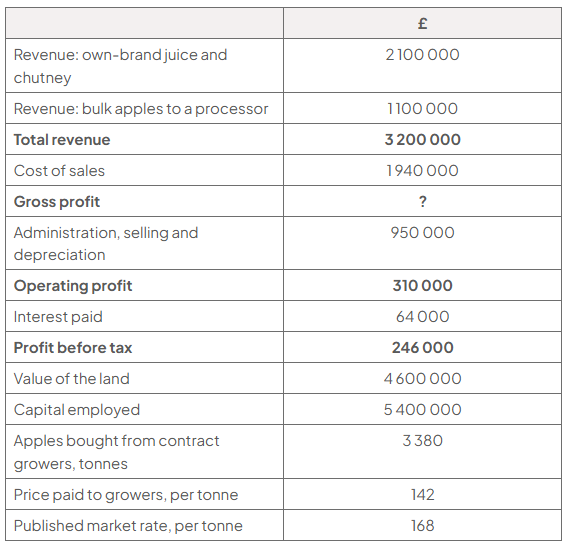
It sells in two ways. Its own-brand juice and chutney go to farm shops, delicatessens and garden centres, and brought in £2.1 million last year. Bulk apples it does not need go to a large juice processor, which brought in £1.1 million. Total revenue was £3.2 million.

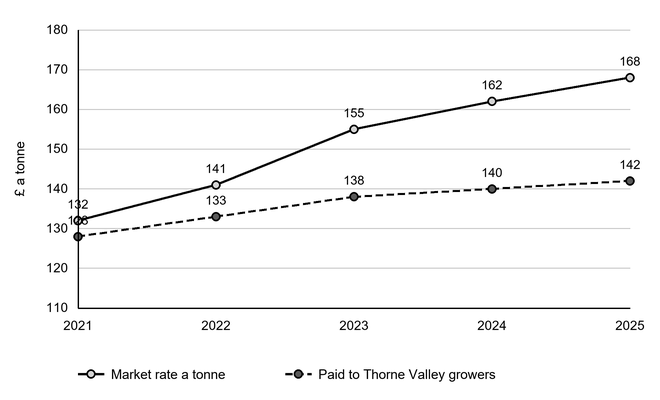
Its own orchards do not produce enough. Thorne Valley Orchards Ltd buys a further 3 380 tonnes of apples a year from fourteen contract growers, all of them small farms within thirty miles. It pays them £142 a tonne. The published market rate last year was £168 a tonne, and Appendix E shows how that gap has widened. The growers accept it because Thorne Valley Orchards Ltd takes the whole crop, pays within fourteen days and has done so for years. Its own customers, the farm shops and delicatessens, take about 45 days to settle.

The land is worth £4.6 million. Together with the buildings, press and kitchen, capital employed is £5.4 million. Against that, operating profit last year was £310 000 and profit before tax, after £64 000 of interest, was £246 000.

Marianne Vance has been offered a contract by a supermarket for 900 000 bottles of own-label juice a year at £1.10 a bottle. Her own brand sells at £2.40. The press currently runs at about 40% of what it could do.

Appendix D: Thorne Valley Orchards Ltd, summary of last year

Appendix D table: revenue £3 200 000 (£2 100 000 own-brand; £1 100 000 bulk), cost of sales £1 940 000, gross profit ?, administration/selling/depreciation £950 000, operating profit £310 000, interest £64 000, profit before tax £246 000; land £4 600 000, capital employed £5 400 000, growers 3 380 tonnes at £142 per tonne versus market £168.

Source: Analyst

Appendix E: What Thorne Valley Orchards Ltd pays its growers, against the market rate

Line chart of £ per tonne paid to growers versus market rate, 2021 to 2025: market rate 132, 141, 155, 162, 168; Thorne Valley paid 128, 133, 138, 140, 142. Gap widens over time.

Source: Analyst

Assess whether Thorne Valley Orchards Ltd should pay its contract growers the published market rate.

Calculate Thorne Valley Orchards Ltd's gross profit to support your answer.

5
9 marks

Source B: Aldergate Landscapes Ltd

Aldergate Landscapes Ltd designs and builds gardens across Cheshire and north Staffordshire. It is a private limited company owned by Joss Aldergate and his wife Ruth, and it employs 19 people alongside regular subcontractors for stonework and electrics.

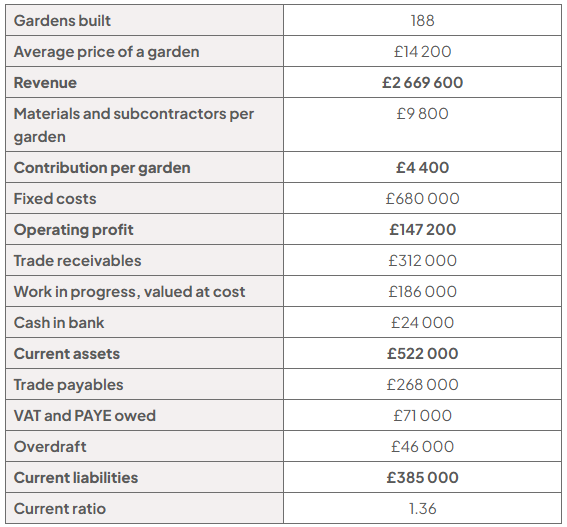
Most of the work is for private clients having a whole garden rebuilt, at an average of £14 200 a garden. The rest is for two housing developers who want the gardens finished before a show home opens. Last year the company built 188 gardens for revenue of £2 669 600. Materials and subcontractors cost £9 800 a garden. Everything else, meaning the yard, the vans, the permanent staff, the designer and the office, cost £680 000.

The work does not arrive evenly. Appendix E shows what comes in each month, and the three months from December to February brought in £214 000 between them, against fixed costs of about £170 000 for the same period.

To manage this, Aldergate Landscapes Ltd asks private clients for a 50% deposit when the design is signed off. The deposit is spent almost immediately, though not usually on that client's garden: it pays for materials on the job already running.

At the year end the company was owed £312 000 by clients and developers, held £186 000 of gardens that were half built and not yet invoiced, and had £24 000 in the bank. Against that it owed £268 000 to suppliers and subcontractors, £71 000 in VAT and PAYE, and was £46 000 into its overdraft.

Appendix D: Aldergate Landscapes Ltd, summary of last year

Appendix D summary table adds: contribution per garden £4,400; operating profit £147,200; current assets £522,000; current liabilities £385,000; current ratio 1.36.

Source: Analyst

Assess whether Aldergate Landscapes Ltd should change how it uses the 50% deposits it takes from private clients.

1
15 marks

Source B: Big Issue Media Ltd

Big Issue Media Limited publishes The Big Issue, a weekly magazine sold on the street by people who are homeless or at risk of becoming homeless. The company was set up in 1991 and is part of a group of 16 companies known as the Big Issue Group. It is a social enterprise: it trades like any other business, but it exists to create work for its vendors rather than to pay outside shareholders.

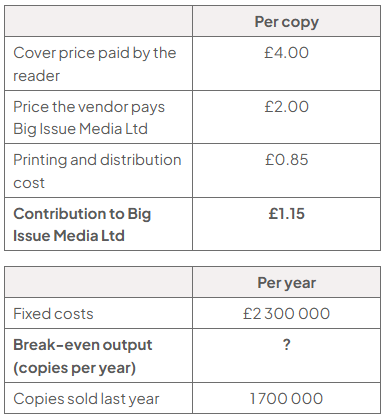
The selling model is unusual. Vendors buy copies of the magazine from Big Issue Media Limited at half the cover price, then sell them at the full price and keep the difference. A vendor is not an employee. What they earn depends entirely on how many copies they sell, so the number of magazines moving through the business is also the number that decides whether a vendor can pay their rent.

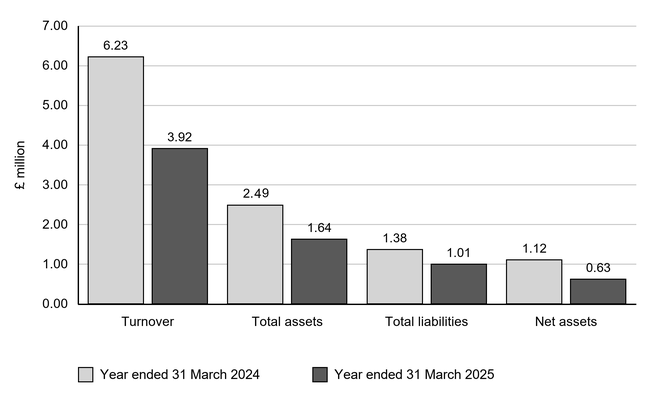
That number has been falling. Fewer people carry cash, fewer people buy print magazines, and the streets are quieter than they were. In the year to 31 March 2025 turnover fell by 37.1% to £3.92 million. The company cut its workforce from 74 people to 56. Cash at the bank fell to £297 000 and net assets fell by 43.6% to £630 000. Appendix D shows how the business changed.

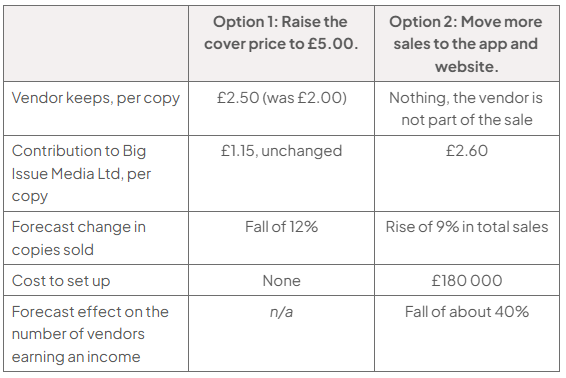
The directors are considering two ways forward. They could raise the cover price, which would give each vendor more money for every copy sold. Or they could push more sales through the Big Issue app and website, which costs less to run but cuts the vendors out of the sale. Appendix F sets out the two options.

Source: information sourced from Companies House, 2026

Appendix D: How Big Issue Media Ltd changed during the year

Grouped bar chart of Big Issue Media Ltd finances in £ million for years ended 31 March 2024 and 2025: turnover 6.23 to 3.92, assets 2.49 to 1.64, liabilities 1.38 to 1.01 and net assets 1.12 to 0.63.

Source: Companies House

Appendix E: Information on the economics of the magazine

Appendix E tables: per copy, cover price £4, vendor pays £2, printing and distribution costs £0.85, contribution £1.15; per year, fixed costs £2.3 million, break-even output unknown, copies sold 1.7 million.

Source: Analyst

Appendix F: Data for two ways forward

Table comparing two options: raise cover price to £5 or shift sales to the app and website. Raising price: vendor £2.50 per copy, contribution £1.15, copies fall 12%, no set-up cost, vendor impact n/a; digital: vendor £0, contribution £2.60, sales rise 9%, £180 000 set-up, earning vendors fall about 40%.

Source: Analyst

Appendix F shows two ways forward for Big Issue Media Ltd.

Evaluate both options and recommend which one would be the better way forward for Big Issue Media Ltd.

2
15 marks

Source A: Nationwide Building Society

Nationwide is the world's largest building society and the second largest mortgage lender in the United Kingdom. It is a mutual, which means it has no shareholders. It is owned by its members, who are the people who bank, save or hold a mortgage with it, and in principle every member is an owner. Nobody outside the membership has a claim on its profit.

That changes what profit is for. A listed bank divides its profit between dividends to shareholders and money kept in the business. Nationwide has no shareholders to pay, so it keeps almost all of its profit in the business to build its financial strength, and gives value to members in two other ways. The first is pricing, through better savings rates and lower mortgage rates. In the year to 31 March 2025 it put this at £1 795 million of member financial benefit, which is its estimate of how much better off its members were than they would have been with a typical high street bank. The second is direct payments: £1 000 million paid to eligible members through the Fairer Share Payment and a one-off reward called The Big Nationwide Thank You. Both reach members before profit is calculated, so neither is paid out of profit.

The year was a large one. On 1 October 2024 Nationwide completed the acquisition of Virgin Money, a bank with its own customers, brand and business lending arm. Statutory profit before tax rose to £2 302 million from £1 776 million, even after the direct payments to members. The rise was mainly due to a one-off accounting gain of £2.3 billion on buying Virgin Money, which arose because the assets acquired were valued at more than the £2.8 billion price. Underlying profit before tax, which leaves out one-off items and the direct payments, fell to £1 852 million from £2 003 million, which the society put down to its decision to pay members better rates. Total underlying income reached £5.2 billion, and Pay.UK switching data for the nine months to December 2024 showed more current account switchers moving to Nationwide than to any other brand.

Buying a bank is an unusual thing for a mutual to do. Virgin Money's customers did not choose a mutual, and integrating it will take years and a great deal of money. Every pound spent on that integration is a pound not returned to members this year, which is the tension the society is now living with.

Source: information sourced from Nationwide Building Society preliminary results for the year ended 31 March 2025

Appendix A: Nationwide Building Society selected results

Table comparing Nationwide results for 2024 and 2025: underlying income £4,664m/£5,211m; underlying profit £2,003m/£1,852m; one-off items £117m/£1,450m; member payments £344m/£1,000m; statutory profit £1,776m/£2,302m; member benefit £1,850m/£1,795m; no external shareholders.

Source: Nationwide Building Society

Appendix B: What being a mutual means

Table comparing a mutual building society with a listed bank: members own the former and receive profit through better rates, lower charges and direct payments; shareholders own the latter and receive dividends and rising share price. Outsiders cannot invest in a mutual but can buy bank shares.

Source: Analyst

Appendix C: Where the value went, Nationwide and a typical listed bank with the same profit before tax

Bar chart (£ billions, scale 0–2.5) comparing Nationwide with a typical listed bank: member benefit 1.80 versus 0; direct payments 1.00 versus 0; profit before tax 2.30 each; dividends 0 versus 0.90; retained 2.30 versus 1.40.

Source: Analyst

Nationwide Building Society gave members £1 795 million of member financial benefit and £1 000 million of direct payments, and is spending heavily on integrating Virgin Money.

Evaluate whether Nationwide Building Society should return more of its profit to members now or keep more of it in the business.

3
15 marks

Source B: Kettleby Plant Hire Ltd

Kettleby Plant Hire Ltd hires excavators, dumpers and telehandlers to builders across the East Midlands. It is a private limited company owned by Sean Kettleby and it employs 22 people, including four fitters who service the machines and two drivers who deliver them.

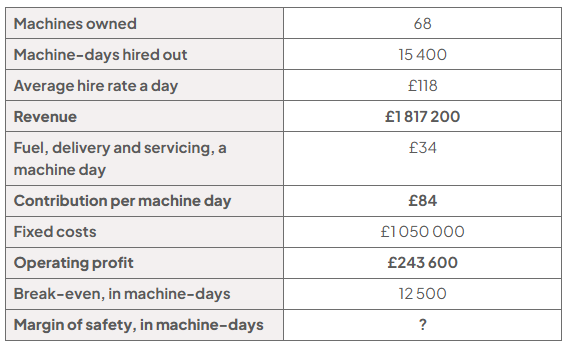
It owns 68 machines. Last year they were out on hire for 15 400 machine-days in total, at an average of £118 a day, which is revenue of £1 817 200. Fuel, delivery and servicing cost £34 for every day a machine is out. Everything else costs £1 050 000 a year and is paid whether the machines are out or standing in the yard.

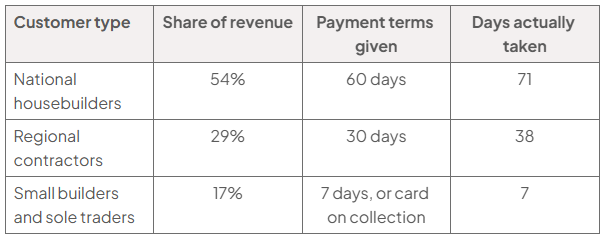
Its customers are not alike. National housebuilders take more than half the revenue and are given sixty days to pay, which in practice becomes seventy-one. Small builders and sole traders are given seven days, or asked for a card when they collect. Sean Kettleby set it up that way and is candid about why: the housebuilders would go elsewhere if he pushed them, and the sole traders would not.

The machines are wearing out. Three excavators need replacing this year at £74 000 each. Sean Kettleby can buy them, which is what he has always done, or he can hire them in from a larger national firm when a customer needs one and hand the margin over. The bank has offered him a five-year loan for the £222 000, and he has enough in the company to pay cash if he chooses to.

Appendix D: Kettleby Plant Hire Ltd, summary of last year

Appendix D table: 68 machines; 15,400 machine-days hired at £118 per day; revenue £1,817,200; costs £34 and contribution £84 per machine-day; fixed costs £1,050,000; operating profit £243,600; break-even 12,500 machine-days; margin of safety: ?.

Source: Analyst

Appendix E: Kettleby Plant Hire Ltd, who pays and when

Table: national housebuilders account for 54% of revenue and receive 60 days, taking 71; regional contractors 29%, 30 days, taking 38; small builders and sole traders 17%, 7 days or card on collection, taking 7.

Source: Analyst

Appendix E shows the payment terms Kettleby Plant Hire Ltd gives each type of customer.

Evaluate whether Kettleby Plant Hire Ltd should give every customer the same payment terms or keep the terms it has.