Forms of Employment (AQA A Level Business): Revision Note
Syllabus Edition
First teaching 2026
First exams 2028
Exam code: 7132

Full-time employment
A full-time contract of employment requires an employee to work the total number of hours considered by the company to be full-time in a week
In the UK this is usually 35 hours or more per week
Advantages and disadvantages of full-time employment contracts
For the employer
Advantages |
|
|---|---|
Disadvantages |
|
For the employee
Advantages |
|
|---|---|
Disadvantages |
|
Part-time employment
Employees who work part-time may only work two or three days a week
Part-time employment may be more flexible and can be adjusted subject to employee availability and employer requirements
Part-time employees at IKEA UK work between 8 and 30 hours per week
Advantages and disadvantages of part-time employment contracts
For the employer
Advantages |
|
|---|---|
Disadvantages |
|
For the employee
Advantages |
|
|---|---|
Disadvantages |
|
Permanent vs temporary employment
What is permanent employment?
Permanent employment is a contract with no fixed end date
The employee continues in their role until they choose to leave or are dismissed
Advantages and disadvantages of permanent employment contracts
For the employer
Advantages |
|
|---|---|
Disadvantages |
|
For the employee
Advantages |
|
|---|---|
Disadvantages |
|
What is temporary employment?
Temporary employment is a contract with a defined end date
The employee is hired for a specific period, project or season
Advantages and disadvantages of temporary employment contracts
For the employer
Advantages |
|
|---|---|
Disadvantages |
|
For the employee
Advantages |
|
|---|---|
Disadvantages |
|
Zero-hours employment
A zero-hours contract is an arrangement where an employee agrees to be available for work as and when the business requires, with no guaranteed minimum number of hours
The employer is not obliged to offer any hours, and the employee is not required to accept any hours offered
UK employers cannot offer zero-hours contracts that prevent employees from also working for other employers
Advantages and disadvantages of zero-hours employment contracts
For the employer
Advantages |
|
|---|---|
Disadvantages |
|
For the employee
Advantages |
|
|---|---|
Disadvantages |
|
Example
Sports Direct faced significant trade union and media criticism for its widespread use of zero-hours contracts
Critics argued this gave the business excessive power over its workforce whilst offering workers very little security
Freelance employment
Freelance workers (also called the self-employed) work for themselves rather than for a single employer
They take on work from multiple clients and manage their own tax affairs and working arrangements
Freelancers are concentrated in the tertiary (service) sector
Common examples include graphic designers, photographers and marketing consultants
Advantages and disadvantages of freelancing
For the business
Advantages |
|
|---|---|
Disadvantages |
|
For the freelancer
Advantages |
|
|---|---|
Disadvantages |
|
Flexible employment
Flexible working refers to arrangements that give employees a degree of choice over when, where or how they work
Examples of flexible employment
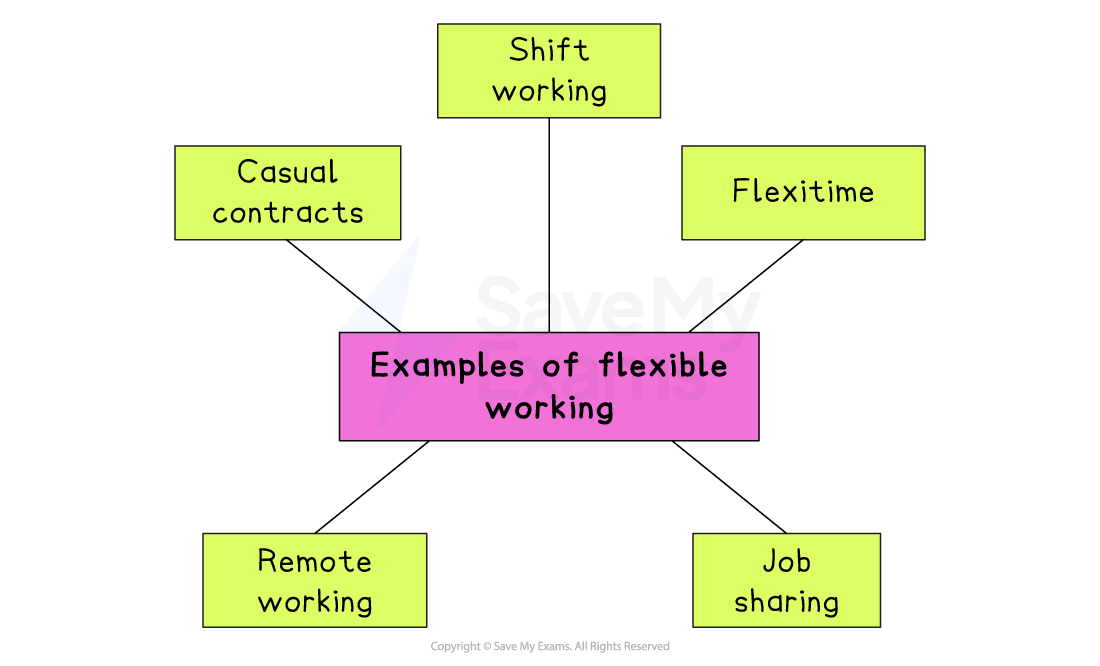
Casual contracts
An employee on a casual contract works whenever the business needs them, often on a seasonal or short-term basis
E.g. ski instructors are hired to work for two months during the winter season at the Alpen Resort and Spa in the Swiss Alps
Advantages and disadvantages of casual contracts
For the employer
Advantages |
|
|---|---|
Disadvantages |
|
For the employee
Advantages |
|
|---|---|
Disadvantages |
|
Shift working
Shift work involves working different hours at different times, usually on a rota system
It typically refers to working outside the standard Monday-to-Friday working week
Around 14% of the UK workforce are shift workers
E.g. warehouse employees at Gist UK work early shifts to ensure deliveries are dispatched on time
Advantages and disadvantages of shift working
For the employer
Advantages |
|
|---|---|
Disadvantages |
|
For the employee
Advantages |
|
|---|---|
Disadvantages |
|
Flexitime
Flexitime allows employees to choose when they work, outside of a set period of core hours when all staff must be present
E.g. a flexitime employee at Birmingham City University who is required to be at work between 10am and 2pm can choose to start earlier and finish at 3pm to manage the school run, rather than working the standard 9am to 5pm
Advantages and disadvantages of flexitime
For the employer
Advantages |
|
|---|---|
Disadvantages |
|
For the employee
Advantages |
|
|---|---|
Disadvantages |
|
Working remotely
Advances in technology have enabled far more workers to work from home than was previously possible
Employees use tools such as email, video conferencing, collaborative software and instant messaging to carry out work remotely
E.g. Save My Exams employees work remotely, using online scheduling and communication tools to stay in touch with colleagues
Around 40% of UK workers now have some ability to work from home, following a significant increase during the Covid-19 pandemic
Mobile working allows employees to work from any location using portable technology and mobile data connections
Fast mobile networks mean employees can work productively whilst travelling, in client offices or in public spaces
Some train companies provide free wi-fi and charging points on long-distance services, enabling passengers to work during their journey
Advantages and disadvantages of working remotely
For the employer
Advantages |
|
|---|---|
Disadvantages |
|
For the employee
Advantages |
|
|---|---|
Disadvantages |
|
Job sharing
Job sharing is where two or more employees share a single full-time role between them, with pay, benefits and leave allocated proportionally
It allows employees to maintain a senior or specialist position whilst working part-time hours
Advantages and disadvantages of job sharing
For the employer
Advantages |
|
|---|---|
Disadvantages |
|
For the employee
Advantages |
|
|---|---|
Disadvantages |
|
Examiner Tips and Tricks
You do not need detailed legal knowledge of employment contracts. Focus on being able to weigh up the advantages and disadvantages of each form of employment for both the employer and the employee – and always consider the specific circumstances of the business when deciding which form is most appropriate

Unlock more, it's free!
Join the 100,000+ Students that ❤️ Save My Exams
the (exam) results speak for themselves:

Was this revision note helpful?
