Distribution (Place) (AQA A Level Business): Revision Note
Syllabus Edition
First teaching 2026
First exams 2028
Exam code: 7132

Introduction to place
In the marketing mix, place refers to how a product gets from the producer to the final customer
Also known as distribution, place is about making the product available in the right location, at the right time and in the right quantity to meet customer needs
Place decisions matter because a product can be perfectly designed, competitively priced and heavily promoted, but if customers cannot easily access it, sales will still suffer
Convenience and accessibility are critical factors in the purchase decision
Like all elements of the marketing mix, place must be consistent with the overall positioning of the product
A premium product should be distributed through select, high-end outlets that reinforce its exclusivity
A mass-market product requires wide distribution to maximise the number of customers who can access it
A product targeting a young, digitally active audience should be available online as a priority
Place decisions also affect costs
Wider distribution typically costs more, and the choice of distribution channel directly impacts profit margins
The value of distribution channels
A distribution channel is the route a product takes from producer to final customer
It may be direct (producer sells straight to the customer) or indirect (involving one or more intermediaries such as wholesalers or retailers)
Distribution channels create two important types of utility
Place utility
Making products available where customers want to buy them (a nearby shop, an online store, a specialist outlet)
Time utility
Making products available when customers want them (a 24-hour website, a convenience store open late)
Why effective distribution channels are important
Effective distribution channels add value to both the business and the customer
For the business
Channels of distribution extend reach beyond what the business could achieve through its own sales efforts alone
They reduce the cost of reaching large numbers of customers
They allow the business to focus on production while intermediaries handle selling
For the customer
Distribution channels make it more convenient to find and purchase products
Intermediaries such as retailers often provide additional services, including product advice, after-sales support and easy returns
A well-chosen distribution channel can also be a genuine source of competitive advantage
If customers can access a product more easily than a rival's, they are more likely to buy it
Examiner Tips and Tricks
The choice of distribution channel is not just a logistical decision - it directly affects brand image, profit margins and the customer experience. Always consider how place decisions interact with the rest of the marketing mix
Direct distribution
Direct distribution means the producer sells its products straight to the final customer, without using any intermediaries
Examples include factory outlets, the business's own website, direct sales representatives and market stalls
Advantages and disadvantages of direct distribution
Advantages | Disadvantages |
|---|---|
|
|
E-commerce
E-commerce involves selling online through a business's own website or app
It is the most significant and fastest-growing form of direct distribution in modern marketing
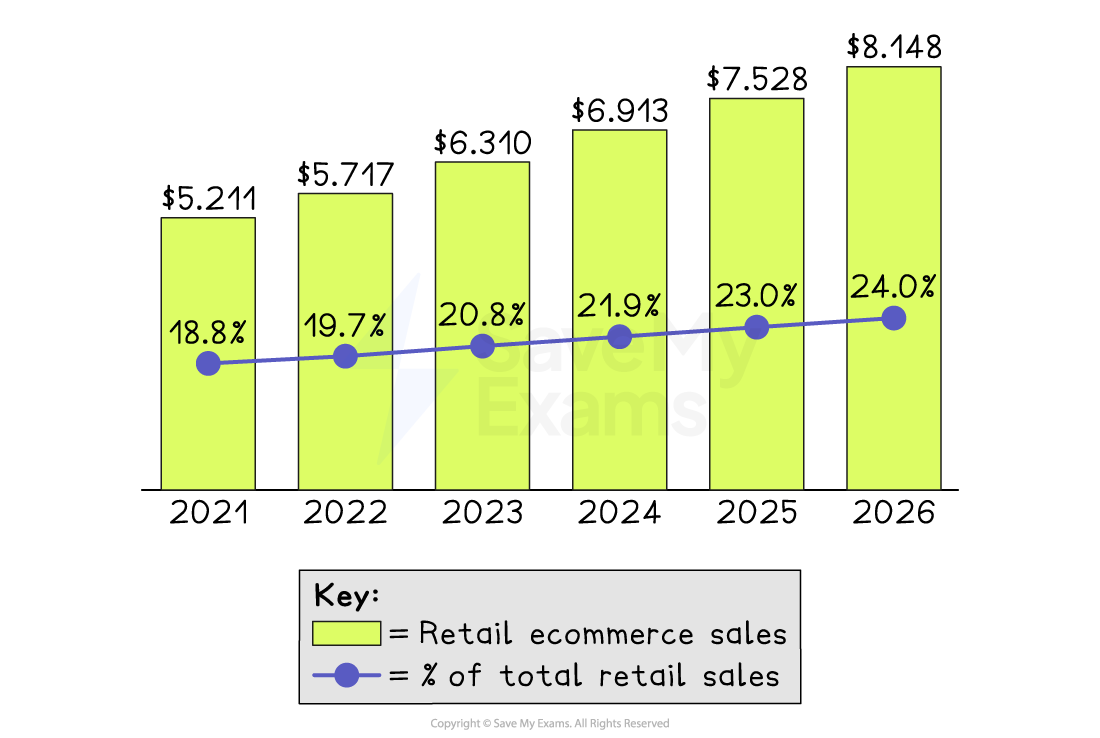
Retail e-commerce sales worldwide 2021-2026
Advantages and disadvantages of e-commerce
Advantages | Disadvantages |
|---|---|
|
|
Case Study
Hazel & Grey

Hazel & Grey is a homeware and candle brand that spent its first five years selling through independent gift shops and a regional department store chain. While this gave the brand good visibility, profit margins were small as retailers demanded significant discounts. The brand also had no direct contact with its customers and no control over how products were displayed or priced in-store.
When the department store chain reduced its gift range, Hazel & Grey lost its largest retail account almost overnight. Rather than seek new retail partners, the business decided to move entirely to e-commerce, selling exclusively through its own website.
The transition brought immediate benefits: profit margins improved significantly, the brand could control its own presentation, and customer data – previously invisible – began flowing directly to the business.
However, the move also created new pressures. Without retailers driving footfall, Hazel & Grey had to invest heavily in social media advertising and SEO to attract traffic to its site, adding costs it had not previously faced
Examiner Tips and Tricks
E-commerce has transformed direct distribution, making it accessible to businesses of all sizes. However, the advantages only materialise if the business can drive sufficient traffic to its website - a beautifully built online store with no visitors generates no sales
The use of intermediaries
Intermediaries are businesses that operate between the producer and the final customer
The two main types are wholesalers and retailers
Wholesalers | Retailers |
|---|---|
|
|
Benefits of using intermediaries
Greater reach
Retailers have established locations and loyal customer bases, giving the producer access to far more customers than it could reach alone
Reduced distribution burden
Intermediaries handle storage, transport and sales, freeing the producer to focus on manufacturing
Wholesalers provide large, predictable orders
Buying in bulk gives producers reliable revenue and simplifies logistics significantly
Retailers provide display space and sales support
This reduces the producer's need to invest in its own retail infrastructure and sales staff
Established customer trust
Well-known retailers lend credibility to the products they stock, reassuring customers about quality and reliability
Disadvantages of using intermediaries
Loss of control
The producer has limited influence over how the product is displayed, priced, or presented to customers
Reduced profit margins
Each intermediary takes a share of revenue, reducing the producer's profit per unit sold
Distance from the customer
The producer loses direct contact with the end customer, making it harder to gather feedback and respond to changing needs
Dependence on intermediary priorities
A retailer may choose to promote a competitor's product more prominently or reduce shelf space for the producer's product at any time
Wholesaler risk
Products may sit in wholesale storage for extended periods, risking damage or obsolescence, with the producer having little visibility or control
Examiner Tips and Tricks
Using intermediaries involves a trade-off between reach and control. For many businesses - particularly smaller ones without the resources to manage their own distribution - intermediaries are essential. But the loss of control over brand presentation and pricing can be a significant drawback, especially for premium products
Multi-channel distribution
Multi‑channel distribution means making a product available to customers through two or more different channels at the same time
For example, physical stores, a branded website, online marketplaces and mobile apps
Reasons for the growth of multi-channel distribution
The rise of e‑commerce and smartphones
Shoppers now expect to browse and buy anywhere, anytime
E.g. Zara allows customers to order via app, website or in-store
Click and collect popularity
Combining online ordering with store pickup saves delivery fees and brings footfall into shops
E.g. Argos reports most web orders are collected in‑store within hours
Need for seamless customer experience
Firms link channels so baskets, loyalty points and returns work everywhere
E.g. John Lewis & Partners integrates its website, app and department stores under one account
Competitive pressure
Rivals offering more choice encourage others to follow
E.g. grocery chains such as Sainsbury’s added rapid‑delivery apps after Deliveroo gained market share
Falling technology costs
Cloud platforms and third‑party fulfilment companies, such as Evri, make it affordable even for smaller brands
E.g. soft drinks manufacturer Innocent sells direct via Shopify as well as in supermarkets and other retailers
Advantages and disadvantages of multichannel distribution
Aspect | Advantages | Disadvantages |
|---|---|---|
Customer reach |
|
|
Convenience and loyalty |
|
|
Resilience |
|
|
Data collection |
|
|
Revenue opportunities |
|
|

Unlock more, it's free!
Join the 100,000+ Students that ❤️ Save My Exams
the (exam) results speak for themselves:

Was this revision note helpful?