Gaining, Maintaining & Losing Competitiveness (AQA A Level Business): Revision Note
Syllabus Edition
First teaching 2026
First exams 2028
Exam code: 7132

Written by: Lisa Eades
Updated on
Competitive advantage
A competitive advantage is an attribute, or combination of attributes, that allows a business to consistently outperform its rivals by offering customers greater value than they can match
A genuine competitive advantage tends to be difficult, slow or costly for rivals to imitate
It is usually achieved through one of two broad routes (see Porter's generic strategies)
Cost advantage
Achieved through economies of scale, highly efficient operations or access to cheaper suppliers or resources, allowing lower prices without sacrificing profit
Differentiation advantage
Achieved through unique product features, a strong brand, superior customer service or protected technology that rivals cannot easily copy
Competitive advantage explains why some businesses consistently outperform their rivals
Example
Amazon's competitive advantage rests heavily on its enormous logistics and fulfilment network, built up over two decades
This allows delivery speeds that smaller rivals struggle to match even if they wanted to copy the model
Strategic drift and other pressures explain why this advantage can be eroded or lost
Example
Debenhams used to be one of the UK's leading department stores, but over the 2010s it slowly lost ground as more shoppers moved online and cheaper rivals took its customers
Rather than making big changes to keep up, Debenhams only made small adjustments, and the pressure of high store costs kept building
This mix of slow decisions and external pressure eventually led to the company collapsing in 2021
Understanding how competitiveness is gained, and why it is often so difficult to sustain, helps a business plan for the long term rather than assuming past successes will continue automatically
Reasons for losing competitiveness
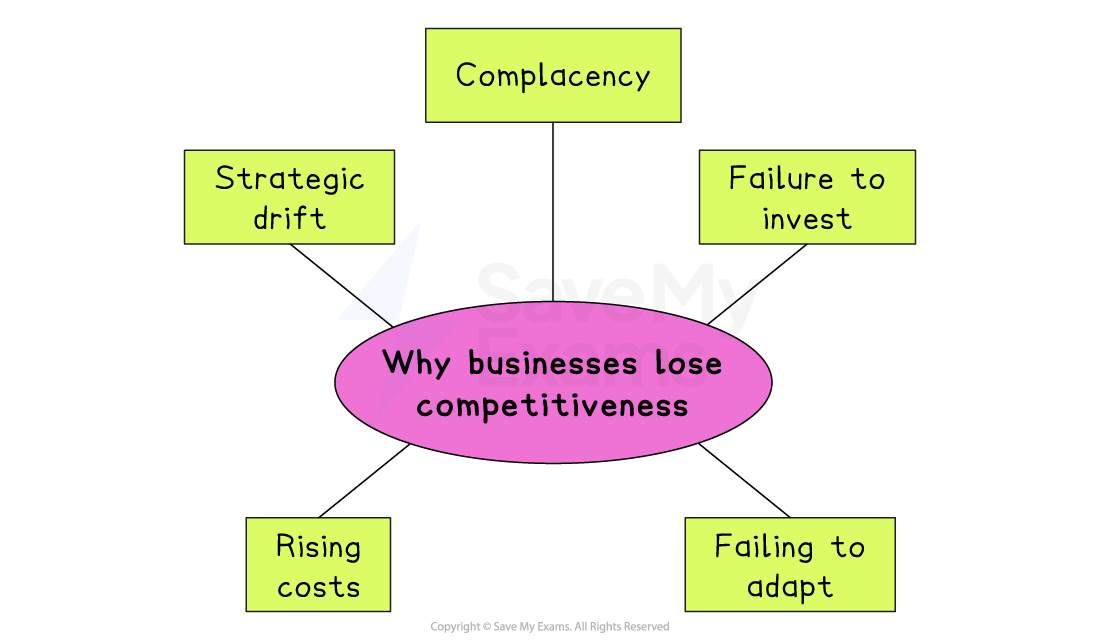
Strategic drift
Strategic drift is a gradual, often unnoticed, mismatch between a business's strategy and its changing external environment
It is caused by making small, incremental adjustments to an existing strategy rather than fundamentally rethinking it when the market changes
Example
Blockbuster's strategy of relying on physical video and DVD rental stores drifted further from customer expectations as digital streaming emerged
The company turned down the chance to buy Netflix for $50 million in 2000, and its responses proved far too slow once streaming took over the market
Complacency
A business that has been successful for a long period may stop innovating or investing, assuming its position is secure
This allows rivals to catch up or overtake it
Example
In the 1970s, a Xerox research lab invented new technology, including the computer mouse and the first graphical computer screens we still use today
However, Xerox's bosses were too focused on their photocopier business and did not think this new technology mattered
Because Xerox never turned its own inventions into products, other companies, like Apple, used these same ideas to build huge success
Failure to invest in new technology or capabilities
Competitors who adopt more efficient processes, or launch innovative new products, can leave a business behind if it does not keep pace
Example
BlackBerry dominated the smartphone market in the mid-2000s through its physical keyboard and secure email system, but was slow to invest in touchscreen technology
As Apple and Android devices rapidly improved, BlackBerry's failure to keep pace saw its global market share collapse within a few years
Rising costs relative to competitors
If a business's costs rise faster than its rivals', for example through wage inflation or raw material costs, without matching productivity gains, its cost advantage can be eroded
Example
Thomas Cook struggled to compete as it continued to have to meet the high costs of maintaining hundreds of high street travel shops, while its rivals increasingly operated online with much lower overheads
These rising costs were a key factor in the company's collapse in 2019
Failing to adapt to changing customer needs
A business that does not change its product offer as customer expectations change gradually becomes less relevant to its target market
Example
Toys "R" Us failed to invest enough in online retail as shopping habits changed, leaving it unable to compete on price or convenience with online retailers such as Amazon
Difficulties of maintaining competitiveness
Sustaining a competitive advantage indefinitely is difficult, for several reasons
Difficulty | Explanation | Example |
|---|---|---|
Rivals can imitate successful strategies |
|
|
Continual external change |
|
|
Success can cause internal resistance to change |
|
|
Balancing short-term and long-term pressures |
|
|
Even a long-established competitive advantage can be difficult to maintain if internal standards slip
E.g. Boeing's dominant position against rival Airbus was seriously undermined by a series of quality and safety issues, including a series of 737 MAX crashes
Case Study
Redwood Office Supplies

Redwood Office Supplies is a regional retailer that built a strong competitive advantage over several decades by offering bulk-buying discounts and knowledgeable, in-person advice to small local businesses ordering stationery and office equipment.
For years this cost and service-based advantage went unchallenged until online retailers, particularly large platforms such as Amazon Business, began offering lower prices and next-day delivery.
Redwood responded modestly, adding a small loyalty discount and a basic website, rather than rethinking its business model.
Over several years, this mismatch between Redwood's strategy and its changing market became a clear strategic drift, and its market share fell sharply as customers switched to cheaper, more convenient online alternatives.
By the time management recognised the scale of the problem, competing head-on with established online rivals on price and speed was extremely difficult, since Redwood lacked the logistics infrastructure larger competitors had built up over many years.
It responded instead by focusing on same-day local delivery for its remaining business customers, a service larger rivals could not easily replicate. This stabilised the business, though at a smaller scale than before.
Examiner Tips and Tricks
When a business in the exam's case study loses market share, always check whether the cause looks like sudden competitor action or a slower pattern of strategic drift.

Unlock more, it's free!
Join the 100,000+ Students that ❤️ Save My Exams
the (exam) results speak for themselves:

Was this revision note helpful?