The Target Market (AQA A Level Business): Revision Note
Syllabus Edition
First teaching 2026
First exams 2028
Exam code: 7132

Choosing a target market
A target market is the specific group of customers a business decides to focus its products or services on
Rather than trying to appeal to everyone, businesses identify which group of people they can best serve, most profitably
Once the wider market has been segmented (divided into groups by demographics, geography, psychographics, or behaviour), a business must decide which segment(s) to target and how to enter that market
Influences on choosing a target market
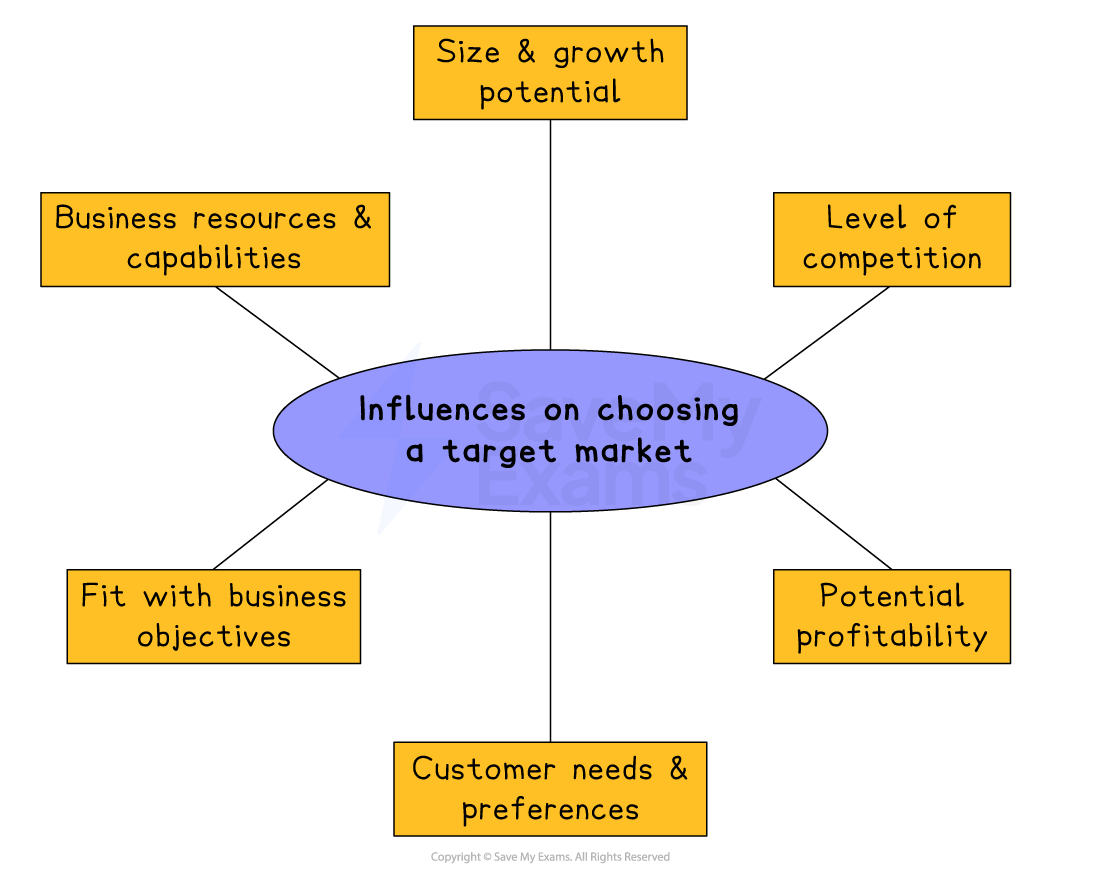
Size and growth potential
A larger market offers more potential customers and higher revenue
A growing market suggests future opportunities but can also attract more competitors
Some businesses deliberately choose a smaller niche to avoid intense competition
Level of competition
A market with few competitors may be easier to enter and establish a presence in
Highly competitive markets make it harder to win customers and maintain profit margins
Businesses assess whether they can differentiate themselves enough to compete effectively
Business resources and capabilities
The business must have the skills, technology and finance needed to serve the target market well
A smaller business with limited funds may target a specialist market where costs are lower
Entering a large, competitive market often requires significant investment in production, distribution and marketing
Potential profitability
The target market must offer a realistic prospect of profit
This depends on;
The price customers will pay
The likely volume of sales
The cost of reaching and serving those customers
Fit with business objectives
The chosen market must align with the business's wider aims
For example, a business committed to sustainability may target environmentally conscious consumers
A business pursuing rapid growth may prioritise large, fast-growing markets over more profitable but slower ones
Customer needs and preferences
The business must be confident it can meet customer needs better than its rivals
Understanding what customers value most is essential to making the right choice
Is it price, quality, convenience or brand image - or a combination?
Influences on entering a target market
Deciding which market to target and actually getting into that market are two different challenges
Influence | Explanation |
|---|---|
Barriers to entry |
|
Cost and financial risk |
|
Time required to establish |
|
Access to suppliers and distributors |
|
Examiner Tips and Tricks
When assessing whether a business should enter a particular target market, always link your answer to the specific business in the case study. The 'right' market depends on the firm's size, financial resources, existing strengths, and objectives - there is no one-size-fits-all answer
The marketing mix and target market
The marketing mix - often called the 4Ps - covers four key decisions;
Product
Price
Place
Promotion
Once a business has chosen its target market, it must design its marketing mix around the needs and characteristics of that market
Every element of the marketing mix must be appropriate for the target market
A mismatch between any element and the target customer will undermine the marketing strategy
Product | Price |
|---|---|
The product must be designed or adapted to meet the specific needs and preferences of the target market
| The pricing strategy must reflect what the target market is willing and able to pay
|
Place (Distribution) | Promotion |
The distribution channels chosen must allow the product to reach the target market efficiently and conveniently
| The promotional strategy must reach the target market through the right channels and communicate the right messages
|
Why consistency matters
All four elements of the marketing mix must work together coherently, and all must be suited to the target market
A mismatch between any element creates confusion and undermines the brand
A premium product priced at a luxury level must be sold in upmarket outlets and promoted through aspirational channels; otherwise, customers lose confidence in the brand
A budget product sold through exclusive boutiques at a high price will confuse its intended target market and fail to attract the right customers
Case Study
Gymshark
Founded in 2012 by 19-year-old Ben Francis in Solihull, Gymshark targets young fitness enthusiasts aged 16–30 who want gym wear that combines performance with style
Every element of its marketing mix is built around this customer
The product is functional but stylish, with moisture-wicking fabrics, a strong aesthetic, and body-positive sizing that resonates with its socially aware audience
New collections are released as timed "drops," creating urgency and excitement, a tactic copied from streetwear brands that Gymshark's young target market already responds to
Pricing is accessible premium (£20–£60) - affordable for students and young adults, yet aspirational enough to feel like a genuine brand choice rather than a budget compromise
Distribution is almost entirely direct-to-consumer through gymshark.com, reflecting the fact that its target market shops online as a default
Occasional pop-up events at fitness events reinforce community without requiring a costly high-street presence
Promotion runs almost exclusively through social media and a network of fitness influencers on Instagram, TikTok, and YouTube; these channels are what its target market trusts far more than traditional advertising
With every decision driven by the same target customer, Gymshark has grown from a garage business to a £1 billion brand (Forbes, 2020)
Examiner Tips and Tricks
In evaluation questions, consider whether a business's marketing mix is internally consistent as well as appropriate for the target market. Real-world marketing failures often come down to a mismatch - for example, a luxury price point combined with discount retail distribution. This is a strong evaluative point that goes beyond simply listing the 4Ps

Unlock more, it's free!
Join the 100,000+ Students that ❤️ Save My Exams
the (exam) results speak for themselves:

Was this revision note helpful?
