Ethics in HR (AQA A Level Business): Revision Note
Syllabus Edition
First teaching 2026
First exams 2028
Exam code: 7132

Codes of conduct
A code of conduct is a formal document that sets out the standards of behaviour expected of all employees within an organisation
Purpose and value of a code of conduct
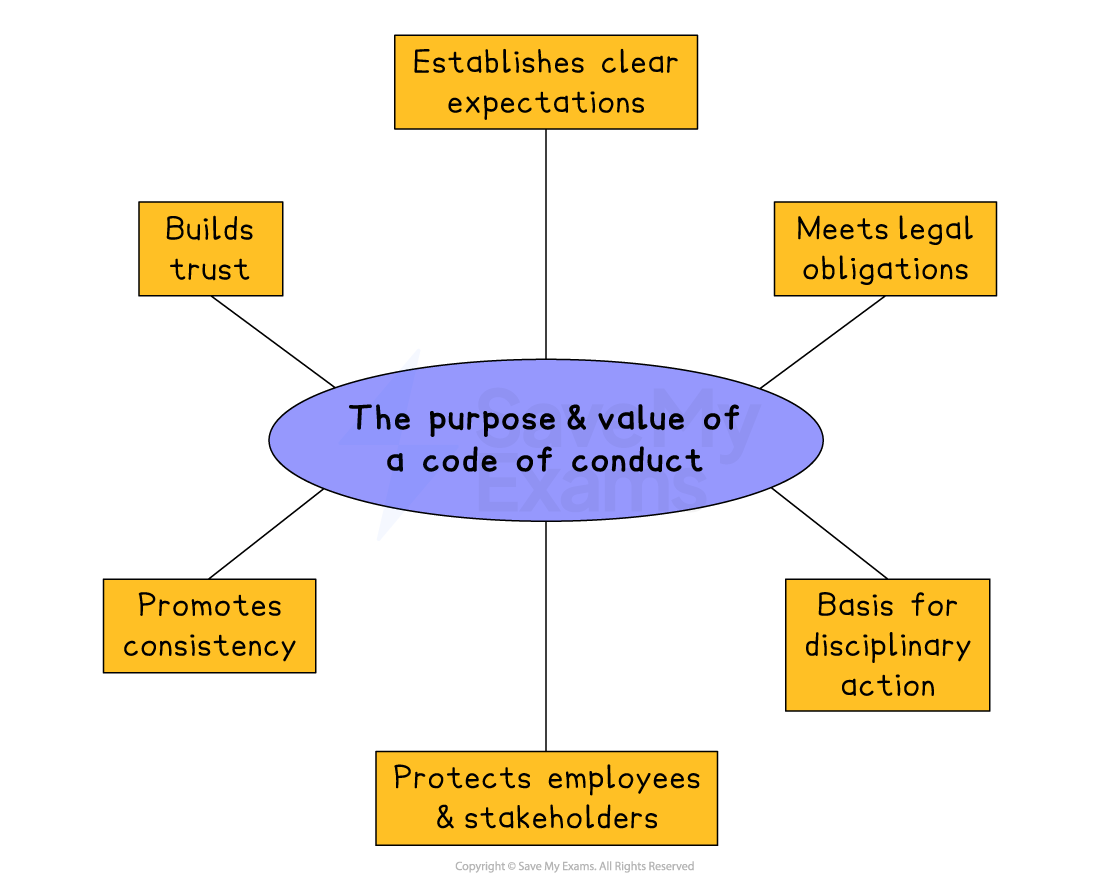
A code of conduct sets out clear expectations
Employees understand what is and is not acceptable behaviour in the workplace
This reduces confusion and the risk of misconduct
It protects employees and stakeholders
By defining standards of professional behaviour, a code of conduct helps create a safe, respectful environment for everyone
It provides a basis for disciplinary action
If an employee breaks the code, the business has a clear standard against which behaviour can be measured
It builds trust with employees, customers and investors
A business with a visible, credible code of conduct shows that it takes ethical standards seriously
Meets legal obligations
A well-designed code of conduct helps ensure the business meets its obligations under employment law, data protection regulations and health and safety legislation
It improves consistency
All employees are held to the same standards regardless of seniority
This reduces the risk of favouritism or double standards
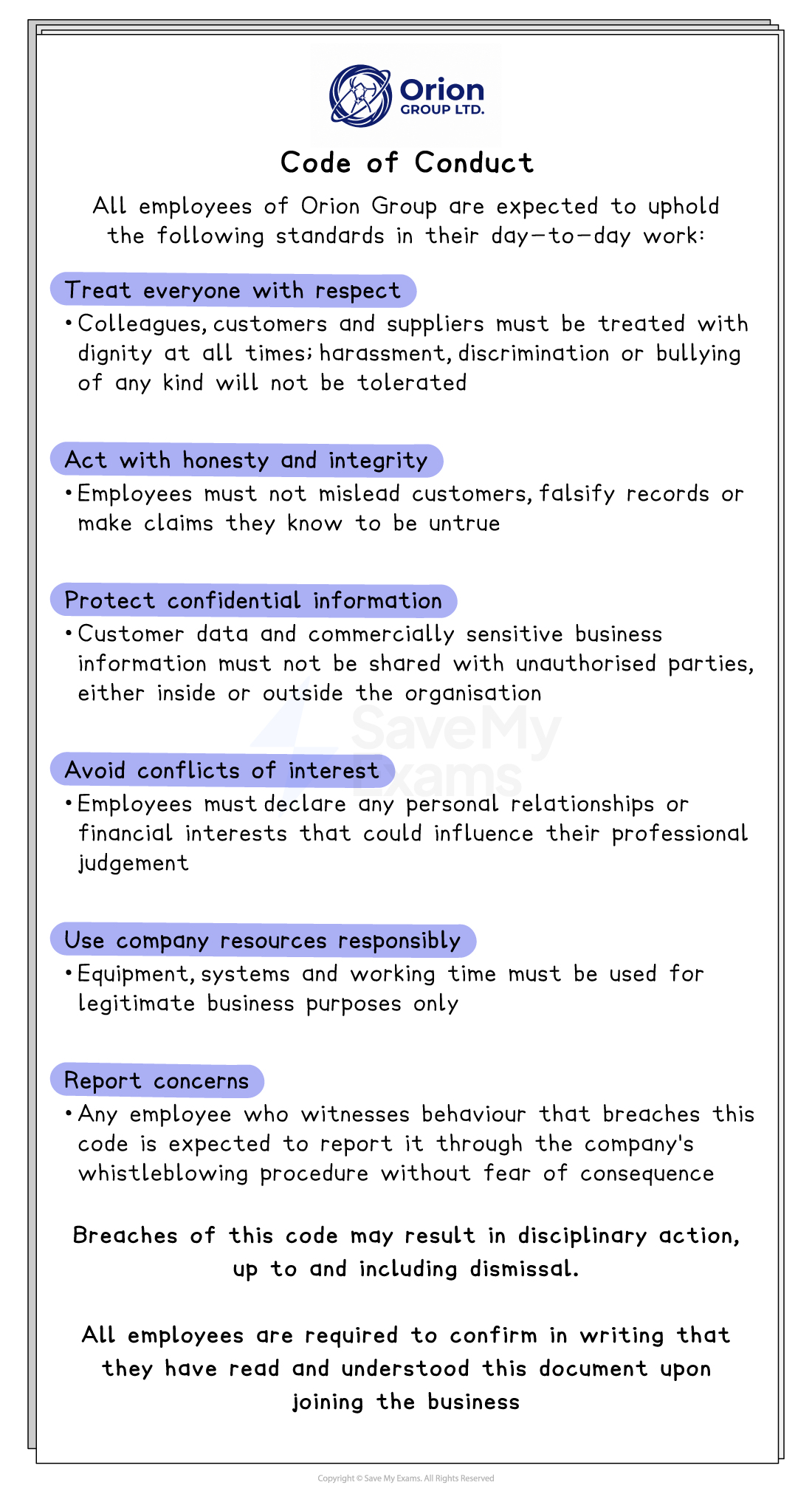
An example code of conduct
Most large businesses publish a corporate code of conduct covering areas such as anti-bribery, conflicts of interest, data handling and treatment of colleagues
Equality, diversity, inclusion and belonging
Key terms
Term | Definition |
|---|---|
Equality |
|
Diversity |
|
Inclusion |
|
Belonging |
|
Protected characteristics under the Equality Act 2010
The Equality Act 2010 makes it unlawful to discriminate against employees on the basis of nine protected characteristics
Age
Disability
Gender reassignment
Marriage and civil partnership
Pregnancy and maternity
Race
Religion or belief
Sex
Sexual orientation
Key ethical issues
Direct discrimination
Treating an employee less favourably because of a protected characteristic
It is both illegal and regarded as morally unacceptable
Example
A sales manager informs a member of her team that she will not be considered for an upcoming promotion because she is pregnant and is "unlikely to be fully committed to the role."
The decision is based entirely on her pregnancy rather than her performance or qualifications
Indirect discrimination
Applying a policy or practice that disadvantages people with a protected characteristic, even if unintentionally
Example
A logistics company introduces a policy requiring all employees to be available to work every Saturday.
While the policy applies equally to everyone, it indirectly disadvantages Jewish employees, for whom Saturday is the Sabbath — a protected religious observance
Unless the business can fully justify the requirement, this is indirect discrimination
Unconscious bias
Making decisions influenced by stereotypes without being aware of it
It can affect recruitment, promotion and pay decisions even where no deliberate discrimination is intended
Example
Research into professional orchestra auditions found that when a screen was introduced to hide the identity of musicians during the selection process, the proportion of women chosen increased significantly
The same musicians who had previously been rejected were selected when interviewers could not see who was playing
Source: Goldin, C. and Rouse, C. (2000) — "Orchestrating Impartiality: The Impact of 'Blind' Auditions on Female Musicians", published in the American Economic Review, Volume 90, Issue 4, pp. 715–741
The glass ceiling
The invisible barrier that prevents women and employees from minority backgrounds from reaching senior positions, despite being qualified to do so
Example
Despite women making up around half of the UK workforce, they hold fewer than one in ten chief executive positions in FTSE 100 companies
The pattern is consistent across sectors — women are well represented at junior and middle management levels but face barriers to progression to the most senior roles
Source: Cranfield School of Management — Female FTSE Board Report
Tokenism
Making superficial efforts to appear diverse without making genuine structural changes to create a fairer environment
E.g. Appointing one person from an under-represented group to a visible role
Example
A construction company facing criticism for its lack of diversity appoints one woman to its twelve-person board of directors and prominently features her in its annual report and marketing materials
However, the company makes no changes to its recruitment processes, pay structures or workplace culture
The appointment improves the business's public image without addressing the underlying barriers that prevent women from progressing within the organisation
Intersectionality
The way multiple protected characteristics can combine to worsen disadvantage
E.g. A woman from an ethnic minority background may face greater barriers than someone who faces just one form of discrimination
Example
Research by the Trades Union Congress found that Black women in the UK earn significantly less on average than both white women and Black men — a gap that cannot be explained by either race or gender alone
The combination of two protected characteristics compounds the disadvantage each group faces individually
Source: TUC (2020) — "BME Women and Work"
Why this matters ethically
A business has both a legal duty and a moral responsibility to treat all employees fairly
Businesses that fail to address these issues risk damaging their reputation, losing talented staff and making decisions that suffer from a lack of diverse perspectives
Genuine inclusion is not simply about avoiding discrimination
It is about actively creating conditions where all employees can perform at their best
Case Study
Pinnacle Consulting
Pinnacle Consulting is a UK-based management consultancy with 600 employees. Despite strong financial performance, a 2023 internal review revealed that women made up just 18% of senior managers and only 9% of employees came from an ethnic minority background - significantly below the national average.
Exit interviews indicated that employees from under-represented groups felt their contributions were undervalued and that promotions were given to personal contacts rather than being awarded through transparent processes. Several employees reported experiencing microaggressions that had gone unaddressed by management.
In response, Pinnacle arranged an independent review of its recruitment and promotion processes. The review identified evidence of unconscious bias in interviews and recommended blind recruitment for shortlisting, interviews with diverse panels and inclusion training for all managers.
Eighteen months later, the proportion of women in senior roles had risen to 26% and scores for "feeling valued at work" in the annual staff survey improved significantly.
Pay gaps
The gender pay gap
The gender pay gap is the difference in average hourly earnings between male and female employees across an organisation
It is important to distinguish this from unequal pay
Paying men and women differently for the same work has been illegal in the UK since 1970
The gender pay gap exists because of structural factors
Women are more likely than men to work in lower-paid sectors and roles
They are more likely than men to work part-time
They are more likely to take career breaks for caring responsibilities
UK businesses with 250 or more employees are legally required to publish their gender pay gap data annually
This measure was introduced to increase transparency and encourage businesses to take action
Key ethical issues
The gap often reflects wider inequalities in society that businesses alone cannot solve
E.g. women bearing a disproportionate share of caring responsibilities
This does not remove their ethical obligation to address what they can control
Risk of pay gap washing
Businesses publishing data and setting targets without making genuine structural changes to recruitment, career progression opportunities or pay
The gap between senior managers and other employees
The executive pay gap refers to the difference between the earnings of senior leaders and the average pay of the workforce
UK public limited companies are required to report the chief executive's total pay as a ratio to the average pay of all employees
In recent years, many large UK businesses have reported ratios of 50:1 or higher
This means the chief executive earns 50 or more times the salary of the typical employee
Key ethical issues
Is very high executive pay justifiable when workers are paid at or near the minimum wage?
Does executive pay truly reflect individual contributions, or have they become disconnected from senior leaders' performance?
Do bonuses, which disproportionately benefit senior employees, widen inequality rather than reward genuine performance?
The impact on employee morale
Large visible pay gaps can damage trust, reduce motivation and undermine the sense of fairness across a workforce
Case Study
Harvest Retail plc

Harvest Retail plc is a UK supermarket chain employing 8,000 people across 120 stores. In 2023, the business published its annual gender pay gap report, revealing that women earned on average 21% less per hour than male employees - well above the national average.
The gap was explained by the concentration of women in part-time customer service roles, while the majority of store managers and senior leaders were male. The same report disclosed that the chief executive's total pay was 204 times the average employee's salary - a ratio that attracted media criticism.
Harvest Retail responded by announcing targets to increase the proportion of women in store management to 45% by 2028 and committed to a pay review for its lowest-paid employees. However, the targets were non-binding and no specific budget was allocated.
Critics argued that Harvest Retail's response illustrated a wider problem: businesses meeting their legal reporting obligations without the commitment needed to bring about change.
Examiner Tips and Tricks
When answering questions on pay gaps, be precise - the gender pay gap and unequal pay are not the same thing. Unequal pay means paying men and women differently for the same work, which is illegal. The gender pay gap reflects broader differences in the types of roles men and women hold and is not automatically evidence of unlawful discrimination. Making this distinction clearly in an exam answer demonstrates the kind of precision that earns marks in higher-tariff questions

Unlock more, it's free!
Join the 100,000+ Students that ❤️ Save My Exams
the (exam) results speak for themselves:

Was this revision note helpful?
