Social Media Campaigns & Content Marketing (AQA A Level Business): Revision Note
Syllabus Edition
First teaching 2026
First exams 2028
Exam code: 7132

Social media campaigns
A social media campaign is a coordinated marketing effort carried out across one or more social media platforms, designed to achieve a specific marketing objective within a defined timeframe
Unlike a business's ongoing day-to-day social media activity, a campaign has a clear goal, a set duration and measurable targets
These may include increasing brand awareness, launching a new product or driving traffic to a website
The value of social media campaigns
Benefit | Explanation |
|---|---|
Targeted at a relatively low cost |
|
Speed and flexibility |
|
Two-way engagement |
|
Measurable outcomes |
|
Viral potential |
|
Supports other marketing objectives |
|
Digital technology and AI in social media campaigns
Digital technology and artificial intelligence (AI) have transformed what businesses can achieve through social media campaigns
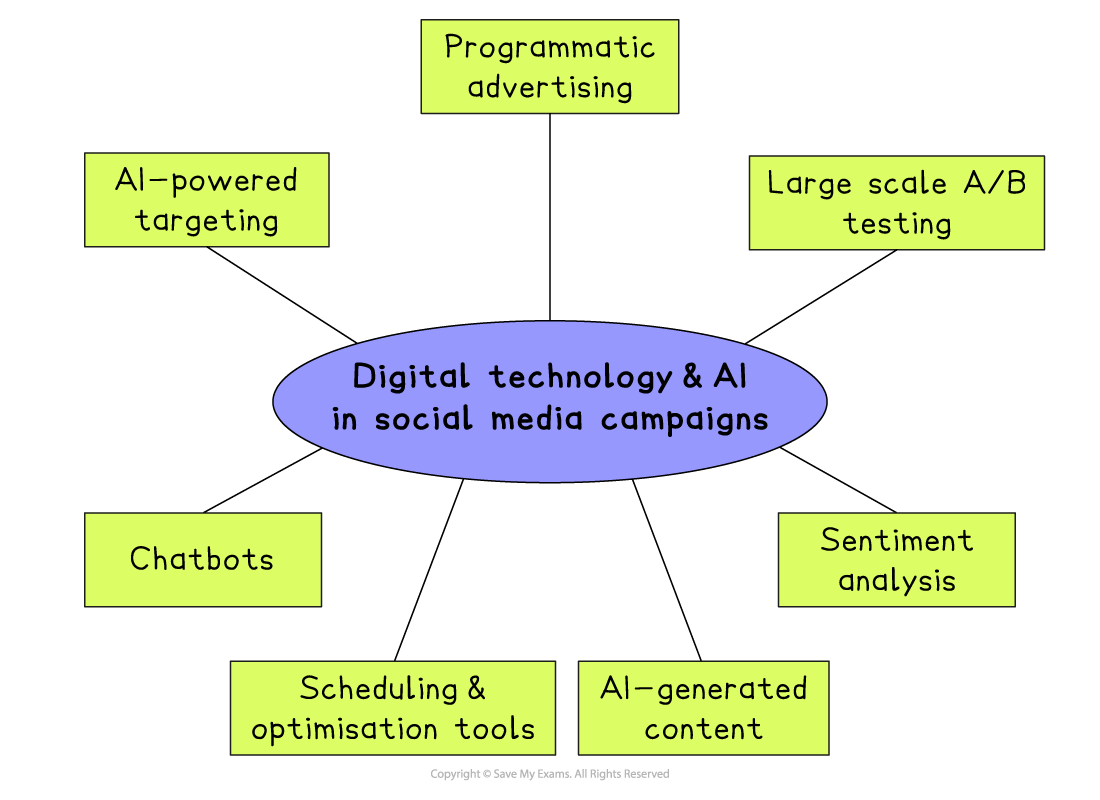
AI-powered targeting
Platforms such as Meta (Facebook and Instagram), TikTok and YouTube use AI algorithms to show campaign content to the users most likely to engage with it
Based on detailed analysis of their behaviour, interests and demographics
This dramatically improves the efficiency of campaign spending
Programmatic advertising
AI automates the buying and placing of digital advertising space in real time
It selects the best available slots at the lowest cost and continuously optimises, based on performance data
Large-scale A/B testing
Digital tools allow businesses to run multiple versions of an advert simultaneously (different images, headlines or calls to action)
AI identifies which version performs best and can automatically direct more budget towards it
Sentiment analysis
AI can scan comments, mentions and reactions across social platforms in real time to assess how a campaign is being received
This alerts the business to negative reactions before they escalate
AI-generated content
AI tools can assist in generating campaign text, images and short-form video content quickly
This reduces the time and cost of campaign production
Scheduling and optimisation tools
AI analyses audience behaviour patterns to identify the best times to publish content for maximum engagement
This removes the need for research or manual guesswork
Chatbots
Chatbots are automated computer programs that simulate a conversation with customers online
They are used by businesses to answer queries and provide support instantly without the need for a human member of staff
Case Study
Kestrel Travel's social media campaign
Kestrel Travel is an independent travel company specialising in sustainable holidays - small-group tours to destinations across Europe and Central Asia, designed to minimise environmental impact.

Each January, it runs a social media campaign to encourage bookings during the key holiday-planning window, when consumers are most likely to commit to a summer trip.
This year's campaign ran across Instagram and Facebook for six weeks, targeting users aged 30–55 who had shown interest in sustainable living, adventure travel and outdoor activities. AI-powered targeting tools allowed Kestrel to exclude users who had already booked through its website, ensuring the promotional budget was focused entirely on gaining new customers.
Two creative approaches were tested in the first week. The first included striking destination photography, and the second focused on short customer video testimonials.
Analytics showed the testimonial format generated a significantly higher click-through rate, and promotional spend was reallocated towards it automatically.
The campaign generated 340 holiday enquiries over the six-week period, each tracked back to a specific advert. Kestrel's marketing team used this data to calculate a clear cost per enquiry, informing how the budget would be allocated in future campaigns.
Examiner Tips and Tricks
Social media campaigns are not simply about posting content. The real competitive advantage comes from how effectively a business uses data and AI to target the right people, test and refine its messaging, and convert engagement into sales. A campaign with strong creative but poor targeting will underperform against one with good targeting and average creative
Content marketing
Content marketing involves creating and distributing valuable, relevant and consistent content to attract and retain a clearly defined target audience
It aims to build trust, brand authority and long-term customer relationships
Content marketing seeks to educate, entertain or inform the target audience, drawing them towards the brand without an immediate 'hard sell'
Common forms of content include blog posts and articles, videos, podcasts, infographics, email newsletters, how-to guides and webinars
The value of content marketing
Benefit | Explanation |
|---|---|
Builds brand authority and trust |
|
Generates organic traffic through SEO |
|
Supports the full customer journey |
|
Cost-effective lead generation |
|
Builds long-term loyalty |
|
Versatile and repurposable |
|
Digital technology and AI in content marketing
Digital technology and AI have significantly expanded what businesses can achieve through content marketing
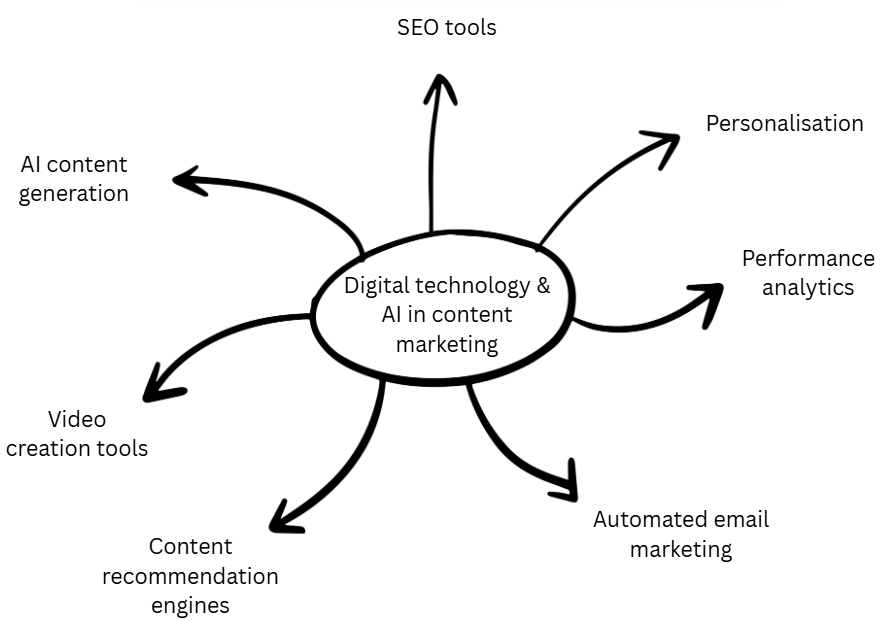
AI content generation
AI tools can assist in drafting blog posts, email newsletters, social media captions, and product descriptions quickly and in large volumes
This reduces the time and cost of content production considerably
Content marketing is, therefore, more accessible to smaller businesses with limited marketing teams
SEO tools
Digital technology helps businesses identify the specific keywords and questions their target audience is searching for online
This allows content to be created and optimised to appear prominently in search results
Personalisation
AI can tailor content to individual users based on their browsing behaviour, previous purchases and stage in the customer journey
For example, a returning customer who has viewed a particular product might automatically receive a targeted email featuring content relevant to that product
Performance analytics
Digital tools track in detail which content pieces are generating the most traffic, engagement and conversions
This enables marketing teams to invest in the most effective topics and formats rather than relying on intuition
Automated email marketing
AI can generate personalised content emails based on specific customer actions, such as abandoning a shopping basket or revisiting a product page multiple times
Video creation tools
AI-powered tools can make high-quality video content quickly and cheaply
This allows businesses without large budgets to create engaging videos for YouTube, Instagram and TikTok
Content recommendation engines
AI analyses user behaviour on websites to recommend the most relevant content to each visitor
This can increase the time customers spend on a website and the likelihood of conversion
Examiner Tips and Tricks
Content marketing is a long-term strategy - it rarely delivers immediate results in the way a sales promotion or paid advertising campaign might. In evaluation questions, consider whether a business has the time and resources to invest in content marketing, and whether its marketing objectives are better served by short-term promotional activity or long-term brand and authority building.

Unlock more, it's free!
Join the 100,000+ Students that ❤️ Save My Exams
the (exam) results speak for themselves:

Was this revision note helpful?
