Teamwork (AQA A Level Business): Revision Note
Syllabus Edition
First teaching 2026
First exams 2028
Exam code: 7132

The purpose and value of teams
A team is a group of people who work together towards a shared goal, each contributing different skills and areas of expertise
Teams are particularly valuable for complex, multi-stage projects where no single person has all the skills required
For example, a product launch team might bring together people from marketing, finance, design and logistics
Benefits of teams to a business
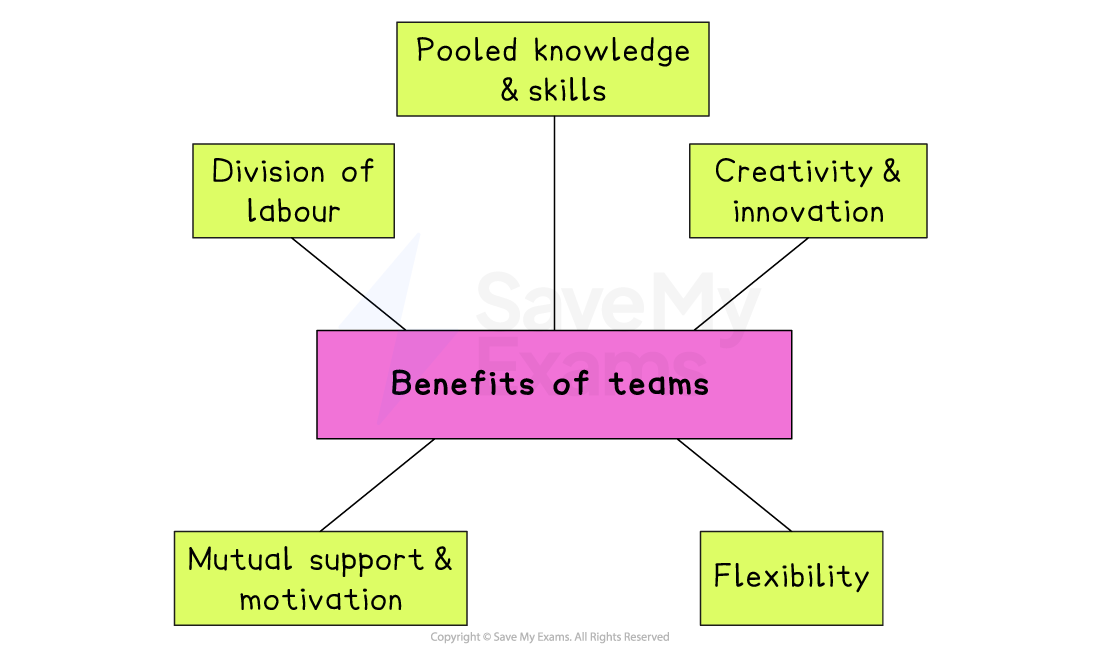
Division of labour
Tasks can be split according to individual strengths, improving efficiency and quality of output
Pooled knowledge and skills
Team members bring different expertise
This allows problems to be solved more effectively than by individuals working alone
Creativity and innovation
Discussion and collaboration generate ideas that people working alone are unlikely to produce
Mutual support and motivation
Team members can encourage each other, share workloads during busy periods and cover for colleagues when needed
Flexibility
Teams can adapt more quickly to changing demands than rigid individual roles
The effectiveness of teams
Not all teams perform well
Team effectiveness depends on more than simply putting capable people together — the conditions in which the team operates matter enormously
Hackman’s model of team effectiveness
Hackman argued that teams need five conditions to perform at their best
The absence of any one condition can significantly reduce a team's effectiveness, even when individual members are highly capable
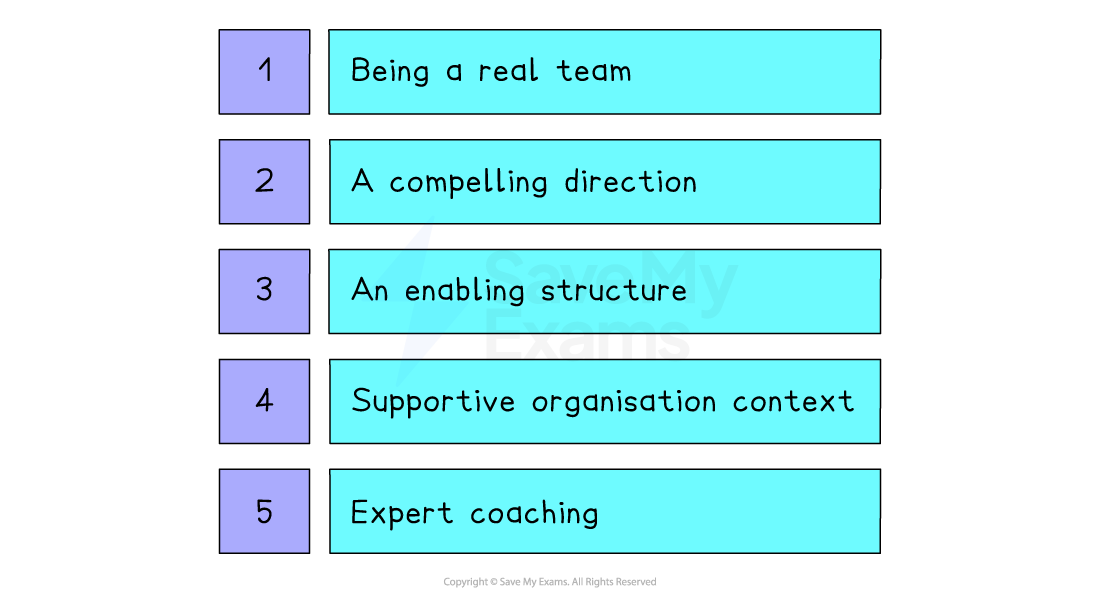
Condition 1: Being a real team
The team must have clear boundaries
Members know who is and is not part of the team
Members must be interdependent
They genuinely need each other to complete the work
Membership must be reasonably stable
Constant changes in the make-up of the team disrupt trust and working relationships
Example
England manager Alf Ramsey selected a settled, stable squad for the 1966 World Cup, with clearly defined roles for each player
His decision to stick with a consistent group rather than frequently rotating the squad is widely credited as a contributing factor in England's success
Condition 2: A compelling direction
The team needs a clear, challenging and meaningful goal that motivates members and gives their work a sense of purpose
The direction should energise and give a clear focus for the whole team
Vague or trivial goals undermine commitment
Team members need to believe the work matters
Example
When an oxygen tank exploded on NASA's Apollo 13 mission in 1970, the engineering team on the ground was given one clear, urgent goal: bring the crew home safely
The clarity of that goal united the team and drove extraordinary problem-solving under extreme pressure
Condition 3: An enabling structure
Three structural elements are required for a team to function well
The right mix of people
The team needs the skills required for the task
Hackman argued that most teams are too large, recommending groups of six to eight people for complex work
Clear norms of conduct
Shared expectations about how members will behave, communicate and make decisions
A motivating task
Work that members find meaningful or interesting
Example
Dave Brailsford became performance director of British Cycling in 2003 and quickly assembled a small group of specialists with complementary skills – riders, coaches, physiologists, psychologists and equipment engineers – ensuring the right mix of expertise
Every decision was judged against a single question – does this improve performance, however slightly?
The task was motivating - the aim was to win Olympic gold
Britain went on to win eight gold medals at the 2008 Beijing Olympics and Bradley Wiggins became the first British winner of the Tour de France in 2012
Condition 4: A supportive organisational context
The organisation around the team must provide the resources, information and support the team needs to do its work
Reward systems should recognise team performance, not just individual achievement
Otherwise members compete with each other rather than collaborate
Unfair reward distribution or a lack of recognition can cause resentment and reduce effort, even in otherwise well-functioning teams
Teams need access to training and development to maintain and improve their collective capabilities
Example
Project Aristotle, a 2016 study of 180 internal teams at Google, found that teams performed best when the organisation provided psychological safety
This included an environment where members felt safe to speak up, take risks and admit mistakes without fear of blame
Google went on to train its managers how to build this kind of culture
Condition 5: Expert coaching
Teams benefit from coaching at the team level
A good team coach focuses on the collective rather than on developing members individually
Hackman argued coaching is most valuable at three points
At the start of a project by establishing its direction and approach to be taken
At the midpoint by reviewing project progress and adjusting plans
At the end by reflecting on the project and learning for next time
Example
Jürgen Klopp's approach at Liverpool FC is recognised as team-level coaching rather than individual development
Before each match, Klopp briefs the squad on the game plan. At half-time, he adjusts the team's approach based on what is and is not working. After each match, the squad reviews performance together
His focus throughout is on the team's collective performance – not on developing individual players in isolation
Case Study
GreenBowl

GreenBowl is a UK-based meal kit company that delivers fresh, healthy recipes to customers' homes. When the business decided to launch a subscription app, the chief executive assembled a cross-functional project team of seven people from technology, design, marketing and customer service.
The team was given a clear brief: build and launch a fully functional app within nine months. Weekly check-ins with the chief executive provided coaching and kept the team focused as challenges arose.
However, four months in, progress slowed. Exit interviews with two departing members revealed that the reward structure had not been updated – bonuses were still calculated on individual departmental targets rather than shared outcomes, creating internal competition rather than collaboration. The business quickly introduced a team-based performance bonus tied to the launch date and customer retention targets.
The app launched on schedule and attracted 14,000 subscribers within three months. GreenBowl's experience illustrates how even a well-structured team can underperform when the organisational context works against collective effort – a direct illustration of Hackman's fourth condition
Beyond Hackman's model
A range of factors beyond the five conditions in Hackman's model can influence how well a team performs
The team's size and composition
Smaller teams tend to communicate more effectively and make faster decisions
As team size grows, coordination becomes more difficult and individual accountability can weaken
Sometimes individuals contribute less effort because they assume others will compensate
This is more common in larger teams
Also known as "social loafing"
Effective teams need the right mix of skills, including technical knowledge, problem-solving ability and interpersonal skills
Diversity of background and experience can improve creativity and decision-making by bringing different perspectives to a problem
Clarity of goals and roles
Teams perform better when every member understands the shared objective and their individual contribution to it
Members can focus on their areas of strength without second-guessing what others are responsible for
Communication
Open, honest communication enables teams to share ideas, raise problems early and resolve disagreements before they escalate
Teams that communicate poorly are more likely to make errors, miss deadlines or duplicate work
Regular, structured communication keeps all members aligned with the project's goals
Leadership
Effective team leadership provides direction, resolves conflict and maintains momentum
Overly controlling leadership can reduce creativity and members' sense of ownership
Too little direction can lead to confusion and the project may drift
Effective team leaders balance task focus (ensuring the work gets done) with people focus (maintaining morale, motivation and positive working relationships)
Conflict management
Some disagreement within a team is healthy, as it can lead to better ideas and challenge assumptions
Unresolved conflict, however, damages relationships, reduces morale and disrupts performance
Effective teams have clear ways to handle disagreement and manage conflict more effectively than those without them

Unlock more, it's free!
Join the 100,000+ Students that ❤️ Save My Exams
the (exam) results speak for themselves:

Was this revision note helpful?
