Key Operations Objectives (AQA A Level Business): Revision Note
Syllabus Edition
First teaching 2026
First exams 2028
Exam code: 7132

What are operations objectives?
Operations management refers to the processes and activities a business uses to produce goods or deliver services
Every business, whether manufacturing cars, running a supermarket or delivering a streaming service, has an operations function
Operations objectives are the specific, measurable targets that guide how the operations function is managed
They translate the overall goals of the business into priorities for production and product or service delivery
Operations objectives typically cover five key areas
Efficiency
Quality
Production volume
Flexibility
Environmental impact
Together, these objectives determine how a business organises its resources to produce and deliver goods and services competitively
Influences on operations objectives
Operations objectives are shaped by a range of internal and external factors
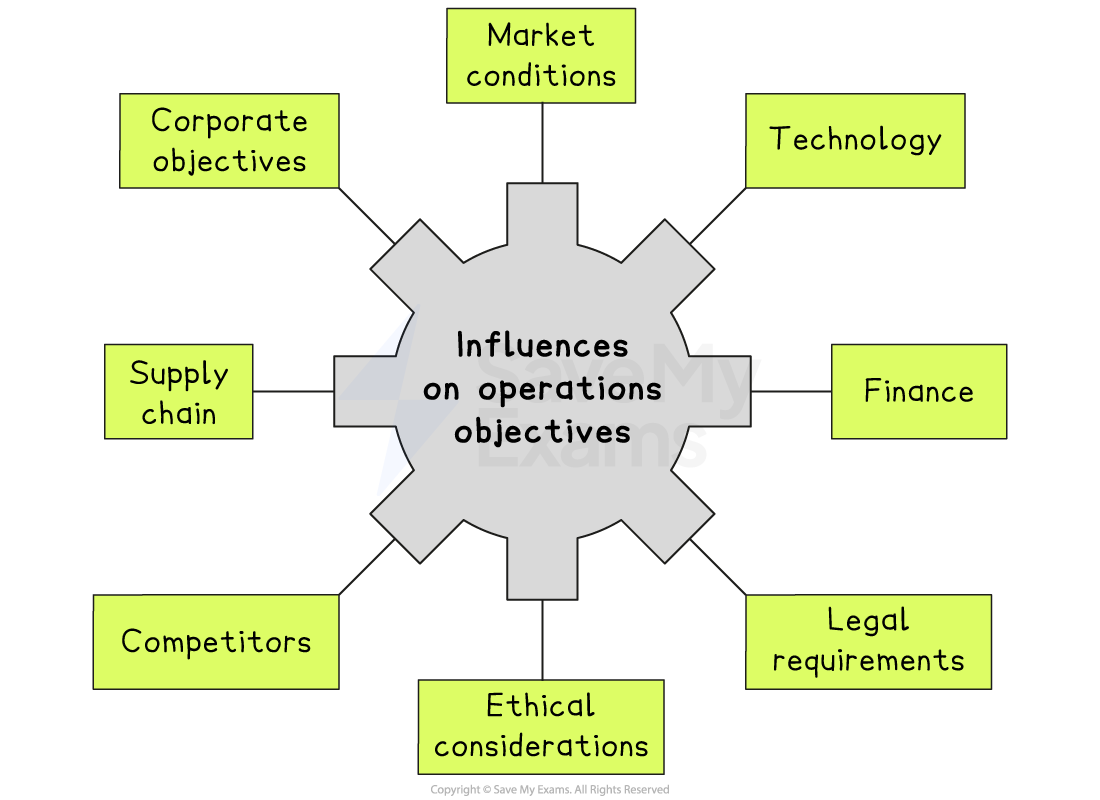
Corporate objectives
Operations objectives must support the wider goals of the business
If the corporate goal is to increase market share, operations must prioritise increasing output volume and flexibility
If the goal is premium positioning, quality is likely to be the main objective
Market conditions
The level of competition, customer expectations and the pace of change in the market determines what operations must deliver
Example
Customers' expectations for next-day delivery from online retailers has encouraged them to make speed and flexibility key operations objectives
Technology
Advances in technology, such as automation and artificial intelligence change what is achievable in terms of efficiency, flexibility and quality
Businesses that adopt new technology can often set higher operations objectives
Example
The introduction of robotics in Amazon's fulfilment centres transformed what the business could achieve in terms of efficiency and volume, enabling it to set ambitious operations targets
Finance
The budget available determines what operations can achieve
Capital investment in new machinery or IT systems may be necessary before certain objectives can be met
Legal requirements
Health and safety law, environmental regulations and product safety standards place minimum requirements on operations
In many cases these determine specific objectives
Example
The 2022 UK Plastic Packaging Tax requires businesses to set specific objectives around reducing plastic content in their packaging
Ethical considerations
Businesses often set operations objectives that reflect their commitment to sustainability, fair labour practices and community impact, going beyond what the law requires
Competitors
What rivals achieve in terms of cost, quality and speed sets a benchmark
Businesses set objectives to match or exceed competitor standards in the areas most valued by customers
Example
When budget airlines introduced very low fares, traditional airlines had to make cost efficiency a much higher operations priority to allow them to remain competitive on price
Supply chain
The reliability, capacity and sustainability of suppliers directly influences what operations can deliver
Disruptions in the supply chain can make objectives temporarily unachievable
Example
The global semiconductor shortage of 2021–2022 forced car manufacturers, including Ford and Volkswagen to significantly reduce their production volume objectives
Efficiency
Efficiency in operations means producing the maximum output from a given level of input, or achieving a given level of output at the lowest possible cost
Productive efficiency |
|
|---|---|
Allocative efficiency |
|
Why efficiency matters
Efficient operations reduce unit costs, improving profit margins
In competitive markets, businesses that operate more efficiently than rivals can offer lower prices or achieve a higher profit margin at the same price
Efficiency gains free up resources that can be reinvested elsewhere in the business
How is efficiency measured?
Capacity utilisation
The proportion of total production capacity currently in use
Expressed as a percentage and calculated using the formula
Employee productivity
Output per worker over a given period
Expressed as a number of units and calculated using the formula
Unit cost
The total cost of production divided by the number of units produced
Expressed as a value and calculated using the formula
Example
Toyota's production system is globally recognised for eliminating waste - a principle known as 'muda'
By removing any activity that does not add value, Toyota has achieved some of the lowest unit costs and highest productivity levels in the automotive industry
Its approach has been adopted by businesses across many sectors as a model of operational efficiency
Quality
Quality refers to the degree to which a product or service meets or exceeds customer expectations
Quality is not only relevant to premium or luxury products
A budget supermarket can be considered high-quality if it consistently delivers what its customers expect at the promised price
Quality objectives focus on reducing defect rates, minimising returns and complaints and consistently meeting agreed specifications
Why quality matters
Poor quality generates direct costs
Returns, replacements, repairs and compensation
It also generates indirect costs
Damage to brand reputation, loss of customer loyalty and reduced future sales
In markets where products are similar in price and features, quality can be an important competitive advantage
Approaches to quality
Approach | Explanation |
|---|---|
Quality control |
|
Quality assurance |
|
Total Quality Management (TQM) |
|
Example
Dyson invests heavily in quality assurance throughout its product development and manufacturing process, testing products to demanding standards before distribution
This approach supports Dyson's premium positioning and justifies its high prices relative to competitors
Production volume
Production volume refers to the quantity of goods or services a business produces within a given period
Businesses often set the objective to match production volume as closely as possible to customer demand
Overproduction leads to excess inventory, increased storage costs and potential waste – particularly serious for businesses handling perishable goods
Underproduction results in lost sales, delayed fulfilment and damage to customer relationships
Methods of production
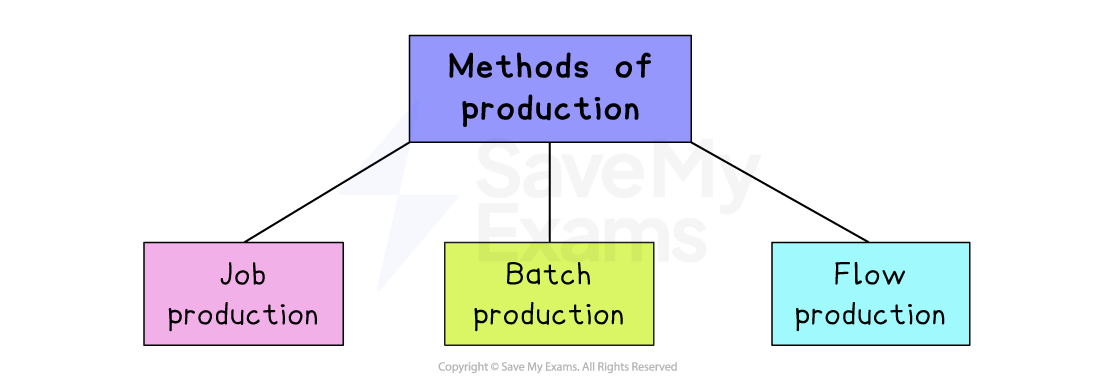
Job production
One-off, custom products made to individual specifications
Example: a wedding cake or a custom-built yacht
Batch production
Groups of identical products made together before switching to a different product
Example: a bakery producing white loaves, then switching to seeded loaves
Flow production
Continuous, large-scale production of identical products
Example: a water bottling plant producing millions of units per day
Flexibility
Flexibility in operations refers to the ability to adapt production processes, volumes or product ranges quickly and cost-effectively in response to changing customer needs or market conditions
Volume flexibility
The ability to increase or decrease production levels without major disruption or cost
Important in markets with seasonal or unpredictable demand
Mix flexibility
The ability to switch between producing different product lines
Important for businesses offering a wide range
Delivery flexibility
The ability to vary delivery times or methods to meet different customer requirements
Why flexibility matters
Markets change rapidly
Customer preferences shift, new competitors emerge and unexpected events disrupt supply and demand
Flexible businesses can respond to these changes without the delays and costs that affect less adaptable rivals
Flexibility is important for mass customisation
Producing personalised products efficiently in large quantities
Example
During the Covid-19 pandemic, several UK clothing manufacturers and distilleries rapidly switched their production lines to manufacture personal protective equipment and hand sanitiser
The ability to adapt production in response to sudden, unexpected demand demonstrated the competitive advantage of operational flexibility
Environmental impact
Environmental impact refers to the effect of a business's operations on the natural environment
This includes carbon emissions, energy consumption, water use, waste generation and resource depletion
Environmental objectives have moved from being a niche concern to a core operations priority due to regulation, consumer expectations and pressure from investors
The UK government's commitment to net zero by 2050 requires businesses to reduce their carbon footprint significantly
Common environmental operations objectives
Reducing energy consumption and switching to renewable energy sources
Minimising packaging and switching to sustainable materials
Cutting transport emissions through more efficient, localised supply chains
Reducing waste through circular economy approaches
Designing products to be repaired, reused or recycled rather than discarded
Why environmental objectives matter
Compliance
Businesses that fail to meet environmental standards face fines, legal action and reputational damage
Consumer expectations
A growing proportion of customers prefer businesses with strong environmental credentials
Cost savings
Reducing energy use and waste often lowers operating costs alongside environmental impact
Investor pressure
Investors increasingly apply ESG (Environmental, Social and Governance) criteria when deciding where to place their capital
Poor environmental performance can, therefore, reduce access to funding
Example
IKEA has committed to using only renewable and recycled materials across all its products by 2030 and to becoming climate positive – removing more carbon from the atmosphere than its operations emit
Environmental objectives are embedded into every stage of IKEA's operations, from product design through to delivery and packaging
Adding value
Value added is the difference between the selling price of a product or service and the cost of the inputs used to create it
Effective operations management adds value by transforming inputs into outputs that customers are willing to pay significantly more for
How operations adds value
The more effectively a business manages its operations, the greater the value it can add – and the stronger its ability to compete on quality, price or both
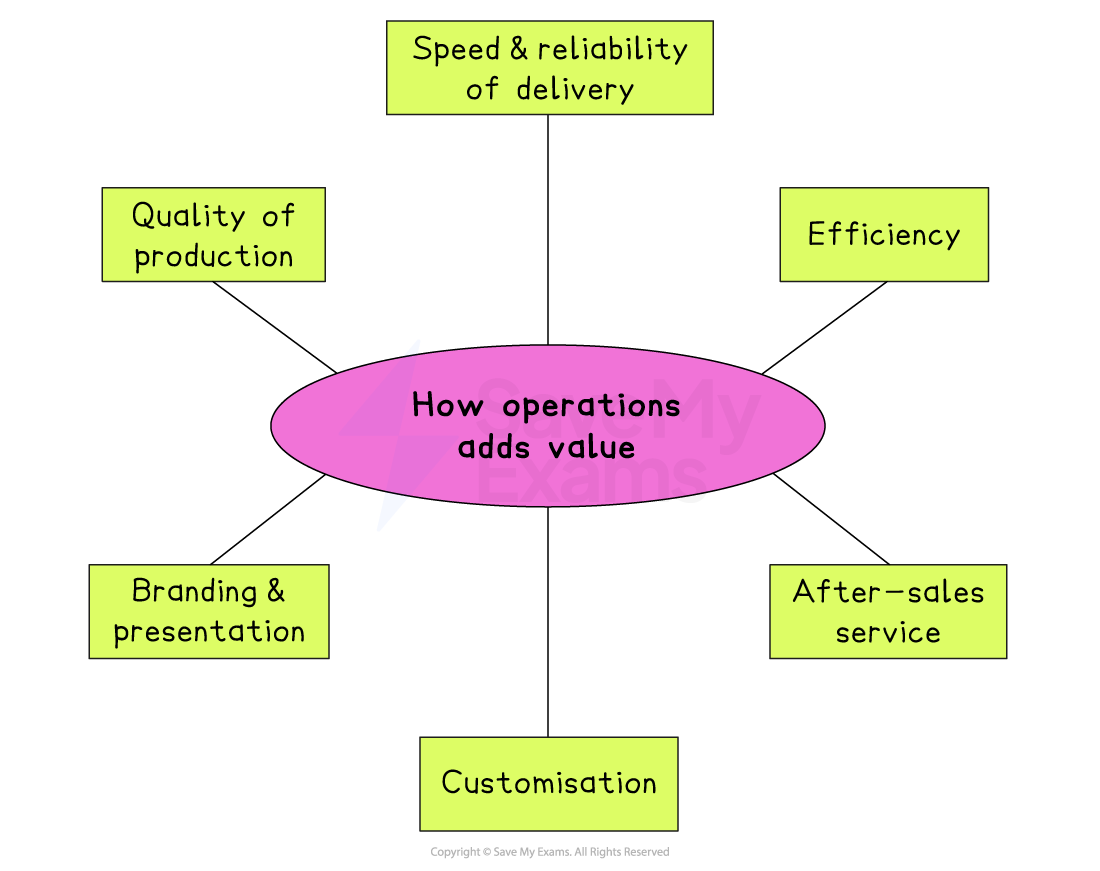
Quality of production
Consistently well-made goods can be sold at a premium price and generate repeat purchases
Speed and reliability of delivery
Customers often pay more for faster or more dependable delivery
E.g. next-day and same-day delivery services
Customisation
Producing goods or services tailored to individual requirements adds value that standardised products cannot match
Efficiency
Reducing costs without reducing quality increases the difference between costs of production and the selling price
After-sales service
Reliable warranties, repairs and customer support increase the perceived value of a product after a customer has purchased it
Branding and presentation
The way a product is packaged and positioned can add perceived value even where the product itself is similar to a competitor's
Examiner Tips and Tricks
When answering questions on operations objectives, always consider how the objectives link to the business's competitive strategy. A low-cost retailer will prioritise efficiency and production volume, whilst a luxury brand will prioritise quality and flexibility.
Objectives that are appropriate for one business may be entirely wrong for another – explaining this distinction clearly is what earns application marks.

Unlock more, it's free!
Join the 100,000+ Students that ❤️ Save My Exams
the (exam) results speak for themselves:

Was this revision note helpful?
