What is Leadership? (AQA A Level Business): Revision Note
Syllabus Edition
First teaching 2026
First exams 2028
Exam code: 7132

Written by: Lisa Eades
Updated on
Introduction to leadership
Leadership is about having a vision, sharing that vision with others and providing direction
Leaders inspire and motivate others to work towards a common goal
This contributes to the meeting of aims and objectives and supports the development of a motivated workforce
Leaders must also be prepared to pursue a new direction or even step aside when circumstances change
While some managers may be good leaders, not all leaders have a management role
Employees will follow a manager's direction but may not be truly inspired to support the manager in achieving ambitious business goals
Leadership is necessary in many different contexts
A leader in sport could be the captain of a national football or basketball team
A political leader could be a president or leader of a political group or trade union
Influences on business leadership
There is no single 'best' approach to leadership that works in all situations
The approach a leader takes is shaped by a range of internal and external factors
Effective leaders adapt their style in response to changing circumstances rather than applying the same approach regardless of context
Factors affecting leadership approach
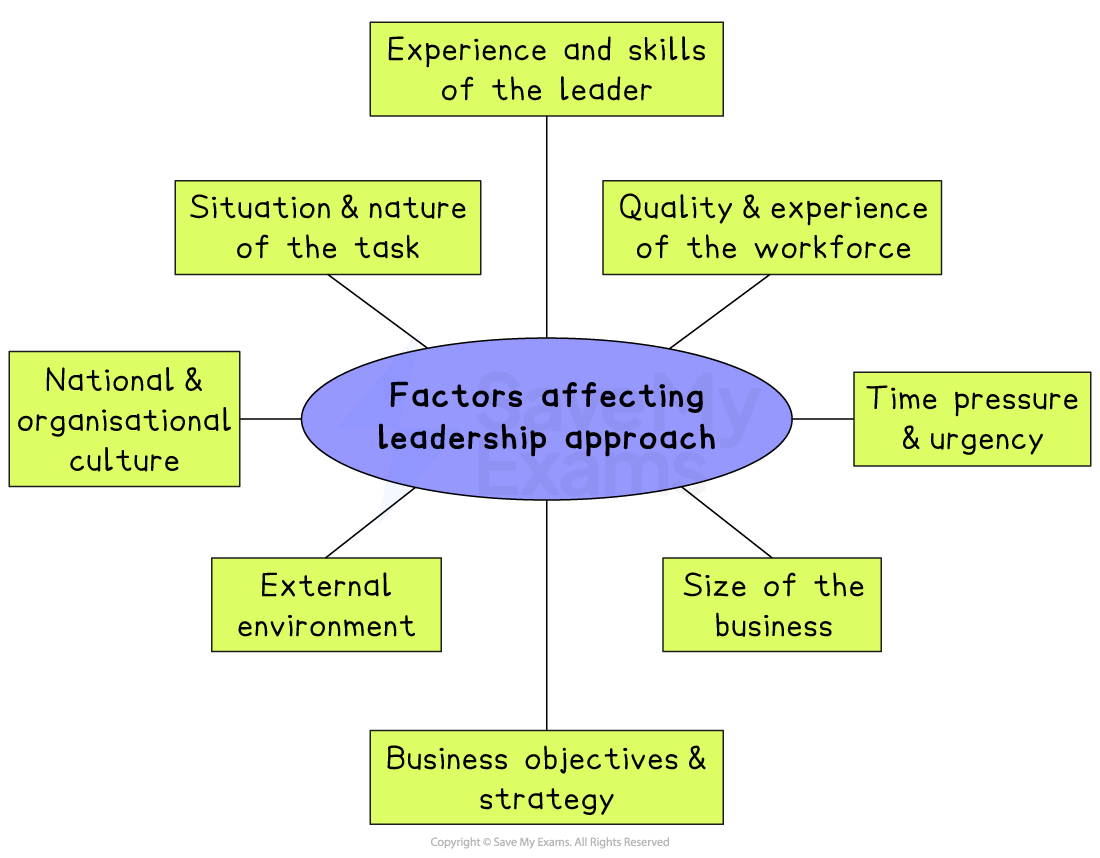
The situation and nature of the task
The type of task being carried out has a significant influence on how a leader should approach it
Routine, well-defined tasks can often be delegated with minimal supervision
Employees know what to do and need little direction
Complex, unfamiliar or high-stakes tasks may require a more hands-on, directive approach from the leader
Particularly where the consequences of mistakes are serious
Crisis situations – such as a sudden loss of a major customer, a product recall or a financial emergency – typically call for quicker, more decisive leadership
There is less time for consultation or consensus-building
Example
A factory manager who normally adopts a democratic style may shift to a more directive approach if a safety incident occurs, where speed and clear instructions are more important than employee input
Experience and skills of the leader
A new or inexperienced leader may feel more comfortable adopting a directive style
They rely on clear structures and close oversight whilst they develop their understanding of the business and their team
An experienced leader with deep knowledge of the business, industry and workforce may feel confident enough to delegate widely and adopt a more empowering approach
A leader's personal values and personality also play a significant role
Some leaders are naturally more comfortable with collaboration and consultation
Others prefer to retain control and make decisions independently
Leadership training and development can increase the range of styles a leader is able to apply, making them more adaptable to different situations
Example
An owner who has built a business from scratch may struggle to delegate even as the business grows
Their style was formed in an environment where they made every decision themselves
This can lead to delays as the organisation becomes too large for one person to control
Quality and experience of the workforce
The most important single influence on leadership style is often the capability and confidence of the team being led
Highly skilled, experienced and motivated employees can be trusted to work with autonomy
The team has the expertise to make good decisions without close supervision
New, inexperienced or less confident employees need more direction, structure and support
A more directive style helps ensure quality and reduces the risk of mistakes
Staff motivation and engagement also matter
A disengaged or resistant team may require a different approach to one that is enthusiastic and self-motivated
Where trust between leader and team is well established, more collaborative and empowering styles tend to work well
Where trust is limited or new, closer oversight may be needed
Example
A creative marketing agency, where all staff are experienced professionals, is likely to perform well under a leader who sets broad objectives and allows the team to determine how to achieve them
The same approach in a call centre with a high proportion of new recruits would likely result in inconsistency and poor performance
Size of the business
In small businesses, leaders often have direct contact with all employees and can manage using a more personal, hands-on style
As businesses grow, it becomes impossible for a single leader to oversee everything directly
Delegation becomes necessary, leading the organisation towards a decentralised and empowering approach
Very large organisations require different leadership styles at different levels
A directive style may be appropriate for frontline management whilst senior leaders adopt a more strategic, delegating approach
Time pressure and urgency
When decisions need to be made quickly, there is less time for consultation, discussion or consensus-building
This usually moves leaders towards a more directive style
When time allows, more consultative approaches can be used, using the knowledge and ideas of the workforce
Leaders who only ever operate under time pressure may always use directive behaviour even when it is unnecessary
This can limit employee development and engagement over time
Business objectives and strategy
The goals a business is pursuing influence the leadership approach most likely to achieve them
A business focused on cost reduction or efficiency may require tight control, clear targets and close oversight
A business pursuing innovation, product development or cultural change is more likely to benefit from empowering employees, encouraging creative thinking and tolerating some degree of risk
During a period of major change, such as a merger or restructuring, strong, clear leadership is often needed to provide direction and reassurance
Example
When a retailer decides to change its entire business model from physical stores to online-only, the chief executive may temporarily adopt a more directive leadership style to drive the change quickly and decisively
They may return to a more collaborative approach once the transition is complete
External environment
Volatility in the external environment, caused by changing economic conditions, new competition, technological change or changes to the law, can influence how directive or flexible a leader needs to be
In a stable, predictable environment, leaders can plan ahead, delegate confidently and give teams significant autonomy
In a rapidly changing or uncertain environment, leaders may need to make quicker decisions with less information, keeping tight control until the situation is more stable
The sector also matters
Safety-critical industries such as aviation, healthcare and nuclear energy require more rule-based leadership to manage risk
Creative industries tend to encourage more open, empowering approaches
National and organisational culture
Leadership expectations vary significantly across different national cultures
In some cultures, employees expect leaders to be decisive and directive
Challenge from below is seen as disrespectful and undermines authority
In others, consensus and collaboration are valued
A leader who makes decisions without consulting the team may be seen as arrogant or out of touch
Businesses operating internationally must be aware that a leadership style that works well in one country may be ineffective or even counterproductive in another
Example
A UK manager taking on a leadership role in a Japanese subsidiary may find that their instinct to make quick, independent decisions conflicts with an organisational culture that values careful consensus-building before action is taken
Every organisation has an established culture – a set of shared values, norms and expectations about how things are done
In a hierarchical, rule-based culture, employees may expect clear direction from above and be uncomfortable with a leadership style that asks them to make their own decisions
In an entrepreneurial or creative culture, employees may expect autonomy and resist controlling leadership
A leader who tries to impose a style that conflicts with the existing organisational culture is likely to face resistance, regardless of their own preferences
Example
A newly appointed chief executive joining a business with a long history of top-down management may find that attempting to introduce a sudden shift to a more consultative style causes confusion and anxiety among employees who are accustomed to being told what to do
Examiner Tips and Tricks
Questions on leadership style rarely have a single right answer. The key is to show that you understand leadership style as something that should be adapted to context – not a fixed characteristic of a person. When evaluating leadership in the exam, always consider the specific circumstances: what is the team like, what is the task, what are the pressures the leader is operating under, and what does the business need to achieve?

Unlock more, it's free!
Join the 100,000+ Students that ❤️ Save My Exams
the (exam) results speak for themselves:

Was this revision note helpful?