Customer Relationship Management (AQA A Level Business): Revision Note
Syllabus Edition
First teaching 2026
First exams 2028
Exam code: 7132

The purpose and value of CRM
Customer relationship management (CRM) involves a business focusing its marketing efforts around building a deep understanding of customers, consistently meeting customer needs and developing long-term customer loyalty
Its purpose is to;
centralise all customer information in one place, giving every team a complete picture of each customer's history, preferences and behaviour
improve communication with customers by making interactions more timely, relevant and personalised
support sales, marketing and customer service teams in working more efficiently and consistently
Benefits and costs of CRM
Benefits | Costs |
|---|---|
|
|
Elements of CRM
CRM strategies and tactics are focused on four key areas
CRM strategies and tactics
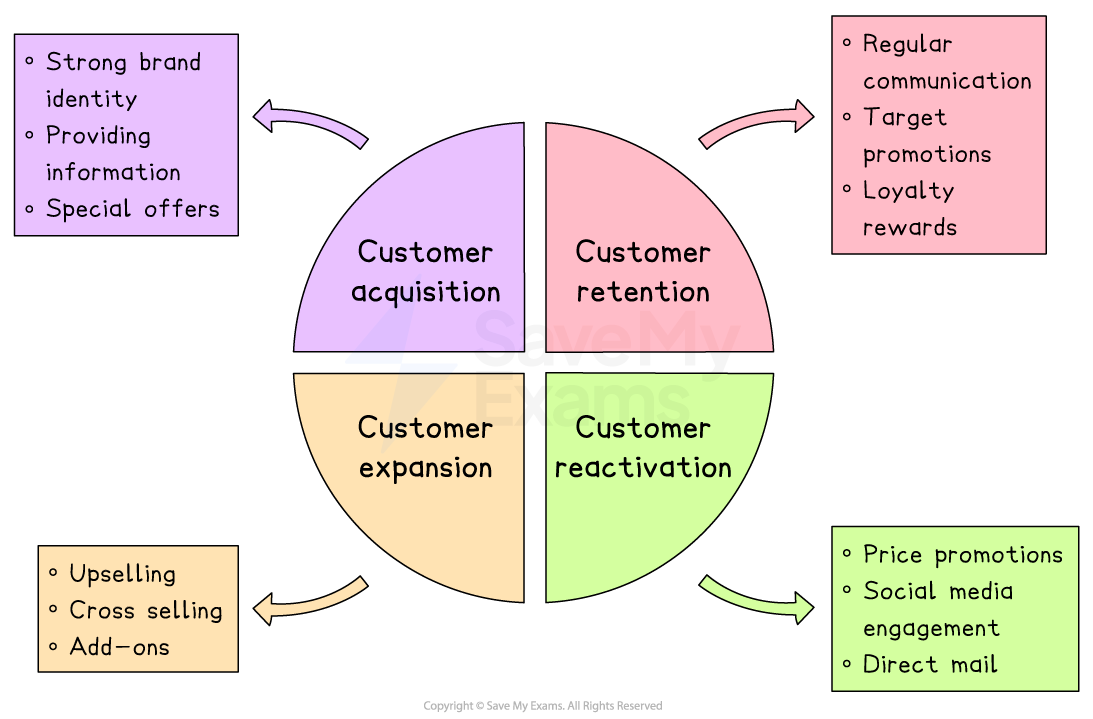
Customer acquisition
Attracting interested consumers and converting them into customers to achieve growth, make money and improve chances of business survival
Businesses can acquire customers in many different ways, including
Building a strong brand identity
Delivering excellent customer experiences
Providing clear information
Offering special rewards, such as price promotions
Customer retention
Customer retention involves encouraging customers to remain loyal to a business and its brands over time
Encouraging loyalty is important for several reasons
Attracting new customers often costs more than retaining current customers
Loyal customers tend to be valuable repeat customers
Retained customers can refer new customers to a business
Word-of-mouth marketing is a form of free marketing for a brand
Happy customers talking about a business or brand in positive ways can help persuade people they know to become loyal customers as well
Businesses can retain customers in many different ways, including
Customer loyalty schemes
Regular communication about new products or promotional offers
Targeted price promotions or other perks for existing customers
Customer expansion
Customer expansion is the process of encouraging existing customers to increase the value and frequency of their spending on products and services over time
Businesses can achieve customer expansion in several different ways, including
Upselling by encouraging customers to upgrade to premium products
Cross-selling by offering customers a related product or service
Providing add-ons such as insurance policies, extra features or extended warranties
Customer reactivation
Customer reactivation involves reaching out to customers who have previously expressed interest in or purchased a product but have since become disengaged
Businesses can adopt a range of techniques to reactivate customers, including
Social media engagement
Targeted price promotions for returning customers
Direct mailings via post or email
CRM and lead generation
Lead generation is the process of identifying and attracting potential customers, known as leads, who have shown some level of interest in the business's product or service but have not yet made a purchase
CRM systems capture lead information from sources, such as website enquiry forms, social media, events and email sign-ups, and store it in a single database for the sales team to follow up
Leads can be scored based on their likelihood to convert
For example, a lead who has visited the pricing page three times is more likely to buy than one who has only read a single blog post
Higher-scoring leads can be prioritised
Automated follow-ups, such as a series of helpful emails triggered when someone downloads a guide, can be managed through CRM software, keeping leads 'warm' until they are ready to buy
A well-managed lead generation process ensures the sales team always has a pipeline of potential customers to work with, reducing the risk of a sudden drop in new business
CRM and pipeline management
Pipeline management involves tracking all potential sales opportunities through each stage of the sales process, from initial contact through to a completed purchase
The sales pipeline gives the team a clear, visual picture of where every opportunity currently stands
CRM software displays the pipeline as a series of stages, showing how many opportunities are at each stage and their combined value
This allows sales managers to forecast future revenue, identify where deals are stalling, and provide support to the sales team at the right moments
A typical sales pipeline
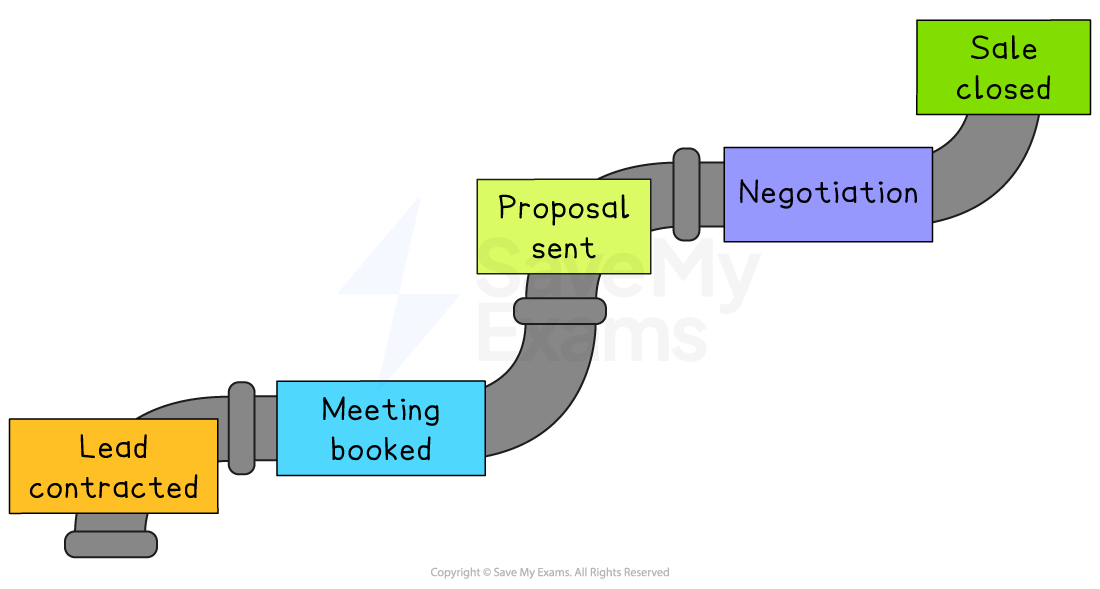
If many opportunities are consistently dropping out at the same stage, it signals a problem
Perhaps the price proposal is putting people off, or the follow-up process is too slow - that can then be addressed
Effective pipeline management improves the efficiency and success rate of the sales team
It reduces the number of opportunities lost through poor follow-up, and gives management a reliable forecast of future income
Case Study
Ironbridge Fitness

Ironbridge Fitness is a chain of six gyms across the West Midlands. With competition from budget gym chains nearby, keeping hold of members and winning new ones is a constant challenge, so the business uses CRM software to manage customer relationships more effectively.
When someone fills in an online form asking about membership, their details are saved in the system as a lead. Staff can see at a glance which leads have not been followed up yet, so no potential member is forgotten. Each lead moves through clear stages - enquiry received, trial visit booked, membership offered - until they either sign up or drop out.
Once someone becomes a member, the CRM tracks how often they visit. Members who have not been to the gym for three weeks automatically receive a friendly message encouraging them to come back. Those who have been members for eleven months get a personalised reminder about renewing before their membership expires.
By staying in regular, relevant contact with both potential and existing members, Ironbridge has reduced the number of memberships that lapse each month and improved its conversion rate from enquiry to sign-up.
Examiner Tips and Tricks
CRM is most valuable when it is embedded across the whole business - not just the sales team. When marketing, sales, and customer service all work from the same customer data, the business can deliver a consistent, joined-up experience that builds genuine long-term loyalty

Unlock more, it's free!
Join the 100,000+ Students that ❤️ Save My Exams
the (exam) results speak for themselves:

Was this revision note helpful?
