Promotional Mix (AQA A Level Business): Revision Note
Syllabus Edition
First teaching 2026
First exams 2028
Exam code: 7132

Purpose and value of promotion
The purpose of promotion is to communicate with potential and existing customers to influence their attitudes and behaviour towards a product or brand
Promotion aims to:
Build awareness
Letting target customers know a product or brand exists is particularly important for new products or businesses entering a new market
Inform
Communicating the features, benefits and value of a product to help customers make informed purchase decisions
Persuade
Encouraging potential customers to choose this product over a competitor's
Remind
Keeping the brand in the minds of existing customers to encourage repeat purchase and maintain loyalty
Differentiate
Highlighting what makes the product unique or superior to alternatives, strengthening the brand's competitive position
The value of promotion
Effective promotion delivers significant benefits to a business
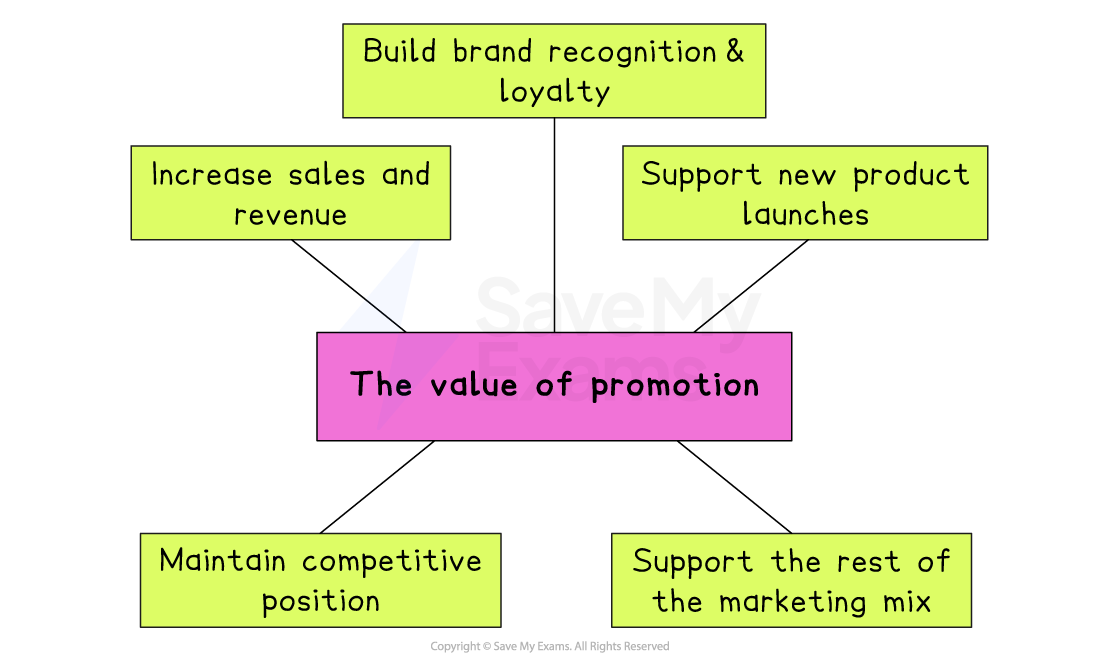
Increases sales and revenue by reaching more potential customers and persuading them to buy
Builds brand recognition and loyalty
Consistent, well-targeted promotion creates familiarity and trust over time
Supports new product launches
Promotion is essential in the introduction stage of the product life cycle, where building awareness is the priority
Maintains competitive position
Promotion keeps a business visible and relevant in a competitive market
Supports the rest of the marketing mix
Promotion communicates the value of the product, helps justify the price and directs customers to where they can buy it
What is the promotional mix?
The promotional mix is the combination of promotional tools a business uses to communicate with its target market
Rather than relying on a single method, most businesses use several tools together
They select the combination that will most effectively reach their target customers and achieve their marketing objectives
Elements of the promotional mix
Element | Description |
|---|---|
Advertising |
|
Sales promotions |
|
Personal selling |
|
Sponsorship |
|
Digital and social media marketing |
|
Examiner Tips and Tricks
Promotion does not work in isolation - it must be consistent with the rest of the marketing mix. Advertising a luxury product through low-quality, low-budget channels would undermine rather than support the brand's positioning
Influences on the promotional mix
The combination of promotional tools a business selects is shaped by several important factors
The target market
The characteristics of the target market are arguably the most important influence on the promotional mix
A younger, digitally active audience is best reached through social media platforms such as Instagram, TikTok and YouTube
An older or broader audience may respond better to television, radio or print advertising
A niche business-to-business (B2B) audience is most effectively reached through personal selling, trade publications and industry events
Marketing budget
The promotional budget directly limits which tools are available
Television advertising campaigns can cost millions of pounds and are beyond the reach of most smaller businesses
Social media and email marketing are relatively low-cost, making them accessible to businesses with limited budgets
A restricted budget may require a business to focus on one or two highly targeted tools rather than a broad mix
Nature of the product
The type of product influences which promotional tools are most effective
Mass-market consumer goods (e.g. food, drink, personal care)
Suit advertising and sales promotions, which reach large audiences quickly
High-value or complex products (e.g. industrial equipment, financial services)
Require personal selling, where a representative can explain benefits and address concerns directly
Products with strong visual appeal
Benefit from image-led channels such as Instagram or lifestyle magazine advertising
Stage in the product life cycle
The promotional mix should reflect where the product sits in its life cycle
Introduction
Advertising to build awareness
Public Relations (PR) to generate media coverage
Growth
Advertising to build brand preference
Social media to build community and engagement
Maturity
Sales promotions to stimulate repeat purchase
Sponsorship to maintain brand visibility
Decline
Reduced promotional spending
Targeted direct marketing to retain the most loyal customers
Marketing objectives
The promotional tools chosen should directly support the marketing objective being pursued
Brand awareness
Advertising and PR reach the widest audience
Customer retention
Direct marketing and loyalty schemes target existing customers personally
Immediate sales boost
Sales promotions such as limited-time discounts or offers
Lead generation
Paid search advertising and email campaigns
Competitors' promotional activity
A business must consider how its rivals are promoting their products
If competitors invest heavily in advertising, cutting promotional spend risks losing visibility and market share
If a rival launches an innovative campaign, the business may need to respond to protect its competitive position
Type of market
In B2C (business-to-consumer) markets
Promotion tends to focus on emotional appeal, brand building and reaching large audiences efficiently
In B2B (business-to-business) markets
Promotion tends to focus on personal relationships, technical performance and direct communication with specific decision-makers
Examiner Tips and Tricks
There is rarely a single correct promotional mix - the right combination depends on the specific business, its target market, its budget, and its objectives. In evaluation questions, justify your choice of promotional tools by linking them clearly to the business's context, rather than simply listing every option available

Unlock more, it's free!
Join the 100,000+ Students that ❤️ Save My Exams
the (exam) results speak for themselves:

Was this revision note helpful?
