Market Competition (AQA A Level Business): Revision Note
Syllabus Edition
First teaching 2026
First exams 2028
Exam code: 7132

Degrees of competition
Every business operates within a competitive environment, and the nature of that competition shapes the decisions it makes about pricing, marketing and strategy
Understanding market conditions - how competitive a market is, how rivals behave and whether the market is growing - is essential for effective business planning
The nature of competition
Competition exists when there is more than one business supplying goods to consumers in a market
Types of competition
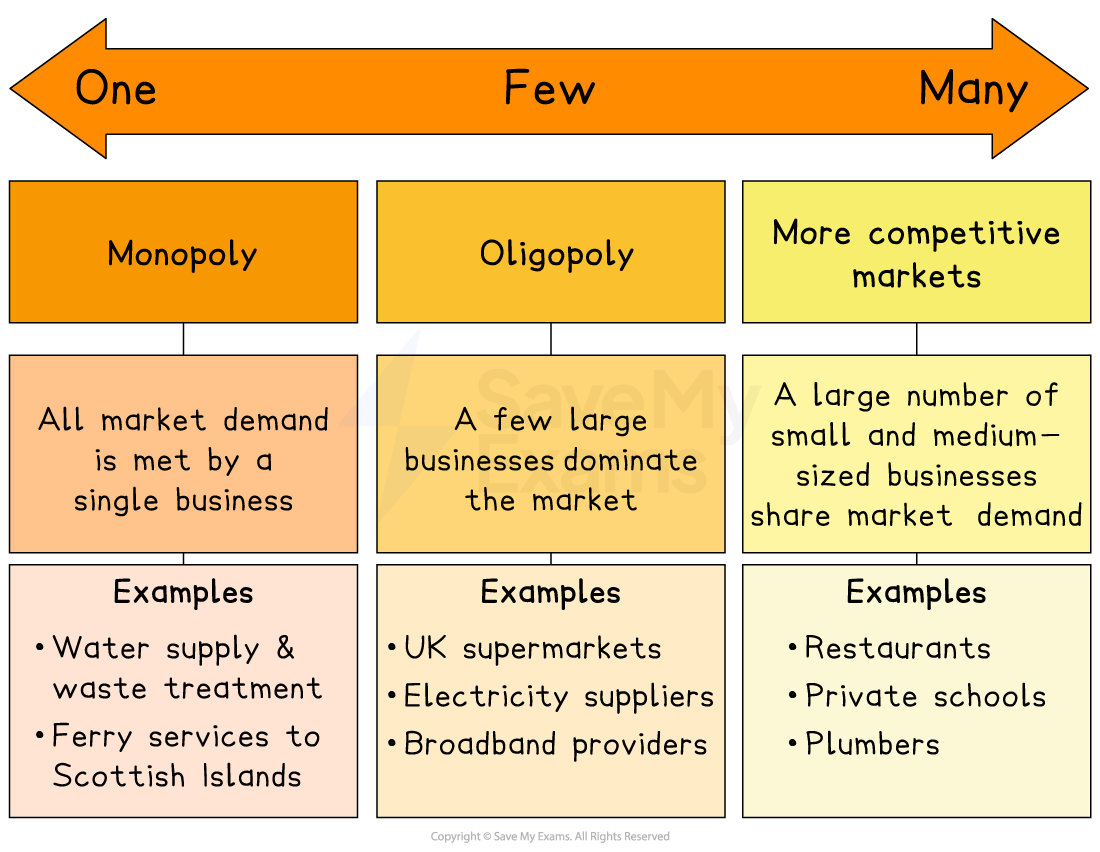
Monopoly markets
In monopoly markets, one business meets all consumer demand
In the UK, these markets have often emerged as a result of privatisation, where public sector monopolies were transferred to private ownership in the 1980s
Examples include water supply and waste treatment, as well as some transport services, including ferry services to remote Scottish islands
Competition in monopoly markets
Businesses that operate as the single provider in a market do not need to compete with rivals
Monopoly businesses' price policies are controlled by the government, to ensure that they do not overcharge for their services
Monopoly businesses can make large profits
They do not need to spend money on product innovation, advertising or market research
Some monopolies are criticised for their failure to invest in infrastructure, whilst rewarding shareholders with large dividends
Customers cannot shop around for a better deal
If customers need to buy products sold by monopoly businesses, their needs are unlikely to be fully met, as products are standardised
Oligopoly markets
In an oligopoly, a few large businesses dominate the market
Examples include UK supermarkets, electricity suppliers and broadband suppliers
Most business sectors in the UK are dominated by this type of competition
Competition in oligopoly markets
Where a small number of large firms dominate a market, there is often limited price competition
Prices are often similar between powerful firms, with large sums spent on promotion to differentiate products
Smaller businesses may be able to offer lower prices, but they are likely to struggle to survive
Products are quite similar but, often, highly branded to appear different to those of rivals
Customers have some choice, but this is often based on quality, product range, accessibility of the business and customer service
Product development is a key way to compete in oligopoly markets, with new and improved products helping key brands stand out from rivals and encourage customer loyalty
In some oligopoly markets, governments intervene to ensure that no one business becomes too powerful
E.g. the UK government blocked the takeover of failing UK supermarket Safeway by market leaders Tesco, ASDA and Sainsbury's
More competitive markets
In some cases, a large number of small and medium-sized businesses compete to meet market demand
This is called perfect competition
Examples include restaurants, nail bars and home services such as plumbers
Competition in more competitive markets
Where many small and medium-sized businesses compete to meet market demand, price competition is likely to be most intense
Customers can switch with ease between the many different providers of products
Customers have a high level of choice between businesses offering a wide range of unique products
Businesses that can afford to do so invest in innovation and product differentiation to build market share
Customers can be persuaded to become loyal to businesses through excellent customer service and products that meet their needs closely
Competitive behaviour
Competitive behaviour describes the strategies businesses use to win and retain customers in the face of rivalry
Businesses in highly competitive markets must monitor rival behaviour constantly and be ready to adapt their strategies quickly
Examples of competitive behaviour
Competitive behaviour | Explanation |
|---|---|
Price competition |
|
Non-price competition |
|
Product differentiation |
|
Innovation |
|
Case Study
Apple's competitive strategies

Apple is one of the world's most valuable companies, yet it rarely competes on price. In a smartphone market where rivals such as Samsung and Google compete aggressively on features and cost, Apple has built its competitive advantage almost entirely through non-price competition.
Product differentiation
Apple devices are designed to work seamlessly together (iPhone, iPad, Mac, Apple Watch, AirPods), making switching to a rival brand costly and inconvenient for customers
Brand loyalty
Consistent design, intuitive software and a carefully managed premium image mean millions of customers upgrade within the Apple range rather than considering alternatives
Innovation
The regular launch of new technologies, such as Apple Silicon chips and Face ID, keeps the brand ahead of competitors and generates media coverage at no advertising cost
Premium pricing
Rather than cutting prices, Apple deliberately positions itself at the top of the market, using price as a signal of quality and exclusivity
The result is profit margins that most rivals cannot come close to matching
Market growth
Market growth refers to an increase in the total size of a market over time, measured by sales volume or value
The rate at which a market is growing has important implications for business strategy:
In a fast-growing market, such as electric vehicles or AI software, businesses can increase sales without taking customers from rivals, reducing the pressure to compete aggressively
Growing markets tend to attract new entrants, which increases competition over time and may reduce the advantage of early movers
In a mature or declining market, such as print newspapers or landline telephones, total sales are flat or falling, so businesses must fight harder for market share
A declining market may force businesses to cut costs, diversify or exit altogether
Monitoring market growth trends helps businesses make important decisions, including:
where to invest
which products to develop
which markets to enter or leave
Examiner Tips and Tricks
When analysing market conditions in an exam, always link your answer to the implications for the specific business in the case study. For example, if a business operates in a highly competitive market, explain what this means for its pricing strategy, profit margins or marketing spend - do not just describe the market. In evaluation questions, consider whether non-price competition is likely to be more effective than price competition, given the business's resources and market position

Unlock more, it's free!
Join the 100,000+ Students that ❤️ Save My Exams
the (exam) results speak for themselves:

Was this revision note helpful?
