What is Corporate Social Responsibility (CSR)? (AQA A Level Business): Revision Note
Syllabus Edition
First teaching 2026
First exams 2028
Exam code: 7132

The purpose of corporate social responsibility (CSR)
Corporate Social Responsibility (CSR) refers to the concept that businesses have a responsibility to consider and positively impact society beyond their economic interests
It is a framework through which companies voluntarily integrate social and environmental concerns into their business operations and interactions with stakeholders
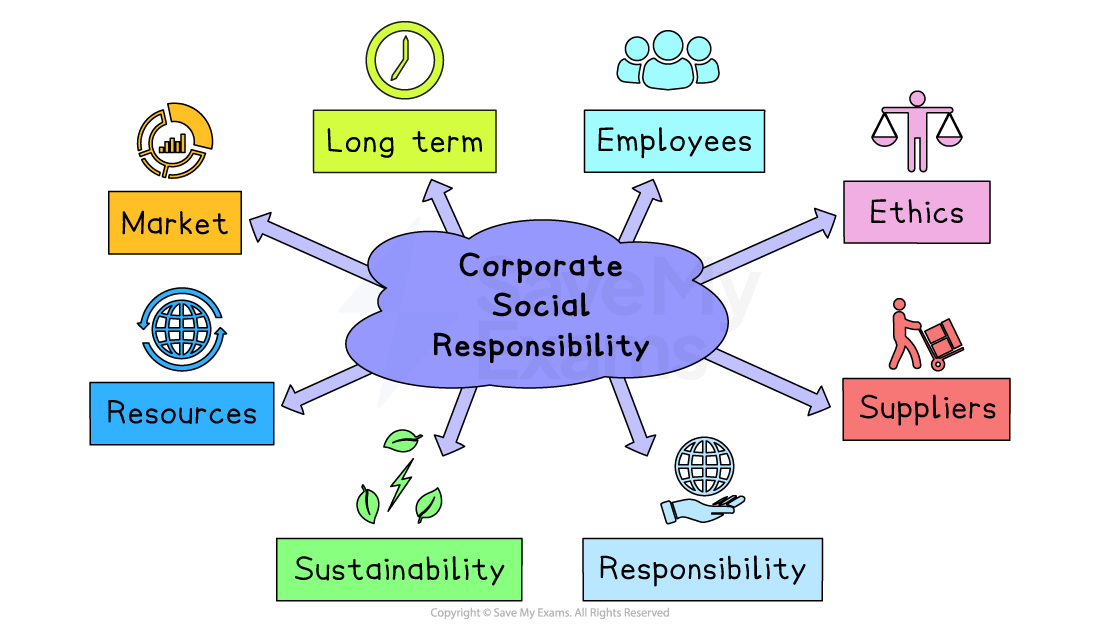
CSR involves taking into account the impact of business activities on various stakeholders, including employees, customers, communities, the environment, and society at large
CSR goes beyond legal compliance and strives for companies to actively contribute to sustainable development and societal well-being
The value of CSR
It encourages businesses to consider the wider impact of their decisions on stakeholders beyond shareholders alone
Rather than focusing purely on profit
It helps build a positive reputation and trust with customers, employees and investors
This can support long-term commercial success
It reduces the risk of future legal problems
Businesses that act responsibly are less likely to break rules designed to encourage good practice
It can improve staff motivation, recruitment and retention
Employees increasingly want to work for a business with a genuine social conscience
It supports better relationships with communities a business operates in
It can reduce conflict and build local support for its operations
It can create a genuine competitive advantage
Differentiating a business from rivals who take a narrower, purely profit-focused approach
Examples of socially responsible activities
Sustainable sourcing of raw materials and components
Japanese fashion retailer Uniqlo has moved towards an eco-friendly strategy in recent years, focusing on technologies that make the production of new clothing from recycled materials possible
Responsible marketing
Marks and Spencer ensures that it never actively directs any marketing communications to children under the age of 12 and does not directly advertise any products high in fat, sugar or salt to children under the age of eighteen
Protecting the environment
Multinational coffee chain Starbucks offers discounted coffee for customers
with a branded multi-use cup
Responsible customer service
John Lewis's famous 'Never Knowingly Undersold' slogan refers to the company's commitment to checking competitor prices regularly to ensure that the price its customers pay is price matched to major online and high street retailers at that time
CSR versus PR
Public relations (PR) is the management of a business's communication and reputation with the public, media and other stakeholders, focused on shaping how a business is perceived
CSR is about a business's genuine actions and their impact on society
PR is about how a business communicates and manages its public image
Genuine CSR can support good PR
However, PR without real CSR substance behind it risks misleading stakeholders about how responsible a business actually is
Greenwashing
Greenwashing means a business exaggerating, misrepresenting, or falsely claiming that its products, services or practices are more environmentally friendly than they genuinely are
It is used as a form of PR without matching real action and can mislead customers and investors
If exposed, it causes serious reputational damage and a loss of trust
Example
In 2022, Keurig Canada was fined $3 million after regulators found it had made false or misleading claims that its single-use coffee pods could be recycled, when in reality many local recycling programmes did not accept them or required extra steps the company hadn't disclosed.
Keurig had to correct its packaging and publish notices admitting the claims were misleading
Bluewashing
Bluewashing means a business associating itself with ideas around human rights and ethics, to appear socially responsible without genuinely changing its practices
The name comes from the blue of the United Nations flag and logo
Like greenwashing, bluewashing can mislead stakeholders
If a business's claims to social responsibility are shown to be superficial, it can damage trust more severely than if it had never made the claim at all
Example
Nike, Shell and Rio Tinto were among the earliest companies to join the UN Global Compact in 2000, a voluntary agreement on human rights and environmental principles. These businesses were facing well-documented criticism at the time over labour conditions, human rights and environmental damage.
Critics argue that simply signing the Compact, which is not binding, let such companies borrow the UN's reputation for legitimacy without making real changes to their practices.

Unlock more, it's free!
Join the 100,000+ Students that ❤️ Save My Exams
the (exam) results speak for themselves:

Was this revision note helpful?
