The Importance of Sustainability (AQA A Level Business): Revision Note
Syllabus Edition
First teaching 2026
First exams 2028
Exam code: 7132

The nature of sustainability
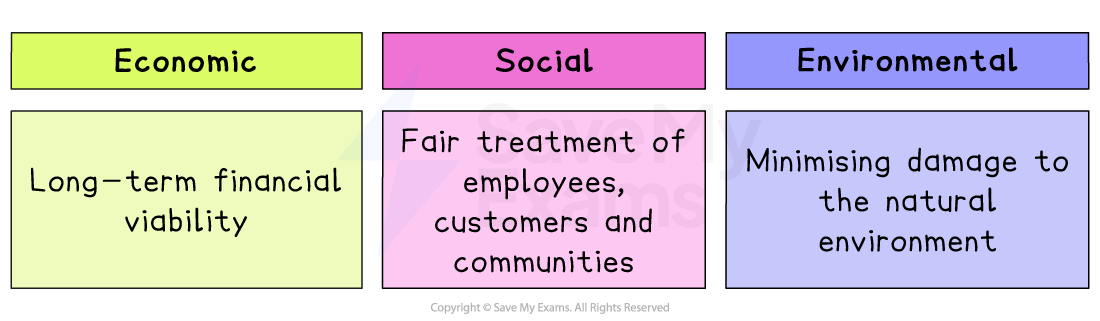
Sustainability in business means meeting the needs of the present without compromising the ability of future generations to meet their own needs, balancing economic, social and environmental considerations
Dimensions of sustainability
Benefits of sustainability
Sustainability is likely to lead to long-term profitability
Businesses that ignore social or environmental risks may face rising costs, legal challenges or resource shortages in the future
It helps a business meet increasing expectations
Customers, investors and regulators increasingly reward or punish businesses based on their sustainability record
It reduces the risk of reputational damage, fines or lost customers that can result from unsustainable practices being exposed
It improves access to finance
Many investors and banks now favour, or require, evidence of sustainable practices before investing or lending
Example
Apple has raised $4.7 billion through 'green bonds' since 2016, using the money specifically to fund clean energy and carbon-reduction projects, giving it access to finance tied directly to its sustainability commitments
It can improve staff recruitment, retention and motivation
Employees often want to work for businesses whose values align with their own
Example
A Deloitte survey of over 23,000 Gen Z and Millennial employees found that 70% considered a company's environmental record important when choosing an employer, and that around 40% had left a job or turned one down due to a mismatch with their personal values
Source: Deloitte - GenZ, Millennial Survey (opens in a new tab)
It supports long-term resource security
It protects the materials, energy and other resources a business will continue to need in future
It can create competitive advantage
It differentiates a business from rivals seen as less sustainable
Example
Tesla built an early competitive advantage in the car industry by focusing on electric vehicles well before most competitors, positioning it as a leader in sustainable transport while traditional manufacturers were still investing mainly in petrol and diesel models
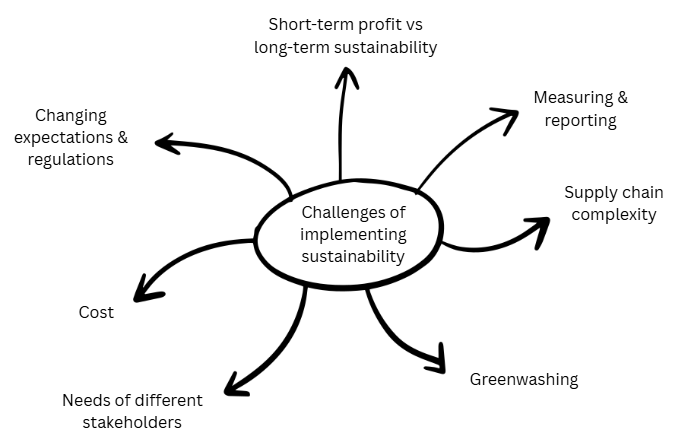
Challenges of implementing sustainability
Cost
Sustainable materials, technology and processes are often more expensive in the short term than conventional alternatives
This can be a particular challenge for smaller businesses that may not enjoy cost benefits of economies of scale
Balancing short-term profit with long-term sustainability
Shareholders and managers are often under pressure to deliver short-term financial results
This can conflict with the longer payback period of many sustainability initiatives
Example
In 2023, BP scaled back its climate targets, cutting its planned oil and gas production reduction from 40% to 25% by 2030, following pressure from shareholders who wanted higher short-term financial returns instead
Measuring and reporting sustainability accurately
Unlike financial performance, sustainability impacts, such as carbon emissions or social impact, can be difficult to measure consistently
This makes it hard to prove genuine progress
The complexity of supply chains
Businesses often rely on suppliers based around the world
This makes it difficult to monitor and guarantee sustainable practices throughout the whole supply chain
Example
Apple, Google, Tesla and Microsoft were sued in 2019 over claims that cobalt used in their products, mined in the Democratic Republic of Congo, involved child labour.
The case was dismissed by a US court, which said simply buying a material through a global supply chain did not make the companies legally responsible, illustrating how difficult it can be to guarantee ethical practice deep within a complex supply chain
Greenwashing accusations
Greenwashing is when a business exaggerates or falsely claims that its products, services, or practices are environmentally friendly in order to appear more sustainable than it really is
Businesses that do so can face accusations of exaggerating or misrepresenting their genuine impact
This damages trust if it is exposed
Example
In 2020, the UK's Advertising Standards Authority banned Ryanair adverts that claimed it was 'Europe's lowest emissions airline,' ruling the claims misleading. While Ryanair had used a genuine measure (CO₂ per passenger-kilometre) the ASA found the evidence did not clearly support the claim as presented.
Even a technically correct environmental claim can still be judged as greenwashing if it isn't made clear and fully justified to customers.
Balancing the needs of different stakeholders
Shareholders, employees, customers and environmental groups may have competing priorities
It is difficult to satisfy every group at once
Keeping pace with changing expectations and regulations
Sustainability expectations and legal requirements are evolving
Businesses must continually adapt rather than treating sustainability as a one-off project
Case Study
Millbrook Dairies
Millbrook Dairies is a dairy processing company supplying milk and cheese to UK supermarkets.
Aiming to reduce its environmental impact, the company announced plans to move its entire fleet of collection lorries to electric vehicles and to source milk only from farms meeting new animal welfare and environmental standards.
The investment required for new vehicles and charging equipment was far higher than expected, and some shareholders raised concerns about the impact on short-term profit margins.
Verifying that every one of its several hundred dairy farm suppliers met the new environmental standards proved difficult and time-consuming, as farms varied significantly in size and record-keeping.
When Millbrook launched an advertising campaign describing its milk as 'carbon neutral' a customer complaint led to the claim being investigated, and the company had to clarify that the label applied only to emissions from transport rather than the whole production process.
Some farmers also threatened to switch to a competitor rather than meet the new requirements, risking a supply shortage.
Examiner Tips and Tricks
A common error is treating sustainability as purely an environmental issue. At A-Level, sustainability covers economic, social and environmental dimensions, so make sure your answer reflects this broader definition rather than focusing only on the environment

Unlock more, it's free!
Join the 100,000+ Students that ❤️ Save My Exams
the (exam) results speak for themselves:

Was this revision note helpful?
