Methods of Improving Quality (AQA A Level Business): Revision Note

Syllabus Edition

First teaching 2026

First exams 2028

Exam code: 7132

Lisa Eades

Written by: Lisa Eades

Reviewed by: Bridgette Barrett

Updated on

Quality control and quality assurance

Quality control

  • Quality control is a traditional method of checking quality at the end of the production process by using quality inspectors to find faults

  • It is not possible to achieve perfection in every production process

    • E.g. there will always be some variation in terms of materials used, production skills applied or reliability of the finished product

Advantages and disadvantages of quality control

Advantages

  • Specialists in quality control check standards

  • Little staff training is needed, as inspectors check quality rather than the employees themselves

  • It is an inexpensive and simple way to check that output is fit for purpose

Disadvantages

  • Rejecting finished goods is a significant waste of resources

  • The cause of defects is ignored, so problems may continue

  • There are high costs of scrapping or reworking products

Quality assurance

  • Quality assurance involves inspecting the quality of production throughout the process

    • Workers check their own work and, sometimes, the work of others at various stages of production 

  • Some businesses take a whole-business approach to quality assurance, with systems such as quality circles, benchmarking and total quality management (TQM)

Advantages and disadvantages of quality assurance

Advantages

  • Quality issues are identified early, so products may be reworked rather than rejected

  • The cause of defects is the focus, so future quality issues may be prevented

Disadvantages

  • Staff training and a skilled workforce is required, so labour costs may be increased

  • Reworking may lengthen the production process

Total Quality Management (TQM)

  • TQM involves the organisation of the business with quality at its core and with every worker responsible for quality

Advantages and disadvantages of TQM

Advantages

  • Improved efficiency

    • Focusing on quality in every part of the business helps reduce waste and mistakes, which can lead to higher profits

  • Positive culture

    • TQM encourages a workplace culture where everyone aims for high standards and continuous improvement

Disadvantages

  • Commitment and training

    • All employees must be fully committed, and regular training is needed to keep quality high

  • Strong leadership needed

    • Managers must carefully monitor progress and lead by example to keep the system working effectively

Quality circles

  • Quality circles are groups of workers who meet regularly to solve quality problems identified in the production process

Advantages and disadvantages of quality circles

Advantages

  • Improved motivation

    • Workers feel more valued and motivated when they are included in decision-making

  • Better solutions

    • Employees often understand daily processes well, so the ideas they suggest are likely to be relevant and effective

  • Higher productivity

    • When workers help create solutions, they are more engaged and likely to work harder to make them succeed

Disadvantages

  • Trust from management

    • Leaders must trust employees’ ideas, which may not always happen easily

  • Training required

    • Employees may need regular training to take part effectively in decision making

  • Time and organisation

    • Meetings and discussion structures must be organised regularly, which takes time and effort

Benchmarking

  • Benchmarking involves a business comparing its quality and performance with market leaders within the same industry

Internal benchmarking

  • Comparison of different functions within a business such as finance and marketing

    • Performance 

      • Comparison of key performance indicators such as labour productivity or labour turnover rates

    • Process

      • Comparison of business operations and processes such as call centre queue times or delivery times

External benchmarking

  • Comparison of key performance indicators (such as product recalls) against those of market leaders in an industry

  • International benchmarking compares key performance indicators against those of market leaders overseas

Advantages and disadvantages of benchmarking

Advantages

  • Helps identify areas where businesses can improve their performance by learning from the best practice of other successful companies

  • Can identify innovative practices and processes used by competitors

  • Can support the setting of realistic performance goals by comparing current performance with industry standards

  • Workers may feel a sense of pride and motivation when they see their employer striving to be a leader in the industry

Disadvantages

  • Differences in metrics used to measure performance can affect the accuracy and comparability of benchmarking data

  • Best practices from market leaders may not always be directly applicable to the unique needs of a specific business

  • Small businesses may struggle to find the time and resources for data collection, analysis and implementation required for benchmarking

  • Focusing too much on benchmarking against competitors may lead to a narrow view of success that ignores ideas for improvements that come from other sources

Difficulties of improving quality

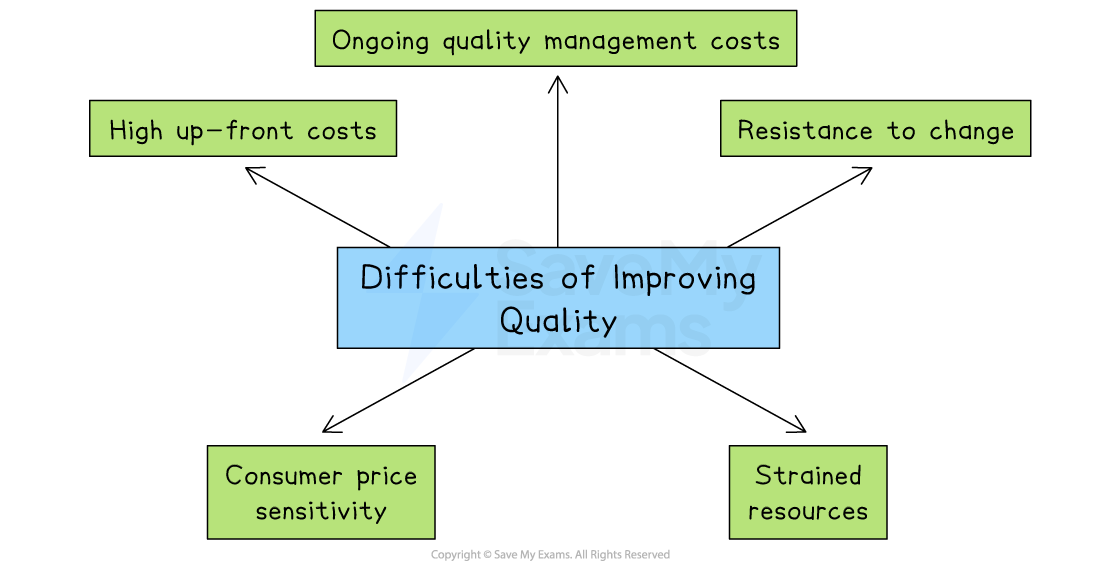
Flowchart showing difficulties of improving quality: ongoing costs, high up-front costs, resistance to change, consumer sensitivity and strained resources.
Improving quality can be difficult due to high up-front costs, resistance to change and ongoing quality management costs
  • High up‑front and ongoing quality management costs

    • Small firms often struggle to pay for staff training, better materials and certification fees

  • Staff or union resistance to new quality systems

    • Changing routines and adding checks can meet resistance from workers, slowing down their introduction

  • Customer price sensitivity

    • Better quality can push costs and, consequently, prices up

    • Price‑sensitive shoppers may switch brands

  • Strain on resources

    • If funds are scarce, pushing for higher quality can overstretch staff and cut service levels

Unlock more, it's free!

Join the 100,000+ Students that ❤️ Save My Exams

the (exam) results speak for themselves:

Lisa Eades

Author: Lisa Eades

Expertise: Curriculum Expert

Lisa has taught A Level, GCSE, BTEC and IBDP Business for over 20 years and is a senior Examiner for Edexcel. Lisa has been a successful Head of Department in Kent and has offered private Business tuition to students across the UK. Lisa loves to create imaginative and accessible resources which engage learners and build their passion for the subject.

Bridgette Barrett

Reviewer: Bridgette Barrett

Expertise: Development Editor

After graduating with a degree in Geography, Bridgette completed a PGCE over 30 years ago. She later gained an MA Learning, Technology and Education from the University of Nottingham focussing on online learning. At a time when the study of geography has never been more important, Bridgette is passionate about creating content which supports students in achieving their potential in geography and builds their confidence.