Choosing a Location (AQA A Level Business): Revision Note
Syllabus Edition
First teaching 2026
First exams 2028
Exam code: 7132

The importance of location
Business location is where a business establishes and runs its operations
Some businesses operate from a single location where they combine production, administration, sales and logistics
Others distribute operations across multiple locations to take advantage of factors such as wage costs, skill availability and levels of taxation
Remote businesses may not operate from a single location
They use online technologies to link dispersed staff and resources
Location is one of the most significant and difficult-to-reverse operational decisions a business makes
The wrong location can increase costs, reduce access to customers or skilled labour and damage long-term competitiveness
Relocating once a business is established is expensive and disruptive
Location affects almost every aspect of business performance
Costs
Rent, rates, wages and logistics vary significantly by location
Revenue
Proximity to customers influences footfall and sales potential
Staffing
Access to a skilled, affordable workforce depends on where the business is based
Efficiency
Transport links and infrastructure affect how smoothly the business can operate
Location cost
Property and land costs
Property and land costs vary dramatically by location
Prime retail or office space in city centres costs significantly more than out-of-town or rural sites
For manufacturing businesses, the cost of land for a factory or warehouse is a major consideration
For retail and service businesses, the higher cost of a prime location must be weighed against the potential revenue it generates through greater customer footfall
Example
A coffee shop in a busy London train station pays far higher rent than one in a market town, but benefits from a significantly higher daily customer footfall
Labour costs
Labour costs differ by region
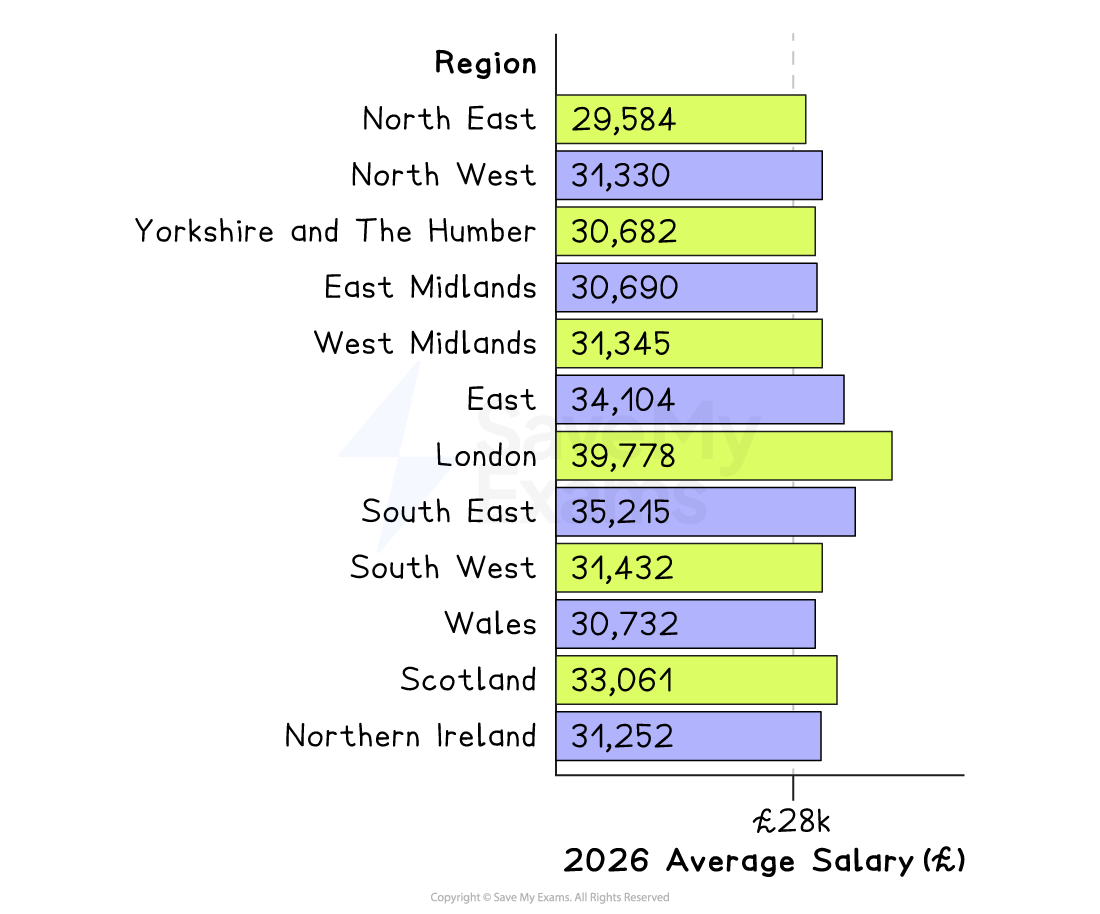
Average wages in London and the South East are typically higher than elsewhere in the UK
This can have a significant effect on the overall costs for businesses that employ large numbers of staff
Business rates (local authority taxes on commercial property) also vary by location and can represent a significant fixed cost
Utility costs, distribution costs and transport costs all differ depending on where a business operates
Demand and location
Businesses that sell directly to consumers need to locate where their target customers are concentrated
Footfall – the number of people passing a given location – is a critical factor for retail businesses
High-footfall locations generate more potential sales but typically cost more in rent
Some businesses benefit from agglomeration – locating near complementary or competing businesses to attract shared customer traffic
Example
Car dealerships frequently cluster together along the same road, as customers shopping for a car are more likely to visit a street where multiple options are available
Businesses selling online are less dependent on physical proximity to customers
They must still consider proximity to distribution networks and delivery hubs
Market research should identify where target customers live, work and shop before a location decision is made
Access to resources and markets
Manufacturing businesses need access to raw materials and components
Locating near suppliers reduces transport costs and lead times
Example
Steel manufacturers historically located near coalfields and iron ore deposits to minimise input costs
Agricultural businesses must locate where climate, soil and water supply are suitable for their produce
Businesses that distribute products widely benefit from central locations with strong connections to major road, rail or port networks
Knowledge and technology businesses cluster in areas with high concentrations of skilled workers
Example
Technology firms cluster around Cambridge and East London - known as the Silicon Roundabout - to access a pool of engineering and software graduates
Globalisation has made it easier for businesses to access resources and markets from a wider range of locations
There are now fewer locational constraints that once tied production to specific regions
Infrastructure and location
Infrastructure refers to the physical and digital systems that support business operations
This includes roads, rail, ports, airports, broadband and energy supply
Strong transport infrastructure reduces logistics costs and speeds up the movement of goods and people
Poor infrastructure in an otherwise attractive location can increase costs and reduce operational efficiency
Digital infrastructure, including high-speed broadband and reliable connectivity, has become essential for technology businesses, financial services and any organisation with remote or hybrid working arrangements
Businesses that rely on importing raw materials or exporting finished goods benefit from proximity to ports or major airports
Example
Manufacturers in the Midlands benefit from excellent road and rail connections to ports across the UK, reducing distribution costs
Government incentives and location
Governments use financial incentives to encourage businesses to locate in specific areas
Particularly those with high unemployment or weak economic performance
Incentives can make a less commercially obvious location financially attractive, particularly for capital-intensive businesses where fixed costs are high
Common types of incentive
Enterprise Zones and Freeports
Designated areas where businesses receive tax breaks, simplified planning permission and reduced customs duties
Example
Freeports have been established in Teesside, Humber and East Midlands Airport following the UK's departure from the EU
Grants
Direct financial awards to businesses that create jobs in target areas
These do not need to be repaid
Reduced business rates
Local authorities may offer discounted rates to attract specific types of business
Subsidised training
Government-funded programmes to upskill workers in target regions, reducing recruitment and training costs for incoming businesses
Ethical, environmental and people factors affecting location
Some businesses choose not to locate in areas where employment laws are weak or poorly enforced, even where doing so would reduce costs
Locating production in countries with lower environmental standards to avoid compliance costs raises significant ethical concerns and reputational risk
Businesses must consider the impact of their presence on local communities, including environmental degradation and the use of local resources
Environmental considerations
The distance between a business's location and its suppliers or customers directly affects its carbon footprint
Shorter supply chains typically mean lower transport emissions
Businesses increasingly assess flood risk, climate vulnerability and exposure to natural disasters when considering potential locations
Planning restrictions may prevent businesses from locating in protected areas, regardless of commercial attractiveness
People and workforce considerations
Access to a skilled workforce is one of the most important location factors for knowledge-intensive businesses
Local unemployment rates affect both the availability of workers and prevailing wage levels
Quality of life factors – schools, housing, transport, amenities – affect a business's ability to attract senior employees who may need to relocate
Commuter accessibility determines the catchment area from which the business can realistically recruit
Break-even, return on investment and location decisions
Break-even and location
Break-even analysis can be used to compare location options by calculating the minimum level of sales needed to cover costs at each site
Different locations have different fixed costs (rent, rates) and potentially different variable costs (wages, utilities)
A city-centre location will have a higher break-even point but may generate higher revenue through greater footfall
A lower-cost out-of-town site will have a lower break-even point but may attract fewer customers
Comparing break-even points across different options allows a business to assess which location offers the strongest financial case given its expected level of demand
Example
A gym considering two sites – one in a city centre at £80,000 annual rent and one on a retail park at £35,000 – would calculate the number of memberships needed to break even at each location before committing
Return on investment and location
Return on investment (ROI) measures the financial return generated by a location decision relative to its cost
It is expressed as a percentage and calculated using the formula
Worked Example
Harlow Home is a UK homeware retailer planning to open a new store. The business is comparing two possible locations.
Location A - High street | Location B - Retail park | |
|---|---|---|
Investment cost | £200,000 | £100,000 |
Projected annual revenue | £480,000 | £300,000 |
Projected annual costs | £400,000 | £245,000 |
Projected annual profit | £80,000 | £55,000 |
Calculate the ROI for each location and recommend which Harlow Home should choose.
Location A
Location B
On the basis of ROI alone, Location B is the stronger financial choice
Although Location A generates a higher absolute profit (£80,000 vs £55,000), Location B produces a significantly higher return on the money invested (55% vs 40%)
However, if Harlow Home has sufficient capital and is prioritising long-term profit growth over return on investment, Location A may be worth considering
Particularly if city-centre footfall and brand visibility are strategic priorities for the business
A premium location may generate a higher ROI despite higher costs if it delivers a significantly greater increase in revenue
ROI analysis should consider the time horizon of the investment
Some locations take longer to generate returns, particularly where the business is entering a new market or building brand awareness from scratch
Break-even and ROI analysis are most useful when used together
Break-even shows when a location becomes profitable
ROI shows how profitable it is relative to the cost of being there

Unlock more, it's free!
Join the 100,000+ Students that ❤️ Save My Exams
the (exam) results speak for themselves:

Was this revision note helpful?
