Principles of Organisational Design (AQA A Level Business): Revision Note
Syllabus Edition
First teaching 2026
First exams 2028
Exam code: 7132

Introduction to organisation structures
Organisational structures show the reporting relationships, roles and responsibilities of employees in a business
Businesses must determine what the best structure is for them to effectively implement their ideas and achieve their objectives
They should consider how the structure may affect the management and effectiveness of operations and communications
A well-designed organisational structure helps to promote clarity, efficiency and accountability
Key terminology used in organisational design
Hierarchy
A hierarchy refers to the levels of authority within an organisation
It describes the ranking of positions from top to bottom
The higher the position in the hierarchy, the more authority and power it holds
The hierarchy usually includes top-level management, middle-level management and lower-level employees
Bureaucracy
A bureaucracy is an organisation with many levels of authority
This makes decision-making and communication somewhat time-consuming
Centralised and decentralised structures
In a centralised structure, decision-making authority is concentrated at the top of the organisation, with senior management making most of the decisions
In a decentralised structure, decision-making authority is distributed throughout the organisation, with lower-level employees having more delegated decision-making power
Decentralisation can promote flexibility and innovation, while centralisation can promote consistency and control
Chain of command
The chain of command is the formal line of authority that flows down from the top management to lower-level employees
It defines who reports to whom
The chain of command helps to establish a clear communication channel and helps to maintain accountability within the organisation
Span of control and levels of hierarchy
The span of control is the number of employees that a manager or supervisor effectively manages
The span of control affects how closely employees are supervised and how quickly decisions can be made
The appropriate span of control depends on the complexity of the work, the experience of the employees and the management style of the business
A wide span of control reduces the number of managers needed, lowering costs
But each manager has less time to devote to each employee, which can reduce the quality of support and oversight
A narrow span of control allows closer supervision and stronger communication between manager and team
But requires more managers, increasing costs and potentially slowing decision-making
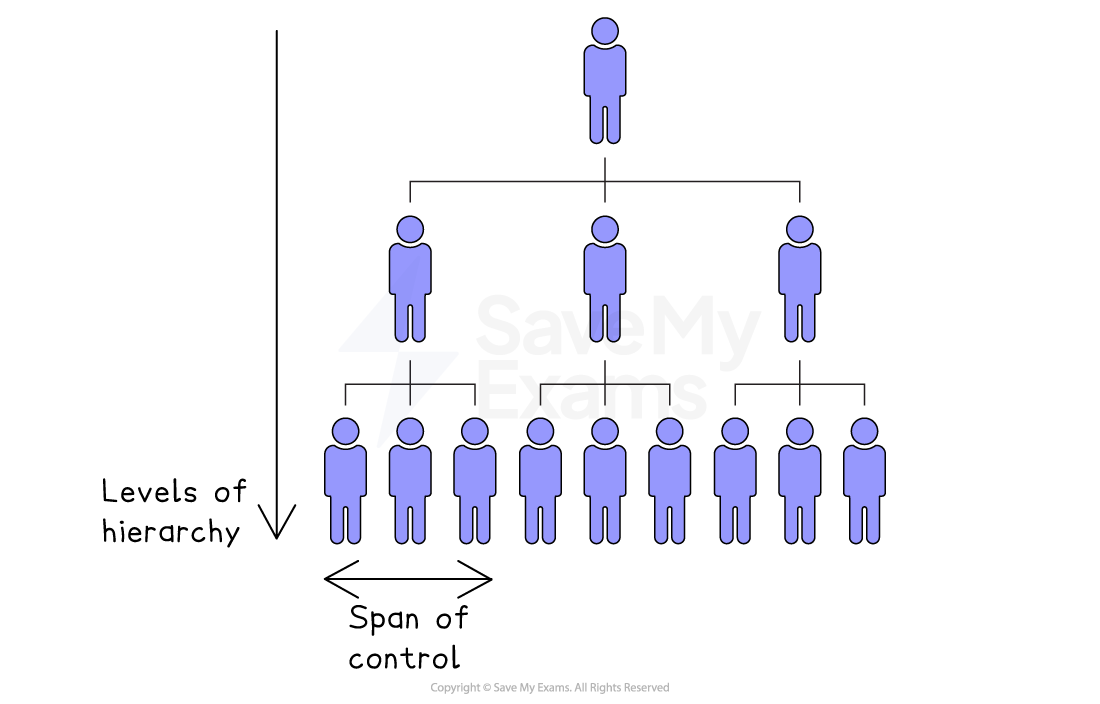
Levels of hierarchy refers to the number of layers of authority within an organisational structure, from the most senior (e.g. the chief executive) to the most junior (e.g. frontline workers)
Levels of hierarchy determine how far decisions must travel up and down the organisation, affecting the speed and quality of communication
Tall structures have many levels of hierarchy
These give employees a clear chain of command and defined career progression
They can slow decision-making and create distance between senior management and frontline staff
Flat structures have fewer levels of hierarchy
They allow for faster decision-making and more direct communication between managers and employees
They can increase individual workloads and limit career progression opportunities
The number of levels is directly linked to span of control
A business with wide spans of control needs fewer levels of hierarchy to manage the same number of employees
Tall and flat structures
Businesses typically design their organisations in one of two ways:
Tall organisational structure
Flat organisational structure
1. Tall organisational structures
Tall or vertical structures have multiple levels of management, a more centralised decision-making process and a long chain of command
Spans of control are usually narrow, and managers exert significant control
Tall structures are common in large organisations with complex operations, e.g. government agencies and universities
What it looks like | Advantages | Disadvantages |
|---|---|---|
 |
|
|
2. Flat organisational structures
Flat or horizontal structures have fewer levels of management, a decentralised decision-making process and a short chain of command
Spans of control are often wide, and employees have some level of autonomy
Flat structures are common in small organisations or start-ups
What it looks like | Advantages | Disadvantages |
|---|---|---|
 |
|
|
Examiner Tips and Tricks
A wider span of control does not always mean better
Explain how it affects communication or workload based on the manager’s context

Unlock more, it's free!
Join the 100,000+ Students that ❤️ Save My Exams
the (exam) results speak for themselves:

Was this revision note helpful?
