Cash Flow Forecasts (AQA A Level Business): Revision Note
Syllabus Edition
First teaching 2026
First exams 2028
Exam code: 7132

The purpose and value of cash flow forecasts
A cash flow forecast is a financial document that predicts the amount of cash expected to flow into and out of a business over a future period
They are typically presented month by month
It shows whether the business is expected to have enough cash to meet its obligations at any given point in time
Key purposes
Identifying future cash shortfalls
The forecast highlights months where outflows are expected to exceed inflows
This allows the business to arrange finance, such as an overdraft, in advance rather than running out of cash
Planning for large expenditures
Significant one-off costs, such as equipment purchases or tax payments, can be planned for and their impact on the cash position assessed before they occur
Supporting applications for finance
Banks and investors routinely ask for cash flow forecasts as part of a business plan
They demonstrate that the owner has a realistic understanding of the business's financial needs
Monitoring and control
By comparing forecast figures with actual cash flows each month, managers can identify where performance differs from the plan and take corrective action early
Managing seasonal variation
Businesses with uneven cash flows across the year can use forecasts to plan for quieter periods and ensure cash reserves are in place
Limitations of cash flow forecasts
Forecasts are usually based on estimates
In reality, inflows and outflows may differ significantly from the estimates
Cash flow forecasts require appropriate skills, insight, research and time to prepare and update adequately
External factors that can impact inflows and outflows may not be reflected in the cash flow forecast
Constructing cash flow forecasts
Key terminology associated with cash flow forecasts
Term | Definition |
|---|---|
Cash inflow |
|
Cash outflow |
|
Net cash flow |
|
Opening balance |
|
Closing balance |
|
Step 1 - Calculate total cash inflows

In this instance, the business expects to receive cash inflows from sales in June, July and August
Owners' capital of £10,000 will be introduced in June
The total for each month is calculated by adding cash from sales to capital introduced
Step 2 - Calculate total cash outflows
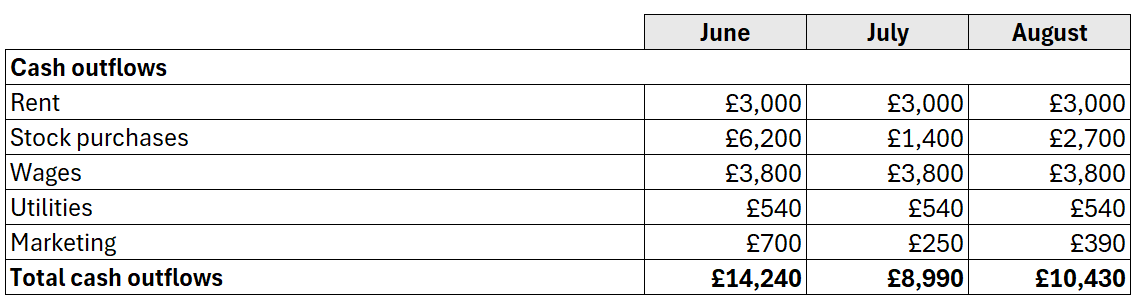
In this instance, the business expects to pay rent of £3,000 in June, July and August
It will purchase a significant amount of inventory in June with smaller amounts in July and August
Wages are expected to be £3,800 each month
Utilities of £540 will be paid each month
Marketing costs are expected to vary
Total cash outflows each month is calculated by adding these together
Step 3 - Calculate net cash flow
The net cash flow is calculated by subtracting total cash outflows from total cash inflows

In June the net cash flow is £14,200 - £14,240 = £(40)
Net cash flow is expected to be negative as cash outflows are greater than cash inflows
In July the net cash flow is £9,600 - £8,990 = £610
Net cash flow is expected to be positive as cash inflows are greater than cash outflows
In August the net cash flow is £10,400 - £10,430 = £(30)
Again, net cash flow is expected to be negative as cash outflows are greater than cash inflows
Step 4 - Calculate opening and closing balances
The opening balance is the previous month’s closing balance carried forward
The closing balance is calculated by adding the net cash flow to the opening balance

In June the opening balance of £0 is added to the net cash flow of £(40) to leave a closing balance of £(40)
In July the closing balance from June is carried forward to become its opening balance of £(40)
This opening balance is added to July's net cash flow of £610 to leave a closing balance of £570
In August the closing balance from July is carried forward to become its opening balance of £570
This opening balance is added to August's net cash flow of £(30) to leave a closing balance of £540
The complete cash flow forecast
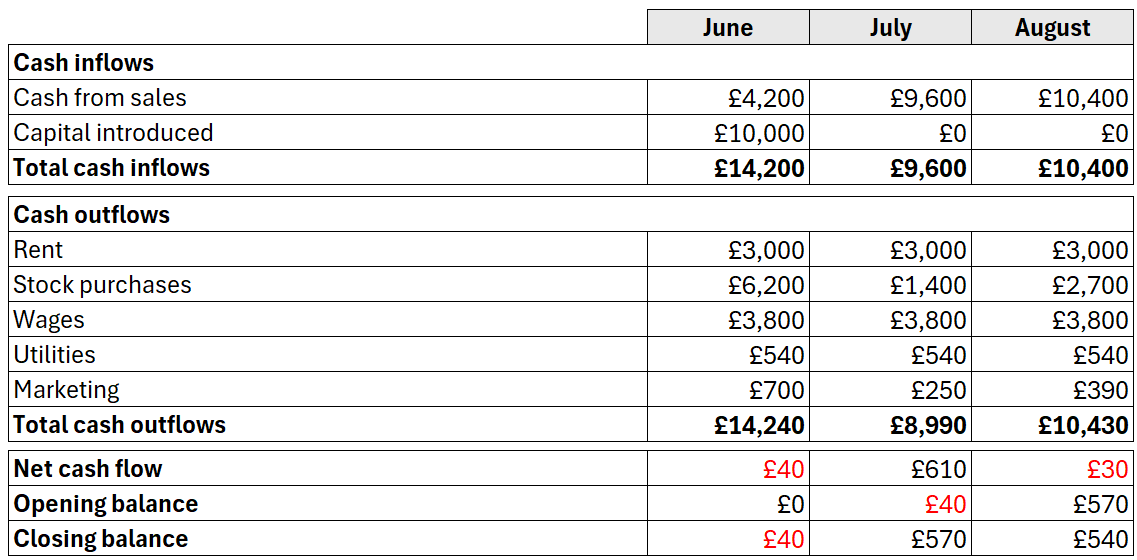
The cash flow forecast shows that the business may require a small overdraft facility initially as its cash flow is forecast to be negative
A longer-term forecast will be needed to determine whether the business will need further use of this overdraft
Examiner Tips and Tricks
In the exam, you may be asked to complete a cash flow forecast by filling in missing figures — always start with net cash flow, then use the previous month's closing balance as the next month's opening balance.
Always double-check your calculations in cash flow forecasts, as one mistake will have a knock-on effect elsewhere and, in some cases, lead you to make inaccurate judgements.
Analysing cash flow forecasts
When analysing a cash flow forecast, the goal is to identify where, when and why the cash position becomes problematic
Rather than simply noting that a closing balance is negative, a thorough analysis considers the trend across months
Is the cash position improving or deteriorating?
Is the problem caused by a one-off event or a recurring pattern?
Is the shortfall likely to be temporary or structural?
A temporary cash flow problem, such as a large payment in a single month, is very different from a situation where outflows consistently exceed inflows over several months
The latter is a more serious concern and may indicate that the business model itself is not generating sufficient cash to survive
It is also important to remember that a cash flow forecast is based on estimates
If sales come in below forecast, or if customers take longer to pay than expected, the actual cash position could be significantly worse than the forecast suggests
Analysing a forecast, therefore, also means asking how realistic the predictions behind it are
Spotting cash flow problems
Sign | Why it is a problem | Possible solutions |
|---|---|---|
Falling closing balance |
|
|
One large outflow |
|
|
Late customer payments |
|
|
Early supplier payments |
|
|
A business can also have too much cash
If it holds large amounts of cash, it may miss out on the benefits of investing it in fixed assets or savings
This may represent a significant opportunity cost, especially when interest rates are high
Further information on solutions to cash flow problems
Examiner Tips and Tricks
When analysing a cash flow forecast, do not just describe the numbers - explain what they mean for the business and suggest what action management should take in response to any problems identified

Unlock more, it's free!
Join the 100,000+ Students that ❤️ Save My Exams
the (exam) results speak for themselves:

Was this revision note helpful?
