Digital Technology & Marketing (AQA A Level Business): Exam Questions

Exam code: 7132

Syllabus Edition

First teaching 2026

First exams 2028

2 hours15 questions
1
6 marks

Source A: Jet2 plc

Jet2 plc describes itself as the UK's leading provider of package holidays and its third largest airline. It is a public limited company with shares traded on the London Stock Exchange, based at Leeds Bradford Airport, and it employs more than 14 000 people. Steve Heapy is the chief executive.

The company sells two different things. A package holiday combines flights, a hotel and transfers in one booking. A flight-only seat is just the flight. In the year to 31 March 2026 Jet2 flew a record 20.83 million passengers, up 5%. Within that total, flight-only passengers rose 15% to 7.64 million while package holiday customers rose 1% to 6.62 million. Jet2 counts each package holiday customer once, while flown passengers are counted on every flight, outbound and return.

Customers pay for a holiday months before they take it, so money arrives long before the flight happens. At the year end the company held £3 292.5 million in cash and money market deposits, and net cash of £2 012.9 million.

Source: Jet2 plc preliminary results, 8 July 2026, and Companies House

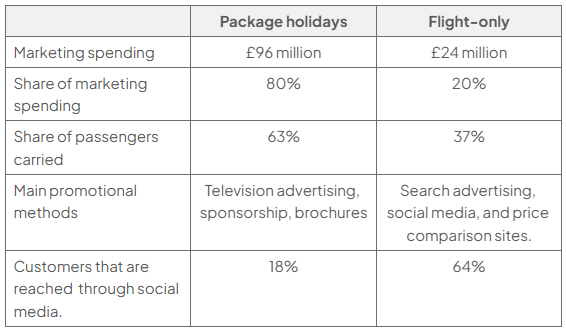
Appendix C: Jet2 plc marketing information for the year to 31 March 2026

Table comparing package holidays and flight-only seats: marketing spending (£96 million versus £24 million), passenger share (63% versus 37%), promotional methods, and social-media reach (18% versus 64%).

Source: Analyst

Appendix C shows that 64% of Jet2 plc's flight-only customers are reached through social media, against 18% of its package holiday customers.

Analyse one reason why social media might suit a flight-only seat better than a package holiday.

2
6 marks

Source A: Greggs plc

Greggs plc is the UK's largest food-to-go retailer. It began as a single bakery in Newcastle upon Tyne and floated on the London Stock Exchange in 1984. It is now part of the FTSE 250 and is led by chief executive Roisin Currie.

Greggs sells sausage rolls, bakes, sandwiches, hot drinks and sweet items at prices deliberately set below those of most high street rivals. It calls itself a value retailer, but says that value comes from quality as well as price, and points to freshly prepared food, hot options and the ability for customers to customise their order. In December 2025 it held 8.6% of all visits in the UK food-to-go market and was rated the country's leading food-to-go brand.

The business has grown by making itself easier to reach. It opened 121 net new shops in 2025, ending the year with 2 739, and says there is a clear opportunity for significantly more than 3 000 UK shops in the longer term. Alongside the shops it has pushed three other ways to reach the customer. Delivery now accounts for 6.8% of sales in company-managed shops. Evening trade is the fastest growing part of the day. The Greggs App was scanned in 26.7% of transactions in 2025, up from 20.1% in 2024, and customers who use the App shop at Greggs more often. The company has also started selling through grocers, launching a Bake-at-Home range with Tesco and widening its range in Iceland.

That growth has been expensive. Capital spending peaked at £287.5 million in 2025 as Greggs built two new national distribution centres, at Derby and Kettering, lifting its logistics capacity to 3 500 shops. Capital spending is expected to fall to around £200 million in 2026. Greggs also made £13.0 million of structural cost savings during 2025 and holds a net cash position of £45.8 million.

The company says its key focus is restoring its return on capital employed to a target of around 20%.

Source: Greggs plc preliminary results, 3 March 2026

The Greggs App was scanned in 26.7% of transactions in 2025, compared with 20.1% in 2024.

Analyse one way in which the growth of the Greggs App could affect Greggs plc's competitiveness.

3
6 marks

Source A: MPB Group Ltd

MPB Group Limited buys and sells used cameras and video equipment. Matt Barker founded the business in Brighton in 2011. Customers can sell their old equipment to MPB, trade it in against something else, or buy used gear at a lower price than new. The company recirculates around 570 000 items a year, and says it wants to extend the life of photo and video equipment rather than see it sit unused in a drawer.

Everything is bought and sold through MPB's own website. There are no shops. The company has offices in Brighton, Brooklyn and Berlin, so it trades in the United Kingdom, the United States and Germany. Every item is inspected by a product specialist and graded for its condition, then sold with a twelve-month warranty. Prices are set by the make, model, condition and the market the item is being sold in.

Because MPB has no shops and does not advertise on television, almost all of its customers arrive through a search engine. Some of those visits are earned, when MPB's own articles, reviews and buying guides appear in the search results without being paid for. Others are bought, when MPB pays to appear above the free results and is charged every time somebody clicks.

MPB has grown quickly. Turnover rose by 15.5% in the year to 31 March 2025 and the company took on 49 more staff. Some of that growth has been funded by borrowing. Over the same year total liabilities rose by 22.7% while net assets fell by 19.7%. Matt Barker is still a director, but he no longer runs the company alone. In 2021 an outside investment company placed directors on the board, and MPB now has 16 shareholders and an independent chairman.

MPB wants to sell more in the United States and Germany. It could spend more on paid search advertising, or it could invest in its own content so that more customers find it without a payment being made for every click.

Source: information sourced from Companies House and MPB Group Ltd, 2026

MPB Group Ltd pays to appear above the free search results and is charged every time somebody clicks, whether or not that person buys anything.

Analyse one way in which paying for each click could affect MPB Group Ltd's profit as its sales grow.

4
6 marks

Source B: Brompton Bicycle Ltd

Brompton Bicycle Limited makes folding bicycles. Andrew Ritchie designed the first one in 1975 and built it in a workshop under a railway arch, and the company was registered the following year. Fifty years on, every Brompton is still made by hand and quality checked at the company's own factory in Greenford, west London. It is a private limited company with around 100 shareholders and is led by chief executive Will Butler-Adams, who joined the company in 2002 and has led it since 2008.

In principle the product has barely changed. A Brompton folds into a small package in under 20 seconds, so an owner can carry it onto a train, put it in a car boot or tuck it under a restaurant table. The range now includes electric, lightweight titanium and larger-wheel models. Brompton describes its purpose as creating urban freedom for happier lives, and it sells durability as part of the deal. Every frame carries a seven-year warranty, the bikes are designed to be repaired rather than replaced, and there are now more than a million Brompton owners and over 300 owners' groups around the world.

The year to 31 March 2025 was harder than usual. Turnover slipped by 0.9% to £121.45 million, the workforce fell by 54 people to 790, and cash at the bank almost halved. Over the same year the company's total liabilities rose by 53.5%.

Brompton would like to invest £15 million in its factory so that it can build more bikes at a lower cost per bike. It does not hold enough cash to pay for this out of its own resources. It could borrow the money from a bank, or it could ask its existing shareholders to buy new shares.

Source: information sourced from Companies House and Brompton Bicycle Ltd, 2026

There are more than 300 Brompton owners' groups around the world, which Brompton Bicycle Ltd describes as fan groups.

Analyse one reason why depending on groups of fans to promote the brand might be risky for Brompton Bicycle Ltd.

5
6 marks

Source B: Brightpath Learning Ltd

Brightpath Learning Ltd is an online tutoring company set up six years ago by two former teachers, Aisha Rahman and Tom Petridis, who are its only shareholders and directors. It employs 31 people at its office in Leeds and works with about 400 self-employed tutors.

It sells two quite different things.

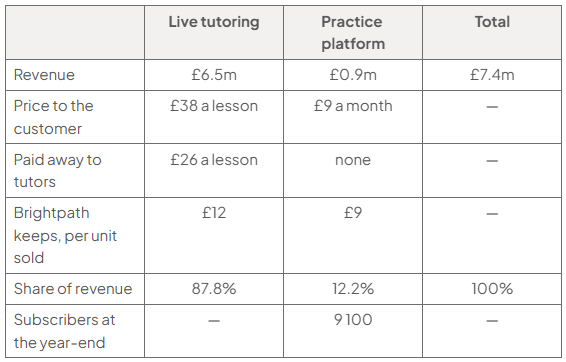
Live tutoring. A student books one-to-one lessons online with a subject specialist. A lesson costs the parent £38. Brightpath pays the tutor £26 and keeps £12. This is the larger part of the business and the part parents ask for by name, but it can only grow as fast as Brightpath can recruit and check tutors, and a tutor can only teach one student at a time.

The practice platform. A subscription costs £9 a month and gives a student unlimited access to Brightpath's own question banks, marked practice papers and progress tracking. It costs almost nothing to serve one more subscriber, because the material is already written. Fewer parents ask for it, because it is harder to explain than a lesson with a teacher.

Last year Brightpath took £7.4 million: £6.5 million from tutoring and £0.9 million from subscriptions. Fixed costs — the office, the 31 staff, the software and the marketing — came to £1.9 million.

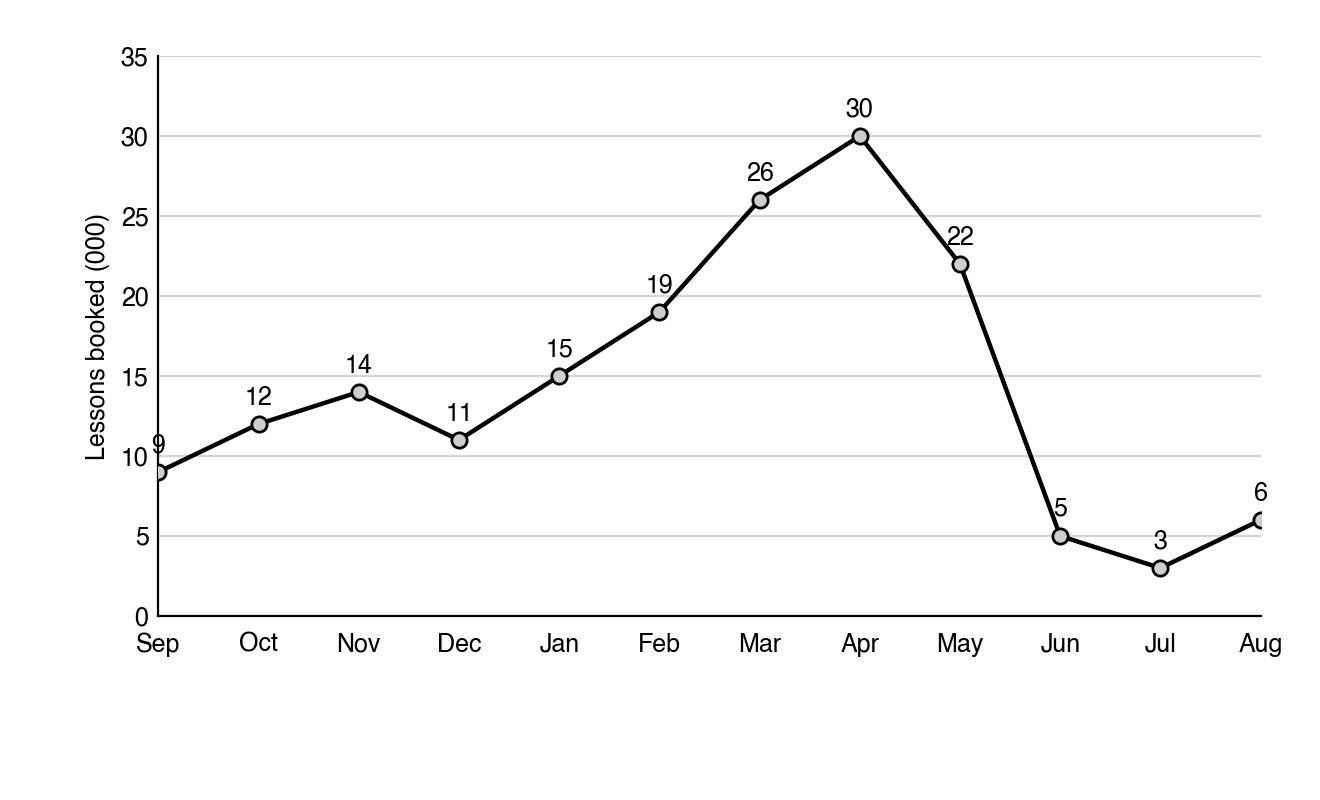
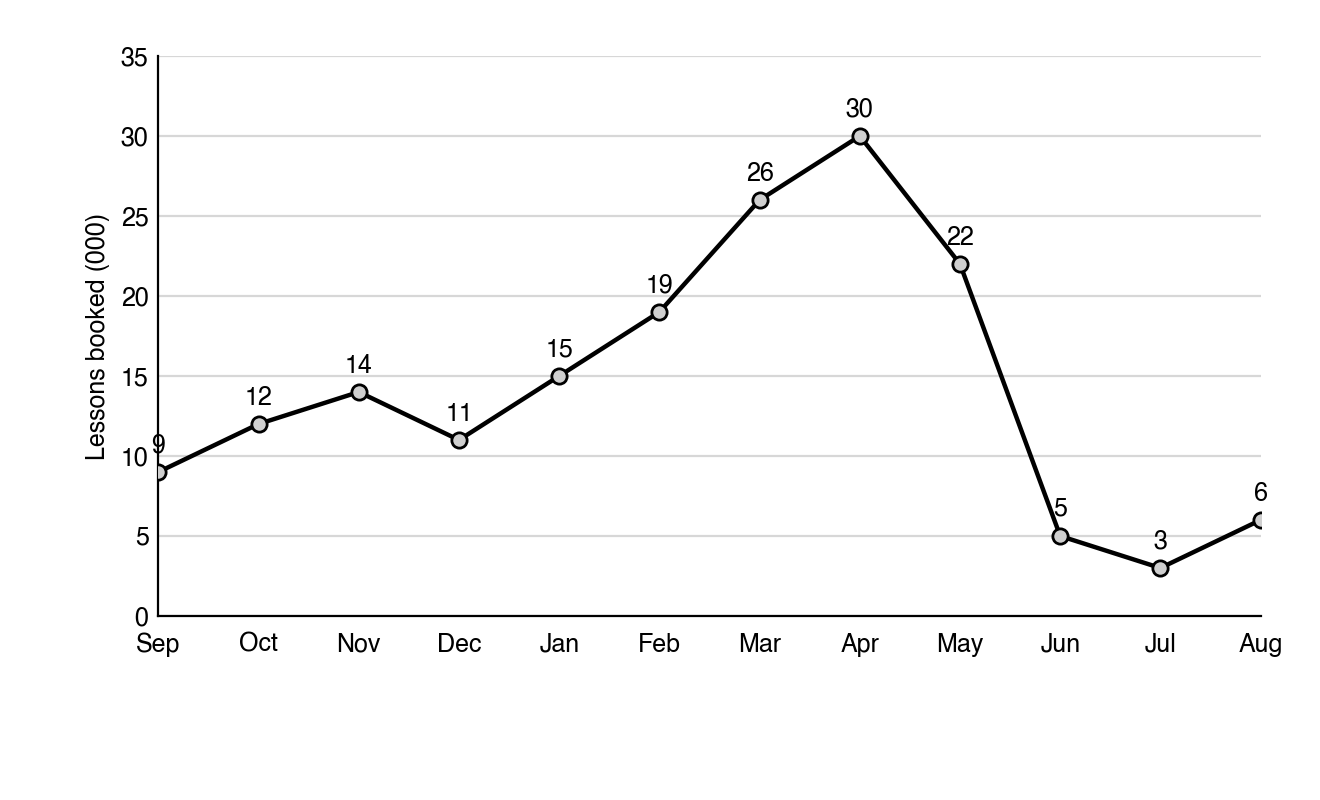
The business is highly seasonal. Appendix E shows lessons booked month by month: demand builds through the autumn, rises sharply after Christmas and peaks in April, then collapses once exams finish. Aisha and Tom have to pay the office and the staff through June, July and August whatever happens.

They now have to decide where to put next year's money. Appendix F sets out the two options.

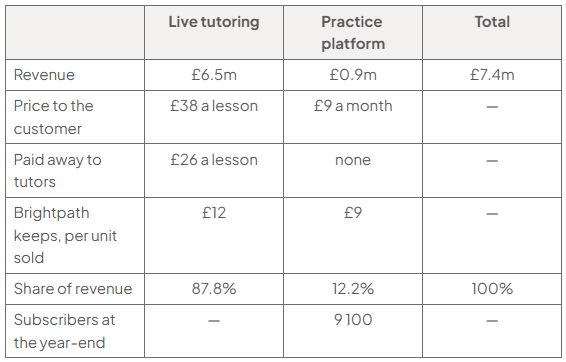
Appendix D: Brightpath Learning Ltd, summary of last year

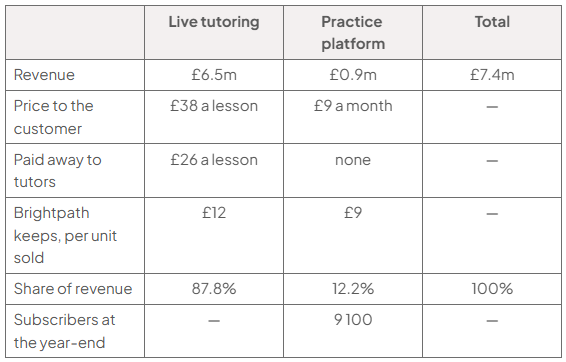
Table comparing live tutoring and the practice platform: revenue £6.5m versus £0.9m; customer price £38 per lesson versus £9 per month; Brightpath keeps £12 versus £9 per unit, with 9,100 platform subscribers.
  • Fixed costs for the year: £1 900 000

Source: Analyst

Brightpath Learning Ltd's practice platform costs almost nothing to supply to one more subscriber, but far fewer parents ask for it than for live tutoring.

Analyse one way in which this might affect the profit Brightpath Learning Ltd makes as the number of subscribers grows.

6
6 marks

Source B: Dunelm Group plc

Dunelm Group plc sells homewares and furniture: curtains, bedding, cookware, lighting, storage, sofas. It is a public limited company and it sells through large out-of-town stores and through its website and app.

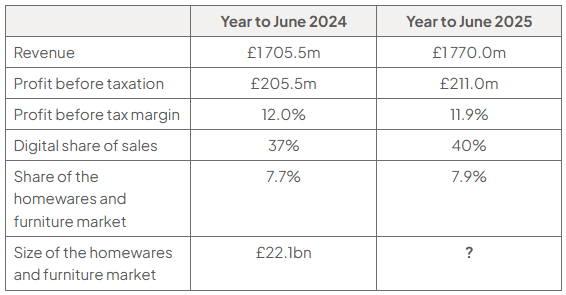
In the year to 28 June 2025 revenue rose 3.8% to £1.77 billion and profit before tax rose 2.7% to £211 million, with the margin slipping slightly to 11.9%. Its share of the combined homewares and furniture market rose from 7.7% to 7.9%, and the number of active customers, meaning people who have bought something within the last year, rose slightly.

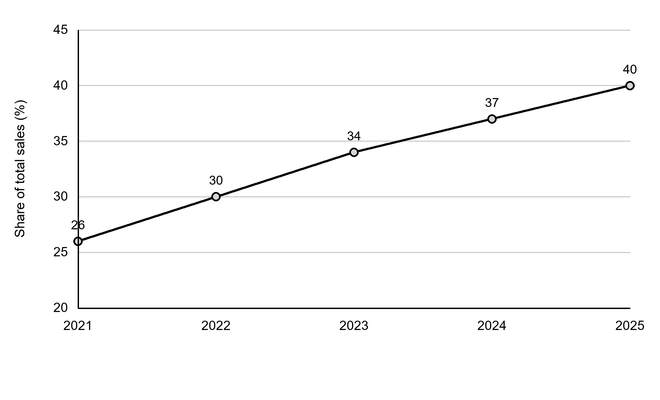
The change underneath those figures is where the customer shops. Digital sales are now 40% of everything Dunelm sells, up from 37% the year before. Appendix E shows how that share has moved over five years.

The complication is that digital and stores are not two separate businesses with two separate customers. The same person browses online and buys in store, or measures an item in store and orders at home, or buys online and returns to a store. A sofa is rarely bought without being sat on. A set of tea towels rarely needs a visit. Dunelm has to work out what a customer actually wants from each part of the business, when that customer does not think of them as separate at all.

It now has to decide where the next investment goes. Appendix F sets out the options.

Source: information sourced from Dunelm Group plc preliminary results for the year ended 28 June 2025

Appendix D: Dunelm Group plc selected results

Results table, years to June 2024/2025: revenue £1,705.5m/£1,770.0m; profit before tax £205.5m/£211.0m; margin 12.0%/11.9%; digital sales 37%/40%; market share 7.7%/7.9%; market size £22.1bn/unknown.

Source: Dunelm Group plc

Appendix E: Dunelm digital share of sales, analyst estimates

Line chart of Dunelm’s digital sales share, rising each year from 26% in 2021 to 30% in 2022, 34% in 2023, 37% in 2024 and 40% in 2025. Y-axis: share of total sales (%).

Source: Analyst

Digital sales are now 40% of everything Dunelm Group plc sells, up from 37%.

Analyse one way in which this change might affect the costs Dunelm Group plc has to meet.

7
6 marks

Source A: Nine Acres Kitchen Ltd

Nine Acres Kitchen Ltd delivers meal kits: a box of measured ingredients and a recipe card for each meal. It is a private limited company founded by Dan Ferreira and Aisha Nkemelu, it employs 210 people across a packing site in Northamptonshire and an office in Manchester, and it has 12 600 active subscribers.

A subscriber chooses their meals on an app each week. The standard box costs £48.99 and the average subscriber takes two a month, which gives revenue of £14.8 million a year. Ingredients, packing and delivery cost £31.20 a box.

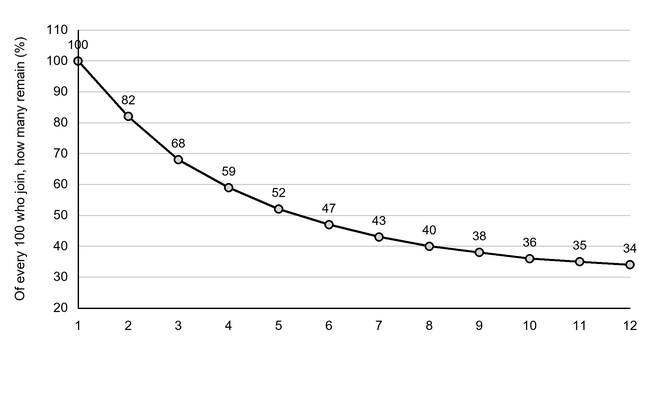
Getting people to try it is not the problem. The first box costs £14.99, and the offer works: the company recruits about 1 400 new subscribers a month. Keeping them is a different matter. Appendix B shows what happens to every hundred people who join. By the fourth box, the third charged at the full £48.99, 41 of them have gone.

The company knows a great deal about all of this. The app records what each subscriber cooks, what they skip, when they pause and what they were looking at before they cancelled. Dan Ferreira wants to use it to work out who is about to leave so the company can offer them something. Aisha Nkemelu wants to use it to suggest what they might cook next, on the grounds that people who enjoy the food do not cancel.

There is a third thing neither of them has raised at a board meeting. Starting a subscription takes about two minutes on the app. Cancelling one requires a telephone call, on weekdays between nine and five.

Appendix A: Nine Acres Kitchen Ltd, last year

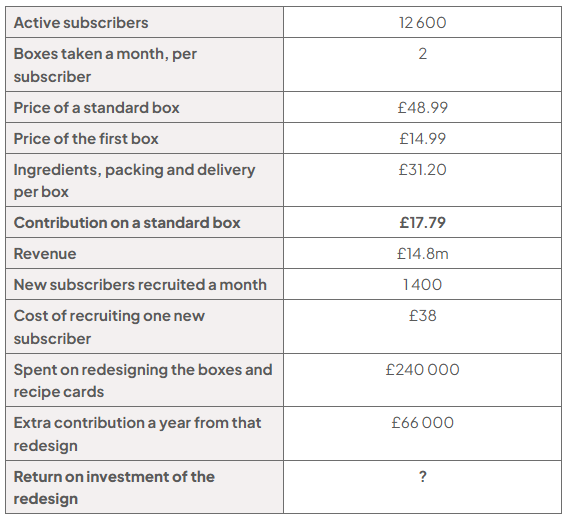
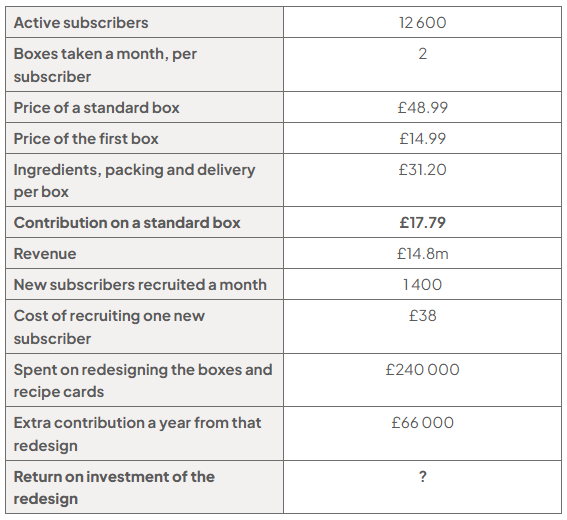
Table also shows a £17.79 contribution per standard box, £38 recruitment cost per new subscriber, £240,000 redesign spend, £66,000 extra annual contribution and an unanswered return on investment.

Source: Analyst

Nine Acres Kitchen Ltd's app records what each subscriber cooks, what they skip and when they pause their deliveries.

Analyse one way in which having this information might affect the meals Nine Acres Kitchen Ltd offers.

1
9 marks

Source A: MPB Group Ltd

MPB Group Limited buys and sells used cameras and video equipment. Matt Barker founded the business in Brighton in 2011. Customers can sell their old equipment to MPB, trade it in against something else, or buy used gear at a lower price than new. The company recirculates around 570 000 items a year, and says it wants to extend the life of photo and video equipment rather than see it sit unused in a drawer.

Everything is bought and sold through MPB's own website. There are no shops. The company has offices in Brighton, Brooklyn and Berlin, so it trades in the United Kingdom, the United States and Germany. Every item is inspected by a product specialist and graded for its condition, then sold with a twelve-month warranty. Prices are set by the make, model, condition and the market the item is being sold in.

Because MPB has no shops and does not advertise on television, almost all of its customers arrive through a search engine. Some of those visits are earned, when MPB's own articles, reviews and buying guides appear in the search results without being paid for. Others are bought, when MPB pays to appear above the free results and is charged every time somebody clicks.

MPB has grown quickly. Turnover rose by 15.5% in the year to 31 March 2025 and the company took on 49 more staff. Some of that growth has been funded by borrowing. Over the same year total liabilities rose by 22.7% while net assets fell by 19.7%. Matt Barker is still a director, but he no longer runs the company alone. In 2021 an outside investment company placed directors on the board, and MPB now has 16 shareholders and an independent chairman.

MPB wants to sell more in the United States and Germany. It could spend more on paid search advertising, or it could invest in its own content so that more customers find it without a payment being made for every click.

Source: information sourced from Companies House and MPB Group Ltd, 2026

Appendix A: MPB Group Ltd selected financial data

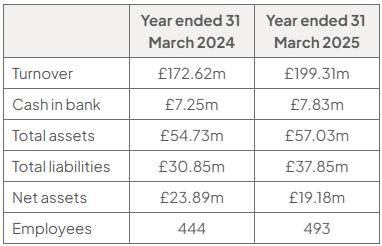
Table comparing MPB Group Ltd in years ended 31 March 2024 and 2025: turnover £172.62m and £199.31m; cash £7.25m and £7.83m; assets £54.73m and £57.03m; liabilities £30.85m and £37.85m; net assets £23.89m and £19.18m; employees 444 and 493.

Source: Companies House

Appendix C: MPB Group Ltd selected information

  • Items recirculated each year = 570 000

  • Offices = Brighton, Brooklyn and Berlin

  • Warranty offered on every item sold = 12 months

  • Employees, 2025 = 493 (2024: 444)

  • Turnover growth, 2024 to 2025 = 15.5%

Source: MPB Group Ltd

Assess whether the information in Appendix C is a good measure of how successful MPB Group Ltd's marketing has been.

2
9 marks

Source B: Brightpath Learning Ltd

Brightpath Learning Ltd is an online tutoring company set up six years ago by two former teachers, Aisha Rahman and Tom Petridis, who are its only shareholders and directors. It employs 31 people at its office in Leeds and works with about 400 self-employed tutors.

It sells two quite different things.

Live tutoring. A student books one-to-one lessons online with a subject specialist. A lesson costs the parent £38. Brightpath pays the tutor £26 and keeps £12. This is the larger part of the business and the part parents ask for by name, but it can only grow as fast as Brightpath can recruit and check tutors, and a tutor can only teach one student at a time.

The practice platform. A subscription costs £9 a month and gives a student unlimited access to Brightpath's own question banks, marked practice papers and progress tracking. It costs almost nothing to serve one more subscriber, because the material is already written. Fewer parents ask for it, because it is harder to explain than a lesson with a teacher.

Last year Brightpath took £7.4 million: £6.5 million from tutoring and £0.9 million from subscriptions. Fixed costs, covering the office, the 31 staff, the software and the marketing, came to £1.9 million.

The business is highly seasonal. Appendix E shows lessons booked month by month: demand builds through the autumn, rises sharply after Christmas and peaks in April, then collapses once exams finish. Aisha and Tom have to pay the office and the staff through June, July and August whatever happens.

They now have to decide where to put next year's money. Appendix F sets out the two options.

Appendix D: Brightpath Learning Ltd, summary of last year

Appendix D table comparing live tutoring and the practice platform: revenue £6.5m versus £0.9m (£7.4m total); prices £38 per lesson versus £9 monthly; tutor payment £26 versus none; Brightpath keeps £12 versus £9; revenue shares 87.8% versus 12.2%; 9,100 platform subscribers.
  • Fixed costs for the year: £1 900 000

Source: Analyst

Appendix E: Brightpath Learning Ltd lessons booked by month

Line graph of lessons booked (thousands) by month: Sep 9, Oct 12, Nov 14, Dec 11, Jan 15, Feb 19, Mar 26, Apr 30, May 22, Jun 5, Jul 3 and Aug 6.

Source: Analyst

Assess whether Brightpath Learning Ltd should spend more on explaining the practice platform to parents.

3
9 marks

Source A: Moonpig Group plc

Moonpig Group plc sells greeting cards, gifts and experience days online. It has no shops. The group owns the Moonpig brand in the UK, Greetz in the Netherlands, and Buyagift and Red Letter Days, which sell experience days such as spa breaks and driving days. It is a public limited company listed in London.

The business runs on knowing when a customer's friends and family have birthdays. A customer who sends one card gives Moonpig Group plc a name and a date, and the company then reminds them when that date comes round again. Around that reminder it offers a gift to send with the card, which is where much of the growth now comes from. It also sells a paid membership called Plus, and during the year it launched tools that use artificial intelligence to help customers write and design cards.

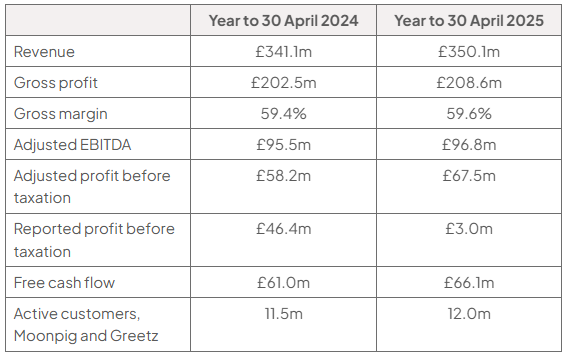
In the year to 30 April 2025 revenue was £350.1 million, 2.6% up on the year before. That figure hides three very different businesses. The Moonpig brand grew 8.6%, and its revenue in the United States, Australia and Ireland grew 36.1% between them. Greetz fell 4.7%. The Experiences business was difficult enough that the group wrote £56.7 million off the value of it.

Underneath, the numbers the company watches most closely moved the right way. Active customers across Moonpig and Greetz reached 12.0 million, up from 11.5 million. Total orders grew 4.1% and the average order value grew 2.1%.

Profit depends entirely on which figure is read. Adjusted profit before tax, which leaves out the write-off, was £67.5 million against £58.2 million, a rise of 16.0%. Reported profit before tax, which includes it, was £3.0 million against £46.4 million, a fall of 93.6%. Free cash flow was £66.1 million, and the company bought back £25 million of its own shares during the second half.

Source: information sourced from Moonpig Group plc results announcement for the year ended 30 April 2025

Appendix C: Moonpig Group plc marketing channels, analyst estimates

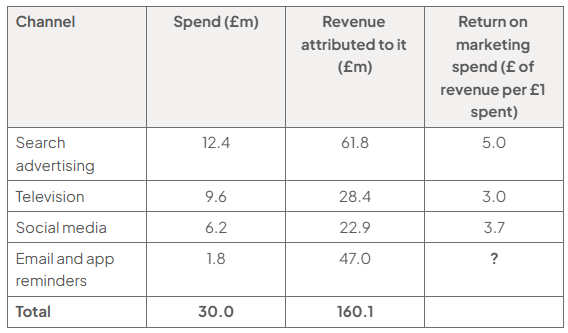
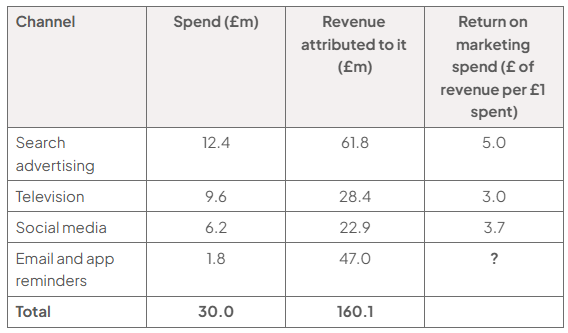
Table of marketing channels: search advertising £12.4m spend and £61.8m revenue; television £9.6m and £28.4m; social media £6.2m and £22.9m; email and app reminders £1.8m and £47.0m. Total spend £30.0m and revenue £160.1m; return for reminders is missing.

Source: Analyst

Assess whether Moonpig Group plc should spend more on its email and app reminders.

Calculate the return on marketing spend for email and app reminders to support your answer.

Give your answer to one decimal place.

4
9 marks

Source A: Loomfield Home Ltd

Loomfield Home Ltd sells bedding, towels and throws online. It has no shops. It is a private limited company founded by Esi Boateng, it employs 23 people and it works from a warehouse in Bristol.

Everything it sells is made from organic or recycled cotton, and that is what the business is built on. Its packaging carries the words "carbon neutral", which the company can say because it buys offsets to match the emissions of its deliveries, rather than because those deliveries produce no emissions. Nothing about the claim is untrue, and Esi Boateng has begun to wonder how long it will be before a customer asks her to explain the difference.

The website does something else she is less comfortable with. When a product is running low the page shows how many are left, and the number is real. What is not obvious to a customer is that the message appears whenever inventory falls below twenty, which for most lines is most of the time.

Last year Loomfield Home Ltd took £6.4 million, of which £5.6 million was in the United Kingdom, £0.5 million in Germany and £0.3 million in France. Both European markets are sold through the same website in the local language, with delivery from Bristol.

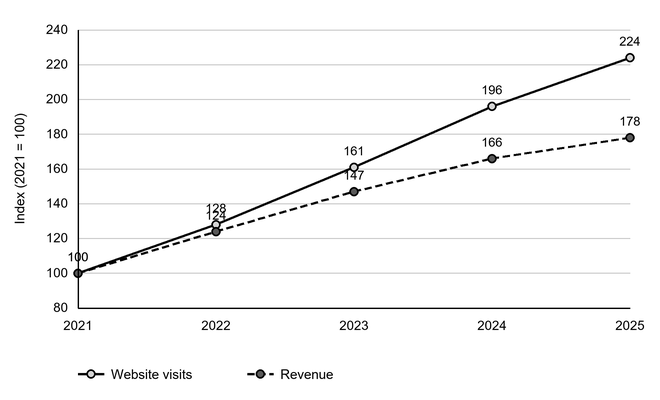
The company spends most of its marketing money on getting people to the website, and it has been successful at it. Since 2021 the number of visits has more than doubled. The number of orders has not.

Appendix A: Loomfield Home Ltd, four years apart

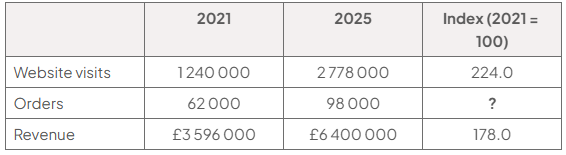
Table comparing Loomfield Home Ltd in 2021 and 2025, with 2021 as index 100: visits 1,240,000 to 2,778,000 (224.0); orders 62,000 to 98,000 (?); revenue £3,596,000 to £6,400,000 (178.0).

Source: Analyst

Appendix B: Loomfield Home Ltd, website visits and revenue since 2021

Line chart of website visits and revenue indices (2021 equals 100) from 2021 to 2025: visits rise 100, 128, 161, 196, 224; revenue rises 100, 124, 147, 166, 178.

Source: Analyst

Assess whether Loomfield Home Ltd should spend more on attracting visitors to its website.

Using 2021 as the base year, calculate the index number for Loomfield Home Ltd's orders in 2025 to support your answer.

Give your answer to one decimal place.

5
9 marks

Source A: Rowan & Pine Ltd

Rowan & Pine Ltd makes wooden toys in a workshop near Totnes: stacking rings, shape sorters, pull-along animals and a train set that has been in the range since 1998. It is a private limited company owned by Marta Lindqvist and employs 46 people.

It sells in two ways. A little under half its revenue comes from its own website, and the rest from independent toy shops and two department store chains. Last year revenue was £5.4 million, of which £3.60 million was in the United Kingdom, £0.90 million in Germany, £0.60 million in the United States and £0.30 million elsewhere.

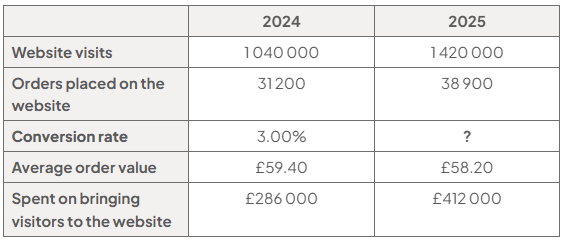
The website has been the focus of the last three years and the traffic shows it. Visits rose from 1 040 000 to 1 420 000. Orders rose from 31 200 to 38 900. Marta Lindqvist has noticed that the second number has not kept up with the first and has not yet decided what to do about it.

There is something else she has not decided what to do about. Every box in the range carries the line "supports early problem-solving and fine motor development". It comes from a study of 34 children carried out six years ago by a university department, which Rowan & Pine Ltd part-funded. Nobody has repeated it. The claim has never been challenged, and it appears on packaging in three countries.

Marta Lindqvist has £200 000 to put behind one overseas market. Germany is the larger of the two and sells almost entirely through toy shops. The United States is smaller, growing faster, and sells almost entirely through the website.

Appendix A: Rowan & Pine Ltd, website and orders

Table comparing 2024 and 2025: website visits 1,040,000 and 1,420,000; orders 31,200 and 38,900; conversion rates 3.00% and unknown; average order values £59.40 and £58.20. Website visitor spend: £286,000 and £412,000.

Source: Analyst

Assess whether Rowan & Pine Ltd should spend more on bringing visitors to its website.

Calculate the percentage change in Rowan & Pine Ltd's website orders between 2024 and 2025 to support your answer.

Give your answer to two decimal places.

1
15 marks

Source B: Brightpath Learning Ltd

Brightpath Learning Ltd is an online tutoring company set up six years ago by two former teachers, Aisha Rahman and Tom Petridis, who are its only shareholders and directors. It employs 31 people at its office in Leeds and works with about 400 self-employed tutors.

It sells two quite different things.

Live tutoring. A student books one-to-one lessons online with a subject specialist. A lesson costs the parent £38. Brightpath pays the tutor £26 and keeps £12. This is the larger part of the business and the part parents ask for by name, but it can only grow as fast as Brightpath can recruit and check tutors, and a tutor can only teach one student at a time.

The practice platform. A subscription costs £9 a month and gives a student unlimited access to Brightpath's own question banks, marked practice papers and progress tracking. It costs almost nothing to serve one more subscriber, because the material is already written. Fewer parents ask for it, because it is harder to explain than a lesson with a teacher.

Last year Brightpath took £7.4 million: £6.5 million from tutoring and £0.9 million from subscriptions. Fixed costs, covering the office, the 31 staff, the software and the marketing, came to £1.9 million.

The business is highly seasonal. Appendix E shows lessons booked month by month: demand builds through the autumn, rises sharply after Christmas and peaks in April, then collapses once exams finish. Aisha and Tom have to pay the office and the staff through June, July and August whatever happens.

They now have to decide where to put next year's money. Appendix F sets out the two options.

Appendix D: Brightpath Learning Ltd, summary of last year

Table comparing live tutoring, practice platform and total: revenue £6.5m, £0.9m and £7.4m; prices £38 per lesson and £9 monthly; tutor payments £26 and none; Brightpath keeps £12 and £9; revenue shares 87.8%, 12.2% and 100%; 9,100 platform subscribers.
  • Fixed costs for the year: £1 900 000

Source: Analyst

Appendix E: Brightpath Learning Ltd lessons booked by month

Line graph of Brightpath lessons booked, in thousands, from September to August: 9, 12, 14, 11, 15, 19, 26, 30, 22, 5, 3 and 6 respectively, peaking in April.

Source: Analyst

Appendix F: Data for two ways of investing £600 000

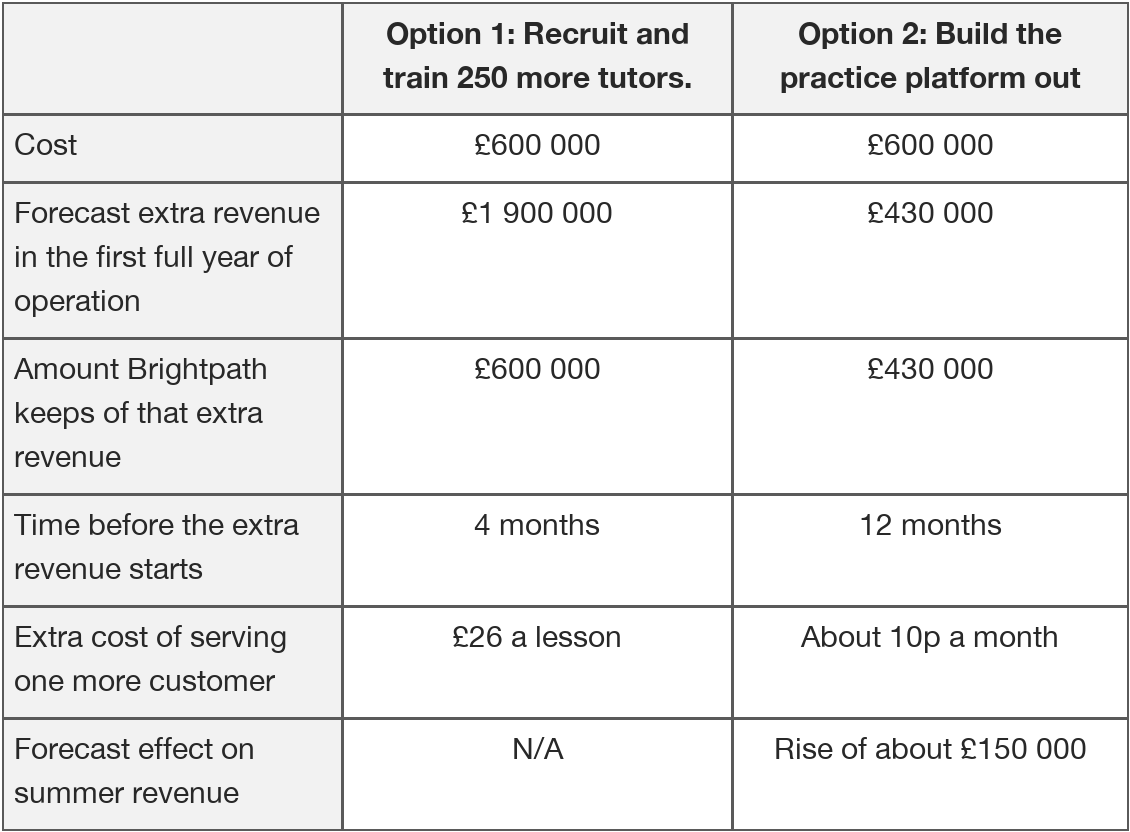
Table comparing £600,000 investments: recruit 250 tutors: £1.9m extra revenue, £600,000 retained, starts in 4 months, £26 per lesson; build platform: £430,000, 12 months, 10p per subscriber monthly, £150,000 summer rise.

Source: Analyst

Appendix F shows two ways in which Brightpath Learning Ltd could invest £600,000.

Evaluate both options and recommend which one would be the better use of Brightpath Learning Ltd's £600,000.

2
15 marks

Source A: Moonpig Group plc

Moonpig Group plc sells greeting cards, gifts and experience days online. It has no shops. The group owns the Moonpig brand in the UK, Greetz in the Netherlands, and Buyagift and Red Letter Days, which sell experience days such as spa breaks and driving days. It is a public limited company listed in London.

The business runs on knowing when a customer's friends and family have birthdays. A customer who sends one card gives Moonpig Group plc a name and a date, and the company then reminds them when that date comes round again. Around that reminder it offers a gift to send with the card, which is where much of the growth now comes from. It also sells a paid membership called Plus, and during the year it launched tools that use artificial intelligence to help customers write and design cards.

In the year to 30 April 2025 revenue was £350.1 million, 2.6% up on the year before. That figure hides three very different businesses. The Moonpig brand grew 8.6%, and its revenue in the United States, Australia and Ireland grew 36.1% between them. Greetz fell 4.7%. The Experiences business was difficult enough that the group wrote £56.7 million off the value of it.

Underneath, the numbers the company watches most closely moved the right way. Active customers across Moonpig and Greetz reached 12.0 million, up from 11.5 million. Total orders grew 4.1% and the average order value grew 2.1%.

Profit depends entirely on which figure is read. Adjusted profit before tax, which leaves out the write-off, was £67.5 million against £58.2 million, a rise of 16.0%. Reported profit before tax, which includes it, was £3.0 million against £46.4 million, a fall of 93.6%. Free cash flow was £66.1 million, and the company bought back £25 million of its own shares during the second half.

Source: information sourced from Moonpig Group plc results announcement for the year ended 30 April 2025

Appendix A: Moonpig Group plc selected results

Results table for years to 30 April 2024/2025: revenue £341.1m/£350.1m; gross profit £202.5m/£208.6m; margin 59.4%/59.6%; adjusted EBITDA £95.5m/£96.8m; adjusted PBT £58.2m/£67.5m; reported PBT £46.4m/£3.0m; free cash flow £61.0m/£66.1m; customers 11.5m/12.0m.

Source: Moonpig Group plc

Appendix B: Moonpig Group plc, three measures

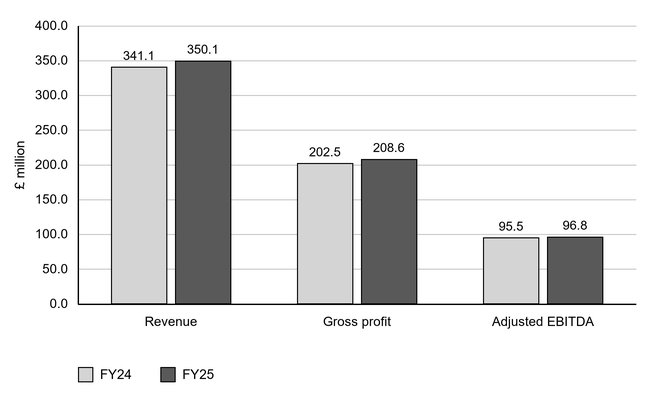
Bar chart comparing Moonpig Group plc’s FY24 and FY25 revenue, gross profit and adjusted EBITDA (£ million): revenue rises from 341.1 to 350.1, gross profit from 202.5 to 208.6, and adjusted EBITDA from 95.5 to 96.8.

Source: Moonpig Group plc

Appendix C: Moonpig Group plc marketing channels, analyst estimates

Marketing table showing spend, attributed revenue and return per £1: search advertising £12.4m, £61.8m, 5.0; television £9.6m, £28.4m, 3.0; social media £6.2m, £22.9m, 3.7; email/app reminders £1.8m, £47.0m, unknown. Total spend £30.0m and revenue £160.1m.

Source: Analyst

Appendix C shows what Moonpig Group plc spends on each of its marketing channels and the revenue attributed to each one.

Evaluate whether Moonpig Group plc should move its television spending into email and app reminders or keep its spending as it is.

3
15 marks

Source A: Nine Acres Kitchen Ltd

Nine Acres Kitchen Ltd delivers meal kits: a box of measured ingredients and a recipe card for each meal. It is a private limited company founded by Dan Ferreira and Aisha Nkemelu, it employs 210 people across a packing site in Northamptonshire and an office in Manchester, and it has 12 600 active subscribers.

A subscriber chooses their meals on an app each week. The standard box costs £48.99 and the average subscriber takes two a month, which gives revenue of £14.8 million a year. Ingredients, packing and delivery cost £31.20 a box.

Getting people to try it is not the problem. The first box costs £14.99, and the offer works: the company recruits about 1 400 new subscribers a month. Keeping them is a different matter. Appendix B shows what happens to every hundred people who join. By the fourth box, the third charged at the full £48.99, 41 of them have gone.

The company knows a great deal about all of this. The app records what each subscriber cooks, what they skip, when they pause and what they were looking at before they cancelled. Dan Ferreira wants to use it to work out who is about to leave so the company can offer them something. Aisha Nkemelu wants to use it to suggest what they might cook next, on the grounds that people who enjoy the food do not cancel.

There is a third thing neither of them has raised at a board meeting. Starting a subscription takes about two minutes on the app. Cancelling one requires a telephone call, on weekdays between nine and five.

Appendix A: Nine Acres Kitchen Ltd, last year

Appendix A table: 12,600 subscribers; 2 boxes/month; prices £48.99 standard and £14.99 first; cost £31.20, contribution £17.79/box; revenue £14.8m; 1,400 new/month at £38 each. Redesign £240,000, extra contribution £66,000, ROI?

Source: Analyst

Appendix B: Nine Acres Kitchen Ltd, what happens to every 100 subscribers who join

Line chart showing subscribers remaining after each box: 100 at box 1, falling to 82, 68, 59, 52, 47, 43, 40, 38, 36, 35 and 34 by box 12; y-axis is percentage of every 100 subscribers.

Source: Analyst

Appendix C: Data for two ways of spending £300 000

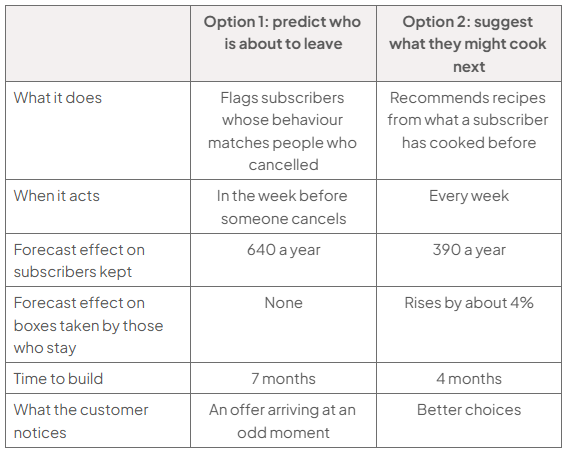
Comparison table of two £300,000 options: predicting who will leave flags matching behaviour the week before, keeps 640 subscribers a year, takes seven months and offers arrive oddly; recipe suggestions act weekly, keep 390, raise boxes 4% and take four months.

Source: Analyst

Appendix C shows two ways in which Nine Acres Kitchen Ltd could spend £300,000 on what it knows about its subscribers.

Evaluate whether Nine Acres Kitchen Ltd should spend it on predicting who is about to leave or on suggesting what they might cook next.