Answering 6-Mark Questions (AQA A Level Business): Revision Note
Syllabus Edition
First teaching 2026
First exams 2028
Exam code: 7132

How do I answer an AQA A Level Business 6-mark question?
Six-mark questions appear in all three exam papers
Each paper has four 6-mark questions
They are the first two questions after each case study
They are worth 24 of the 90 marks on each paper
The command word is always Analyse
Examples
Analyse one way in which…
Analyse one factor that might have caused…
Analyse how one of these…
Analyse one action that…
Analyse one reason why…
Two marks are available for knowledge (AO1), two for application (AO2) and two for analysis (AO3)
There are no evaluation (AO4) marks, so you do not need to weigh arguments up or make a judgement
You only need to develop one line of argument
If the question asks for one way or one factor, develop only one
Writing about three ideas briefly scores lower than developing one idea fully
Aim to spend about 7 minutes on a 6-mark question
With 10 minutes for each 9-mark question and 18 for the 15-mark question, this leaves about 8 minutes to read each case study before you start writing
How 6-mark questions are marked
Six-mark questions are marked using two levels
Level | Marks | What the examiner is looking for |
|---|---|---|
2 | 4–6 |
|
1 | 1–3 |
|
0 | 0 |
|
There are two mark caps to be aware of:
An answer that shows only knowledge can score a maximum of 2 marks
An answer with good knowledge and analysis but no use of the case study can score a maximum of 4 marks
Identifying the two key elements
Every 6-mark question links two elements
The examiner wants a clear chain of reasoning that connects them
Before you write, underline the two elements in the question
Question | Element 1 (the cause) | Element 2 (the effect) |
|---|---|---|
Analyse one way in which setting a high price might affect the revenue the business earns | Setting a high price | Revenue |
Analyse one way in which a strong brand could affect the price elasticity of demand for its products | A strong brand | Price elasticity of demand |
Analyse one way in which a training programme might affect labour productivity | A training programme | Labour productivity |
A common mistake is to stop at a nearby effect rather than the one in the question
E.g. if the question asks about price elasticity of demand, explaining that a strong brand increases sales is not enough
You need to explain why customers become less sensitive to price
Suggested structure
Case Study
Marlow & Finch Ltd
The business is a family-owned chain of 14 garden centres employing 420 staff, many of them on part-time, seasonal contracts. Customers have complained that staff often cannot answer questions about plant care. In 2026, the business launched 'Grow Your Knowledge', a three-day training course covering plant care and the new till system, followed by monthly coaching sessions. Last year, sales revenue per employee at Marlow & Finch Ltd was £62,000, compared with an industry average of £71,000.
Question
Analyse one way in which the 'Grow Your Knowledge' training programme might affect employee productivity at Marlow & Finch Ltd.
[6 marks]
Key business skills are highlighted

Step 1
Start off by defining the key term in the question
This secures knowledge (AO1) marks and keeps your answer focused on what the question is really about
Keep it to one or two sentences. There are only 2 AO1 marks, so a long definition will not earn more

Step 2
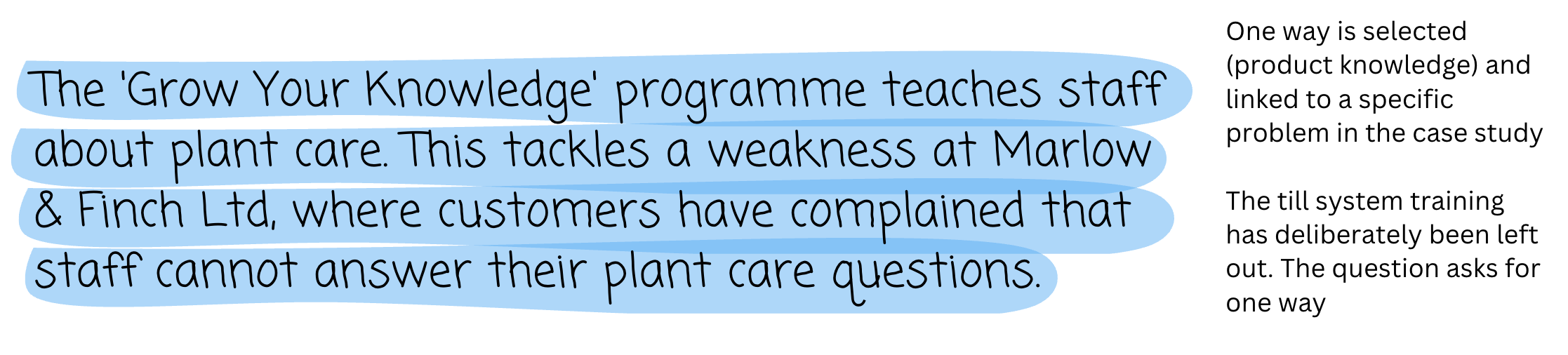
Choose one way and link it straight to the case study
Pick the way you can develop furthest, not just the first one you think of
Use a specific detail from the case study, such as a fact, a figure or a problem the business faces
Do not just copy out the case study. Each detail you use should lead into your reasoning
Step 3
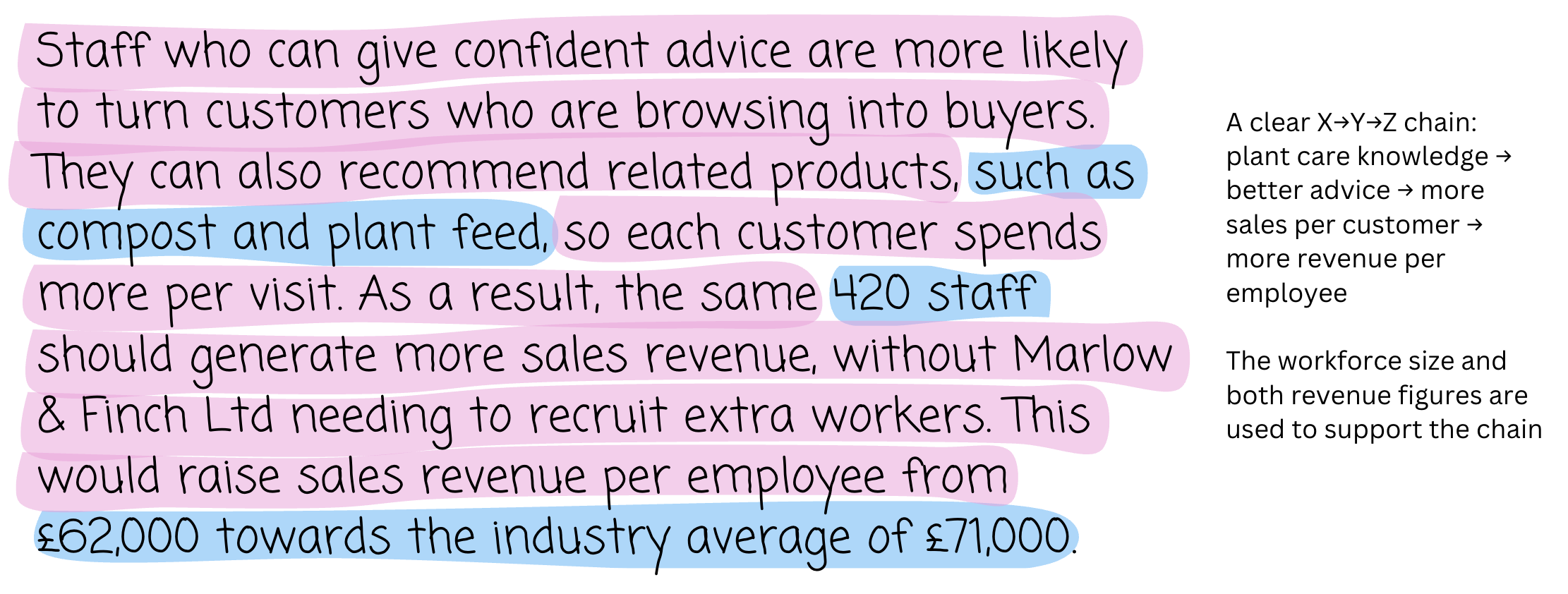
Now develop a chain of reasoning that links the first key element of the question to the second
The X→Y→Z approach is a good way to build a coherent chain
E.g. X leads to Y, which results in Z
Use connectives such as 'this means that...', 'as a result...', 'which leads to...' and 'therefore...' to show each link in the chain
Keep weaving in the case study as you go
The examiner wants application throughout, not just at the start
Use a figure from the case study if one is relevant
Step 4
Finish with a short closing sentence that answers the question directly
Link back to both key elements of the question
This is not a judgement or a counterargument. There are no evaluation marks on a 6-mark question

The full example answer above is around 160 words
A strong 6-mark answer is usually 130–250 words
Common mistakes
Adding a counterargument or judgement
Phrases such as 'However…' or 'On balance…' earn no marks on a 6-mark question
They use up time you need for the 9-mark and 15-mark questions
Writing about more than one way or factor
Two half-developed ideas score lower than one well-developed idea
Analysing the wrong effect
Check that your chain ends at the exact thing the question names (e.g. employee productivity, not staff motivation)
Generic answers
An answer that could have been written about any business cannot reach Level 2
Use the case study throughout
Repeating the case study
Simply copying information from the case study is not creditworthy
Use each detail to support a point
Examiner Tips and Tricks
Before you start writing, try this quick test. Can you finish the sentence "[Element 1] affects [element 2] because…" in your head? If you cannot, choose a different way or factor that you can explain more clearly.

Unlock more, it's free!
Join the 100,000+ Students that ❤️ Save My Exams
the (exam) results speak for themselves:

Was this revision note helpful?