The Nature of Change (AQA A Level Business): Exam Questions

Exam code: 7132

Syllabus Edition

First teaching 2026

First exams 2028

3 hours18 questions
1
6 marks

Source A: Burberry

Burberry Group plc is a British luxury fashion brand, headquartered in London and listed on the London Stock Exchange, where it is a member of the FTSE 100. It was founded in 1856 by Thomas Burberry, whose gabardine fabric and trench coat became the basis of the brand. It sells mainly through its own stores, of which there were 410 at 28 March 2026, and online. It also sells to other retailers and earns income from licences.

In the 52 weeks to 29 March 2025 Burberry's comparable store sales fell by 12% and its adjusted operating profit fell to £26 million. Joshua Schulman, who became Chief Executive in July 2024, launched a strategy called Burberry Forward in November 2024. Its aims include restoring the brand's cultural relevance and asserting its authority in outerwear and scarves before extending that success to other categories.

In the 52 weeks to 28 March 2026 Burberry's revenue was £2 420 million, compared with £2 461 million the year before, while comparable store sales rose by 2% and adjusted operating profit rose to £160 million. The Chief Executive described the year as "a meaningful inflection point". During the year the company:

  • achieved savings in operating costs of £80 million, while continuing to invest in marketing;

  • spent £45 million on restructuring, mainly on redundancies and consultancy;

  • opened 200 scarf bars in its stores;

  • increased e-commerce sales by a percentage in the high teens;

  • opened 9 stores and closed 21.

Outerwear sold better than other categories in every region, scarves grew throughout the year, and sales of leather goods improved in the second half.

Sales growth differed between regions. In Europe, the Middle East, India and Africa, sales were held back by a fall in tourist numbers. In Japan, sales fell by 6% in the final quarter as fewer visitors arrived, while South Korea grew by 13%, helped by visitors from China. In Greater China and the Americas, sales in the final quarter grew by 10%, driven by local customers.

For the year to March 2027 Burberry expects to increase both its revenue and its profit margin, but says it is mindful of the uncertain economic and political environment.

Source: Burberry Group plc, Preliminary Results, 14 May 2026

During the year Burberry spent £45 million on restructuring, mainly on redundancies and consultancy, as part of its Burberry Forward strategy.

Analyse one way in which making staff redundant might affect resistance to further change among Burberry's remaining employees.

2
6 marks

Source B: Eden Project

The Eden Project opened in 2001 in a former china clay pit near St Austell, Cornwall. Its giant biomes hold plants from the rainforest and the Mediterranean, and in February 2026 it welcomed its 25 millionth visitor. Eden Project Limited runs the site, its shops, cafés and events, including the Eden Sessions summer concerts. It is wholly owned by The Eden Trust, a registered charity whose mission is "to demonstrate and inspire positive action for the planet".

The company "exists only to deliver the charitable objectives of the Trust", and every activity, "including that which might ordinarily be termed commercial", is designed to educate people about the environment or inspire them to change. Visitors are described as "the primary source of earned income". Other income includes grants from funders and Gift Aid, a tax relief on donations which the charity reclaims and passes to the company.

Visitor numbers fell by more than 10% in the year to March 2025. In January 2025 Eden Project announced plans to cut its payroll by about 20%, affecting about 80 jobs. Its accounts describe "a programme of organisational change to simplify structures, reduce costs and strengthen operational control", including "workforce reduction and changes to leadership structures". The board endorsed "a stabilisation strategy, prioritising control, clarity and resilience", to lay the foundations for "scaffolded growth".

In the year to 31 March 2026 visitor numbers rose by about 0.4%, and the company said it had "halted the pattern of decline seen in prior years". It is also developing two new Eden projects, in Morecambe and Dundee.

Source: Eden Project Limited, Annual Report and Consolidated Financial Statements for the year ended 31 March 2026

In January 2025 Eden Project announced plans to cut its payroll by about 20%, affecting about 80 jobs. It says it placed emphasis on communication and consultation during the change.

Analyse one way in which this restructuring might affect the motivation of the employees who remained.

3
6 marks

Source A: Mitie

Mitie Group plc was founded in 1987 and is listed on the London Stock Exchange. It is the UK's leading facilities management company, employing 84 000 colleagues who clean, guard, maintain and upgrade buildings for customers such as the Home Office, Transport for London, Asda and GSK.

Mitie's strategic plan for the three years to March 2027 aims to move it from facilities management, where UK market growth is about 2-3% a year, into higher-margin work: Facilities Transformation projects, such as building upgrades, data centres and decarbonisation; and Facilities Compliance, such as fire and security systems that buildings must have by law. In August 2025 it bought Marlowe, a compliance business, for about £350 million in cash and shares.

In the year to 31 March 2026 revenue rose by 10.5% to £5 619 million, including 5.3% organic growth. Costs were increased by higher employers' National Insurance contributions and the loss of two public sector contracts.

Mitie describes itself as "technology-led" and has launched a programme to "re-imagine and optimise" its internal workflows and customer services through agentic AI: AI systems that can carry out tasks with little human input. Its Chief Executive, Phil Bentley, intends to retire at the end of the strategic plan, once a successor is in place.

Source: Mitie Group plc, results for the 12 months to 31 March 2026

In August 2025 Mitie bought Marlowe, a compliance business, for about £350 million, and is moving Marlowe onto its own systems and ways of working.

Analyse one reason why employees of Marlowe might resist the changes that follow the acquisition.

4
6 marks

Source A: Mulberry

Mulberry Group plc was founded in Somerset in 1971 and is known for leather handbags such as the Bayswater. Its two largest shareholders are Challice, controlled by Singapore's Ong family, and Frasers Group, which owns retailers such as Sports Direct and Flannels. In 2024 Mulberry's board rejected a takeover approach from Frasers.

Mulberry designs, makes and sells bags, small leather goods and clothing. About half of its iconic bags are made by craftspeople at its two factories in Somerset. It sells through:

  • its own stores and website

  • franchise partners abroad

  • wholesale to other retailers

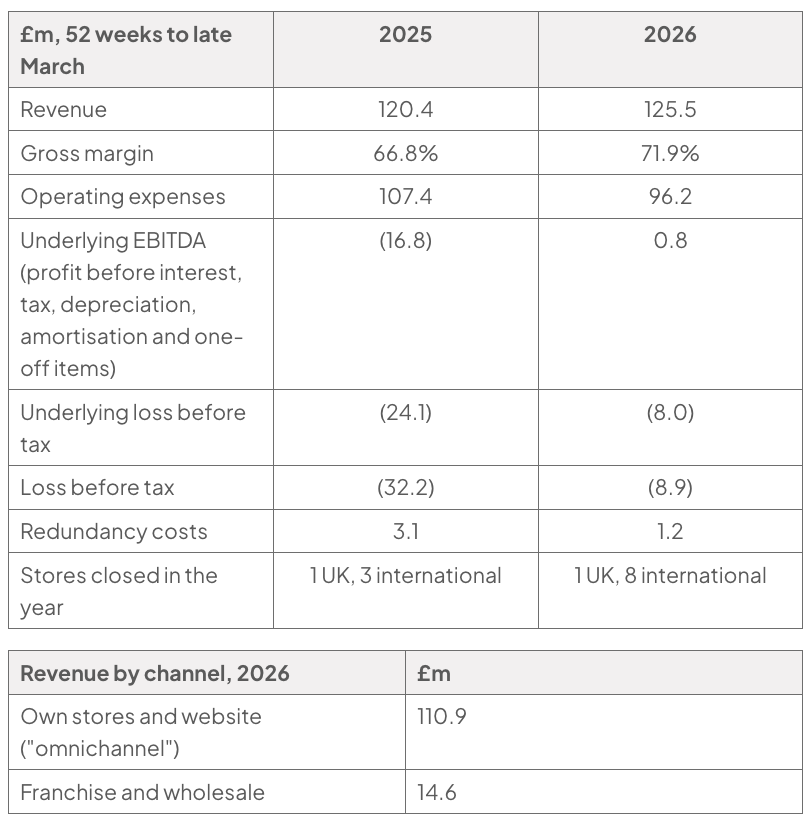
In the year to March 2025 Mulberry's revenue fell by 21% and it made a loss before tax of £32.2 million. Andrea Baldo, who became Chief Executive in 2024, launched a strategy called "Back to the Mulberry Spirit" in January 2025. Its aims are to:

  • simplify the business

  • restore profitability

  • rebuild the gross margin by selling more at full price

  • "put creativity back at the centre of what we do"

In July 2025 Challice and Frasers provided £20 million of funding. As part of the strategy, Mulberry:

  • made redundancies in both the year to March 2025 and the year to March 2026

  • closed one UK store and eight international stores in the year to March 2026

  • introduced a new incentive scheme for store staff "supporting a stronger performance culture"

In the 52 weeks to 28 March 2026 revenue rose by 4% to £125.5 million, and the loss before tax fell to £8.9 million. More than half of Mulberry's UK sales through its stores and website came from returning customers. Its pre-loved service, Mulberry Exchange, which buys back and resells used Mulberry bags, increased its sales by 46%.

Mulberry's medium-term goal is revenue of more than £200 million with an adjusted operating profit margin of 15%.

Source: Mulberry Group plc, audited results for the 52 weeks ended 28 March 2026

Under its "Back to the Mulberry Spirit" strategy, Mulberry simplified the business, closed stores and made redundancies.

Analyse one reason why Mulberry's employees might resist these changes.

5
6 marks

Source B: Hartlake Department Store

Hartlake Department Store Limited has traded from the same building on the high street of a Cheshire market town since 1886. The Hartlake family owns it, and all four directors are family members; the Managing Director is Rachel Hartlake. The board meets four times a year.

The store has four floors selling clothing, beauty, homeware and toys, a café, and 6 500 square metres of selling space. Most in-store sales are to customers aged 55 or over.

Hartlake employs 196 people, down from 210 a year earlier. Many have worked there for more than ten years; 38% are over 50. Most sales staff have strong relationships with regular customers.

In 2023 a new till system took nine months to install instead of the planned three, and cost 40% more than budgeted. In 2025 Hartlake:

  • relaunched its website, offering delivery and click-and-collect; most online sales are to customers under 45

  • introduced self-service tills on the ground floor

In the year to 31 January 2026:

  • revenue fell to £17.1 million and the store made its first operating loss for eleven years

  • visitors to the store fell from 1.42 million to 1.31 million

  • the share of online orders collected in store rose from 31% to 46%; customers who collect spend an average of £18 more in the store on the same visit

  • in a staff survey, 34% of employees felt prepared for the changes ahead

The board must choose between two plans to change the business in 2026. The Managing Director says: "We have never had to change this much, this quickly."

Source: Hartlake Department Store

In 2025 Hartlake Department Store introduced self-service tills on the ground floor. Many of its employees have worked there for more than ten years.

Analyse one reason why employees might resist the introduction of self-service tills.

6
6 marks

Source A: Oxfam GB

Oxfam GB works to end poverty. It is a registered charity and a company limited by guarantee, and one of 21 affiliates of the Oxfam confederation, which worked in 79 countries in 2024/25. In 2024/25 Oxfam GB's work reached 9.21 million people, 8.05 million of them through humanitarian responses to emergencies.

Oxfam GB raises money from four main sources:

  • donations and legacies

  • grants from governments and international organisations

  • funding from other Oxfam affiliates

  • its shops

In 2024/25 Oxfam GB's income fell by £28.6 million, and it spent more than it received for the second year running. Funding from other Oxfam affiliates fell from £104.1 million to £82.0 million. The largest affiliate funder, Oxfam Germany, gave £17.8 million, down from £27.2 million.

Oxfam GB has gone through several changes:

  • Pay. In December 2023 its staff held the first strike in Oxfam's history. It was settled with a 6% pay rise for most staff and a £2 300 payment.

  • Restructure. In April 2025 it began a restructure to save £10.2 million of forecast pay costs, putting 265 jobs at risk.

  • Leadership. Its chief executive since April 2024 left in December 2025, and an interim chief executive, Richard Hawkes, took over from 31 March 2026.

Its goals for 2025/26 are Income, Influence, People and Decolonisation. Decolonisation means shifting money and decision-making to partners in the Global South.

Source: Oxfam GB, annual report and accounts for the year ended 31 March 2025, and press reports

In April 2025 Oxfam GB began a restructure to save £10.2 million of forecast pay costs, putting 265 jobs at risk.

Analyse one reason why Oxfam GB's staff might resist this change.

7
6 marks

Source A: Glastonbury Festival

Glastonbury Festival Events Limited organises the Glastonbury Festival of Contemporary and Performing Arts at Worthy Farm, a working dairy farm in Pilton, Somerset, where the festival has been held since 1970. The company is owned by Emily Eavis, who replaced her father, the festival's founder Michael Eavis, as the person with significant control in October 2024. Both are directors. The company employs an average of 105 people.

The company's objective is "to host an event that joyfully celebrates music and culture". It aims to keep ticket prices "as low as possible" so that the festival remains accessible, and it supports charities including Oxfam, Greenpeace and WaterAid.

The festival's licence allows up to 210 000 people on site. Tickets are sold online under three rules:

  • Registration. Everyone aged 13 or over must register before buying a ticket.

  • Photo tickets. Each ticket carries the holder's photo and cannot be transferred.

  • One ticket agent. Tickets are sold only through See Tickets and are "not available for sale on any secondary sales sites".

Every five or six years the festival takes a fallow year, with no festival, so that the farmland can recover. 2026 is a fallow year, and the company expects "a significant cost". Tickets for the 2027 festival went on sale in October 2026.

The company finances its operations through retained profits and paid no dividends. It describes its main risk as cancellation because of "extremely bad weather or a global pandemic". In the year to March 2025 it spent £3.5 million buying land to "protect the future of the Festival".

Source: Glastonbury Festival Events Limited, annual report and financial statements for the year ended 31 March 2025, and press reports

In October 2024 Emily Eavis replaced her father, the festival's founder Michael Eavis, as the person with significant control of the company that runs Glastonbury.

Analyse one way in which this change might affect Glastonbury's stakeholders.

8
6 marks

Source B: Kelsmere Community Trust

Kelsmere Community Trust is a registered charity founded in 2003 on the Kelsmere estate in Middlesbrough. It employs 15 staff and is supported by 96 volunteers. Its founder and chief executive, who has led the charity for 23 years, will retire in December 2026. It runs:

  • a food bank

  • a youth club

  • a café that trains young people for work; in 2026, 15 of its 22 trainees found work

Most of Kelsmere's income comes from a five-year National Lottery grant, which is its largest single source of income, and a contract with the local council to run youth services. Eleven local businesses now support the charity with money, food or staff time, up from seven. In the year to March 2026, income from local business partners and income from café and room hire both rose.

The charity faces four main pressures:

  • Demand. Use of the food bank is rising.

  • Council funding. The council cut the youth services contract by £30 000 in 2025/26, and the youth club has closed on Fridays since September 2025 because of the cut. The council proposes a further 20% cut from April 2027.

  • Lottery funding. The National Lottery grant ends in March 2027. A new application must show evidence of the charity's impact.

  • Volunteers. Volunteers agreeing "I feel listened to" fell from 81% to 63%.

The trustees are considering whether to merge with Northgate Family Centre, a charity 1.5 miles away that provides family support and debt advice.

Source: Kelsmere Community Trust

Kelsmere Community Trust's founder and chief executive will retire in December 2026 after leading the charity for 23 years.

Analyse one way in which this change might affect Kelsmere Community Trust.

1
9 marks

Source A: The Body Shop

The Body Shop was founded by Anita Roddick, who opened its first shop in Brighton on 27 March 1976 with 25 products. From the start it sold products in refillable bottles. It became known for its campaigns: in 1987 it launched Community Trade, through which it buys ingredients directly from producer communities, and in 1989 it began campaigning against the testing of cosmetics on animals. In 2019 it was certified as a B Corporation. Much of its growth outside the UK came through franchising; by 1994, 89% of its shops were run by franchisees.

The business has had four owners since 2006:

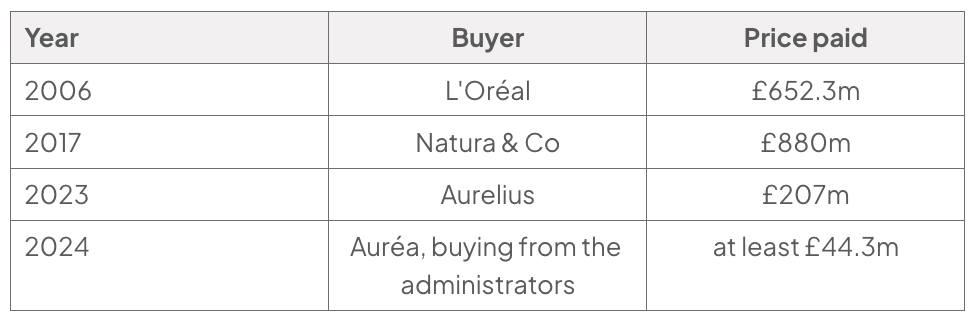
  • L'Oréal bought it for £652.3 million in 2006.

  • Natura & Co bought it for £880 million in 2017, when it had about 3 200 stores in 66 countries.

  • Aurelius, an investment firm, bought it for £207 million in November 2023.

  • Auréa, a group led by Mike Jatania, bought the UK business and the brand from the administrators in September 2024 for at least £44.3 million.

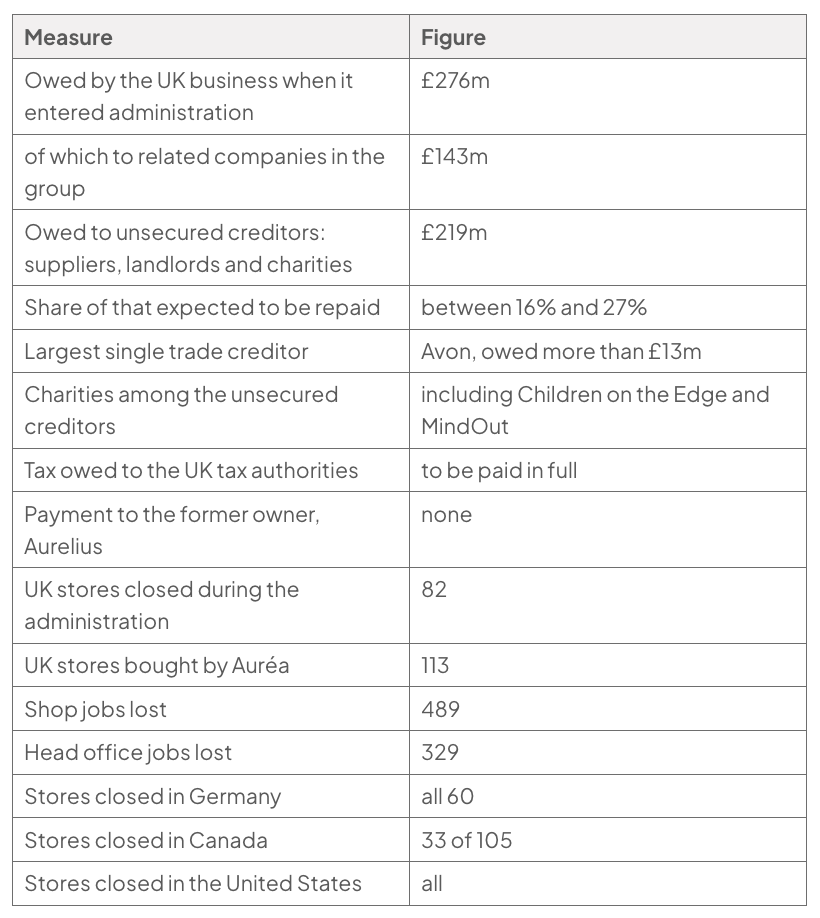
In February 2024 the UK business entered administration owing £276 million. More than 80 UK stores closed and more than 800 jobs were lost. The company-run businesses in Germany and the United States closed all their stores, while shops run by franchisees in many other countries continued to trade.

Auréa has said that the business returned to profit after it "fundamentally changed the operating model" and cut costs quickly, including reducing the range from more than 800 products. It has said that The Body Shop is unlikely to open many more UK stores, and that it is considering selling its products through other retailers, such as Boots, and supplying miniature products to hotels. In January 2024 the company completed a move to make its entire range vegan; in August 2025 it reintroduced some products which are not vegan.

Source: The Body Shop, Auréa and press reports

Appendix A: The owners of The Body Shop

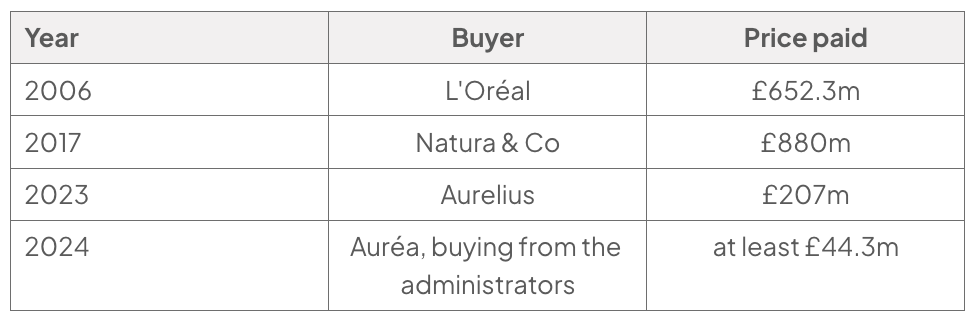
Table of The Body Shop owners and purchase prices: 2006 L’Oréal £652.3m; 2017 Natura & Co £880m; 2023 Aurelius £207m; 2024 Auréa, buying from administrators, at least £44.3m.

Source: Analyst

Appendix C: Since the rescue

  • The first 100 days. In December 2024 the new management told staff that the business had made a profit of £2 million on sales of £28 million in its first 100 days under Auréa. A source close to the business warned that it was now a smaller operation and that sales may have been helped by discounting and clearing old inventory.

  • Profit. In June 2026 Auréa said that the accounts it was about to file would show earnings before interest, tax, depreciation and amortisation of more than £24 million for the latest year, compared with a loss of £27 million the year before: the first profit since 2021.

  • What changed. The loss-making UK stores had already been closed during the administration. The new owners reduced the range from more than 800 products and cut costs.

  • Where it plans to sell. Auréa has focused on online sales and on wholesale deals with other businesses. It is considering selling through rival retailers such as Boots, and supplying miniature products to hotels. It has said it is unlikely to open many more UK stores.

  • Franchise markets. The franchise partner in India, with around 200 stores, aims to have more than 400 within five years. The Body Shop returned to New Zealand through a franchise partner in November 2025, after the company-run business there closed. The company-run business in Austria became insolvent in January 2026, affecting 12 shops.

  • Values. The range became entirely vegan in January 2024. In August 2025 some products that are not vegan were reintroduced.

Source: Analyst, using press reports

Assess whether frequent changes of ownership are likely to have reduced The Body Shop's ability to respond to changes in its market.

2
9 marks

Source A: Yeo Valley

Yeo Valley Farms (Production) Limited makes yogurts, desserts, ice cream, fruit products and soups, which it sells to UK retailers under the Yeo Valley Organic brand and other brands, including Tideford. The business traces its origins to 1961, when Roger and Mary Mead bought a farm in the Yeo Valley in Somerset. Yeo Valley is the third largest yogurt brand in the UK, and all Yeo Valley branded products are organic. Most of its products are chilled foods with a short shelf life. The company states its purpose as "To Nurture and Nourish People and Planet".

In the 53 weeks to 1 June 2025 turnover rose 17.6% to £424.6 million, mainly because of higher sales volumes rather than higher prices. Profit before tax fell from £6.4 million to £4.7 million. The company has a long-stated aim of a 5% profit before tax margin, and is in the second year of a five-year plan which runs to May 2028.

Demand grew faster than the company's factories could meet. Large investments in production capacity and automation came into use from spring 2025; until then, the additional volume was made using less efficient methods. During the year the company also:

  • raised the price it pays its organic dairy farmers by 16.5%, to give them the confidence to grow with the business and to attract new farmers into organic dairy;

  • completed its first acquisition, The Collective, a more premium yogurt brand with ranges for children and indulgent desserts;

  • launched products in new categories, including kefir, granola and an organic beef burger.

Five years ago employees became co-owners, when the company established an employee benefit trust which holds 20% of its shares on their behalf. The majority shareholder sits on the board as a non-executive director. Co-owners have a voice in decisions through Co-Ownership Forums, and the company measures their engagement through an annual survey, Yeo Voice.

The company identifies three principal risks:

  • Resilience of supply. The number of dairy farmers in the UK is falling, and few are converting to organic.

  • Availability of labour and skills, particularly in specialist technical roles.

  • Cyber security. A breach could make the company's business systems unavailable. It has detailed business continuity plans, which are kept under regular review.

Yeo Valley buys all its electricity from verifiable renewable sources and holds ISO 14001 environmental accreditation. During the year it began a programme to reuse waste heat from its cooling processes in its heating processes, and improved pipework across its sites to reduce the energy lost. Much of the emissions from farm to fork fall outside the emissions it is required to report, and it is registering for science-based targets in order to set a date for reaching net zero. The company has given surplus food to the charity FareShare since 2015, providing 121.5 tonnes in the year.

Source: Yeo Valley Farms (Production) Limited, Annual Report and Financial Statements 2025

Appendix A: Yeo Valley selected data

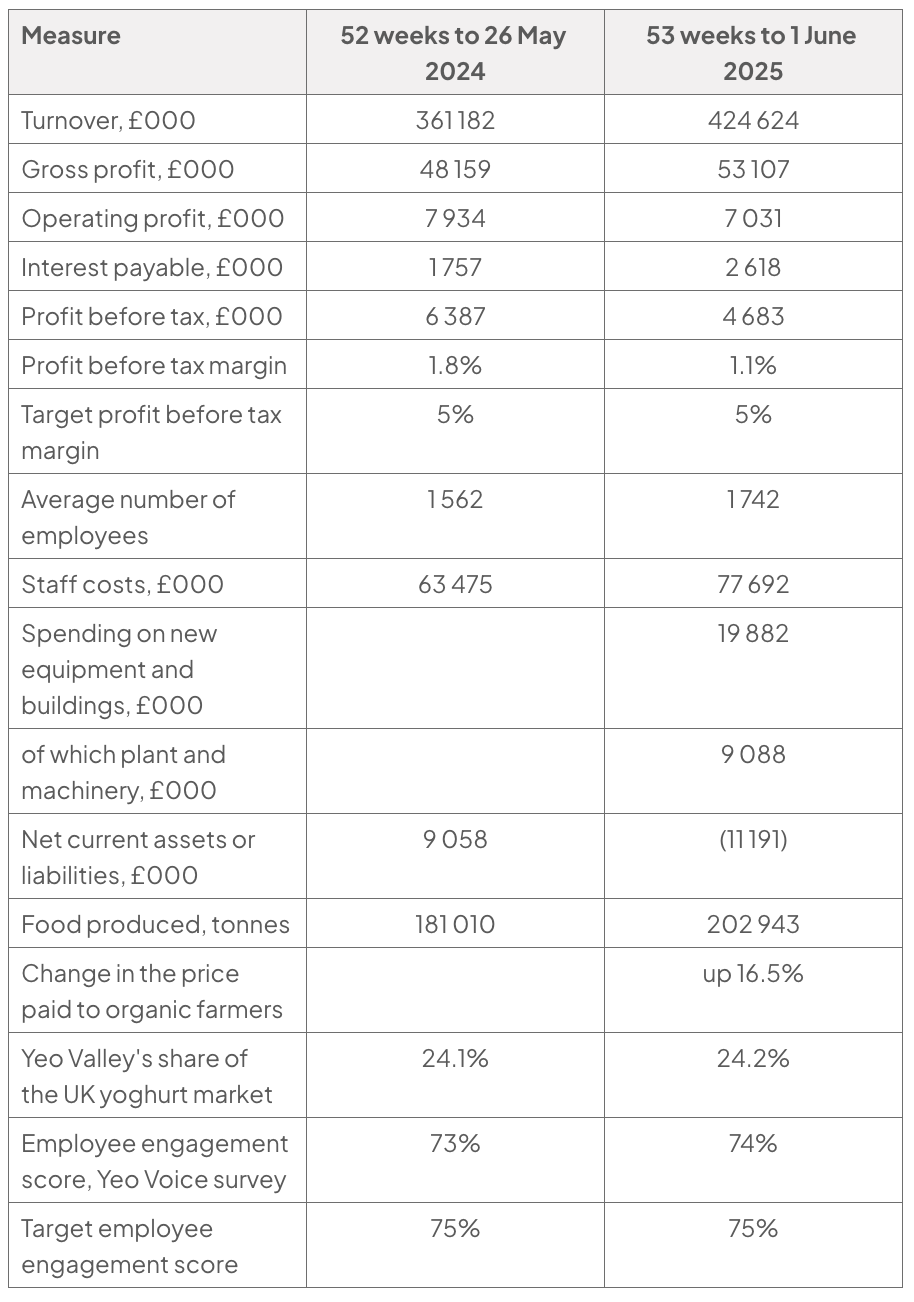
Two-year comparison table of Yeo Valley’s financial performance, workforce, investment, production, market share and employee engagement for 2024 and 2025, including targets where applicable.

The company aims to reach an employee engagement score of 81% by May 2028.

Source: Yeo Valley Farms (Production) Limited

Appendix B: The Collective, automation and the five-year plan

  • The Collective. Acquired in March 2025. In the 14 months to 1 June 2025 it had revenue of £31 million and a profit of £1.3 million, compared with a profit of £362 000 in its previous financial year. On an annual basis its revenue was unchanged. Yeo Valley states that, as a more premium brand than Yeo Valley Organic, The Collective gives it more options to improve its profit margins in the second half of the five-year plan.

  • Capacity and automation. The new investments came into use from spring 2025. The company expects them to help with economies of scale and to increase its resilience to shortages of labour.

  • Co-owners. The Co-Ownership Forums are intended to give co-owners a voice in business decisions and the opportunity to challenge them. The company held local events for all co-owners to share its new five-year plan and to seek their feedback. During the year it made a Winter Support payment to all co-owners.

  • Consumers. Weight-loss drugs known as GLP-1s may change what people buy. In the US, overall grocery sales have fallen while sales of the kinds of products Yeo Valley makes have risen. The company describes the effect in the UK as uncertain.

Source: Analyst, using Yeo Valley Farms (Production) Limited and The Grocer

Assess whether making its employees co-owners is likely to reduce resistance to the changes in Yeo Valley's five-year plan.

3
9 marks

Source A: Harbourne Joinery

Harbourne Joinery Limited makes timber windows, doors and staircases in a workshop near Totnes, Devon. The company was founded in 1994 by Martin Pryce and employs 48 people, including four apprentices. In the year to 31 March 2026 its sales came from three groups of customer:

  • Owners of listed buildings and of homes in conservation areas, 46% of sales.

  • Architects and building contractors, 34%.

  • Small housebuilders, 20%.

All of the company's timber is certified as coming from responsibly managed forests, and 80% of it is bought from a single importer in Bristol. In 2021, when timber was scarce, the importer supplied Harbourne Joinery ahead of smaller customers.

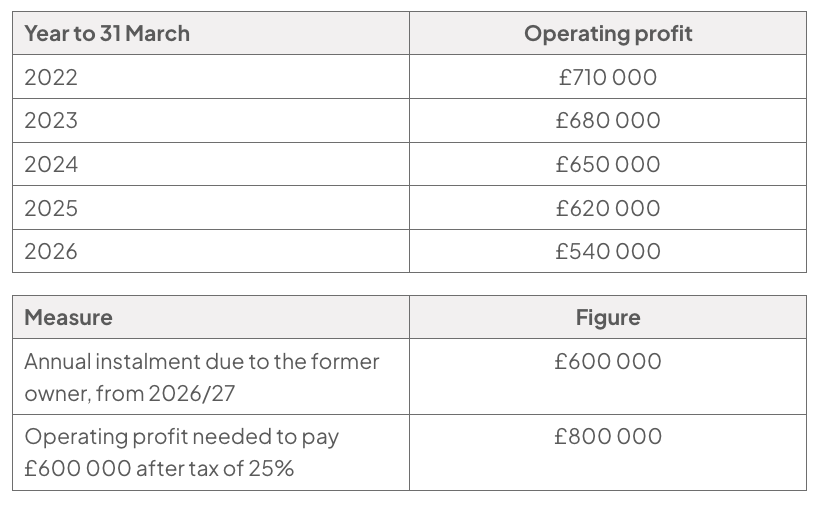
In April 2025 Martin Pryce sold the whole company to an employee ownership trust for £4.2 million. The trust holds the shares on behalf of all employees; no employee owns shares individually. £600 000 was paid on completion from the company's cash. The remaining £3.6 million is to be paid from the company's profits after tax, in six annual instalments of £600 000 beginning in 2026/27. Under the rules for employee-owned companies, each employee may receive bonuses of up to £3 600 a year free of income tax, and each received a bonus of £1 000 in December 2025. Martin Pryce remains chair until 2027. The former production manager, Sian Kerr, has become Managing Director.

In 2019 the company installed a biomass boiler which burns the offcuts and sawdust from the workshop to heat the building and to dry timber. Before then, it paid to have this waste collected and heated the workshop with oil. The boiler must be loaded and cleaned by staff each day.

Harbourne Joinery's windows cost more than windows made of uPVC, a plastic. Timber frames can be repaired rather than replaced. Owners of listed buildings usually need consent to replace their windows, and are normally expected to replace them like for like.

The company is considering how it can demonstrate its commitment to its employees, its community and the environment. It is assessing three possibilities: certification as a B Corporation, taking on more apprentices, and a service which repairs old timber windows rather than replacing them.

Source: Harbourne Joinery

Appendix B: Harbourne Joinery selected data

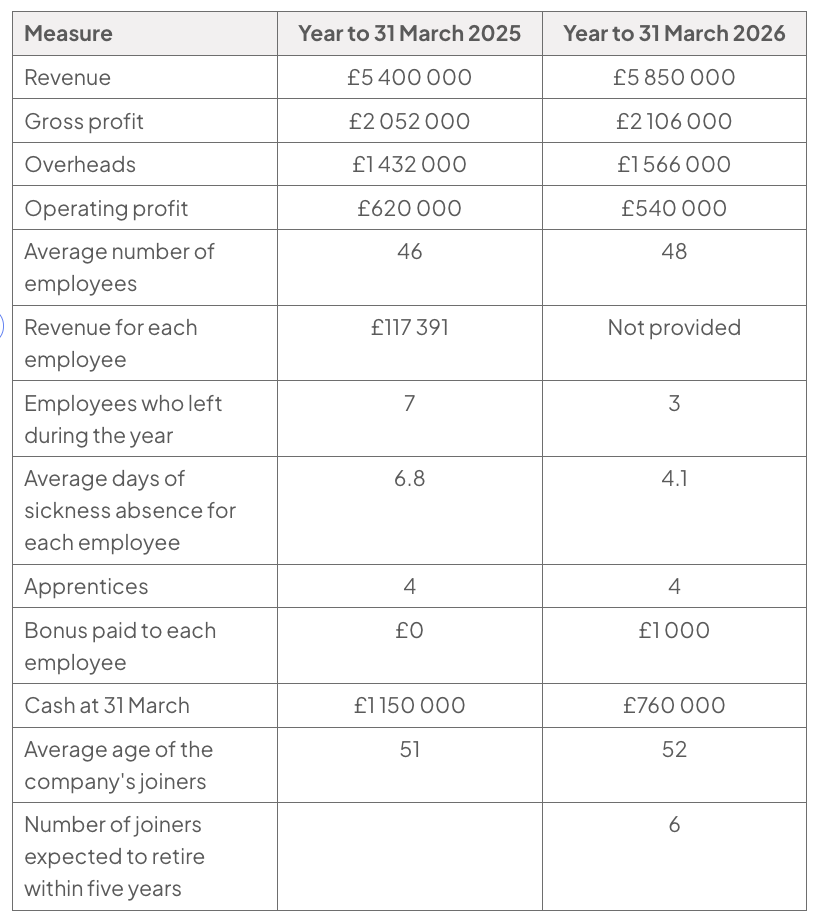
Table comparing Harbourne Joinery’s 2025 and 2026 data; 2026 revenue is £5 850 000 and average employees 48, while revenue per employee is marked “Not provided” for calculation.

Source: Harbourne Joinery

Appendix C: Paying for employee ownership

  • The sale. Martin Pryce sold 100% of the shares to an employee ownership trust in April 2025 for £4.2 million.

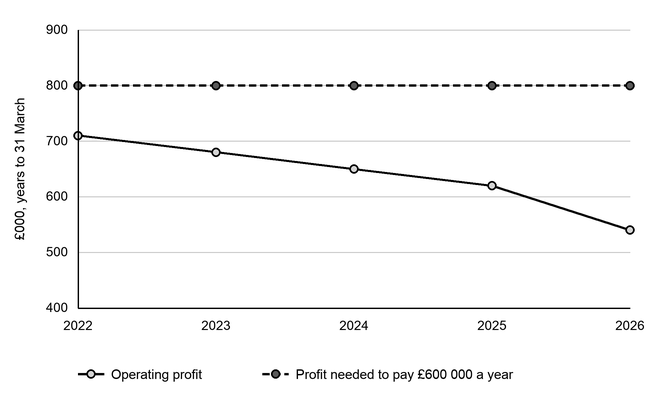
  • How it is paid. £600 000 was paid on completion from the company's cash. The remaining £3.6 million is paid in six annual instalments of £600 000 from 2026/27, out of the company's profit after corporation tax of 25%.

  • The trust. The trust board has four members: an independent chair, two trustees elected by employees, and Martin Pryce until 2027.

  • Employees' voice. An employee council, elected by all staff, meets the Managing Director every month.

  • Bonuses. Each employee may receive up to £3 600 a year free of income tax.

Line graph of Harbourne Joinery’s operating profit and annual profit needed to pay £600 000, 2022 to 2026. Operating profit falls from £710 000 to £540 000; the required amount remains £800 000.
Two tables: operating profit for years to 31 March 2022 to 2026, followed by measures and figures for the employee-ownership instalment and required operating profit after tax.

Source: Harbourne Joinery

Assess whether becoming employee-owned is likely to improve Harbourne Joinery's productivity.

Calculate Harbourne Joinery's revenue for each employee in the year to 31 March 2026 to support your answer.

4
9 marks

Source A: ITV

ITV plc is a UK broadcaster and programme maker listed on the London Stock Exchange. It has two divisions:

  • Media & Entertainment (M&E) runs ITV1, ITV2 and other channels and the streaming service ITVX, and earns most of its income from advertising.

  • ITV Studios makes and sells programmes, such as Coronation Street, Emmerdale and Love Island, to ITV and to other broadcasters and streaming services around the world.

ITV follows its "More Than TV" strategy, which has three parts: expanding ITV Studios, "supercharging" streaming and optimising broadcast television. In 2025 ITV made £63 million of permanent cost savings through technology, organisational redesign and growing use of AI.

In 2025 total revenue was £4 121 million, almost unchanged on 2024. The company faces two main pressures:

  • Viewing. ITV says that "linear viewing continues to decline, particularly among younger audiences".

  • Advertising. Total advertising revenue fell 5% in 2025. Digital revenue, mainly from ITVX, rose 10% to £614 million, but most advertising revenue still comes from the broadcast channels.

On 6 July 2026 ITV agreed to sell M&E, including its channels, ITVX and the Channel 3 licences, to Sky for up to £1.6 billion. ITV Studios would remain a separate company listed in London. The sale must be approved by regulators, including the Competition and Markets Authority. ITV and Sky argue that, including online advertising, they would have about 20% of UK advertising spending; on a television-only measure the share would be much higher. The sale is expected to complete in the second half of 2027.

Source: ITV plc, results for 2025 and the first half of 2026, and announcement of 6 July 2026

Appendix A: ITV financial data

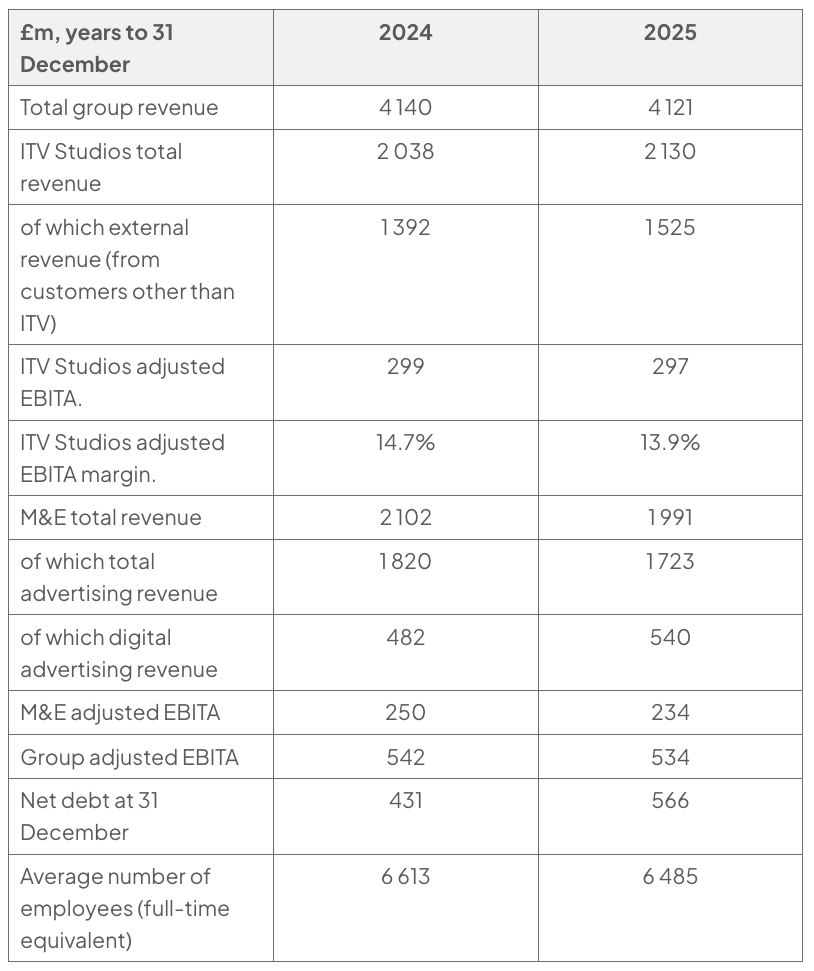
ITV financial data table in £m for 2024 and 2025: total group revenue 4 140 and 4 121; M&E total advertising revenue 1 820 and 1 723, of which digital advertising revenue 482 and 540; average number of employees (full-time equivalent) 6 613 and 6 485; other rows cover ITV Studios and M&E revenue, adjusted EBITA and net debt.

Adjusted EBITA is profit before interest, tax, amortisation and one-off items.

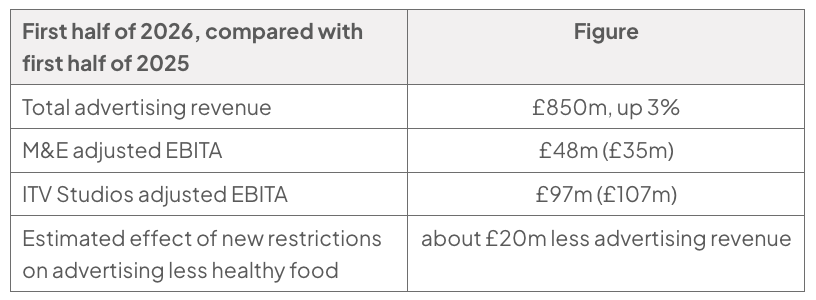
Table comparing first-half 2026 with 2025: advertising revenue £850m, up 3%; M&E adjusted EBITA £48m versus £35m; ITV Studios £97m versus £107m; food-ad restrictions may cut advertising revenue by about £20m.

Source: ITV plc

Appendix B: Viewers, streaming and technology

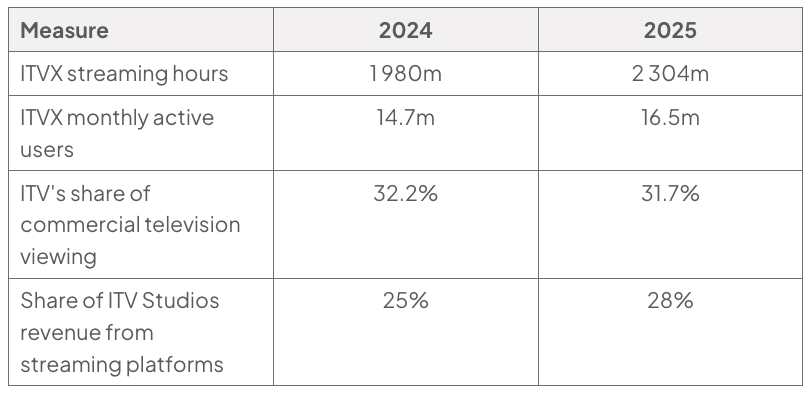
Table comparing ITV measures in 2024 and 2025: streaming hours rose from 1 980m to 2 304m; users from 14.7m to 16.5m; viewing share fell from 32.2% to 31.7%; Studios streaming revenue share rose from 25% to 28%.
  • Digital target. In 2022 ITV set a target of £750m of digital revenue. After deciding to give less priority to paid subscriptions, it says reaching it "will take slightly longer".

  • YouTube. ITV shows its programmes on YouTube; over 40% of the viewing of ITV content on YouTube is by people under 35.

  • ITV Studios. 59% of its revenue comes from outside the UK.

  • Costs. £63m of permanent cost savings in 2025, and £253m since 2019, through technology, organisational redesign and growing use of AI; a further £20m is planned for 2026.

Source: Analyst, using ITV plc

Assess whether ITV has successfully managed the change from broadcast television to streaming.

5
9 marks

Source A: Oxfam GB

Oxfam GB works to end poverty. It is a registered charity and a company limited by guarantee, and one of 21 affiliates of the Oxfam confederation, which worked in 79 countries in 2024/25. In 2024/25 Oxfam GB's work reached 9.21 million people, 8.05 million of them through humanitarian responses to emergencies.

Oxfam GB raises money from four main sources:

  • donations and legacies

  • grants from governments and international organisations

  • funding from other Oxfam affiliates

  • its shops

In 2024/25 Oxfam GB's income fell by £28.6 million, and it spent more than it received for the second year running. Funding from other Oxfam affiliates fell from £104.1 million to £82.0 million. The largest affiliate funder, Oxfam Germany, gave £17.8 million, down from £27.2 million.

Oxfam GB has gone through several changes:

  • Pay. In December 2023 its staff held the first strike in Oxfam's history. It was settled with a 6% pay rise for most staff and a £2 300 payment.

  • Restructure. In April 2025 it began a restructure to save £10.2 million of forecast pay costs, putting 265 jobs at risk.

  • Leadership. Its chief executive since April 2024 left in December 2025, and an interim chief executive, Richard Hawkes, took over from 31 March 2026.

Its goals for 2025/26 are Income, Influence, People and Decolonisation. Decolonisation means shifting money and decision-making to partners in the Global South.

Source: Oxfam GB, annual report and accounts for the year ended 31 March 2025, and press reports

Appendix A: Oxfam GB financial data

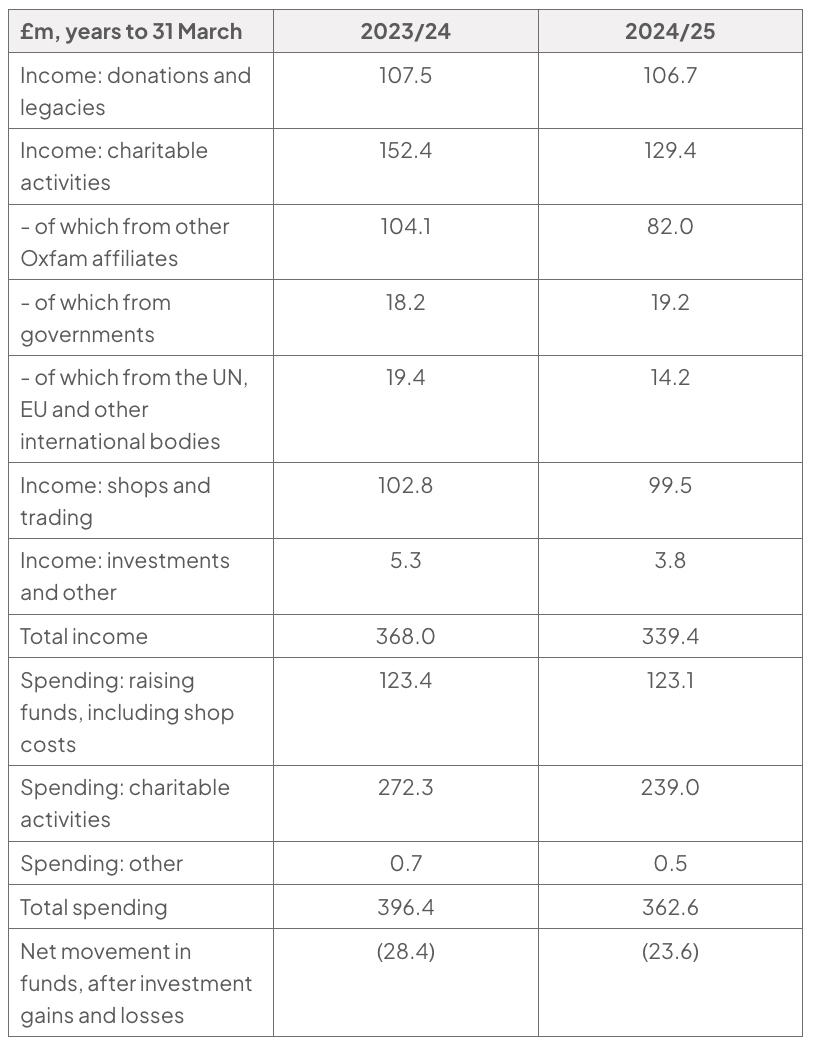
Financial table (£m, years to 31 March) comparing Oxfam GB in 2023/24 and 2024/25: total income 368.0 and 339.4, including 104.1 and 82.0 from other Oxfam affiliates, 18.2 and 19.2 from governments, and 19.4 and 14.2 from the UN, EU and other international bodies; total spending 396.4 and 362.6; net movement in funds after investment gains and losses (28.4) and (23.6).
  • Why income fell. "Largely due to lower emergency appeal income", together with lower income from other Oxfam affiliates and international bodies.

  • Charitable spending, 2024/25. Humanitarian 52%, development 46%, campaigning 2%.

  • Reserves. General reserves rose from £32.9m to £35.5m, against a target range of £35m to £45m.

  • Shops. 534 shops in 2024 and 515 in 2025. Shop profit fell from £8.3m to £6.3m. Online sales were £11.2m in 2024/25.

  • People. Average staff fell from 4 180 to 4 084: 2 119 employed in Great Britain and 1 965 overseas. About 28 000 volunteers, more than 20 000 of them in shops.

Source: Oxfam GB

Appendix B: Funding and the outside world

  • UK aid. On 25 February 2025 the UK government announced that aid spending would fall from 0.5% to 0.3% of national income by 2027, to pay for higher defence spending.

  • United States. In January 2025 the US government froze aid funding. In February 2025 USAID ended its humanitarian contracts with Oxfam GB.

  • Government funders, 2024/25. Sweden £10.8m, the United States £2.8m, Switzerland £2.5m.

  • Oxfam affiliates. The largest affiliate funder, Oxfam Germany, gave £17.8m, down from £27.2m.

  • History. In 2018 it was reported that Oxfam staff had committed misconduct in Haiti in 2011. Oxfam GB stopped bidding for UK government funding, and in June 2019 a Charity Commission inquiry found that its culture and safeguarding had repeatedly fallen short and issued it with an Official Warning. New UK government funding was suspended again in April 2021 and restored in November 2022.

Source: Analyst, using Oxfam GB, UK government announcements and press reports

Assess whether the changes at Oxfam GB in 2025 were caused mainly by external factors.

6
9 marks

Source B: Woolmere Data Services

Woolmere Data Services Limited was founded in Sheffield in 2009. It analyses customer data for retailers and leisure businesses, helping them understand what their customers buy and why. It employs 160 people, most of whom are either consultants, who analyse data and advise clients, or software engineers. It stores its clients' data on its own computer servers in Sheffield.

For most of its history Woolmere earned its revenue from consultancy projects, in which its analysts studied a client's data and presented their findings. In 2022 it launched Woolmere Insight, an online platform that clients pay for by annual subscription and use to run their own analysis. The number of subscription clients rose in 2025.

In 2025 Woolmere reorganised into teams built around the platform and announced the changes to staff by email. Consultants now spend part of their time supporting platform clients instead of leading projects.

Woolmere opened a small office in Dublin in 2024, and its revenue from clients in Ireland rose in 2025. Two of its UK clients, which also have stores in the United States, have asked whether Woolmere could support them there.

The company faces two main pressures:

  • Competition. Two large international software businesses sell platforms similar to Woolmere Insight.

  • Staff. Most of the employees who left in 2025 were consultants with more than five years' service.

Its board is considering where to expand outside the UK, whether to stop taking new consultancy projects, and whether to move its clients' data to a cloud computing provider.

Source: Woolmere Data Services

Appendix D: Woolmere Data Services selected data

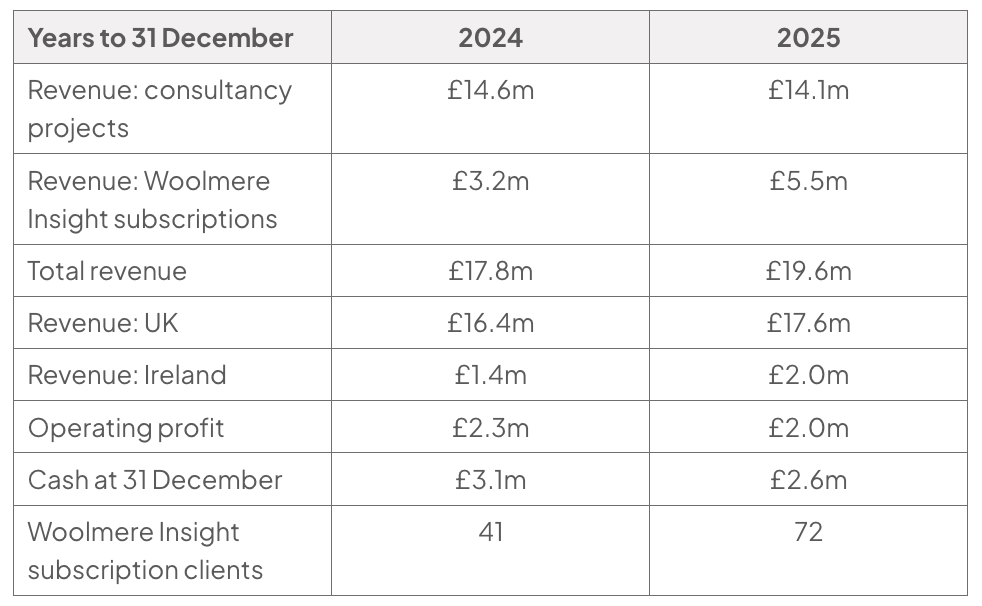
Two-column table of Woolmere Data Services’ selected data for 2024 and 2025, covering revenue, operating profit, cash and Woolmere Insight subscription clients.

Source: Woolmere Data Services

Appendix E: People and change

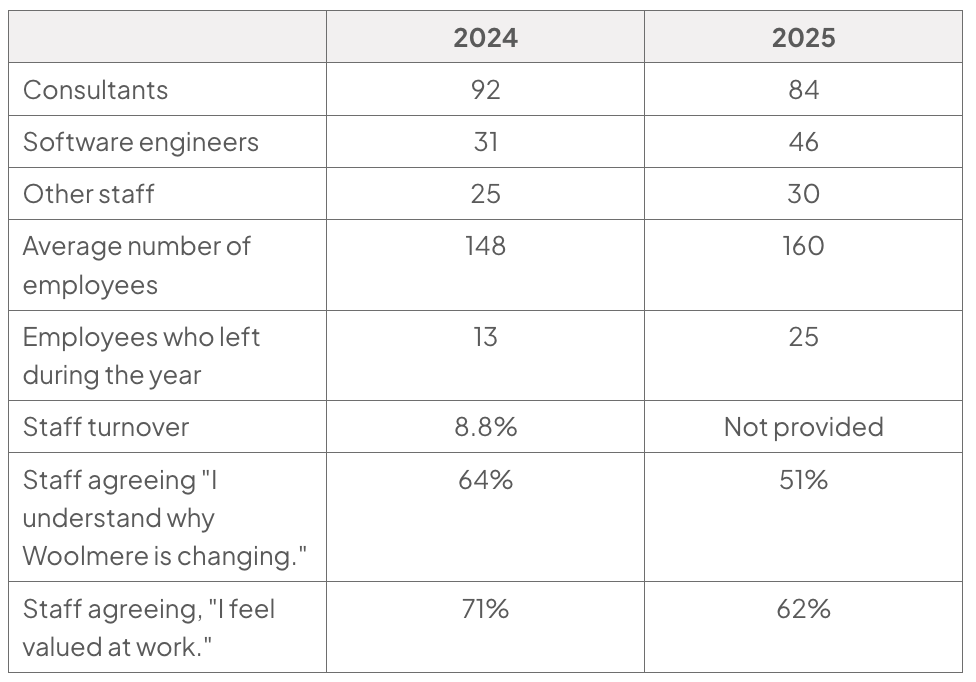
Table comparing Woolmere staff data for 2024 and 2025: average employees 148 and 160; employees leaving 13 and 25; turnover 8.8% and not provided; understanding change 64% and 51%; feeling valued 71% and 62%.
  • Most of those who left in 2025 were consultants with more than five years' service.

  • Consultants now spend part of their time supporting platform clients instead of leading projects.

Source: Woolmere Data Services

Assess whether Woolmere Data Services has managed its change to a platform business effectively.

Calculate Woolmere Data Services' staff turnover in 2025 to support your answer. Give your answer to one decimal place.

1
15 marks

Source A: The Body Shop

The Body Shop was founded by Anita Roddick, who opened its first shop in Brighton on 27 March 1976 with 25 products. From the start it sold products in refillable bottles. It became known for its campaigns: in 1987 it launched Community Trade, through which it buys ingredients directly from producer communities, and in 1989 it began campaigning against the testing of cosmetics on animals. In 2019 it was certified as a B Corporation. Much of its growth outside the UK came through franchising; by 1994, 89% of its shops were run by franchisees.

The business has had four owners since 2006:

  • L'Oréal bought it for £652.3 million in 2006.

  • Natura & Co bought it for £880 million in 2017, when it had about 3 200 stores in 66 countries.

  • Aurelius, an investment firm, bought it for £207 million in November 2023.

  • Auréa, a group led by Mike Jatania, bought the UK business and the brand from the administrators in September 2024 for at least £44.3 million.

In February 2024 the UK business entered administration owing £276 million. More than 80 UK stores closed and more than 800 jobs were lost. The company-run businesses in Germany and the United States closed all their stores, while shops run by franchisees in many other countries continued to trade.

Auréa has said that the business returned to profit after it "fundamentally changed the operating model" and cut costs quickly, including reducing the range from more than 800 products. It has said that The Body Shop is unlikely to open many more UK stores, and that it is considering selling its products through other retailers, such as Boots, and supplying miniature products to hotels. In January 2024 the company completed a move to make its entire range vegan; in August 2025 it reintroduced some products which are not vegan.

Source: The Body Shop, Auréa and press reports

Appendix A: The owners of The Body Shop

Table of The Body Shop’s owners: 2006 L’Oréal, £652.3m; 2017 Natura & Co, £880m; 2023 Aurelius, £207m; 2024 Auréa from administrators, at least £44.3m.

Source: Analyst

Appendix B: The UK administration, 2024

Table of UK administration figures: £276m owed, including £143m to related companies; £219m owed to unsecured creditors, with 16% to 27% expected to be repaid. It also lists creditors, payments, store closures and job losses.

Source: Analyst, using the administrators' reports and press reports

Appendix C: Since the rescue

  • The first 100 days. In December 2024 the new management told staff that the business had made a profit of £2 million on sales of £28 million in its first 100 days under Auréa. A source close to the business warned that it was now a smaller operation and that sales may have been helped by discounting and clearing old inventory.

  • Profit. In June 2026 Auréa said that the accounts it was about to file would show earnings before interest, tax, depreciation and amortisation of more than £24 million for the latest year, compared with a loss of £27 million the year before: the first profit since 2021.

  • What changed. The loss-making UK stores had already been closed during the administration. The new owners reduced the range from more than 800 products and cut costs.

  • Where it plans to sell. Auréa has focused on online sales and on wholesale deals with other businesses. It is considering selling through rival retailers such as Boots, and supplying miniature products to hotels. It has said it is unlikely to open many more UK stores.

  • Franchise markets. The franchise partner in India, with around 200 stores, aims to have more than 400 within five years. The Body Shop returned to New Zealand through a franchise partner in November 2025, after the company-run business there closed. The company-run business in Austria became insolvent in January 2026, affecting 12 shops.

  • Values. The range became entirely vegan in January 2024. In August 2025 some products that are not vegan were reintroduced.

Source: Analyst, using press reports

Auréa has said that The Body Shop is unlikely to open many more UK stores, and is considering selling its products through other retailers.

Evaluate whether The Body Shop should focus on selling through other retailers, such as Boots, or on its own shops and website.

2
15 marks

Source A: Yeo Valley

Yeo Valley Farms (Production) Limited makes yogurts, desserts, ice cream, fruit products and soups, which it sells to UK retailers under the Yeo Valley Organic brand and other brands, including Tideford. The business traces its origins to 1961, when Roger and Mary Mead bought a farm in the Yeo Valley in Somerset. Yeo Valley is the third largest yogurt brand in the UK, and all Yeo Valley branded products are organic. Most of its products are chilled foods with a short shelf life. The company states its purpose as "To Nurture and Nourish People and Planet".

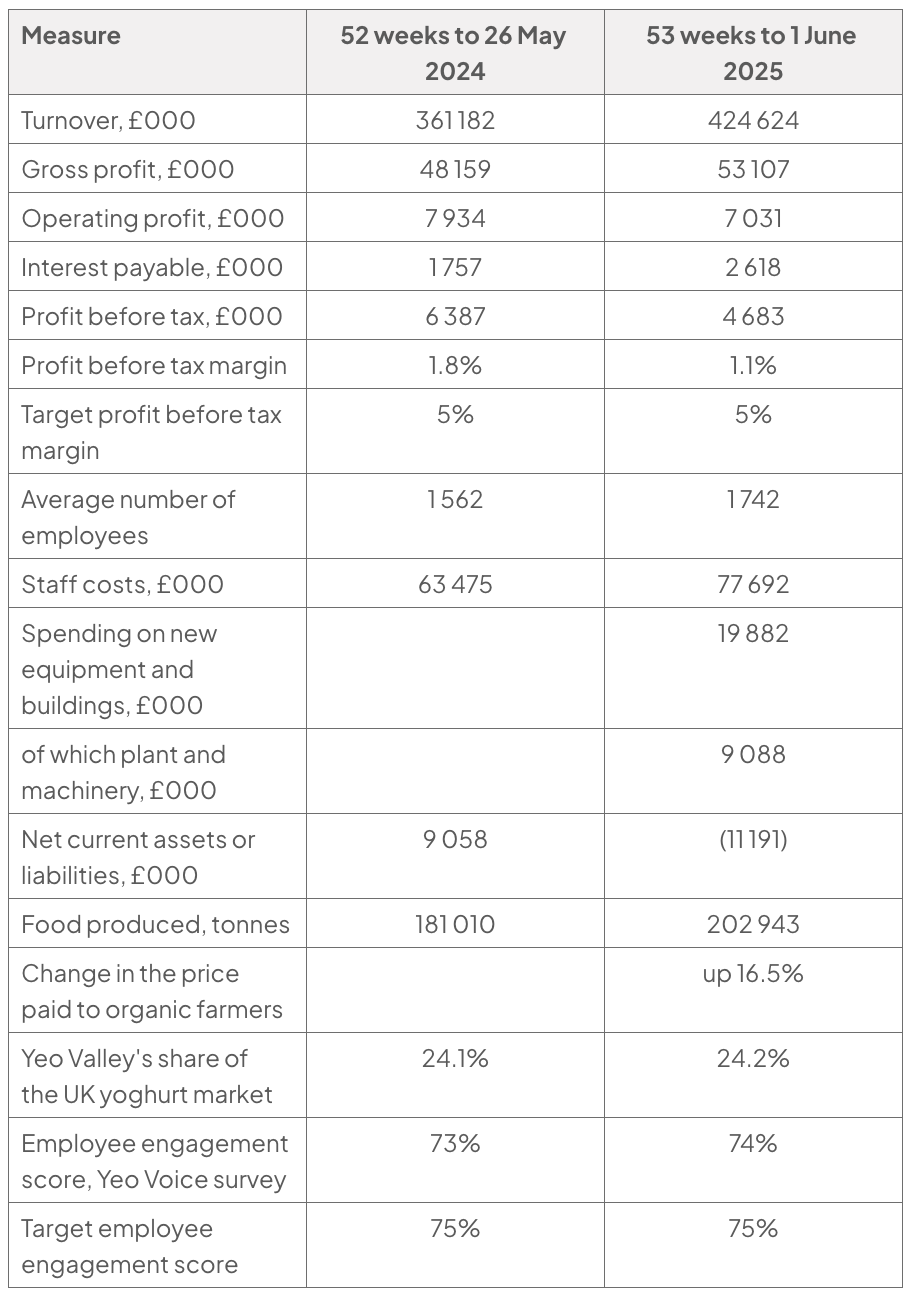
In the 53 weeks to 1 June 2025 turnover rose 17.6% to £424.6 million, mainly because of higher sales volumes rather than higher prices. Profit before tax fell from £6.4 million to £4.7 million. The company has a long-stated aim of a 5% profit before tax margin, and is in the second year of a five-year plan which runs to May 2028.

Demand grew faster than the company's factories could meet. Large investments in production capacity and automation came into use from spring 2025; until then, the additional volume was made using less efficient methods. During the year the company also:

  • raised the price it pays its organic dairy farmers by 16.5%, to give them the confidence to grow with the business and to attract new farmers into organic dairy;

  • completed its first acquisition, The Collective, a more premium yogurt brand with ranges for children and indulgent desserts;

  • launched products in new categories, including kefir, granola and an organic beef burger.

Five years ago employees became co-owners, when the company established an employee benefit trust which holds 20% of its shares on their behalf. The majority shareholder sits on the board as a non-executive director. Co-owners have a voice in decisions through Co-Ownership Forums, and the company measures their engagement through an annual survey, Yeo Voice.

The company identifies three principal risks:

  • Resilience of supply. The number of dairy farmers in the UK is falling, and few are converting to organic.

  • Availability of labour and skills, particularly in specialist technical roles.

  • Cyber security. A breach could make the company's business systems unavailable. It has detailed business continuity plans, which are kept under regular review.

Yeo Valley buys all its electricity from verifiable renewable sources and holds ISO 14001 environmental accreditation. During the year it began a programme to reuse waste heat from its cooling processes in its heating processes, and improved pipework across its sites to reduce the energy lost. Much of the emissions from farm to fork fall outside the emissions it is required to report, and it is registering for science-based targets in order to set a date for reaching net zero. The company has given surplus food to the charity FareShare since 2015, providing 121.5 tonnes in the year.

Source: Yeo Valley Farms (Production) Limited, Annual Report and Financial Statements 2025

Appendix A: Yeo Valley selected data

Table comparing Yeo Valley’s selected financial, operational and workforce data for the 52 weeks to 26 May 2024 and 53 weeks to 1 June 2025, including targets and percentage measures.

The company aims to reach an employee engagement score of 81% by May 2028.

Source: Yeo Valley Farms (Production) Limited

Appendix B: The Collective, automation and the five-year plan

  • The Collective. Acquired in March 2025. In the 14 months to 1 June 2025 it had revenue of £31 million and a profit of £1.3 million, compared with a profit of £362 000 in its previous financial year. On an annual basis its revenue was unchanged. Yeo Valley states that, as a more premium brand than Yeo Valley Organic, The Collective gives it more options to improve its profit margins in the second half of the five-year plan.

  • Capacity and automation. The new investments came into use from spring 2025. The company expects them to help with economies of scale and to increase its resilience to shortages of labour.

  • Co-owners. The Co-Ownership Forums are intended to give co-owners a voice in business decisions and the opportunity to challenge them. The company held local events for all co-owners to share its new five-year plan and to seek their feedback. During the year it made a Winter Support payment to all co-owners.

  • Consumers. Weight-loss drugs known as GLP-1s may change what people buy. In the US, overall grocery sales have fallen while sales of the kinds of products Yeo Valley makes have risen. The company describes the effect in the UK as uncertain.

Source: Analyst, using Yeo Valley Farms (Production) Limited and The Grocer

Yeo Valley aims to raise its profit before tax margin to 5% by the end of its five-year plan in May 2028. Either route below would require significant change within the business.

Evaluate whether Yeo Valley should focus on further automation of its factories or on growing The Collective.

3
15 marks

Source A: Mulberry

Mulberry Group plc was founded in Somerset in 1971 and is known for leather handbags such as the Bayswater. Its two largest shareholders are Challice, controlled by Singapore's Ong family, and Frasers Group, which owns retailers such as Sports Direct and Flannels. In 2024 Mulberry's board rejected a takeover approach from Frasers.

Mulberry designs, makes and sells bags, small leather goods and clothing. About half of its iconic bags are made by craftspeople at its two factories in Somerset. It sells through:

  • its own stores and website

  • franchise partners abroad

  • wholesale to other retailers

In the year to March 2025 Mulberry's revenue fell by 21% and it made a loss before tax of £32.2 million. Andrea Baldo, who became Chief Executive in 2024, launched a strategy called "Back to the Mulberry Spirit" in January 2025. Its aims are to:

  • simplify the business

  • restore profitability

  • rebuild the gross margin by selling more at full price

  • "put creativity back at the centre of what we do"

In July 2025 Challice and Frasers provided £20 million of funding. As part of the strategy, Mulberry:

  • made redundancies in both the year to March 2025 and the year to March 2026

  • closed one UK store and eight international stores in the year to March 2026

  • introduced a new incentive scheme for store staff "supporting a stronger performance culture"

In the 52 weeks to 28 March 2026 revenue rose by 4% to £125.5 million, and the loss before tax fell to £8.9 million. More than half of Mulberry's UK sales through its stores and website came from returning customers. Its pre-loved service, Mulberry Exchange, which buys back and resells used Mulberry bags, increased its sales by 46%.

Mulberry's medium-term goal is revenue of more than £200 million with an adjusted operating profit margin of 15%.

Source: Mulberry Group plc, audited results for the 52 weeks ended 28 March 2026

Appendix A: Mulberry financial data

Two tables show Mulberry’s 2025 and 2026 financial data in £m: revenue, gross margin, expenses, EBITDA, losses, redundancies and stores closed; a second table breaks 2026 revenue into own-channel and franchise/wholesale.
  • Revenue grew 11% in the second half of the year. Like-for-like sales through Mulberry's own stores and website rose 9%.

  • Mulberry's bank facilities are committed until July 2028. Staff costs were £41.2m.

Source: Mulberry Group plc

Appendix B: Markets around the world

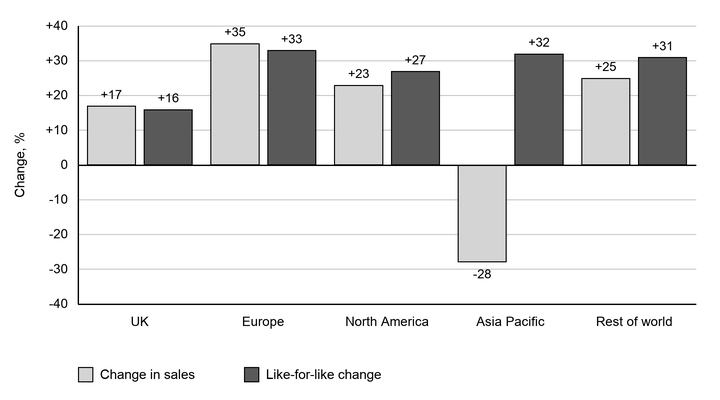
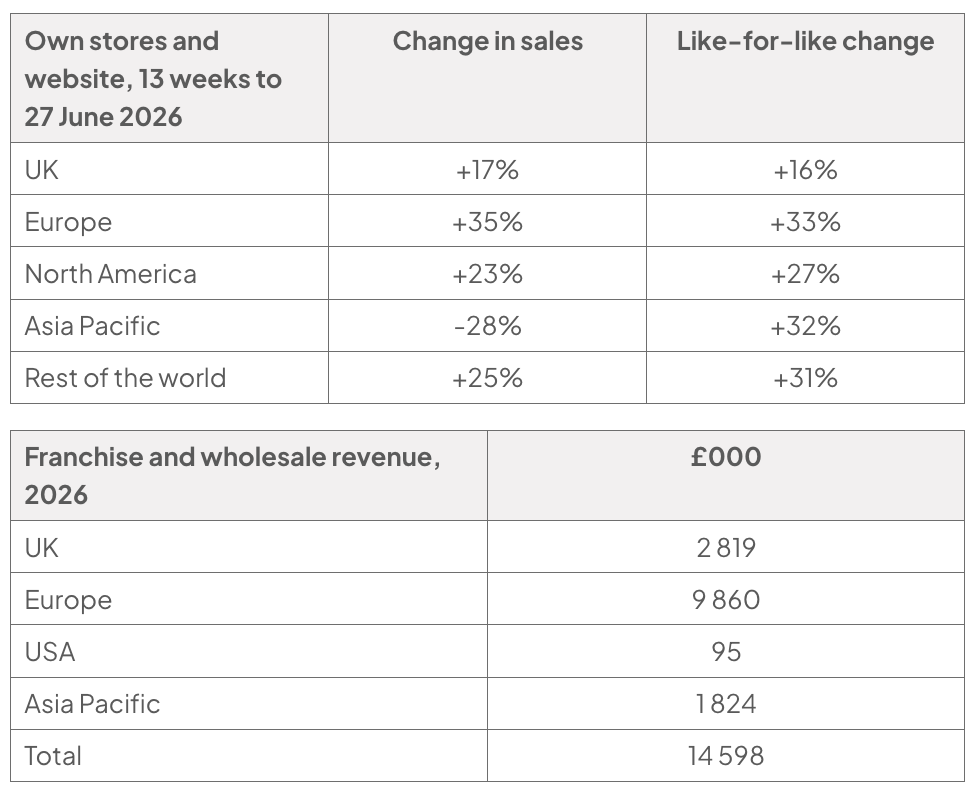
Grouped bar chart of Mulberry’s sales changes by region in the 13 weeks to 27 June 2026: UK +17%/+16%, Europe +35%/+33%, North America +23%/+27%, Asia Pacific −28%/+32%, and rest of world +25%/+31%; bars show total and like-for-like changes.
Two tables show regional sales changes for the 13 weeks to 27 June 2026 and 2026 franchise and wholesale revenue. Asia Pacific fell 28% overall but rose 32% like-for-like; Europe led revenue.
  • Group revenue in the 13 weeks to 27 June 2026 was 23% higher than a year earlier; franchise and wholesale revenue was 56% higher.

  • Mulberry is "reshaping the Asia Pacific business with a focus on profitability".

  • Like-for-like sales compare stores and websites that were open in both periods.

Source: Mulberry Group plc

Appendix C: Carrying out the change

  • Product. New creative team; the return of the Roxanne bag; a limited edition Bayswater "sold out within minutes". The designer Christopher Kane was appointed creative director for clothing.

  • Pricing. Less discounting and "greater full-price discipline".

  • Wholesale. New UK partnerships with John Lewis, Liberty, Flannels and Harvey Nichols.

  • People. Redundancies in both years; a new incentive scheme for store staff "supporting a stronger performance culture". In September 2026 Kenny Wilson, former Chief Executive of Dr. Martens, joined the board.

  • Technology. Investment in a new e-commerce platform and customer relationship management.

  • Brand. Campaigns with the actor Cynthia Erivo and "Rooted in Craft"; the Chair says the board chose "to prioritise brand equity over short-term volume".

  • Outlook. The Chief Executive says "there is still more to do" and that the business remains "mindful of the wider macroeconomic environment".

Source: Analyst, using Mulberry Group plc

In January 2025 Mulberry launched its "Back to the Mulberry Spirit" strategy to simplify the business and restore profitability.

Evaluate whether Mulberry should next focus on growing revenue through new products or on further cost reductions to complete its turnaround, and recommend which.

4
15 marks

Source B: Kelsmere Community Trust

Kelsmere Community Trust is a registered charity founded in 2003 on the Kelsmere estate in Middlesbrough. It employs 15 staff and is supported by 96 volunteers. Its founder and chief executive, who has led the charity for 23 years, will retire in December 2026. It runs:

  • a food bank

  • a youth club

  • a café that trains young people for work; in 2026, 15 of its 22 trainees found work

Most of Kelsmere's income comes from a five-year National Lottery grant, which is its largest single source of income, and a contract with the local council to run youth services. Eleven local businesses now support the charity with money, food or staff time, up from seven. In the year to March 2026, income from local business partners and income from café and room hire both rose.

The charity faces four main pressures:

  • Demand. Use of the food bank is rising.

  • Council funding. The council cut the youth services contract by £30 000 in 2025/26, and the youth club has closed on Fridays since September 2025 because of the cut. The council proposes a further 20% cut from April 2027.

  • Lottery funding. The National Lottery grant ends in March 2027. A new application must show evidence of the charity's impact.

  • Volunteers. Volunteers agreeing "I feel listened to" fell from 81% to 63%.

The trustees are considering whether to merge with Northgate Family Centre, a charity 1.5 miles away that provides family support and debt advice.

Source: Kelsmere Community Trust

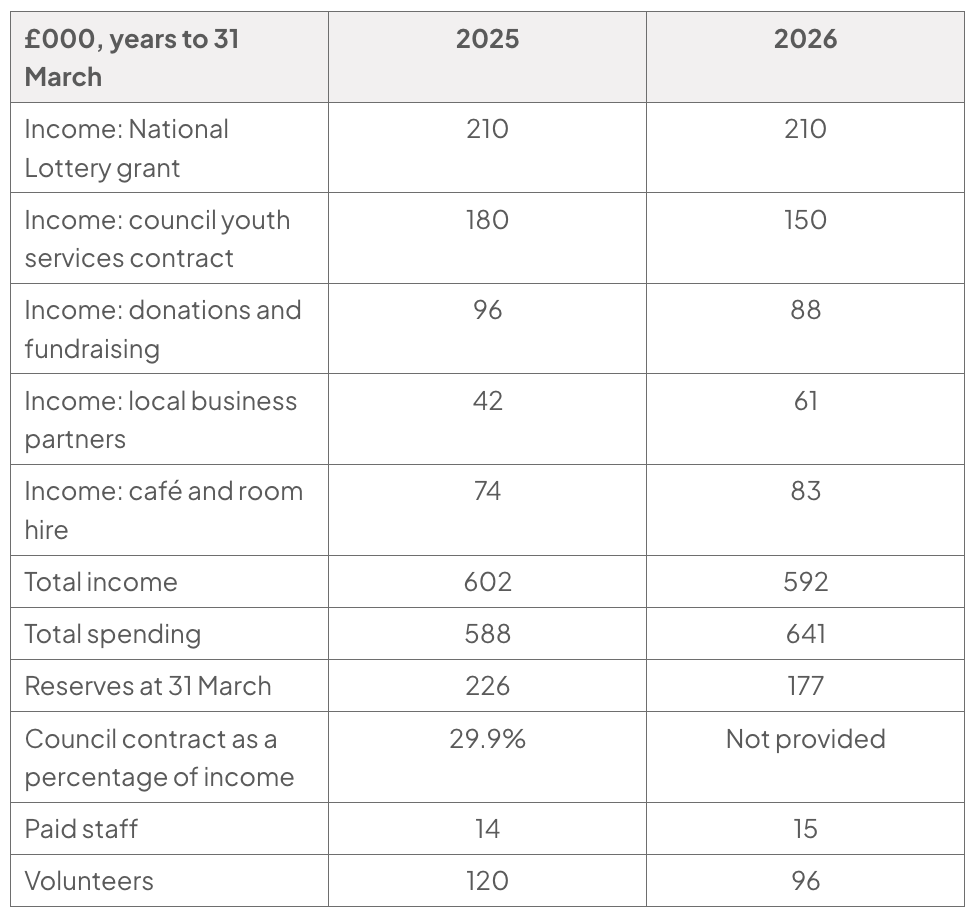
Appendix D: Kelsmere Community Trust financial data

Table of Kelsmere’s finances and staffing in 2025 and 2026 (£000): income fell 602 to 592, spending rose 588 to 641, reserves fell 226 to 177, and volunteers fell 120 to 96.
  • Reserves policy. The trustees aim to hold reserves equal to at least three months' spending.

Source: Kelsmere Community Trust

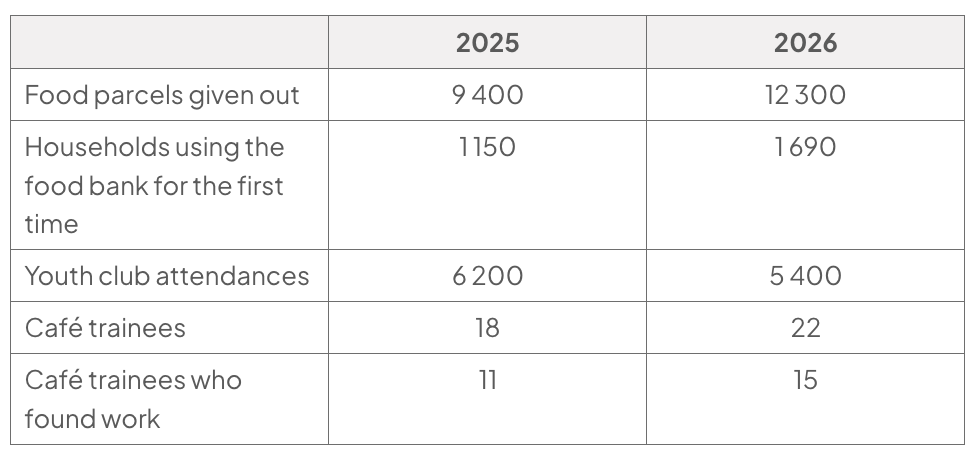
Appendix E: Demand for Kelsmere's services

Table comparing Kelsmere services in 2025 and 2026: food parcels 9 400 to 12 300; first-time food-bank households 1 150 to 1 690; youth attendances 6 200 to 5 400; café trainees 18 to 22, with 11 to 15 finding work.
  • Two in five households using the food bank for the first time in 2026 included someone in work.

  • The youth club closed on Fridays from September 2025 because the council contract was cut.

Source: Kelsmere Community Trust

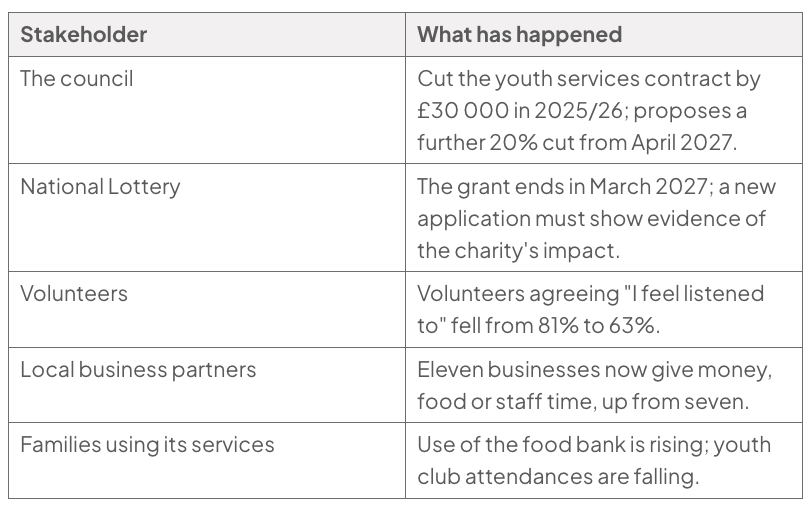
Appendix F: Kelsmere's stakeholders

Table listing five Kelsmere stakeholder groups and the changes affecting them: the council, National Lottery, volunteers, local business partners, and families using its services.

Source: Kelsmere Community Trust

Appendix G: Merging with Northgate Family Centre

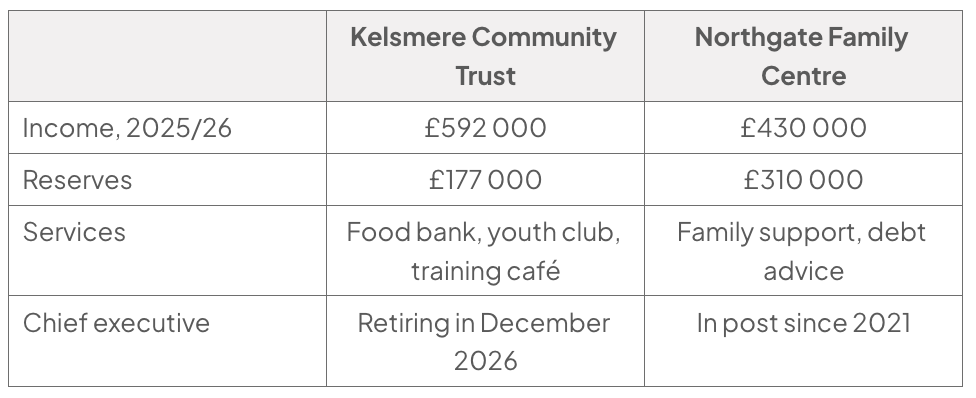
Comparison table: Kelsmere: 2025/26 income £592 000, reserves £177 000, food bank, youth club and training café; chief executive retiring December 2026. Northgate: £430 000, £310 000, family support and debt advice; CEO since 2021.
  • Savings. A merged charity would share premises, finance and management, saving about £58 000 a year.

  • Leadership. Northgate's chief executive would lead the merged charity. If Kelsmere stays independent, it expects a new chief executive to cost £48 000 a year.

  • Concerns. Some volunteers fear that a merged charity would lose the Kelsmere name and its focus on the estate.

Source: Kelsmere Community Trust

The trustees of Kelsmere Community Trust are considering whether to merge with Northgate Family Centre or to stay independent and recruit a new chief executive.

Evaluate whether Kelsmere Community Trust should merge with Northgate Family Centre.

Use information from Appendices D to G to support your answer.