DP IB English A: Literature (HL) Overview (DP IB English A: Literature: HL): Revision Note

The DP IB English A: Literature (HL) course aims to develop your ability to analyse, compare and evaluate literary texts in a wide range of forms and contexts. This section consists of:
Aims of the IB Literature (HL) course
Course structure
How the course is assessed
Literary texts
Aims of the IB Literature (HL) course
Throughout your IB Literature (HL) course, you will engage with a wide range of texts, exploring how meaning is shaped through language, structure and authorial choices, while also considering broader cultural and global perspectives. Here are the aims of your course:
1. engage with a range of texts from different periods, styles, and cultures 2. develop skills in listening, speaking, reading, writing, viewing, presenting and performing 3. develop skills in interpretation, analysis and evaluation 4. develop sensitivity to the formal and aesthetic qualities of texts and an appreciation of how they contribute to diverse responses and open up multiple meanings 5. develop an understanding of relationships between texts and a variety of perspectives, cultural contexts, and local and global issues and an appreciation of how they contribute to diverse responses and open up multiple meanings 6. develop an understanding of the relationships between studies in language and literature and other disciplines 7. communicate and collaborate in a confident and creative way 8. foster a lifelong interest in and enjoyment of language and literature |
How the course is structured and assessed
Areas of Exploration
The IB Literature (HL) course is structured around three Areas of Exploration which overlap and connect with one another with a specific focus.
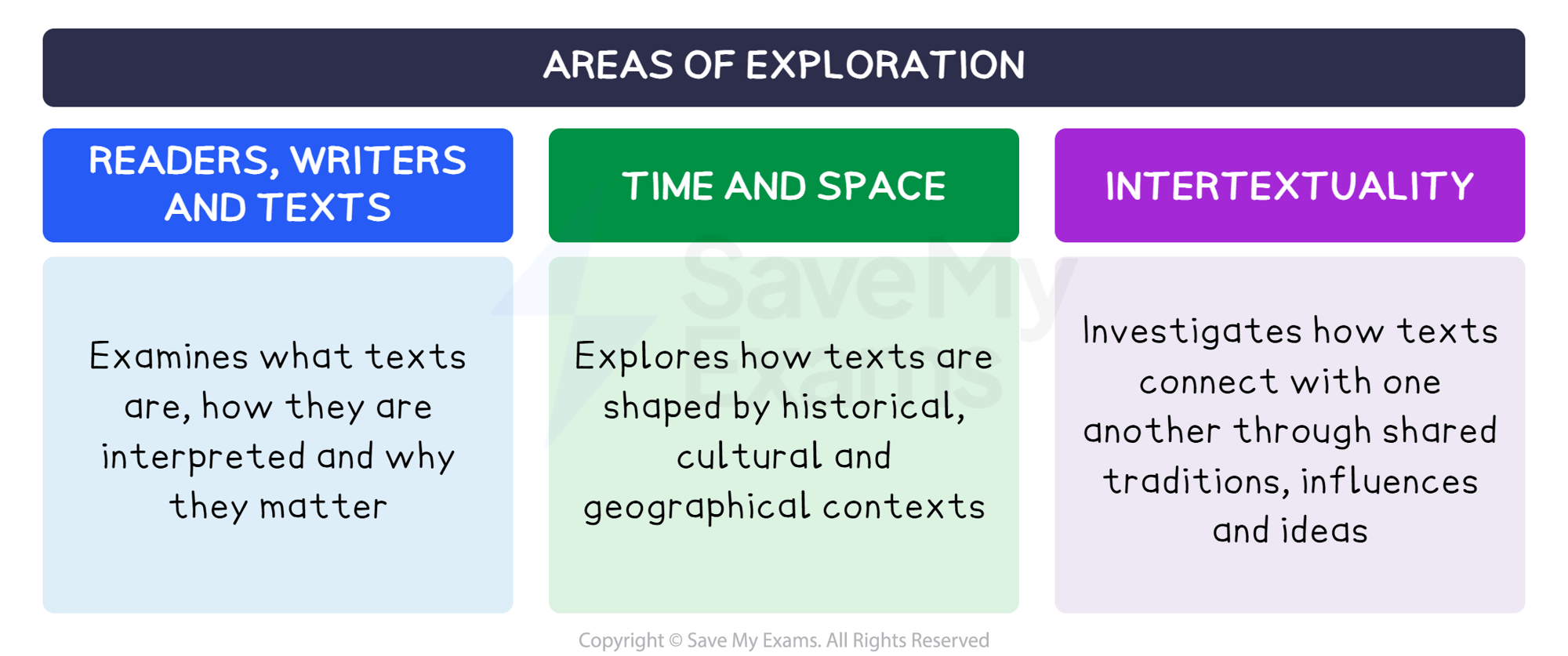
Together, these areas encourage you to think more deeply about how texts function individually and in relation to the wider world.
Course components
Your course is made up of four key components and includes both internal and external assessments.
Assessment component | Weighting | |
External assessment
| Paper 1: Guided literary analysis (2 hours 15 minutes)
| 35% |
Paper 2: Comparative essay (1 hour 45 minutes)
| 25% | |
HL essay
| 20% | |
Internal assessment | Individual oral (15 minutes)
| 20% |
Literary texts
As part of your course, you are expected to study literary texts. Depending on which component you are preparing for, it is important to understand which text types could be considered literary and which could be considered non-literary depending on the specific characteristics of the text being considered. Here are some examples of these two types.
Literary text types | ||||
Novel/novella | Play | Poem | Short story | Graphic novel |
You may also study some texts which could be considered literary or non-literary depending on the specific text. Here are some further examples.
Text types that could be literary or non-literary | ||||
Autobiography/biography | Memoir | Diary entry | Opinion column | Pastiche |
Speech | Travelogue | Manifesto | Essay | |
To determine whether a text is literary or non-literary, you should consider two things:
Is the author on the IB Prescribed Reading List or are they known as a literary writer?
Does the text have a clear artistic or aesthetic purpose?
If either of these apply, then you should generally treat your text as a literary one. If you are still unsure, your teacher will always be able to give you further guidance on this.
Examiner Tips and Tricks
It is also important to know what the IB means when it refers to literary works. A “work” is defined as one single literary text, or an interconnected series of texts, such as:
A novel, autobiography or biography
Two or more shorter literary texts such as novellas
5–10 short stories
5–8 essays
10–15 letters
15–20 shorter poems
A substantial section or the whole of a long poem (at least 600 lines)
Remember, where more than one text is studied as part of a “work”, your texts must be from the same author and belong to the same subcategory within one literary form.
Once you have used a part of a work or body of work for an assessment component, then the whole of that work or body of work becomes unavailable for any other assessment component.
Learn more
Find out more about the Areas of Exploration.

Unlock more, it's free!
Join the 100,000+ Students that ❤️ Save My Exams
the (exam) results speak for themselves:

Was this revision note helpful?